
A mid-sized company has dashboards built on top of warehouse tables, years of raw customer logs sitting untouched in object storage, a new machine learning team asking for historical event data nobody has cleaned, and a finance director asking why last quarter’s revenue report doesn’t match what sales is seeing in their own spreadsheet. Leadership calls a meeting. One engineer recommends investing further in the warehouse. Another wants to build out a proper data lake. A vendor pitches a lakehouse migration. All three are technically right about something, and all three are solving a different piece of the problem.
This is the situation most growing organizations eventually face, and it’s why data lake vs data warehouse vs lakehouse has become one of the most searched comparisons in data engineering. These are not competing products with one universal winner. They are architectural patterns, each built around different assumptions about how data should be structured, governed, stored, and consumed.
This article breaks down what each architecture actually does, how they differ technically, which workloads fit each one, how governance and cost compare, when migration makes sense, and how to decide, using a business’s actual data, team, and goals rather than trends, which foundation fits best.
Quick Answer: Data Lake vs Data Warehouse vs Lakehouse
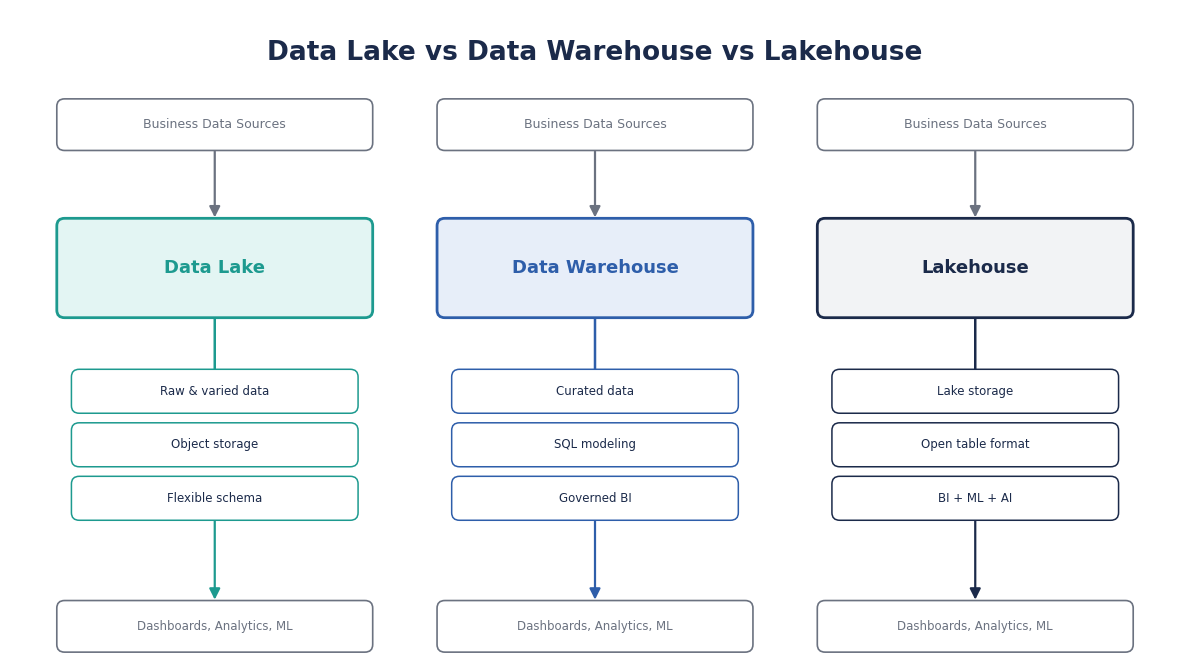
A data warehouse stores curated, structured data that has been modeled and cleaned for SQL analytics, reporting, and dashboards. A data lake stores large volumes of raw structured, semi-structured, and unstructured data in a flexible repository suited to processing and analytics of many kinds. A data lakehouse combines lake-style storage with warehouse-like capabilities, transactions, schema enforcement, and governed analytical query support, over the same underlying data.
In short:
- Choose a warehouse for governed BI and reliable reporting.
- Choose a lake for flexible, low-friction storage of raw and varied data.
- Choose a lakehouse when BI, data science, and AI need to work from a more unified data foundation.
Many organizations don’t pick just one. It’s common to run more than one of these architectures side by side, at least for a while, a point this article returns to throughout.
Data Lake vs Data Warehouse vs Lakehouse Comparison Table
| Feature | Data Warehouse | Data Lake | Data Lakehouse |
|---|---|---|---|
| Primary purpose | Curated analytics and reporting | Flexible storage for raw and varied data | Unified storage with governed analytics |
| Typical data type | Structured, increasingly some semi-structured | Structured, semi-structured, unstructured | All three, layered by processing stage |
| Data state | Cleaned, modeled, curated | Raw or lightly processed | Raw, intermediate, and curated layers coexist |
| Schema approach | Schema-on-write | Schema-on-read | Combination, depending on layer |
| Storage architecture | Often proprietary, optimized columnar storage | Object storage (e.g., cloud blob storage) | Object storage plus an open table/metadata layer |
| File formats | Proprietary or columnar (e.g., internal formats, Parquet) | CSV, JSON, Parquet, Avro, images, logs | Parquet/ORC managed by Delta Lake, Iceberg, or Hudi |
| Query performance | Strong for structured SQL workloads | Depends heavily on the processing engine used | Strong when well-optimized; depends on table format and engine |
| BI suitability | Excellent | Limited without additional modeling | Good, when curated (gold) layers exist |
| Machine learning suitability | Limited for raw/unstructured needs | Excellent for raw historical and varied data | Strong, especially with unified raw + curated access |
| AI suitability | Limited on its own | Good for raw and multimodal data at scale | Strong when governance and quality are also in place |
| Governance | Mature, centralized tooling | Requires deliberate investment | Improved by table format features, but still requires policy |
| Data quality | Enforced before load, generally | Not enforced by default | Managed through layered pipelines (e.g., medallion) |
| ACID transaction support | Yes, natively | Not native; depends on engine | Yes, via table formats like Delta Lake, Iceberg, Hudi |
| Updates and deletes | Straightforward | Historically difficult | Supported through table format metadata |
| Historical versioning | Limited (usually via separate history tables) | Manual, if implemented | Native “time travel” in most table formats |
| Scalability | Strong, but can carry cost at very high volumes | Very high, cost-efficient at scale | Very high, with cost tied to compute and management |
| Flexibility | Lower, structure must be defined upfront | Very high | High, with more structure available where needed |
| Cost structure | Storage + compute + sometimes licensing | Storage + processing engines + governance tooling | Storage + compute + platform/table management overhead |
| Technical skills required | SQL, data modeling, BI tooling | Distributed processing, data engineering | Data engineering plus table format and platform expertise |
| Typical users | Analysts, BI teams, finance, executives | Data engineers, data scientists | Both, analysts, engineers, and data scientists together |
| Common platforms | Snowflake, BigQuery, Redshift, Azure Synapse, Microsoft Fabric Warehouse | Cloud object storage plus engines like Spark | Databricks, Microsoft Fabric, engines built on Iceberg or Delta Lake |
| Data retention | Typically curated subsets, sometimes archived elsewhere | Often long-term/raw retention | Both raw and curated retained in layers |
| Vendor dependence | Can be significant with proprietary engines | Lower, especially with open formats | Lower when open table formats are used |
| Best use case | Governed BI, financial and regulatory reporting | Raw data retention, ML experimentation, logs/IoT | Organizations needing BI, ML, and AI on shared data |
| Main risk | Rigidity and cost at very large or unstructured scale | Becoming an ungoverned “data swamp” | Underestimating the governance and engineering maturity required |
Modern platforms increasingly blur these lines, some cloud warehouses now query semi-structured or external data natively, and some lakehouse platforms offer warehouse-grade BI performance. Treat this table as a description of core tendencies, not fixed rules.
What Is a Data Warehouse?
A data warehouse is a repository built specifically to support analytical, historical, and reporting workloads using well-defined, curated data. Rather than storing raw transactional records exactly as they were generated, a warehouse typically holds data that has been extracted, transformed, and loaded (or extracted, loaded, and transformed) into dimensional models, fact tables capturing measurable events and dimension tables providing business context around them.
This structure is what makes warehouses so strong at powering dashboards and executive reporting: metrics are pre-defined, relationships between tables are consistent, and the schema is fixed before data ever lands (schema-on-write). Analysts querying a warehouse are working against a stable, well-governed structure rather than reconstructing meaning from raw source data each time.
Common cloud data warehouse platforms include Snowflake, Google BigQuery, Amazon Redshift, Azure Synapse Analytics, and Microsoft Fabric Warehouse. It’s worth noting that these platforms don’t map perfectly onto a single architectural category anymore, several now support querying semi-structured data or external tables directly, which narrows some of the traditional gap between warehouses and lakes.
For a deeper look at how a warehouse differs from an everyday operational database, see our guide to data warehouse vs database.
When a Data Warehouse Works Best
- Executive and board-level dashboards
- Financial reporting and close processes
- Sales and revenue reporting
- KPI monitoring across departments
- Customer analytics based on structured transactional data
- Regulatory and compliance reporting
- Operational analytics where the underlying data is already structured
Main Advantages of a Data Warehouse
- Strong, consistent SQL query performance for known workloads
- Governed, centrally defined metrics that reduce “whose number is right” disputes
- Mature, well-understood security and access-control models
- A deep, mature BI tooling ecosystem
- Predictable schema that supports reliable historical reporting
Main Limitations of a Data Warehouse
- Upfront modeling work is required before data becomes usable
- Less flexibility for use cases that weren’t anticipated when the schema was designed
- Storage and compute costs can grow, particularly for very large or high-concurrency workloads
- Handling large volumes of raw multimedia, event, or log data is often awkward without extra tooling
- Reliance on a single platform can create longer-term dependence on that vendor’s ecosystem
What Is a Data Lake?
A data lake is a large-scale, typically cloud-based repository, usually built on object storage, designed to retain data in its raw or only lightly processed form. Unlike a warehouse, a lake doesn’t require data to be modeled or even fully understood before it’s stored. Structured records, semi-structured files like JSON or XML, and unstructured content such as images, audio, or free text can all sit in the same environment.
This is possible because data lakes rely on schema-on-read: rather than enforcing structure at the point of ingestion, the schema is applied later, at the point of processing or query, by whatever tool or engine is being used. That flexibility is the lake’s biggest strength and, without discipline, its biggest risk.
Typical contents include operational logs, JSON API responses, CSV exports, Parquet files, IoT sensor readings, application event streams, and increasingly, unstructured assets like images or audio destined for machine learning pipelines.
When a Data Lake Works Best
- Machine learning and data science experimentation
- Large-scale event streams and clickstream data
- Log analytics and observability data
- IoT and sensor data at high volume
- Long-term archival and raw-data retention
- Exploratory analytics where the questions aren’t fully defined yet
Advantages of a Data Lake
- High flexibility to store nearly any data type without upfront modeling
- Strong horizontal scalability for very large datasets
- Storage costs on object storage are often modest relative to the cost of high-performance analytical compute, though this depends heavily on how much processing the data requires
- Raw data is preserved, which supports use cases discovered later
- Support for structured, semi-structured, and unstructured formats side by side
It’s a mistake to assume data lakes are always the cheaper option outright, the storage layer may be inexpensive, but the processing, cataloguing, and governance needed to make that raw data usable carries real cost too.
Limitations of a Data Lake
- Governance is not built in; it has to be designed and maintained deliberately
- Inconsistent or undocumented schemas across datasets make analysis harder over time
- Without a strong catalog, data becomes difficult to discover or trust
- Running ad hoc SQL analytics typically requires additional engines or table formats layered on top
- Left unmanaged, a lake can turn into a data swamp
A data lake becomes a data swamp specifically when there is no consistent ownership of datasets, no metadata catalog describing what exists, no data quality checks applied anywhere in the pipeline, and no lifecycle policy for what should be archived or removed. The storage itself isn’t the problem, the absence of governance around it is.
What Is a Data Lakehouse?
A data lakehouse is an architectural pattern that layers warehouse-style management, schema enforcement, transactional consistency, and governed analytical query support, on top of lake-oriented storage. Rather than choosing between the flexibility of a lake and the reliability of a warehouse, a lakehouse aims to bring both closer together on the same underlying data, typically stored as open file formats in object storage.
This isn’t a claim that a lakehouse eliminates every trade-off. Query performance, governance discipline, and engineering maturity still matter enormously in a lakehouse; the architecture provides the technical capability for unification, not a guarantee of it.
At a technical level, a lakehouse typically consists of object storage for the underlying files, an open table format that adds metadata and transactional guarantees on top of those files, and one or more compute engines (SQL engines, Spark, or others) that read and write through that table layer.
Key Technologies Behind Modern Lakehouses
Three open table formats are most commonly associated with lakehouse architectures:
- Delta Lake, adds a transaction log over Parquet files to provide ACID transactions, schema enforcement, and time travel.
- Apache Iceberg, a table format designed for very large analytic datasets, with strong support for schema evolution and multi-engine access.
- Apache Hudi, built with a strong focus on efficient upserts and incremental data processing.
At a high level, these formats all provide some combination of: transaction logs and metadata tracking, ACID guarantees for concurrent reads and writes, schema evolution without rewriting entire datasets, point-in-time snapshots (“time travel”), efficient row-level updates and deletes, and better partition management than raw files alone can offer. They are not interchangeable in every respect, and a given platform typically favors one or supports several, organizations should evaluate based on the specific format and engine combination they intend to use, not the lakehouse label alone.
Common Lakehouse Platforms
- Databricks, closely associated with Delta Lake and the lakehouse concept generally
- Microsoft Fabric, which supports both lakehouse and warehouse experiences
- Cloud query engines and platforms built to operate over Apache Iceberg tables
- Various combinations of open-source engines (such as Spark, Trino, or Flink) operating over governed object storage
Because platform categories increasingly overlap, it’s more useful to evaluate a candidate platform on its actual transactional, governance, and query capabilities than on marketing labels like “lakehouse” or “warehouse.”
Schema-on-Write vs Schema-on-Read
One of the clearest technical distinctions between these architectures is when structure gets applied to the data.
Schema-on-write means the structure of the data, column names, types, relationships, is validated or applied before or during the load into the destination system. This is the traditional warehouse approach: data must conform to the model before it’s usable.
Schema-on-read means raw data is stored as-is, and structure is interpreted later, at the point a query or processing job runs against it. This is the traditional data lake approach.
Modern systems increasingly combine both. A lakehouse, for example, might store raw files with schema-on-read flexibility in a bronze layer, while enforcing a strict schema-on-write model for curated gold-layer tables used in BI.
| Question | Schema-on-Write | Schema-on-Read |
|---|---|---|
| Flexibility | Lower, structure fixed before storage | Higher, structure applied at query time |
| Data quality | Enforced up front | Depends on downstream processing |
| Speed to ingest | Slower, transformation happens first | Faster, data lands with minimal processing |
| Query readiness | Immediately query-ready | Requires interpretation before reliable querying |
| Governance | Easier to govern consistently | Requires deliberate cataloguing and standards |
| Best workload | Reporting, dashboards, regulated data | Exploration, ML, unpredictable future use cases |
How the Architectures Work
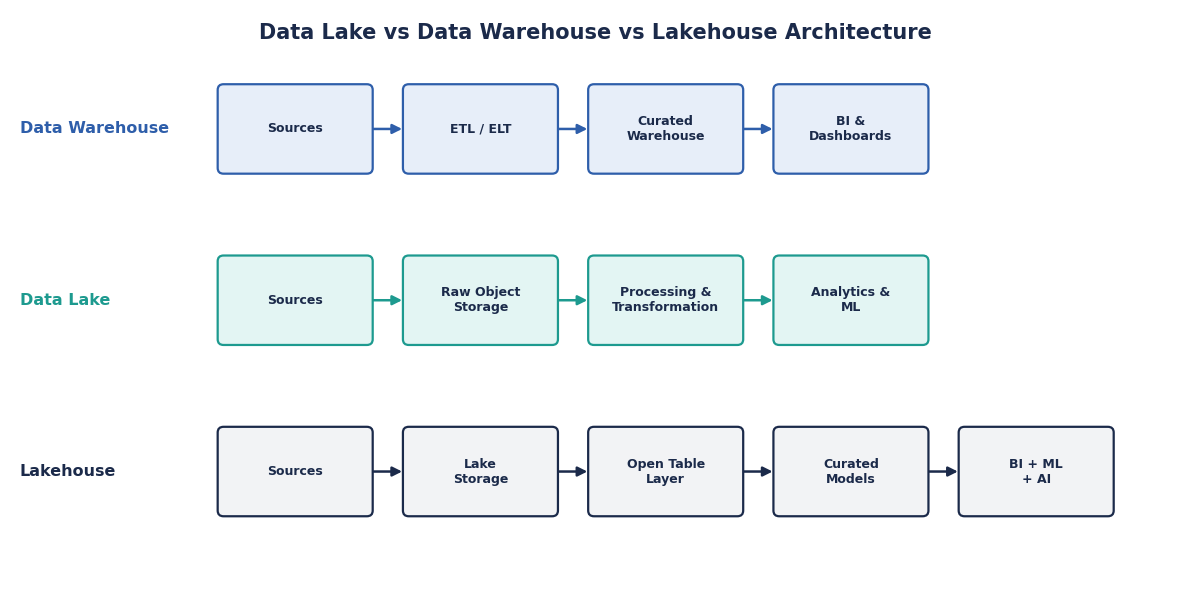
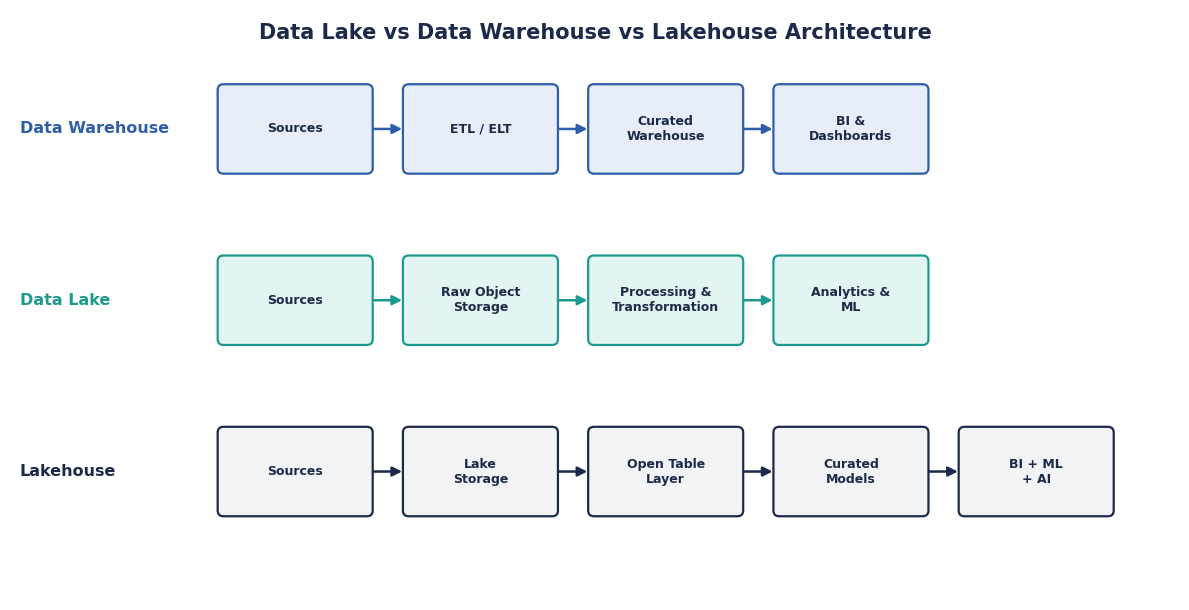
Simplified data flow through each architecture:
Data Warehouse: Sources → ETL/ELT → Curated Warehouse Tables → BI and Dashboards
Data Lake: Sources → Raw Object Storage → Processing and Transformation → Analytics and Machine Learning
Lakehouse: Sources → Lake Storage → Open Table Layer (Delta Lake, Iceberg, or Hudi) → Curated Models → BI + Machine Learning + AI

Data Types: Structured vs Semi-Structured vs Unstructured
Structured data fits neatly into rows and columns with a defined schema, transactional records, CRM entries, invoices, and financial tables are typical examples. This is the data type warehouses have historically been built around.
Semi-structured data has some organizational structure but doesn’t fit a fixed relational schema, JSON documents, XML files, application event payloads, and API responses are common examples. Data lakes handle this naturally; modern warehouses increasingly support querying it as well.
Unstructured data has no predefined structure at all, documents, images, audio, video, and free text fall into this category. This is where data lakes and lakehouses have a clear natural advantage, since traditional warehouse modeling doesn’t apply well to this kind of content.
No architecture handles every data type equally well by default, the differences are about how naturally each fits, not absolute capability.
Data Lake vs Data Warehouse vs Lakehouse for Business Intelligence
For tools like Power BI, Tableau, Looker, or Excel, and for executive or operational dashboards, the deciding factor isn’t really “warehouse vs. lake vs. lakehouse” in the abstract, it’s whether there’s a curated, governed layer of data underneath the BI tool.
This matters even in a lakehouse: raw bronze-layer files stored in object storage are not what BI teams should be querying directly. What makes BI reliable is a semantic layer with clearly defined KPIs, star-schema-style modeling for query efficiency, low query latency, and support for many concurrent users without performance degradation. A warehouse delivers this by design. A lakehouse can deliver it too, but only once curated gold-layer tables exist on top of the raw data, the physical storage location doesn’t replace that modeling work.
Which Is Best for Machine Learning and AI?
Machine learning and AI workloads generally benefit from access to raw, historical, and often multimodal data, exactly what data lakes and lakehouses are built to retain. Feature engineering frequently needs to reach back into unaggregated event-level data that a curated warehouse table may have already summarized away. Lakehouses in particular can support both structured feature tables and raw or document/vector-style data from the same governed environment, which helps with reproducibility and lineage tracking across experiments.
That said, storing data in a lakehouse does not, by itself, make an organization “AI-ready.” AI readiness also depends on data quality, consistent metadata, access governance, lineage tracking, and a clear understanding of what the business is trying to achieve with the model. An organization with excellent lakehouse infrastructure but messy, undocumented, and ungoverned raw data is not meaningfully better positioned for AI than one with a well-run warehouse and a clear, smaller-scope ML use case.
Data Governance and Security
| Consideration | Warehouse | Lake | Lakehouse |
|---|---|---|---|
| Access controls | Mature, table/column-level | Often coarser-grained by default | Improved via table format + platform tooling |
| Data classification | Commonly built into platform | Requires separate tooling | Often integrated with catalog tools |
| Lineage | Available through platform features | Requires deliberate tracking | Stronger when using integrated catalogs |
| Metadata management | Centralized | Needs active investment | Core function of the table format layer |
| Encryption | Standard | Standard at the storage layer | Standard at the storage layer |
| Masking | Native in most platforms | Requires additional tooling | Increasingly available in platform tooling |
| Auditing | Mature | Requires added tooling | Improving, platform-dependent |
| Regulatory fit | Strong for compliance-heavy reporting | Requires careful design | Achievable with proper governance layering |
A data lake with weak governance quickly becomes difficult for anyone to trust, not because the storage is unreliable, but because nobody can say with confidence what a given dataset means, where it came from, or whether it’s current. Lakehouse table formats can meaningfully improve technical governance capabilities, schema enforcement, versioning, access control at the table level, but they do not replace the organizational work of assigning data ownership and enforcing policy. For a closer look at building that quality and governance foundation, see our guide to data quality management.
Data Quality Across Warehouses, Lakes, and Lakehouses
In a warehouse, quality is typically enforced before data reaches reporting models, transformation and validation logic runs during ETL/ELT, so by the time an analyst queries a table, most quality issues have already been caught.
In a lake, raw data may intentionally include incomplete, duplicated, or unstandardized records, because the point of the raw layer is to preserve source data faithfully rather than clean it prematurely.
In a lakehouse, raw and curated layers coexist deliberately, which makes clear layering and governance critical, teams need to know which layer is safe for direct business use and which is meant only for engineering and data science work.
Across all three, mature organizations rely on data quality tests, profiling, validation rules, schema enforcement where appropriate, pipeline observability, reconciliation between systems, and a clear definition of what counts as a “trusted” data product versus a work-in-progress dataset.
Performance and Scalability
Query performance and scalability depend on far more than which architecture is chosen. Columnar storage formats, partitioning strategy, caching, indexing or clustering keys, the degree of storage-compute separation, and how many concurrent users and workloads are hitting the system at once all shape real-world performance, often more than the underlying architecture label does.
It’s inaccurate to claim any of the three is universally faster. A well-tuned lakehouse using Iceberg with sensible partitioning can outperform a poorly modeled warehouse, and a well-modeled warehouse can comfortably outperform an under-engineered lakehouse. Performance is an implementation outcome, not an architectural guarantee.
Data Lake vs Data Warehouse vs Lakehouse Cost
Cost comparisons in this space are frequently oversimplified. Object storage is genuinely inexpensive per gigabyte, but that is only one line item in the total cost of an architecture.
Warehouse cost drivers: compute consumption, storage volume, query frequency and concurrency, ingestion pipelines, and in some cases platform licensing.
Data lake cost drivers: object storage, data transfer between services, the processing engines used to make raw data queryable, cataloguing and metadata tooling, orchestration, and the engineering time required to build and maintain pipelines.
Lakehouse cost drivers: object storage, one or more compute engines, table management and metadata overhead, platform licensing where applicable, and the governance, BI, and ML tooling layered on top.
Cheap storage does not automatically mean a cheap architecture. A realistic total cost of ownership includes engineering time, monitoring, governance tooling, security controls, ongoing support, training, migration effort, and cloud compute, not just the sticker price of storing a terabyte of data.
Not sure whether your business needs a warehouse, lake, lakehouse, or hybrid architecture? DataScienceConsultingPro.com can review your systems, workloads, data quality, security requirements, and analytics goals and recommend a practical architecture.
→ Request a Data Architecture Assessment
Data Warehouse vs Data Lake vs Lakehouse for Different Business Sizes
Small Businesses
For many small businesses, a straightforward cloud data warehouse is genuinely enough, reporting needs are usually structured, the team is small, and the operational overhead of a full lakehouse would outweigh any benefit. Building lakehouse-grade infrastructure before there’s a workload that actually needs it tends to create unnecessary complexity rather than future-proofing.
Mid-Sized Businesses
Mid-sized organizations more often encounter mixed workloads, growing BI needs alongside an emerging interest in machine learning, or new semi-structured data sources like product event streams. This is frequently where the “do we need more than a warehouse” conversation starts in earnest.
Enterprises
Enterprises typically operate many source systems, multiple analytical and data science teams, stricter governance and regulatory obligations, and often hybrid or multi-cloud environments. Lakehouse and hybrid architectures tend to appear more often here, not because of company size alone, but because the diversity and scale of workloads usually demands it.
The right recommendation should always be driven by actual workload and data maturity, company size is a rough proxy at best, not a decision rule.
Can You Use a Data Lake, Warehouse, and Lakehouse Together?
Yes, and in practice, many organizations do, at least during a transition period or by deliberate long-term design.
A common real-world pattern: raw operational and event data lands first in object storage (a lake). Selected, higher-value datasets are promoted into governed lakehouse tables with schema enforcement and transactional guarantees. Meanwhile, the most sensitive or heavily regulated data, finance close data, for instance, may continue to be served through a dedicated warehouse-style structure that the finance team already trusts and knows how to audit.
Modern data architecture is often better understood as a spectrum than as a strict three-way choice. The question worth asking isn’t “which one architecture should we adopt everywhere,” but “which parts of our data estate benefit from which capabilities, and how do we connect them coherently.”
What Is Medallion Architecture?
Medallion architecture is a layered pattern for organizing data as it moves from raw to business-ready, commonly used in lakehouse implementations:
- Bronze, raw data, ingested largely as-is from source systems
- Silver, cleaned, validated, and standardized data, with obvious errors and duplicates resolved
- Gold, business-ready, aggregated, analytics-optimized data intended for BI and reporting
While medallion architecture is closely associated with lakehouses, it’s fundamentally a logical layering pattern, not a mandatory requirement unique to any one platform or architecture. Warehouse and lake environments can and often do apply similar staged-layering thinking, even without using the “medallion” terminology.
Data Lakehouse vs Data Mesh and Data Fabric
It’s worth briefly distinguishing these concepts, since they’re often mentioned in the same conversations but answer different questions. Data lake, data warehouse, and lakehouse primarily describe data storage and processing architectures. Data mesh and data fabric address different organizational and integration concerns, how data ownership is distributed across teams, and how data is discovered and connected across systems, respectively.
For a detailed comparison of those two concepts, see data mesh vs data fabric.
When Should You Choose a Data Warehouse?
- Most of your data is already structured
- Business metrics need to be stable, well-defined, and consistently reported
- BI and dashboarding are the primary workload
- SQL performance and concurrency requirements are demanding
- Finance, regulatory, or compliance reporting is central to the business
- Strong, centralized governance is a priority
- Your team primarily works in SQL and BI tools
- Machine learning workloads are limited or nonexistent today
When Should You Choose a Data Lake?
- You’re generating or receiving large volumes of raw data, logs, IoT, events
- Significant unstructured data (images, audio, documents) needs a home
- Future use cases for the data aren’t fully defined yet
- Long-term, low-cost retention of raw history matters
- Machine learning and data science experimentation is a priority
- You need flexible processing across many different tools and engines
Even here, strong governance is still necessary, a data lake is not a substitute for having a data quality and cataloguing strategy.
When Should You Choose a Lakehouse?
- BI and machine learning need to operate on the same underlying data
- Structured and unstructured data need to coexist in one environment
- Raw and curated data both need to be retained and clearly separated
- Open table formats (Delta Lake, Iceberg, Hudi) would meaningfully simplify your pipeline
- You want transactional and schema-enforcement capabilities directly over lake-style storage
- Your data engineering team has the maturity to manage the additional complexity
A lakehouse is not automatically the right next step for every growing company, it’s the right step when the workload genuinely spans BI, ML, and varied data types, and when the team is ready to manage that complexity well.
Decision Matrix: Which Architecture Fits Your Business?
| Business Requirement | Warehouse | Lake | Lakehouse |
|---|---|---|---|
| Executive BI dashboards | Strong fit | Depends | Strong fit (with curated layer) |
| Finance/regulatory reporting | Strong fit | Depends | Possible, with strong governance |
| Raw log/event retention | Depends | Strong fit | Strong fit |
| Large image/video datasets | Depends | Strong fit | Strong fit |
| Machine learning at scale | Depends | Strong fit | Strong fit |
| Fast ad hoc SQL analytics | Strong fit | Depends | Strong fit (with tuning) |
| Regulatory audit trails | Strong fit | Depends | Possible |
| Data science experimentation | Depends | Strong fit | Strong fit |
| IoT/sensor data at volume | Depends | Strong fit | Strong fit |
| Long historical retention | Depends | Strong fit | Strong fit |
| Mixed BI + ML on shared data | Depends | Depends | Strong fit |
| Frequently changing schemas | Depends | Strong fit | Strong fit (schema evolution) |
| Open format / vendor flexibility | Depends | Strong fit | Strong fit |
| Small team, limited engineering capacity | Strong fit | Depends | Depends |

Architecture Readiness Checklist
Before committing to an architecture or migration, work through the following:
- What data formats do you currently have, structured, semi-structured, unstructured?
- Who actually consumes this data, and how technical are they?
- How many concurrent analytical users need to be supported?
- Is BI and dashboarding your primary workload, or is it secondary?
- Are you actively training or planning to train machine learning models?
- Do you need to retain raw, unprocessed historical data long-term?
- How frequently does your source data’s schema change?
- How mature is your current data governance and ownership model?
- What are your query latency and freshness requirements?
- What is your organization’s broader cloud and platform strategy?
- Does your team have experience with distributed data processing?
- What regulatory or security obligations apply to this data?
- How much additional operational complexity can your team realistically support?
Migration Paths
Warehouse → Lakehouse Makes sense when machine learning, semi-structured data, or long-term raw-data retention become priorities the existing warehouse wasn’t designed for.
Data Lake → Lakehouse Makes sense when the lake has become hard to govern, and the organization needs transactional guarantees, schema enforcement, and reliable SQL analytics over data that’s already there.
Legacy Warehouse → Modern Cloud Warehouse Makes sense when the warehouse architecture itself is still the right fit, but the underlying infrastructure is outdated, inflexible, or expensive to scale.
Warehouse + Lake → Unified Architecture Some organizations consolidate the two into a lakehouse to reduce duplication and simplify pipelines; others deliberately keep both, because the separation reflects a real difference in how the data is governed and used. Migration should follow a genuine business need, it isn’t automatically necessary just because a more modern pattern exists.
Common Architecture Mistakes
- Choosing a technology or platform before clearly defining the workloads it needs to support
- Building a data lake with no governance, ownership, or cataloguing plan
- Adopting a lakehouse mainly because it’s the current trend, not because the workload requires it
- Running every raw dataset through expensive warehouse compute unnecessarily
- Assuming low storage cost translates directly into low total architecture cost
- Ignoring real query patterns when designing partitioning and modeling
- Underestimating concurrency requirements for BI tools
- Overengineering a small company’s data stack far beyond its actual needs
- Mixing raw and trusted datasets without clear layer boundaries
- Poor or absent data cataloguing, making datasets hard to find or trust
- Undefined ownership over datasets and pipelines
- Weak or overly broad access controls
- Copying the same data into multiple systems without a clear reason
- Failing to monitor and control ongoing cloud cost
- Treating the architecture decision as a one-time event rather than something to revisit as workloads evolve
Recommended Architecture by Use Case
| Use Case | Best Starting Point | Why |
|---|---|---|
| Executive dashboards | Warehouse | Requires governed, consistent metrics with strong BI performance |
| Finance reporting | Warehouse | Needs auditability, stability, and strict data quality |
| Customer analytics | Warehouse or Lakehouse | Depends on how much raw behavioral data is involved |
| Machine learning | Lake or Lakehouse | Needs raw, historical, and often unstructured data |
| Generative AI preparation | Lakehouse | Benefits from unified governance over varied data types |
| IoT | Lake or Lakehouse | High-volume, often semi-structured sensor data |
| Log analytics | Lake | Large volumes of semi-structured event data |
| SaaS product analytics | Lakehouse | Mixes structured usage data with event-level detail |
| Data archival | Lake | Cost-efficient long-term raw retention |
| Regulatory reporting | Warehouse | Strong governance and auditability requirements |
| Mixed BI + ML environment | Lakehouse | Needs both curated and raw data on shared infrastructure |
| Enterprise modernization | Lakehouse or Hybrid | Diverse workloads typically require a spectrum of capabilities |
How DataScienceConsultingPro.com Can Help
Choosing between a data warehouse, data lake, lakehouse, or some hybrid combination is rarely a purely technical decision, it depends on your existing systems, your team’s skills, your governance obligations, and where your BI, machine learning, and AI ambitions are actually headed.
DataScienceConsultingPro.com works with organizations to:
- Assess current data architecture and identify gaps
- Inventory existing data sources and understand actual workloads
- Compare warehouse, lake, and lakehouse options against real business requirements
- Design cloud data architecture suited to the organization’s scale and maturity
- Build practical migration roadmaps rather than one-size-fits-all templates
- Build ETL and ELT pipelines that fit the chosen architecture
- Improve data quality through validation, profiling, and monitoring
- Implement governance frameworks that match regulatory and business needs
- Prepare analytics-ready models for BI teams
- Prepare data for machine learning and AI workloads
- Optimize existing cloud data infrastructure for performance and cost
Our data engineering services cover the pipeline, modeling, and platform work needed to implement any of these architectures well, while our cloud engineering services support the underlying cloud infrastructure, migration, and analytics platform work that architecture decisions ultimately depend on.
Get a practical architecture recommendation based on your actual data, team, cloud environment, reporting requirements, and budget.
→ Talk to a Data Engineering Consultant
Frequently Asked Questions About Data Lakes, Warehouses, and Lakehouses
Neither is universally better, they solve different problems. A warehouse is generally better for governed BI and reporting; a lake is generally better for flexible storage of raw or varied data and for machine learning use cases. The right choice depends on the workload.
Not necessarily. Many organizations use lakehouse architecture alongside, rather than instead of, warehouse-style structures, particularly for the most sensitive or heavily regulated reporting, where a mature warehouse workflow may already be trusted and well-understood.
Yes. This is a common pattern, especially during a transition to a more unified architecture, and some organizations maintain both intentionally as a long-term design rather than a temporary state.
Raw or lightly processed data of any type, logs, event streams, IoT sensor data, JSON files, images, audio, and other formats that may not have a defined analytical use yet.
Curated, structured data that has already been cleaned and modeled for reliable SQL analytics, typically transactional summaries, dimensional models, and business metrics used in
Schema-on-read means the structure of data is interpreted at the point of query or processing, rather than enforced when the data is first stored. This is the traditional approach used by data lakes.
Schema-on-write means data structure is validated and applied before or during storage. This is the traditional approach used by data warehouses, ensuring data is immediately query-ready and consistent.
Delta Lake is an open table format that adds a transaction log over Parquet files, providing ACID transactions, schema enforcement, and time travel for data stored in a lake environment.
Apache Iceberg is an open table format designed for very large analytic datasets, offering strong schema evolution support and compatibility across multiple processing engines.
Medallion architecture organizes data into bronze (raw), silver (cleaned and validated), and gold (business-ready) layers as it moves through a pipeline, commonly used in lakehouse implementations, though the pattern itself isn’t exclusive to any one architecture.
Snowflake is generally categorized as a cloud data warehouse, though it has added capabilities for querying semi-structured and external data that overlap with some lakehouse-style functionality. Its core strength remains governed SQL analytics.
Databricks is a platform strongly associated with the lakehouse architecture and built around Delta Lake, but the lakehouse concept itself isn’t exclusive to one vendor, other platforms and open table formats also implement it.
Microsoft Fabric supports both lakehouse and warehouse experiences within the same platform, allowing organizations to use either or both approaches depending on the workload.
Power BI performs best against a curated, well-modeled data layer, whether that layer lives in a traditional warehouse or in the gold layer of a lakehouse. The key factor is the presence of good modeling, not the underlying storage architecture alone.
Data lakes and lakehouses are generally better suited to machine learning because they retain raw, historical, and often unstructured data that feature engineering frequently depends on.
Raw object storage is often less expensive than warehouse storage, but total architecture cost includes processing, governance, cataloguing, and engineering effort, so a data lake is not automatically cheaper once the full picture is considered.
It can turn into a “data swamp”, a repository where data is difficult to find, understand, or trust because there’s no consistent metadata, ownership, or quality management in place.
Start with your workloads: if BI and governed reporting dominate, a warehouse is usually the simpler fit; if raw data retention and ML experimentation dominate, a lake fits better; if you need both on shared infrastructure, a lakehouse is worth the added complexity. Team skills, governance maturity, and budget should shape the final decision.
Choosing the wrong data architecture can create years of unnecessary migration, governance, and cloud cost. If you’re planning a warehouse, data lake, lakehouse, or modernization project, DataScienceConsultingPro.com can help you assess the options and build a practical implementation roadmap.
Conclusion
There isn’t a single “best” answer to data lake vs data warehouse vs lakehouse, each is a strong choice for a different set of problems. A data warehouse remains an excellent option for curated BI and governed analytics, particularly where reporting stability and auditability matter most. A data lake is a strong choice for flexible, raw-data storage and exploratory or machine learning workloads where the future use cases aren’t fully known yet. A lakehouse earns its added complexity when an organization genuinely needs BI, data science, and AI to operate from a more unified data foundation, it’s a useful pattern, not an automatic upgrade every growing company needs.
Hybrid architectures, where more than one of these patterns coexists, are common in practice, and often the right answer, rather than a sign of an incomplete migration. What should drive the decision is your organization’s actual workloads, data types, governance requirements, and team capabilities, not which architecture is currently trending.
If your organization is deciding between a data warehouse, data lake, lakehouse, or hybrid architecture, DataScienceConsultingPro.com can assess your current systems, workloads, governance requirements, and future analytics goals and provide a practical data architecture roadmap.
→ Request a Data Architecture Assessment
