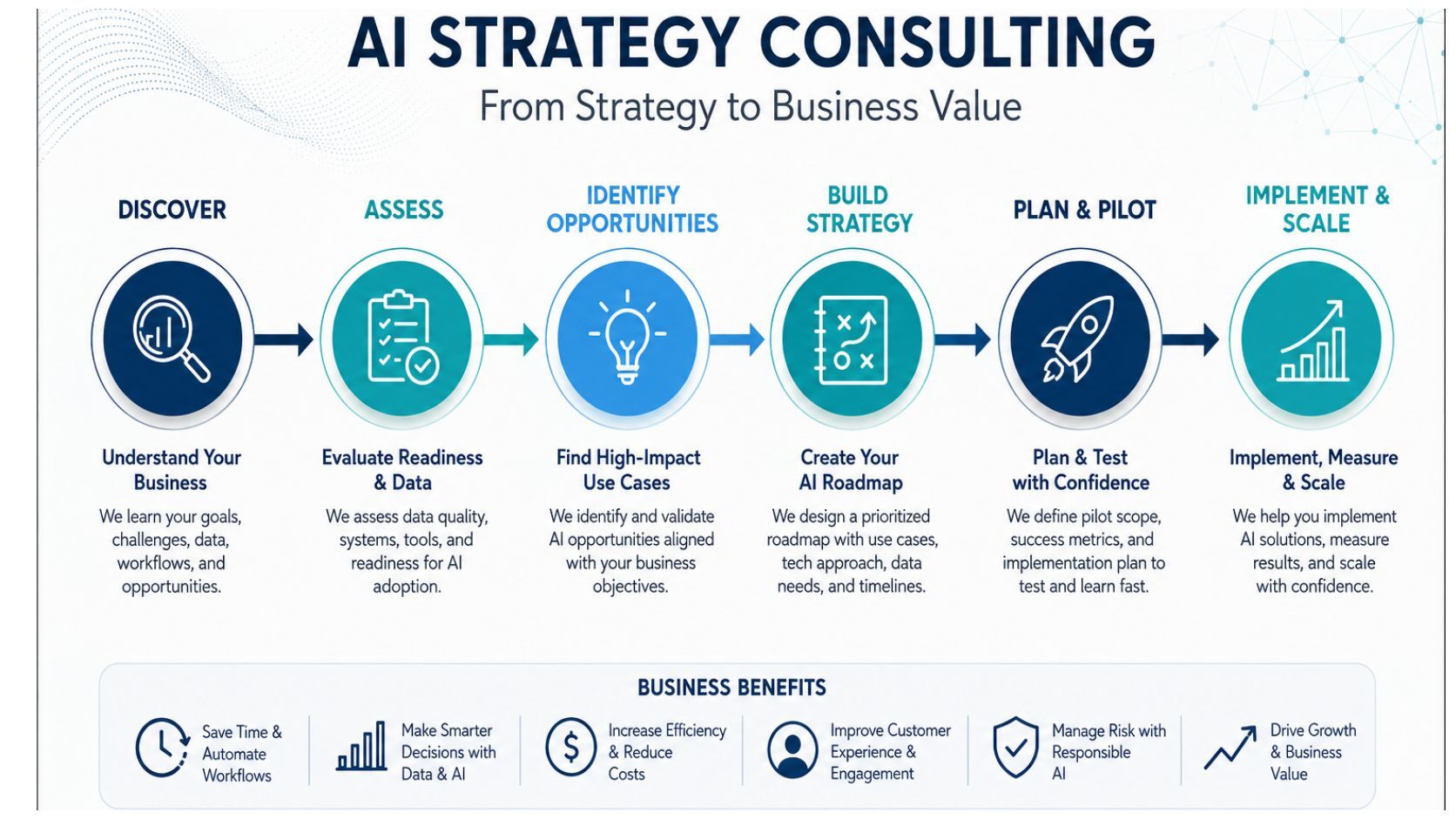
Many businesses know artificial intelligence can improve productivity, reporting, automation, forecasting, customer experience, workflow efficiency, and decision-making. The challenge is not interest. The real challenge is knowing where to start, which AI ideas are worth funding, whether the data is ready, what risks must be controlled, and how to turn AI from a trend into a practical business advantage.
Without a clear strategy, AI adoption can become scattered and expensive. Teams may subscribe to random AI tools, automate disconnected tasks, test pilots without measurable goals, or use sensitive business data without the right governance. This can create unclear ROI, employee uncertainty, security concerns, privacy risks, poor-quality outputs, compliance exposure, and projects that never move beyond experimentation.
DataScienceConsultingPro.com provides AI Strategy Consulting for organizations that want to adopt AI responsibly, practically, and with clear business direction. We help leaders assess readiness, identify valuable opportunities, prioritize use cases, review data foundations, plan governance, and build an AI roadmap that supports measurable implementation.
Our work is designed for business owners, executives, founders, healthcare administrators, finance leaders, retail teams, SaaS companies, e-commerce brands, operations managers, education organizations, NGOs, and regulated businesses that need AI guidance before investing heavily in tools, automation, machine learning, or internal AI systems.
Our approach is not about chasing AI hype. It is about helping your organization decide what AI should do, what it should not do, where human oversight is needed, what data foundation is required, and how to move from uncertainty to a structured implementation plan.
Request an AI Strategy Consultation
What Is AI Strategy Consulting?
AI Strategy Consulting helps organizations decide how to use artificial intelligence in a way that supports business goals, improves workflows, reduces risk, and creates measurable value. It is not only about choosing AI software or adding automation tools to existing processes. A strong AI strategy connects business priorities, data readiness, governance, people, systems, workflows, risk controls, and implementation planning.
An AI strategy consultant helps leadership teams answer practical questions. Which AI opportunities are worth investing in? Which workflows are safe to automate? Which decisions still require human review? Is the organization’s data clean, accessible, and reliable enough for AI? What privacy or compliance risks must be managed? Which pilot should be tested first? How should success be measured?
At DataScienceConsultingPro.com, our AI strategy consulting services may include business goal review, AI readiness assessment, data maturity review, workflow analysis, use case discovery, ROI planning, risk assessment, responsible AI planning, human-in-the-loop workflow design, implementation roadmap development, pilot planning, and stakeholder alignment.
Once the strategy is clear, implementation may connect naturally with our Machine Learning Services, Predictive Analytics Services, Data Engineering Services, Business Intelligence Services, or Dashboard Development Services.
Our role is to help your organization clarify where AI can create value, what needs to be prepared, and how to move forward with a practical roadmap before investing in full implementation.
Why Businesses Need an AI Strategy Before Adopting AI
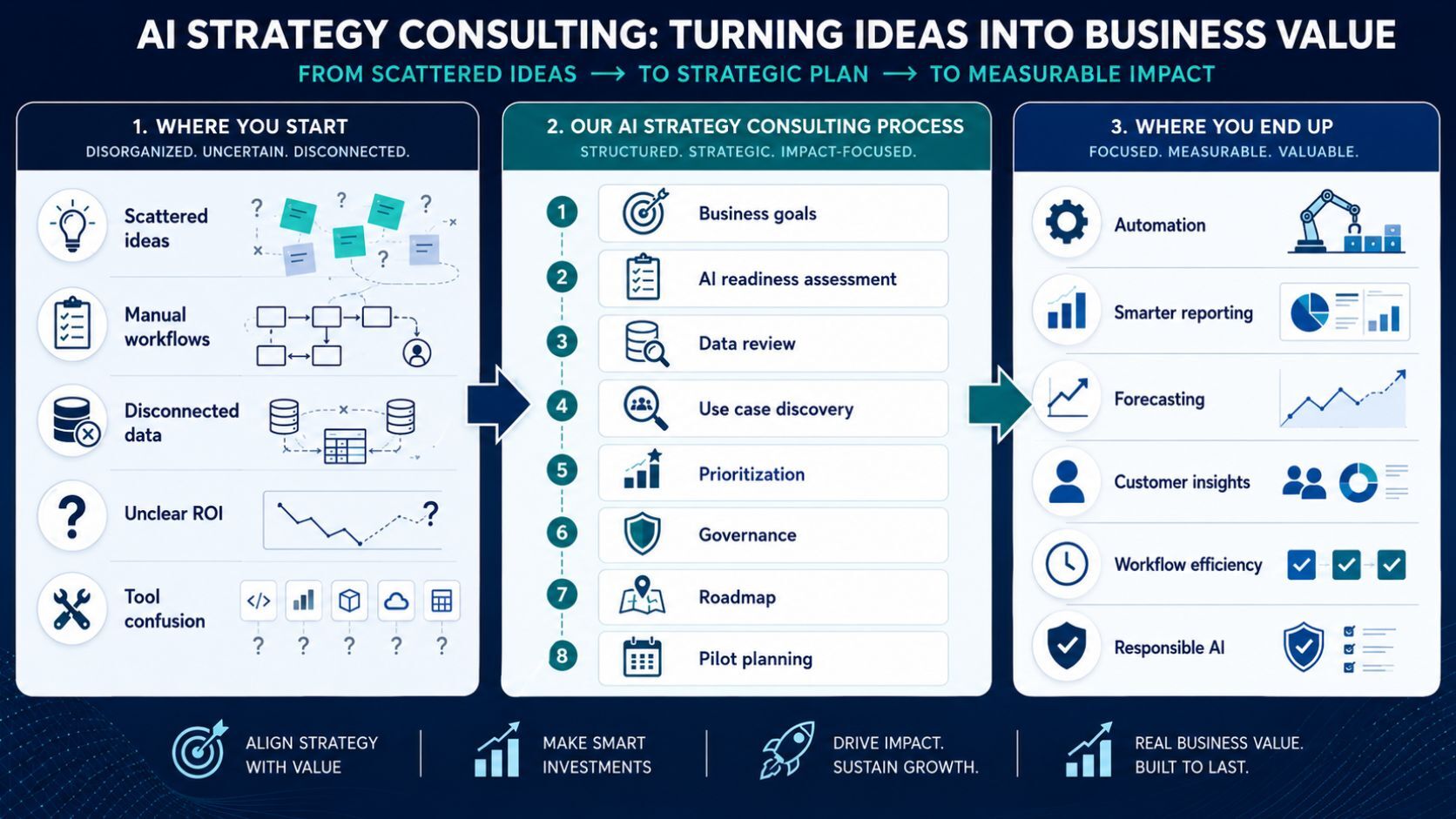
AI can create real value, but only when it is connected to the right business problem. When companies adopt AI without strategy, they often start with tools instead of goals. A team may subscribe to an AI platform, test a chatbot, automate a small task, or launch a pilot without knowing how it supports revenue, operations, compliance, customer experience, or decision-making.
This is where many AI projects lose momentum. The technology may look impressive, but the business process behind it remains unclear. Teams may not know who owns the output, how errors are handled, whether sensitive data is protected, which workflows require human review, or how success should be measured.
A structured AI strategy helps prevent this. It gives leaders a practical view of what AI should do, what data is needed, what risks must be managed, which teams should be involved, and which projects deserve priority.
| Problem | Risk Without AI Strategy | How Our AI Strategy Consulting Helps |
|---|---|---|
| Random AI tool adoption | Teams use disconnected tools without clear value | Creates a business-aligned AI roadmap |
| Unclear ROI | AI spending becomes difficult to justify | Defines measurable success metrics |
| Poor data quality | AI outputs become unreliable | Reviews data readiness and data gaps |
| Weak governance | Privacy, security, and accountability risks increase | Builds responsible AI controls |
| Compliance risk | Regulated workflows may be exposed to errors | Adds risk-aware planning and human review |
| Employee resistance | Teams may distrust or misuse AI | Plans adoption, training, and workflow fit |
| Scattered use cases | Good ideas compete with poor ideas | Prioritizes use cases by value and feasibility |
| No implementation roadmap | AI projects stall after discussion | Creates staged next steps and pilot plans |
A strong AI strategy helps your organization move with confidence. It reduces guesswork, improves leadership alignment, protects against rushed adoption, and makes AI implementation more practical, measurable, and responsible.
Talk to us before investing in AI tools, pilots, or automation workflows.
Our AI Strategy Consulting Services
DataScienceConsultingPro.com supports businesses from early AI exploration to roadmap development and pilot planning. Our AI strategy consulting services are designed to help you understand where AI fits, what needs to be prepared, what should be prioritized, and how to move forward without unnecessary risk.
AI Readiness Assessment
Before investing in AI tools or models, your organization needs to know whether it is ready. AI readiness is not only a technical question. It includes data quality, business goals, leadership alignment, team capability, workflow maturity, governance, privacy, security, and implementation capacity.
Our AI readiness assessment reviews your current systems, reporting workflows, data maturity, automation needs, operational challenges, governance maturity, technical readiness, and leadership priorities. We look at whether the data is accessible, whether it is reliable enough to support AI use cases, and whether the organization has clear business problems that AI can realistically support.
This helps prevent rushed AI adoption. Instead of starting with a tool, we start with the business environment. We identify gaps that may need attention before implementation, such as poor data quality, disconnected systems, unclear ownership, missing documentation, weak reporting workflows, limited data access, or lack of governance rules.
An AI readiness assessment is useful for organizations that want to explore AI but are unsure whether their data, processes, and teams are prepared.
AI Opportunity Discovery
Many organizations have several possible AI ideas but no clear way to decide which ones matter. AI opportunity discovery helps identify where artificial intelligence can create practical value across departments and workflows.
We review opportunities across operations, finance, sales, marketing, customer service, healthcare administration, supply chain, HR, reporting, analytics, research workflows, and internal knowledge management. The goal is to identify real business problems where AI may improve speed, accuracy, consistency, prediction, automation, or decision support.
Examples may include demand forecasting, automated report summaries, customer segmentation, support ticket analysis, lead scoring, anomaly detection, document extraction, internal knowledge search, survey analysis, financial forecasting, workflow monitoring, and performance reporting.
The best AI opportunities are not always the most exciting ones. They are the ones with clear business value, available data, manageable risk, realistic adoption potential, and measurable outcomes.
AI Use Case Prioritization
Not every AI idea deserves investment. Some ideas sound impressive but are expensive, risky, difficult to adopt, or unsupported by reliable data. Other ideas may be simple but highly valuable because they reduce manual work, improve reporting, shorten decision cycles, or help teams act faster.
AI use case prioritization helps separate high-value opportunities from low-value distractions. We assess potential use cases based on business value, feasibility, data availability, risk level, cost, urgency, adoption difficulty, compliance sensitivity, expected impact, implementation complexity, and required oversight.
This process helps leadership teams decide what to do first. It also reduces the risk of investing in AI projects that are too broad, poorly defined, or disconnected from measurable business outcomes.
A prioritized AI use case list gives your team a practical starting point. It shows which opportunities are quick wins, which require better data foundations, which need governance controls, which should be piloted carefully, and which should be delayed or avoided.
AI Roadmap Development
An AI roadmap converts ideas into a staged plan. It helps your organization move from “we should use AI” to “these are the priorities, owners, timelines, data requirements, risks, success metrics, and next steps.”
A strong AI roadmap may include short-term opportunities, medium-term data and workflow improvements, and long-term AI transformation goals. It can define pilot recommendations, required datasets, data quality gaps, governance requirements, workflow redesign needs, model development options, dashboard and reporting connections, automation opportunities, risk notes, budget considerations, success measures, and scaling plans.
The roadmap should be practical enough for leaders to act on. It should clarify what can be done now, what needs preparation, what requires stakeholder approval, and what should only happen after the right data, systems, and controls are in place.
At DataScienceConsultingPro.com, we build AI strategy roadmaps that connect business goals with implementation reality. We help you avoid vague AI plans and instead create a clear direction that can guide decisions, budgets, pilots, internal alignment, vendor discussions, and future technical work.
Request an AI readiness review or AI roadmap consultation today.
AI Governance and Responsible AI Planning
AI strategy is not complete without governance. Businesses need more than automation ideas and technical recommendations. They also need rules, controls, review processes, and accountability structures that guide how AI is used across the organization.
AI governance helps your business answer important questions. Who can use AI tools? What data can be uploaded? Which outputs need human review? How should errors be handled? Who owns the final decision? What records should be kept? How will the organization monitor risk, bias, privacy, accuracy, and compliance?
At DataScienceConsultingPro.com, responsible AI planning is built into our AI strategy consulting process. We help organizations think carefully about privacy, data security, access control, model explainability, human oversight, bias, auditability, accountability, and workflow impact.
This is especially important for healthcare, finance, education, HR, legal, insurance, research, and other regulated or data-sensitive environments. In these settings, AI should support better decisions without removing professional judgment, compliance review, or human accountability.
A responsible AI strategy helps your organization avoid rushed adoption. It creates a safer path for using AI in real business workflows while protecting trust, data, users, customers, employees, and decision-makers.
AI Workflow Automation Strategy
AI can support many repeatable workflows, but automation should be planned carefully. A workflow that is easy to automate is not always safe or valuable to automate. The right strategy looks at business value, process risk, data quality, user adoption, and the role of human review.
Our AI workflow automation strategy helps identify where AI can reduce repetitive work, speed up information processing, improve consistency, and support better decision-making. This may include document review, report summaries, customer support triage, email classification, lead scoring, forecasting, quality checks, data extraction, internal knowledge search, survey analysis, and performance reporting.
For example, a sales team may use AI to summarize leads and prioritize follow-up. A finance team may use AI to flag unusual transactions for review. A healthcare administrator may use AI to summarize operational reports, while keeping clinical judgment and compliance decisions under human oversight. A retail team may use AI to support demand forecasting and inventory planning.
The goal is not to automate everything. The goal is to automate the right tasks in the right way, with clear controls and measurable outcomes.
AI Data Strategy
AI depends on reliable data. If the data is incomplete, duplicated, outdated, poorly structured, or disconnected, AI outputs can become unreliable. A strong AI strategy must therefore include a clear view of the organization’s data foundation.
Our AI data strategy work reviews the data needed to support your AI goals. This may include data quality, data access, data ownership, data pipelines, data cleaning, data structure, reporting systems, database readiness, and integration across business tools.
Many businesses discover that they are interested in AI, but their data environment needs improvement first. Customer records may be duplicated. Finance data may sit in spreadsheets. Sales data may not match CRM records. Operational data may be incomplete. Dashboards may use inconsistent KPI definitions. These issues can weaken AI projects before they begin.
Where needed, AI strategy may connect with our Data Cleaning Services, Data Engineering Services, Data Pipeline Development Services, and Data Analysis Services.
A better data foundation makes AI easier to trust, test, explain, and scale.
AI Pilot and Proof-of-Concept Planning
A pilot helps your organization test an AI idea before committing to a larger investment. However, a pilot should not be a vague experiment. It should have a clear scope, defined users, required data, success metrics, risks, timeline, and decision criteria.
Our AI pilot and proof-of-concept planning helps you design focused AI tests that answer practical business questions. What problem will the pilot solve? What data is required? Who will use the output? What does success look like? What risks need to be controlled? What happens if the pilot works? What happens if it does not?
A useful pilot may test a forecasting model, reporting automation workflow, customer segmentation process, internal knowledge assistant, support ticket triage system, document extraction workflow, or anomaly detection process.
Pilot planning helps reduce risk because it prevents teams from overbuilding too early. It also gives decision-makers evidence before approving full implementation. A well-designed pilot should help your business learn whether the use case is valuable, feasible, trusted by users, and worth scaling.
AI Implementation Support
After the strategy is complete, some organizations need support turning the roadmap into action. Implementation may involve internal teams, external vendors, technical consultants, or a combination of support partners.
DataScienceConsultingPro.com can help translate the AI strategy into implementation requirements. This may include model development planning, workflow automation design, dashboard integration, system integration, documentation, training support, stakeholder communication, change management, and monitoring plans.
Depending on the roadmap, implementation may connect with our Machine Learning Services, Predictive Analytics Services, Business Intelligence Services, or Dashboard Development Services.
Implementation support helps keep strategy connected to action. It also helps ensure that AI projects remain aligned with business goals, data realities, governance requirements, and user needs.
Talk to Us About Building a Practical AI Roadmap
AI Strategy Consulting for Different Business Needs
Different industries need different AI strategies. A healthcare organization does not face the same risks as an e-commerce business. A finance team does not measure value the same way as a SaaS company. A good AI strategy should match the organization’s industry, workflows, data sensitivity, customer expectations, and decision-making needs.
Healthcare
Healthcare organizations can use AI to support patient flow analysis, administrative reporting, operational forecasting, survey analysis, claims review, scheduling support, quality monitoring, and compliance-aware analytics.
However, healthcare AI requires careful governance. AI should support administrative and operational decisions without replacing licensed clinical judgment. Human oversight, data privacy, auditability, and responsible workflow design are essential.
Finance
Finance teams can use AI for forecasting, risk scoring, fraud monitoring, reporting automation, expense analysis, cash flow planning, anomaly detection, and financial dashboard support.
A finance AI strategy should consider accuracy, auditability, data security, approval workflows, and human review. Final financial decisions should remain accountable and reviewable.
Retail and E-commerce
Retail and e-commerce businesses can use AI for demand forecasting, product recommendations, customer segmentation, inventory planning, pricing insights, campaign optimization, product performance analytics, and customer behavior analysis.
The best AI opportunities in retail often connect directly to revenue, customer experience, inventory efficiency, and marketing performance.
SaaS and Technology
SaaS and technology companies can use AI for churn prediction, product analytics, support automation, user behavior analysis, onboarding improvement, customer health scoring, subscription performance tracking, and product recommendation workflows.
A strong AI roadmap can help technology teams prioritize use cases that improve retention, product adoption, support efficiency, and customer success.
Operations
Operations teams can use AI for workflow automation, resource planning, anomaly detection, productivity tracking, service performance, bottleneck analysis, and process optimization.
AI strategy helps operations leaders identify where automation can reduce delays, improve consistency, and support better planning without disrupting critical workflows.
Marketing and Sales
Marketing and sales teams can use AI for lead scoring, campaign analysis, customer targeting, sales forecasting, buyer segmentation, content analysis, email classification, and conversion reporting.
A useful strategy helps teams avoid random tool adoption and instead connect AI to measurable sales performance, customer insights, and campaign outcomes.
HR and Workforce Planning
HR teams can use AI for workforce analytics, employee support automation, skills mapping, training needs analysis, internal knowledge assistants, and attrition risk indicators.
Because HR decisions affect people directly, AI strategy must include fairness, privacy, transparency, human oversight, and careful governance.
Education and Research
Education and research organizations can use AI for survey analysis, learning analytics, reporting automation, research data workflows, administrative process improvement, and student support insights.
A responsible AI strategy can help these organizations improve insight and efficiency while protecting privacy, data quality, and ethical research standards.
AI Strategy Roadmap: What You Receive
A strong AI strategy roadmap should give your team a clear, practical, and decision-ready plan. It should not be a vague document filled with buzzwords. It should help leaders understand what to do, why it matters, what is required, what risks exist, and how to move forward.
Depending on your project scope, your AI strategy roadmap may include:
- AI readiness assessment
- Business goal review
- Data maturity review
- Workflow and process review
- AI opportunity list
- Prioritized AI use cases
- Feasibility scoring
- ROI and impact assumptions
- Risk and governance notes
- Responsible AI recommendations
- Data requirements
- Implementation roadmap
- Pilot recommendations
- Technology recommendations
- Stakeholder alignment notes
- Success metrics
- Timeline and next steps
- Optional support plan
The roadmap is designed to help your organization move from AI uncertainty to practical execution. It gives executives, managers, technical teams, and business users a shared view of priorities, responsibilities, risks, and implementation direction.
Random AI Adoption vs Structured AI Strategy
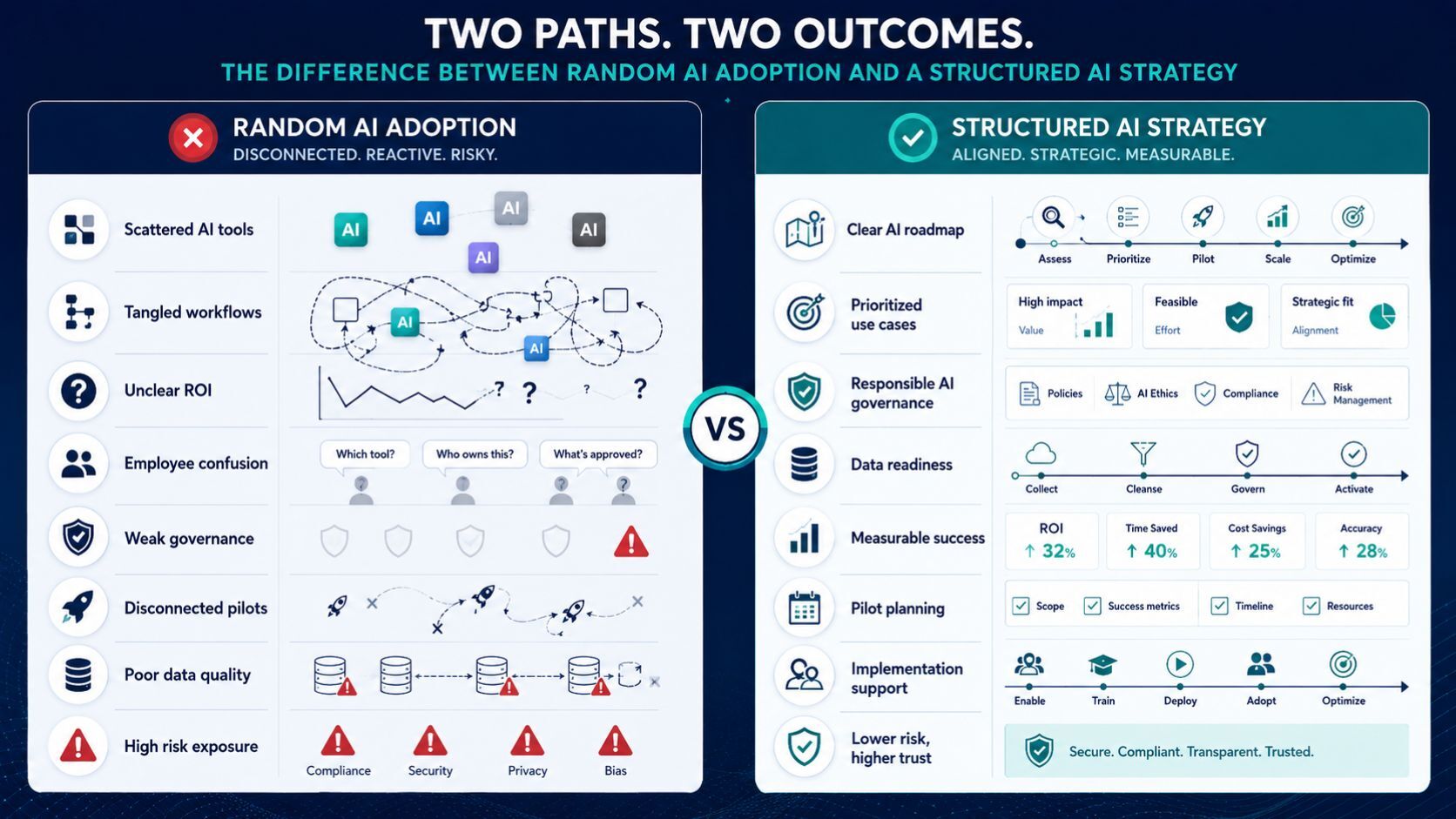
Many businesses begin AI adoption by testing tools without a clear plan. This can create short-term excitement but long-term confusion. A structured AI strategy provides better direction because it connects AI use to business value, governance, data readiness, and measurable outcomes.
| Random AI Adoption | Structured AI Strategy Consulting |
|---|---|
| Tool-first thinking | Business-first planning |
| Scattered AI experiments | Prioritized use cases |
| Unclear ROI | Measurable success metrics |
| Weak governance | Responsible AI controls |
| Poor data readiness | Data foundation review |
| Employee confusion | Adoption and workflow planning |
| Risky automation | Human-in-the-loop design |
| One-off pilots | Scalable AI roadmap |
| Vendor-led decisions | Business-owned AI direction |
| Reactive AI use | Strategic AI adoption |
Structured AI strategy helps organizations make smarter investment decisions. It also helps leaders avoid buying tools before understanding the business problem, the data requirements, the risks, and the expected impact.
Our AI Strategy Consulting Process
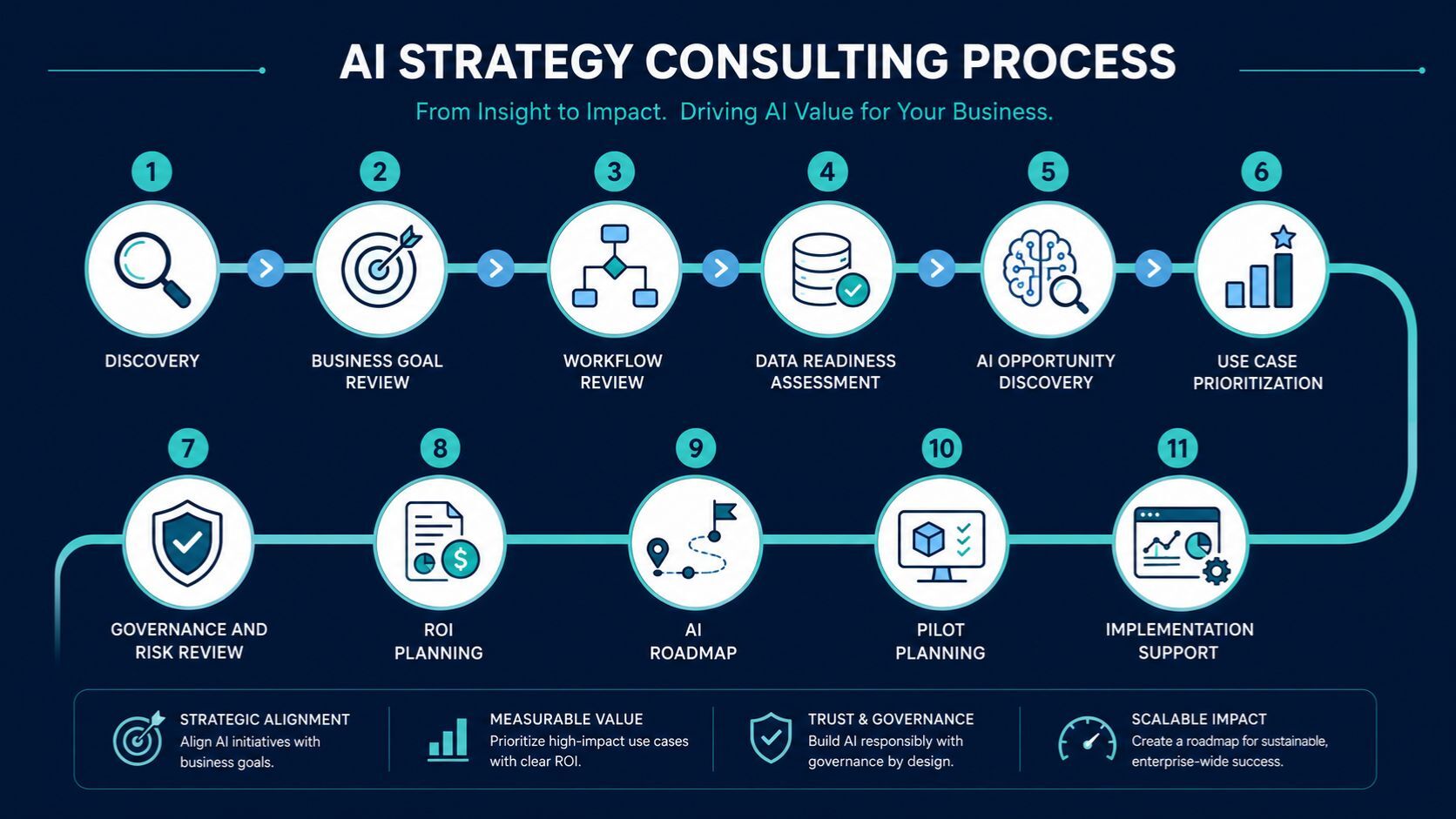
Our AI strategy consulting process is designed to make AI planning clear, structured, and business-focused. We begin by understanding your goals and current environment before recommending tools, pilots, or implementation steps.
- Discovery and business goal review
We clarify what your organization wants to improve, such as reporting, forecasting, automation, customer experience, operational efficiency, cost control, or decision-making. - Current systems and workflow review
We review existing systems, manual processes, data flows, reports, dashboards, and operational workflows to understand where AI could fit. - Data readiness and quality assessment
We assess whether your data is accessible, clean, consistent, structured, and suitable for AI use cases. - AI opportunity identification
We identify possible AI use cases across departments and workflows. - Use case scoring and prioritization
We score AI opportunities based on value, feasibility, risk, data availability, and implementation effort. - Risk, governance, and responsible AI review
We identify privacy, security, bias, explainability, compliance, and human oversight requirements. - ROI and business case development
We define likely benefits, expected impact, measurement methods, and success metrics. - AI roadmap creation
We create a staged plan with priorities, timelines, data requirements, governance notes, and pilot recommendations. - Pilot and implementation planning
We define how selected AI ideas can be tested, measured, and prepared for wider implementation. - Executive presentation and next-step support
We summarize findings and recommendations in a way that leaders, managers, and technical teams can use.
When Should You Hire an AI Strategy Consultant?
You should consider hiring an AI strategy consultant when your organization wants to use AI but does not have a clear direction, roadmap, or governance plan. Many businesses know AI could improve productivity, reporting, automation, forecasting, and customer experience, but they struggle to decide which use cases are realistic, valuable, and safe to implement.
AI strategy consulting is especially useful when leaders are asking questions such as: Where should we start? Which AI tools are worth using? Is our data ready? What should we automate first? What risks should we avoid? How do we measure success? How do we make sure AI supports the business instead of creating confusion?
Your business may need AI strategy consulting if:
- Leaders want to use AI but do not know where to start
- Teams are already using AI tools without governance
- Manual workflows are slowing growth
- Data is scattered, messy, or unreliable
- Executives need a clear AI roadmap
- The business needs AI use cases with measurable value
- Reporting, forecasting, or analysis takes too long
- Employees are unsure how AI should be used
- The company wants to reduce AI risk before implementation
- Internal teams need strategic direction before building pilots
- Regulated workflows require careful planning and human oversight
- The organization wants to test AI but avoid wasted spending
A good AI strategy consultant helps your organization move from interest to direction. Instead of adopting AI because it is popular, you get a structured plan that connects AI investment to business goals, data readiness, workflow fit, governance, and measurable outcomes.
Why Human Expertise Still Matters in AI Strategy
AI tools can generate content, summarize information, classify data, support forecasting, and automate parts of business workflows. However, AI tools cannot replace business judgment, accountability, compliance awareness, stakeholder alignment, or responsible decision-making.
Human expertise still matters because businesses need to know which problems are worth solving, which data can be trusted, which workflows are safe to automate, and where human review must remain part of the process. AI may produce an output, but business leaders still need to understand whether that output is accurate, appropriate, explainable, ethical, and useful.
At DataScienceConsultingPro.com, our AI Strategy Consulting approach combines technical understanding with practical business thinking. We help organizations avoid vendor-led decisions, rushed automation, and unclear AI experiments. The goal is not to use AI everywhere. The goal is to use AI where it improves decisions, reduces friction, strengthens workflows, and supports measurable business value.
Human expertise is especially important when AI affects healthcare operations, financial decisions, customer eligibility, employee workflows, sensitive data, compliance expectations, or executive planning. In these areas, AI should support decision-making, not remove responsibility.
A strong AI strategy keeps people, governance, and accountability at the center of AI adoption.
What AI Should Not Automate Without Human Review
A responsible AI strategy is not only about finding automation opportunities. It is also about knowing where AI should not make final decisions without human oversight.
Some workflows involve high risk, sensitive data, professional judgment, compliance requirements, or direct impact on people. In these cases, AI may help summarize information, flag patterns, or support analysis, but final decisions should remain reviewable and accountable.
AI should not automate the following without careful human review:
- Regulated healthcare decisions
- Final financial approvals
- Legal or compliance-sensitive decisions
- Hiring, promotion, or employee evaluation decisions
- High-risk customer decisions
- Sensitive personal data workflows
- Credit, eligibility, access, or approval decisions
- Decisions that affect safety, care, employment, or rights
- Professional judgments that require expert review
- Workflows where errors may create serious operational or reputational risk
DataScienceConsultingPro.com helps clients design human-in-the-loop workflows so AI supports decision-making without removing accountability. This means building processes where AI outputs can be checked, corrected, explained, escalated, and monitored.
Responsible AI adoption is not about replacing judgment. It is about improving speed, consistency, and insight while keeping the right people responsible for final decisions.
Why Choose DataScienceConsultingPro.com for AI Strategy Consulting?
Choosing the right AI strategy consulting partner matters because AI adoption affects data, people, systems, workflows, governance, and long-term business direction. A generic AI plan is not enough. Your organization needs a strategy that reflects your actual goals, data environment, risks, industry, and implementation capacity.
DataScienceConsultingPro.com focuses on practical AI strategy, not hype. We help businesses clarify where AI can create value, what data foundation is needed, which use cases should be prioritized, and how to move forward responsibly.
Our approach is built around:
- Business-first AI planning
- Practical data and analytics experience
- Clear AI roadmap deliverables
- Responsible AI and governance awareness
- AI readiness assessment before implementation
- Use case prioritization based on value and feasibility
- Support for healthcare, finance, retail, SaaS, e-commerce, operations, education, and regulated workflows
- Ability to connect strategy with implementation
- Experience across data analysis, data engineering, predictive analytics, machine learning, dashboards, and business intelligence
- Clear communication for non-technical leaders
- Realistic AI planning without exaggerated claims
- Quotes based on scope, complexity, data readiness, and deliverables
We understand that AI strategy must connect with real business systems. That is why our recommendations can align naturally with services such as Machine Learning Services, Predictive Analytics Services, Data Engineering Services, Data Pipeline Development Services, Business Intelligence Services, and Dashboard Development Services.
The result is an AI strategy that is easier to explain, easier to implement, and easier to connect with measurable business outcomes.
AI Strategy Consulting Pricing
AI strategy consulting pricing depends on the size, complexity, and depth of the engagement. A small business exploring AI for one workflow will not require the same level of work as an enterprise planning AI adoption across several departments, regulated workflows, and data systems.
Pricing may depend on:
- Business size
- Number of departments involved
- Number of workflows reviewed
- Data maturity
- Systems and tools involved
- Complexity of AI use cases
- Governance and compliance requirements
- Stakeholder interviews
- Roadmap depth
- Pilot planning needs
- Reporting and documentation requirements
- Implementation support
- Urgency and deadline
Instead of offering one fixed price for every client, DataScienceConsultingPro.com reviews your goals, current systems, AI ideas, data environment, and desired deliverables before preparing a quote.
| Package | Best For | What Is Included |
|---|---|---|
| AI Readiness Review | Businesses exploring AI for the first time | Readiness assessment, data review, workflow review, risks, and next-step recommendations |
| AI Roadmap Package | Teams that need a structured AI plan | Use case prioritization, feasibility scoring, roadmap, data requirements, governance notes, and success metrics |
| Enterprise AI Strategy Package | Larger teams or regulated organizations | Stakeholder review, governance planning, data strategy, roadmap, pilot planning, risk review, and executive presentation |
| AI Pilot Planning Package | Businesses ready to test a specific AI idea | Pilot scope, success metrics, required data, risk review, implementation requirements, and decision criteria |
| Ongoing AI Advisory Support | Teams that need continued guidance | Roadmap updates, AI use case review, governance support, implementation advice, and executive reporting support |
The best package depends on where your organization is in its AI journey. Some clients need a readiness review before any technical work begins. Others already have AI ideas but need help prioritizing them. Larger organizations may need governance planning, stakeholder alignment, pilot design, and implementation support.
Request a quote so we can review your goals, data environment, workflows, AI priorities, and required deliverables.
Trust, Risk, and Responsible AI
AI strategy must include trust and risk management from the beginning. A business should not adopt AI only because a tool is available or because competitors are experimenting with automation. AI should be introduced with clear rules, business logic, data controls, and human accountability.
Important trust and risk areas include:
- Privacy
- Data security
- Data quality
- Human oversight
- Bias
- Explainability
- Model quality
- Workflow impact
- Compliance expectations
- Access control
- Monitoring
- Auditability
- Accountability
A rushed AI project can create more problems than it solves. It may expose sensitive data, produce unreliable outputs, confuse employees, create inconsistent decisions, or weaken trust in reporting and analytics. This is especially risky in healthcare, finance, HR, education, legal, insurance, and other regulated or data-sensitive environments.
DataScienceConsultingPro.com helps clients avoid rushed AI adoption by building roadmaps that are practical, governed, and aligned with business value. We help organizations ask the right questions before implementation: Is the data reliable? Is the use case measurable? Who reviews the output? What happens if the system is wrong? How will the workflow be monitored? Which decisions require human approval?
A trustworthy AI strategy supports innovation without ignoring risk.
FAQs About AI Strategy Consulting
AI strategy consulting helps organizations plan how to use artificial intelligence in a practical, responsible, and business-aligned way. It includes readiness assessment, use case discovery, data review, governance planning, roadmap development, pilot planning, and implementation guidance.
Your business needs an AI strategy if you want to adopt AI without wasting money on random tools, unclear pilots, poor data foundations, or risky automation. A strategy helps you prioritize valuable use cases, manage risk, and build a clear roadmap.
An AI strategy consultant reviews your business goals, workflows, data systems, automation opportunities, risks, and implementation needs. The consultant helps you identify the best AI use cases, assess readiness, create governance recommendations, and build a practical AI roadmap.
Your business may be ready for AI if you have clear business problems, accessible data, leadership support, and workflows that could benefit from automation, prediction, or decision support. If your data is messy or scattered, you may need data preparation before implementation.
An AI readiness assessment may review data quality, data access, current systems, reporting workflows, governance maturity, business goals, automation needs, team capability, privacy concerns, and implementation barriers.
We identify AI use cases by reviewing business goals, manual workflows, reporting problems, customer pain points, data availability, risk level, feasibility, expected impact, and implementation complexity.
Yes. AI strategy consulting helps reduce risk by identifying governance needs, privacy concerns, compliance issues, human review points, data quality gaps, and workflows where AI should be used carefully.
AI strategy focuses on planning what AI should do, why it matters, what data is needed, what risks exist, and how implementation should happen. AI development focuses on building the actual models, tools, automation systems, or integrations.
Yes. DataScienceConsultingPro.com can help identify workflows that may benefit from AI automation, such as report summaries, document review, lead scoring, customer support triage, data extraction, forecasting, and internal knowledge search.
Yes. We can support healthcare, finance, education, HR, research, and other regulated or data-sensitive organizations with AI strategy planning. The focus is on responsible use, human oversight, privacy, governance, and practical implementation.
Clean data is important for reliable AI. Some AI use cases may start with limited data, but most serious AI projects need accurate, accessible, structured, and well-governed data. If needed, AI strategy may connect with data cleaning, data engineering, or data pipeline work.
Yes. We can help build an AI roadmap that includes prioritized use cases, data requirements, governance recommendations, pilot plans, success metrics, timelines, and implementation next steps.
Yes. We can score and prioritize AI use cases based on value, feasibility, data readiness, risk, cost, urgency, and implementation complexity.
The timeline depends on the size of the business, number of workflows reviewed, data complexity, stakeholder involvement, and roadmap depth. A focused readiness review may take less time than a full enterprise AI strategy engagement.
Cost depends on project scope, business size, data maturity, number of use cases, governance needs, stakeholder interviews, pilot planning, and implementation support. Request a quote for pricing based on your goals and requirements.
Yes. Depending on your needs, we can support pilot planning, implementation requirements, data preparation, model development planning, dashboards, reporting workflows, governance improvements, and ongoing AI advisory support.
Helpful materials include business goals, current AI ideas, data systems, workflows you want to improve, reporting problems, automation needs, compliance concerns, preferred tools, timelines, and desired deliverables.
Request AI Strategy Consulting Services
Many businesses are interested in AI but lack clear direction, reliable data, measurable use cases, governance controls, and implementation plans. Without strategy, AI adoption can become scattered, risky, expensive, and difficult to scale.
DataScienceConsultingPro.com helps organizations move from AI uncertainty to practical direction. Our AI Strategy Consulting services support readiness assessment, use case prioritization, governance planning, roadmap development, pilot planning, and responsible implementation.
To get started, send us:
- Your business goals
- Current AI ideas
- Current data systems
- Workflows you want to improve
- Industry or compliance concerns
- Reporting or automation problems
- Timeline
- Preferred tools
- Desired deliverables
We will review your needs and help you understand the best next step for your AI adoption journey.