
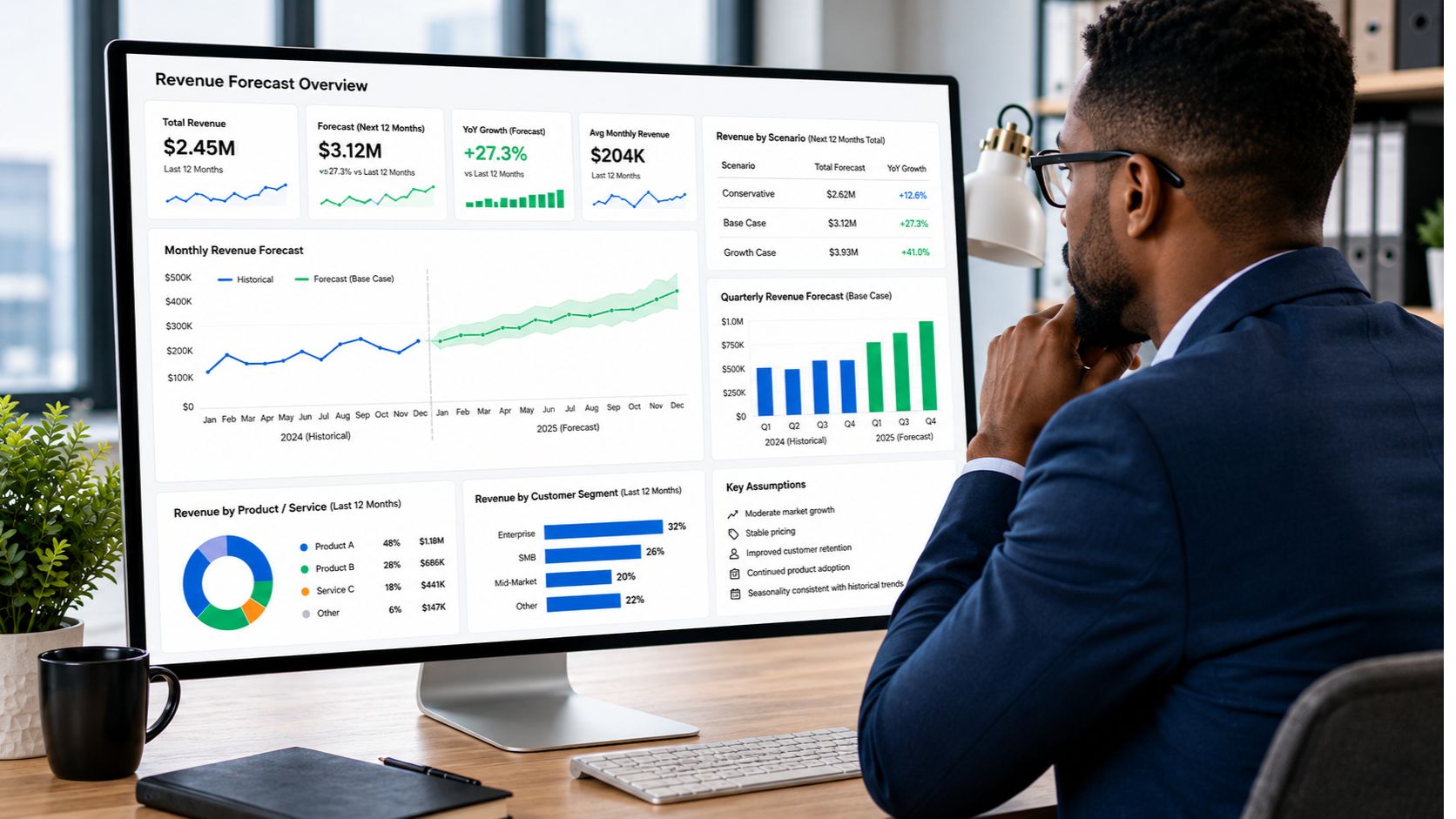
Past revenue tells you what happened. A clear revenue forecast helps you understand what may happen next. Many businesses track sales, invoices, subscriptions, transactions, and monthly revenue reports, but they still struggle to plan future income with confidence. Without a structured forecast, budgeting, hiring, marketing spend, investor updates, and growth planning can depend too much on guesswork.
The Revenue Forecasting Package is a focused catalogue package for businesses that need a clear revenue forecast, revenue trend review, or future revenue planning report without starting a large predictive analytics project. It helps you review historical revenue, sales patterns, subscription trends, product or service performance, customer segments, seasonality, and business assumptions.
At DataScienceConsultingPro.com, we help business owners, founders, executives, finance teams, revenue leaders, sales managers, SaaS companies, e-commerce brands, agencies, professional service firms, B2B companies, nonprofits, and subscription businesses prepare clearer revenue projections for planning and decision-making.
We can review revenue data from sales records, invoices, subscriptions, CRM exports, e-commerce orders, transaction files, accounting exports, spreadsheets, dashboard reports, and monthly financial summaries. The goal is to create a practical forecast that supports better planning, not to promise perfect future revenue. Forecasts depend on data quality, historical patterns, business assumptions, market conditions, and the forecasting method used.
Request a Revenue Forecasting Quote Now
What Is the Revenue Forecasting Package?
The Revenue Forecasting Package is a focused revenue projection package designed to help your team estimate likely future revenue using historical data, sales patterns, customer behavior, product performance, subscription activity, seasonality, and business assumptions.
This package may include historical revenue review, revenue trend analysis, seasonality review, product or service revenue breakdown, customer or segment revenue analysis, sales or subscription pattern review, forecast assumption review, monthly revenue projection, quarterly revenue forecast, annual revenue forecast, scenario-ready output, written interpretation, and practical recommendations.
A revenue forecast is not just a chart showing a line into the future. A useful forecast explains what data was reviewed, which patterns matter, what assumptions influence the projection, what limitations apply, and how leadership can use the forecast responsibly.
This package is designed for a defined scope. It is not an open-ended predictive analytics service, a full financial model, or a complete business plan. It is a practical, order-ready forecasting package for teams that need clearer future revenue visibility.
Who This Package Is For
The Revenue Forecasting Package is useful for businesses and teams that need better future revenue planning. Business owners can use it to understand expected income before making major decisions. Founders and startups can use it for investor updates, funding discussions, board reports, and growth planning.
Executives and finance teams can use this package for budgeting, hiring plans, cash flow conversations, resource planning, and management reviews. Revenue leaders and sales managers can use it to connect sales trends, pipeline expectations, and customer patterns to future revenue planning.
SaaS companies and subscription businesses can use the package to review recurring revenue patterns, renewals, upgrades, churn effects, and subscription growth. E-commerce brands can use it to forecast revenue from product sales, customer segments, order history, seasonality, and campaign periods. Agencies and professional service firms can use it to review client revenue, project pipeline, recurring contracts, and future income expectations.
What This Package Includes
Revenue Data Review
We begin by reviewing the revenue data you provide. This may include historical revenue reports, invoice files, sales records, subscription exports, transaction records, CRM files, e-commerce order data, accounting exports, spreadsheets, dashboard reports, or monthly financial summaries.
This review helps us understand the available time period, revenue structure, product or service categories, customer records, sales channels, and possible data limitations. If your revenue files are messy, duplicated, incomplete, or inconsistent, our Data Cleaning Services can support the preparation stage before forecasting begins.
Revenue KPI and Metric Review
Revenue forecasting works best when the revenue metric is clearly defined. We review the key revenue measure you want to forecast. This may include gross revenue, net revenue, recurring revenue, subscription revenue, product revenue, service revenue, collected revenue, booked revenue, or recognized revenue.
Clear definitions matter because different revenue measures can produce different forecasts. For example, invoice totals may not match collected revenue. Subscription revenue may behave differently from one-time sales. E-commerce revenue may need to account for refunds, discounts, shipping, or returns depending on the reporting goal.
Historical Revenue Trend Analysis
Historical revenue trend analysis shows how revenue has changed over time. We review monthly, quarterly, or annual revenue patterns to identify growth, decline, volatility, seasonality, and major shifts.
This helps reveal whether revenue is stable, accelerating, slowing, seasonal, concentrated in certain months, or dependent on specific products, customers, or channels. A strong forecast begins with a clear understanding of past revenue behavior.
Seasonality and Growth Pattern Review
Many businesses experience seasonal revenue changes. E-commerce revenue may rise during holiday periods. SaaS revenue may change around renewal cycles. Agencies may see revenue shifts based on project timing. Professional service firms may experience seasonal demand or contract cycles.
We review seasonality and growth patterns where the historical data supports it. This helps the forecast avoid treating every month as equal when the business clearly has repeating revenue cycles.
Product or Service Revenue Breakdown
Product or service revenue breakdown helps identify which offers drive income. Some businesses depend heavily on a few products, service lines, subscriptions, contracts, or customer groups. A forecast that ignores this structure may be too broad to be useful.
We can review product-level or service-level revenue where data is available. This helps show which revenue streams are growing, declining, stable, seasonal, or worth forecasting separately.
Customer or Segment Revenue Analysis
Customer and segment revenue analysis helps identify which customers, accounts, industries, regions, or buyer groups contribute most to revenue. This is especially useful for B2B companies, SaaS businesses, subscription companies, agencies, and professional service firms.
Customer segment review can reveal revenue concentration, repeat revenue, customer dependency, high-value groups, inactive accounts, and segments with growth potential.
Sales, Subscription, or Transaction Pattern Review
Revenue can come from many patterns. Sales-based revenue may depend on pipeline, deal size, and conversion. Subscription revenue may depend on renewals, churn, upgrades, downgrades, and new subscriptions. E-commerce revenue may depend on order volume, average order value, product demand, and repeat purchases.
We review the revenue pattern that matches your business model. This helps make the forecast more relevant and easier to interpret.
Forecasting Model or Projection Setup
We prepare a revenue projection based on the available data and agreed scope. This may include a simple trend forecast, monthly forecast, quarterly projection, annual revenue estimate, product-level forecast, subscription revenue forecast, or scenario-based projection.
The forecasting approach depends on the data quality, time period covered, business model, historical patterns, and forecasting question. For advanced forecasting models, our Predictive Analytics Services can support a deeper predictive scope.
Scenario or Assumption Review
Forecasts often depend on assumptions. We can review key assumptions such as growth rate, customer retention, subscription changes, sales pipeline expectations, pricing changes, seasonal demand, campaign periods, or product mix.
Scenario review helps leadership compare possible outcomes. For example, a forecast may include a base case, conservative case, and growth case where the data and scope support it.
Forecast Interpretation
A forecast should be understandable. We explain what the projection shows, which patterns influenced it, what assumptions matter, and what limitations should be considered.
This helps decision-makers use the forecast as a planning tool instead of treating it as a guarantee.
Revenue Forecast Report
The package can include a clear revenue forecast report. This may include historical trend summaries, forecast tables, visual charts, revenue drivers, scenario comparisons, assumptions, limitations, and recommendations.
The report is designed for practical use in budgeting, investor updates, board reporting, management meetings, hiring discussions, marketing spend planning, and growth reviews.
Optional Dashboard-Ready Forecast Output
If you need forecast results prepared for dashboarding, we can provide dashboard-ready forecast tables or structured output. For an interactive revenue forecast dashboard, our Dashboard Development Services can help present revenue projections, trends, and scenarios visually.
Popular Use Cases for This Package
| Use Case | Revenue Question | Package Output |
|---|---|---|
| Monthly revenue forecast | What revenue should we expect next month? | Monthly revenue projection |
| Quarterly revenue projection | What revenue should leadership plan for next quarter? | Quarterly forecast summary |
| Annual revenue planning | What annual revenue range should we prepare for? | Annual revenue forecast |
| SaaS subscription forecast | How might subscription revenue change? | Subscription revenue projection |
| E-commerce revenue forecast | What revenue may product sales generate? | E-commerce revenue forecast |
| Product-level forecast | Which products may drive future revenue? | Product revenue projection |
| Customer segment review | Which customer groups influence revenue most? | Segment revenue summary |
| Investor or board projection | What forecast should we present to stakeholders? | Executive forecast report |
| Budget planning forecast | What revenue assumptions should support budgeting? | Budget-ready revenue forecast |
| Marketing spend planning | What revenue expectations can guide spend? | Forecast and assumption summary |
| Hiring revenue planning | Can future revenue support staffing plans? | Hiring-support forecast summary |
| Scenario analysis | What happens under different assumptions? | Scenario comparison report |
Revenue Data We Can Review
| Data Source | What We Review | Possible Forecasting Insight |
|---|---|---|
| Historical revenue reports | Revenue by month, quarter, or year | Growth, decline, and seasonal patterns |
| Sales records | Sales value, dates, customers, products | Sales-driven revenue trends |
| Invoice data | Billed revenue, payment timing, clients | Revenue timing and customer concentration |
| Transaction data | Orders, payments, dates, amounts | Revenue volume and purchase patterns |
| Subscription data | Renewals, cancellations, upgrades, plans | Recurring revenue and churn effects |
| CRM exports | Pipeline, deals, account value, close dates | Pipeline-based revenue expectations |
| E-commerce order data | Product orders, cart value, sales dates | Product and seasonal revenue patterns |
| Product sales records | Product categories, units, revenue | Product-level revenue drivers |
| Customer databases | Customer value, segments, frequency | Segment-based revenue planning |
| Accounting exports | Revenue categories and financial records | Finance-ready revenue summaries |
| Monthly financial reports | Periodic revenue and performance metrics | Trend and planning review |
| Pipeline forecast files | Expected deals and probability estimates | Sales forecast comparison |
| Spreadsheet trackers | Manual revenue records | Structured revenue forecast input |
Deliverables You Can Request
| Deliverable | Best For |
|---|---|
| Revenue forecast report | Teams that need a clear written forecast |
| Monthly revenue projection | Businesses planning near-term income |
| Quarterly revenue forecast | Leadership preparing for quarterly planning |
| Annual revenue forecast | Founders and executives planning yearly targets |
| Revenue trend summary | Teams that need to understand historical performance |
| Product revenue forecast | Businesses with multiple products or services |
| Customer segment revenue summary | Teams reviewing high-value customer groups |
| SaaS subscription forecast | Subscription businesses reviewing recurring revenue |
| E-commerce revenue forecast | Online stores planning product revenue |
| Scenario comparison summary | Leaders comparing conservative, base, and growth cases |
| Forecast assumption notes | Teams that need transparent planning assumptions |
| Forecast-ready dataset | Analysts who need structured forecasting inputs |
| Dashboard-ready forecast output | Teams preparing visual forecast reporting |
| Executive revenue summary | Board, investor, or management reporting |
| Recommendations report | Teams that need practical next steps |
Benefits of the Revenue Forecasting Package
The Revenue Forecasting Package helps your team move from past reporting to future planning. It gives leaders a clearer view of expected revenue patterns and the assumptions behind those projections.
| Benefit | Business Impact |
|---|---|
| Better future revenue visibility | Helps leaders plan with clearer income expectations |
| Stronger budgeting support | Gives finance teams better revenue assumptions |
| Improved hiring and staffing planning | Helps evaluate whether future income can support expansion |
| Better marketing spend planning | Supports decisions about campaign budgets and timing |
| Clearer investor or board reporting | Provides structured revenue projections for stakeholders |
| Better understanding of revenue trends | Shows growth, decline, seasonality, and volatility |
| Better cash flow discussions | Supports planning conversations around expected income |
| Product or segment revenue clarity | Shows which revenue streams deserve attention |
| Reduced reliance on guesswork | Replaces informal estimates with data-supported projections |
| Better foundation for advanced analytics | Prepares the business for deeper predictive modeling |
How the Package Works
Step 1: Send Your Revenue Data and Forecasting Goal
You send your revenue data, historical reports, invoices, sales records, subscriptions, transaction files, or spreadsheets. You also explain what you want to forecast and why the forecast matters.
Step 2: We Review Data Structure and Available Time Periods
We review the available time range, revenue fields, customer or product categories, sales channels, and data quality. This helps us confirm what forecast is realistic.
Step 3: We Define Revenue Metrics and Forecast Scope
We clarify whether the forecast should focus on monthly revenue, quarterly revenue, annual revenue, product revenue, subscription revenue, e-commerce revenue, or scenario planning.
Step 4: We Prepare the Data for Forecasting
We organize the data enough to support the forecast. This may include checking dates, grouping revenue periods, standardizing categories, reviewing missing values, and preparing the forecast input table.
Step 5: We Analyze Trends, Seasonality, and Revenue Drivers
We review historical revenue behavior, seasonal patterns, product or service revenue, customer segments, sales patterns, subscription movement, and other drivers where data is available.
Step 6: We Prepare the Forecast and Scenario Outputs
We create the agreed revenue projection and scenario outputs where applicable. This may include tables, charts, written summaries, executive notes, or dashboard-ready files.
Step 7: We Explain Findings, Assumptions, and Limitations
We explain the forecast in plain language. We highlight key assumptions, data limitations, revenue patterns, and practical recommendations so your team can use the forecast responsibly.
Optional Add-Ons
This package is designed as a focused revenue forecasting project, but it can connect to broader analytics support when needed.
If your revenue, invoice, CRM, or transaction files are messy, Data Cleaning Services can help prepare them before forecasting.
If you need deeper forecasting models, demand prediction, churn modeling, or advanced predictive work, Predictive Analytics Services can support a broader predictive analytics scope.
If you want revenue projections presented in an interactive dashboard, Dashboard Development Services can help turn forecast outputs into visual reports.
If your business needs recurring revenue reporting, KPI tracking, and management dashboards, Business Intelligence Services can support a wider reporting setup.
If you need a deeper review of pipeline performance, sales team performance, and product sales patterns before forecasting, the Sales Performance Analytics Package can support that review.
For larger analytics planning, forecasting strategy, or end-to-end data support, DataScienceConsultingPro.com also provides Data Science Consulting Services.
When You Should Order This Package
You should order the Revenue Forecasting Package when revenue planning is based on guesswork, leadership needs a clearer revenue forecast, budgeting depends on uncertain future revenue, or investor and board reporting require structured projections.
It is also useful when sales and revenue trends are unclear, subscription revenue is hard to project, e-commerce revenue changes are difficult to explain, or marketing spend decisions need better revenue expectations.
This package can help when hiring plans depend on future income, cash flow discussions need better revenue assumptions, current reports only show the past, or you need a one-time forecast before a planning meeting.
What This Package Is Not
The Revenue Forecasting Package is not a guarantee of future revenue. Forecasts are planning tools, not promises. Actual revenue can change because of market shifts, pricing changes, customer behavior, sales execution, economic conditions, supply issues, competition, or other business factors.
This package is not a full financial model unless that is scoped separately. It is also not accounting, tax, or legal advice. It does not replace your finance team, accountant, or professional advisor.
The package can support business planning, budgeting, investor discussions, board reporting, and growth decisions by reducing guesswork and making assumptions clearer.
Why Choose DataScienceConsultingPro.com?
DataScienceConsultingPro.com provides revenue-focused forecasting support with a data science and analytics consulting background. We do not simply draw a trend line and call it a forecast. We review your revenue data, clarify the forecasting question, examine historical patterns, identify assumptions, prepare projection outputs, and explain what the forecast means.
Choose us when you need data quality review before forecasting, business-first forecast planning, practical assumption review, clear forecast interpretation, scenario-ready outputs where applicable, dashboard-ready outputs where needed, plain-language reporting, and clear package deliverables.
We handle business data professionally and use it only for the agreed package scope.
Request the Revenue Forecasting Package
Your past revenue should help you plan future income more clearly. If your current revenue planning depends too much on guesswork, scattered reports, or unclear assumptions, this package can help you create a more structured forecast.
Send us your revenue data type, historical period, sales or subscription files, main forecasting question, preferred forecast period, desired deliverable, and deadline. We will review the package scope and provide a clear quote based on your data condition, forecasting needs, deliverables, and timeline.
Request a Revenue Forecasting Quote Now
FAQs About the Revenue Forecasting Package
The Revenue Forecasting Package is a focused forecasting service that helps businesses estimate future revenue using historical revenue, sales patterns, customer data, product performance, subscription trends, seasonality, and business assumptions.
Business owners, founders, executives, finance teams, revenue leaders, sales managers, startups, SaaS companies, e-commerce brands, agencies, professional service firms, B2B companies, nonprofits, and subscription businesses can order this package.
You can provide historical revenue reports, sales records, invoice data, transaction files, subscription data, CRM exports, e-commerce orders, accounting exports, spreadsheets, or monthly financial reports.
Yes. We can prepare monthly revenue projections where the data supports monthly forecasting.
Yes. We can create quarterly or annual revenue projections depending on the available data, time period, and forecasting goal.
Yes. We can review SaaS subscription revenue, recurring revenue patterns, renewals, upgrades, downgrades, cancellations, and customer trends where data is available.
Yes. We can forecast e-commerce revenue using order history, product sales, customer segments, seasonal patterns, and transaction data where available.
Yes. Product-level forecasts can be included where your data separates revenue by product, service, category, or offer.
Yes. We can prepare scenario-based forecasts, such as conservative, base, and growth cases, where the data and project scope support it.
Yes. We can prepare data enough for the package scope. If the data needs extensive cleaning, we may recommend a separate data cleaning scope.
No. A revenue forecast is not a guarantee. It is a planning tool based on historical data, assumptions, patterns, and available information. Actual revenue can change.
You can request a revenue forecast report, monthly projection, quarterly forecast, annual forecast, revenue trend summary, scenario comparison, forecast assumption notes, dashboard-ready output, or executive revenue summary.
The timeline depends on data size, data quality, historical period, number of revenue sources, forecast period, scenario requirements, and deliverables.
The cost depends on the data condition, number of files, forecasting complexity, required outputs, scenario needs, documentation, and turnaround time.
Yes. We handle business revenue data professionally and use it only for the agreed package scope.
