
How to Build Reliable Data for Better Business Decisions
Most companies are not short of data. They collect information from CRM systems, ERP platforms, sales software, finance tools, customer databases, websites, marketing platforms, inventory systems, spreadsheets, and operational reports. However, having more data does not automatically lead to better decisions.
The real issue is whether that data can be trusted.
When business data is incomplete, duplicated, outdated, inconsistent, or poorly structured, every decision built on it becomes weaker. Dashboards become unreliable, forecasts become unstable, customer reports become misleading, and executive teams begin questioning the numbers. Employees spend more time correcting spreadsheets than using insights to improve the business.
That is why data quality management is essential. It helps companies assess, clean, standardize, validate, monitor, and improve their data so it becomes reliable for reporting, dashboards, business intelligence, predictive analytics, forecasting, and AI initiatives.
At DataScienceConsultingPro, we help businesses turn messy, fragmented, and unreliable data into trusted information that supports faster, clearer, and more confident decisions. Whether your company needs a one-time data quality audit, CRM cleanup, dashboard-ready data preparation, Power BI data modeling, predictive analytics readiness, or an ongoing data quality management system, our team can help you build a stronger data foundation.
What Is Data Quality Management?
Data quality management is the process of making sure business data is accurate, complete, consistent, valid, timely, unique, relevant, and usable for decision-making. In simple terms, it helps your company answer one important question: can we trust this data?
A strong data quality management process usually includes data assessment, data profiling, data cleaning, duplicate removal, data standardization, validation rule creation, KPI consistency checks, documentation, ownership assignment, and ongoing monitoring. These steps help ensure that data is not only cleaned once, but also managed properly over time.
For example, a sales team may have the same customer recorded under three different names in the CRM, invoicing system, and support platform. One system may use “ABC Limited,” another may use “ABC Ltd,” and another may use “A.B.C. Company.” Without data quality management, customer counts, revenue reports, retention analysis, and segmentation dashboards may all become inaccurate.
Data quality management identifies these issues, fixes them, creates standard rules, and helps prevent the same errors from returning. It is not just a technical process. It is a business discipline that protects reporting quality, leadership confidence, forecasting accuracy, customer understanding, and operational performance.
Why Data Quality Management Matters for Business
Poor data quality affects almost every part of a business. A company may invest in Power BI dashboards, Tableau reports, CRM platforms, forecasting models, AI tools, or business intelligence systems, but if the underlying data is poor, the outputs will still be unreliable.
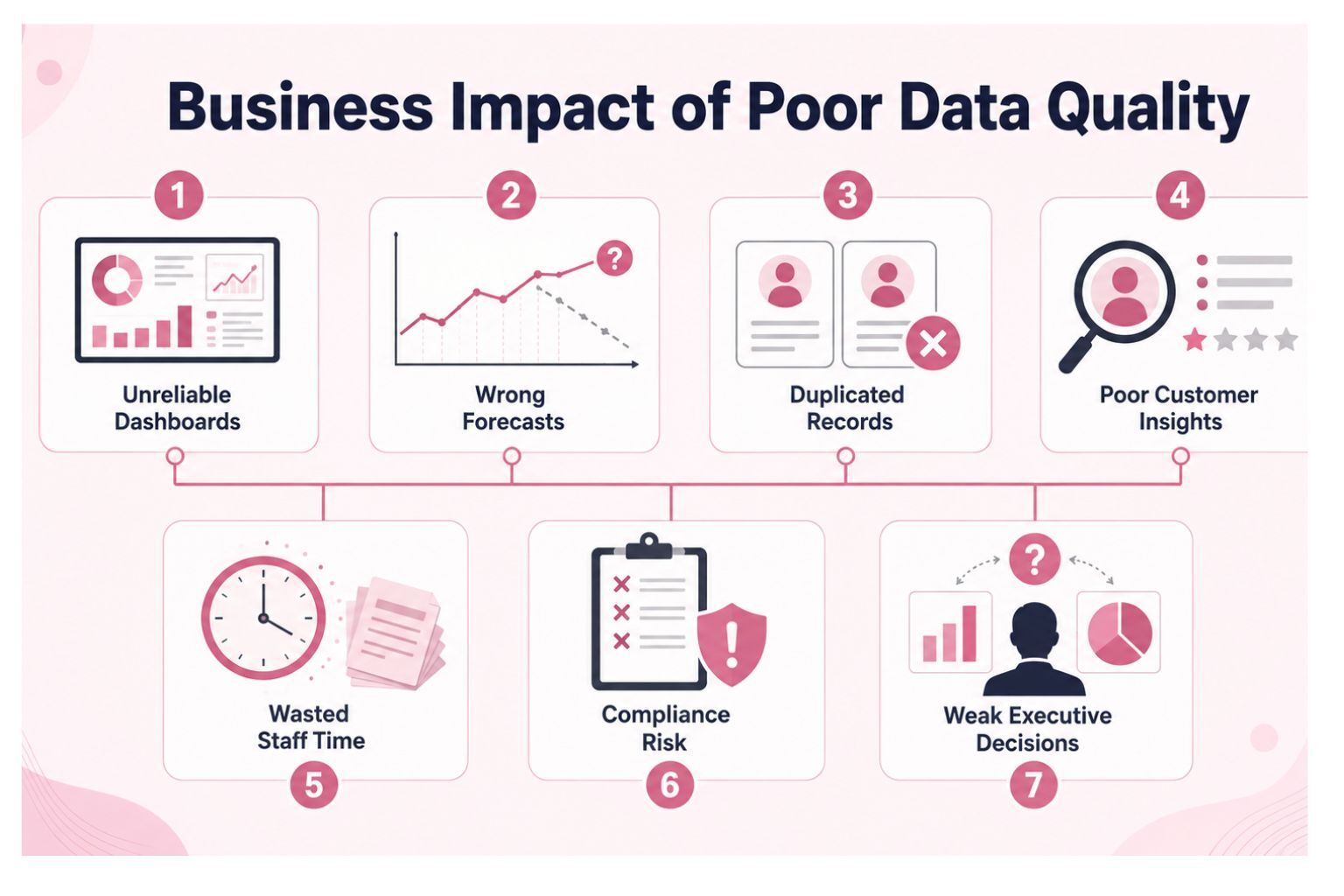
Bad data can create wrong executive reports, conflicting KPI results, inaccurate revenue forecasts, failed dashboard projects, duplicate customer records, weak customer segmentation, unreliable AI outputs, compliance risks, wasted staff time, and low trust in analytics. These problems slow decision-making and make leadership less confident in the reports they receive.
For example, if sales data contains duplicate transactions, a dashboard may overstate revenue. If customer cancellation dates are missing, a churn report may understate customer loss. If product names are inconsistent, inventory reports may split the same product into several categories. These are not small technical mistakes. They affect real business decisions.
Reliable data gives leaders a clearer view of performance. It helps teams compare results, understand trends, identify risks, measure customer behavior, and make decisions based on evidence rather than assumptions. If unreliable reports, messy spreadsheets, or inconsistent dashboards are slowing your team down, Data Analysis Services from DataScienceConsultingPro can help turn unreliable data into clear, decision-ready insight.
The Real Cost of Poor Data Quality
Poor data quality costs businesses time, money, confidence, and opportunity. When teams cannot trust the data, they delay decisions. When reports disagree, managers spend time debating numbers instead of solving problems. When dashboards are wrong, leadership loses confidence in analytics. When CRM records are duplicated, marketing campaigns become wasteful and customer experience suffers.
The cost of poor data quality is not always visible at first. It may appear as slow reporting, inconsistent monthly numbers, failed dashboard adoption, unreliable forecasts, or repeated manual cleanup. Over time, these issues affect budgeting, sales planning, customer retention, inventory management, marketing performance, and executive decision-making.
| Problem | Business Cost | Example | How Data Quality Management Helps |
|---|---|---|---|
| Duplicate customers | Inflated customer count and poor segmentation | The same buyer appears three times in the CRM | Deduplication and master record rules |
| Missing sales fields | Weak forecasting and incomplete reporting | Product, region, or channel is missing from sales records | Required fields and validation checks |
| Conflicting KPIs | Poor executive trust | Finance and sales report different revenue totals | KPI governance and source alignment |
| Outdated records | Poor campaign targeting | Emails are sent to inactive contacts | Data refresh rules and CRM cleanup |
| Inconsistent formats | Broken dashboards and reporting errors | Dates appear in different formats across files | Standardization rules |
| Manual spreadsheet errors | Slow reporting and wrong analysis | Formulas break during monthly reporting | Automated checks and structured workflows |
The longer data quality problems remain unresolved, the harder they become to fix. A small CRM issue can grow into a reporting problem. A reporting problem can become a forecasting issue. A forecasting issue can affect budgeting, hiring, purchasing, marketing, and strategy.
That is why data quality management should be treated as a business priority, not only an IT task.
Common Data Quality Problems Companies Face
Most data quality problems begin quietly. They often appear as small reporting issues, dashboard mismatches, duplicate names, missing fields, or inconsistent spreadsheets. Over time, these small issues affect larger business decisions.
One common problem is missing values. Important fields such as customer email, product category, transaction date, region, or sales channel may be blank. When this happens, reports become incomplete and analysis becomes less reliable. A sales report may fail to show regional performance because region data was not captured properly.
Duplicate records are another major issue. The same customer, product, supplier, or transaction may appear more than once. This can inflate customer counts, distort revenue reports, confuse segmentation, and create poor marketing decisions. Duplicate data also makes it harder for teams to know which record is correct.
Inconsistent names and formats also create major problems. Different teams may use different names for the same customer, product, campaign, or location. Dates, currencies, IDs, phone numbers, and categories may be formatted differently across systems, making it harder to combine data correctly.
Outdated records, invalid entries, conflicting data across systems, poorly defined KPIs, incomplete customer profiles, manual spreadsheet errors, unclear data ownership, broken data pipelines, weak metadata documentation, and unclear reporting logic can all damage business reporting.
DataScienceConsultingPro helps businesses identify these problems, clean the data, document the rules, and build better reporting foundations.
Signs Your Business Needs Data Quality Management
Your business may need data quality management if you regularly experience reporting confusion, dashboard errors, or manual cleanup problems. A common warning sign is when dashboards do not match spreadsheet reports or different departments report different numbers.
Another sign is when your CRM has duplicate or incomplete customer records. This affects sales reporting, marketing campaigns, customer segmentation, and retention analysis. If reports take too long to prepare manually, it may also mean your data is not structured well enough for repeatable reporting.
You may need data quality management if:
- Your dashboards do not match spreadsheet reports.
- Different departments report different numbers.
- Your CRM has duplicate or incomplete customer records.
- Reports take too long to prepare manually.
- Leaders do not trust analytics outputs.
- Power BI or Tableau dashboards keep breaking.
- Customer segmentation is unreliable.
- Employees spend more time cleaning data than analyzing it.
If several of these issues sound familiar, your company does not only need another dashboard. It needs better data quality management. Request a consultation through Contact DataScienceConsultingPro and let our team review your data challenges.
The Core Dimensions of Data Quality
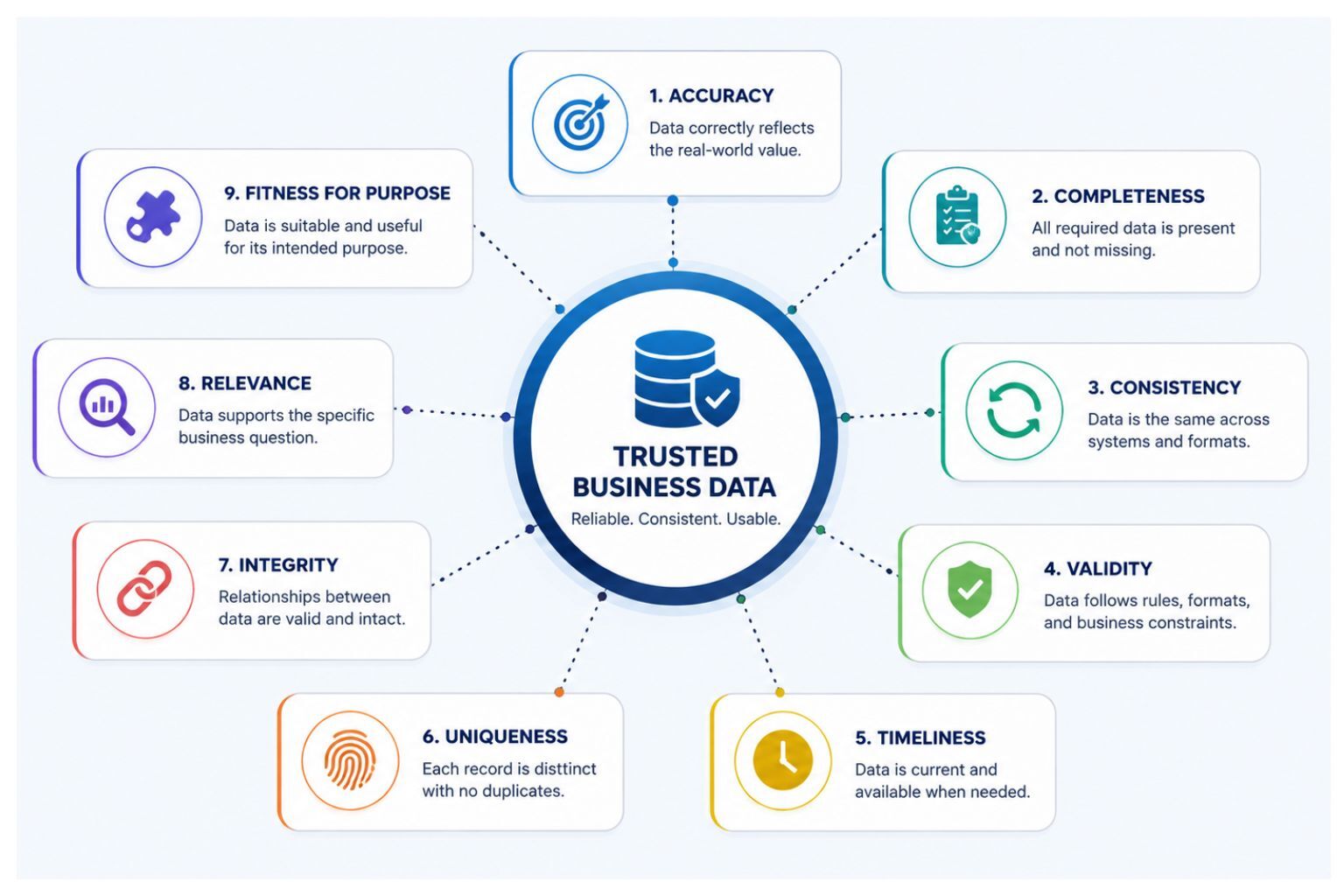
Data quality is usually measured through several dimensions. These dimensions help businesses understand whether data is reliable enough for reporting, dashboards, forecasting, AI, and decision-making.
A dataset may look complete at first glance, but it may still have hidden problems. For example, customer records may be filled in, but the addresses may be outdated. Sales values may be present, but some may be duplicated. Product names may be available, but different departments may use different naming formats. Data quality dimensions help identify these problems in a structured way.
| Data Quality Dimension | What It Means | Business Example | Risk If Ignored |
|---|---|---|---|
| Accuracy | Data correctly reflects the real-world value | Customer address is correct | Wrong delivery, billing, or customer analysis |
| Completeness | Required fields are filled | Every sales record has product, date, region, and value | Incomplete reports and weak forecasting |
| Consistency | Data is the same across systems | CRM and finance use the same customer ID | Conflicting reports |
| Validity | Data follows accepted rules and formats | Email fields contain valid email formats | Failed communication and poor automation |
| Timeliness | Data is current and updated when needed | Inventory data reflects current stock levels | Wrong planning and delayed decisions |
| Uniqueness | Records are not duplicated | One customer has one master record | Inflated counts and duplicate communication |
| Integrity | Relationships between datasets are correct | Customer ID links correctly to orders | Broken analysis and unreliable joins |
| Relevance | Data supports the business question | Sales channel is captured for revenue analysis | Reports that do not answer decision needs |
| Fitness for purpose | Data is usable for its intended goal | Historical sales data is suitable for forecasting | Weak models and misleading outputs |
Data Quality Management Framework
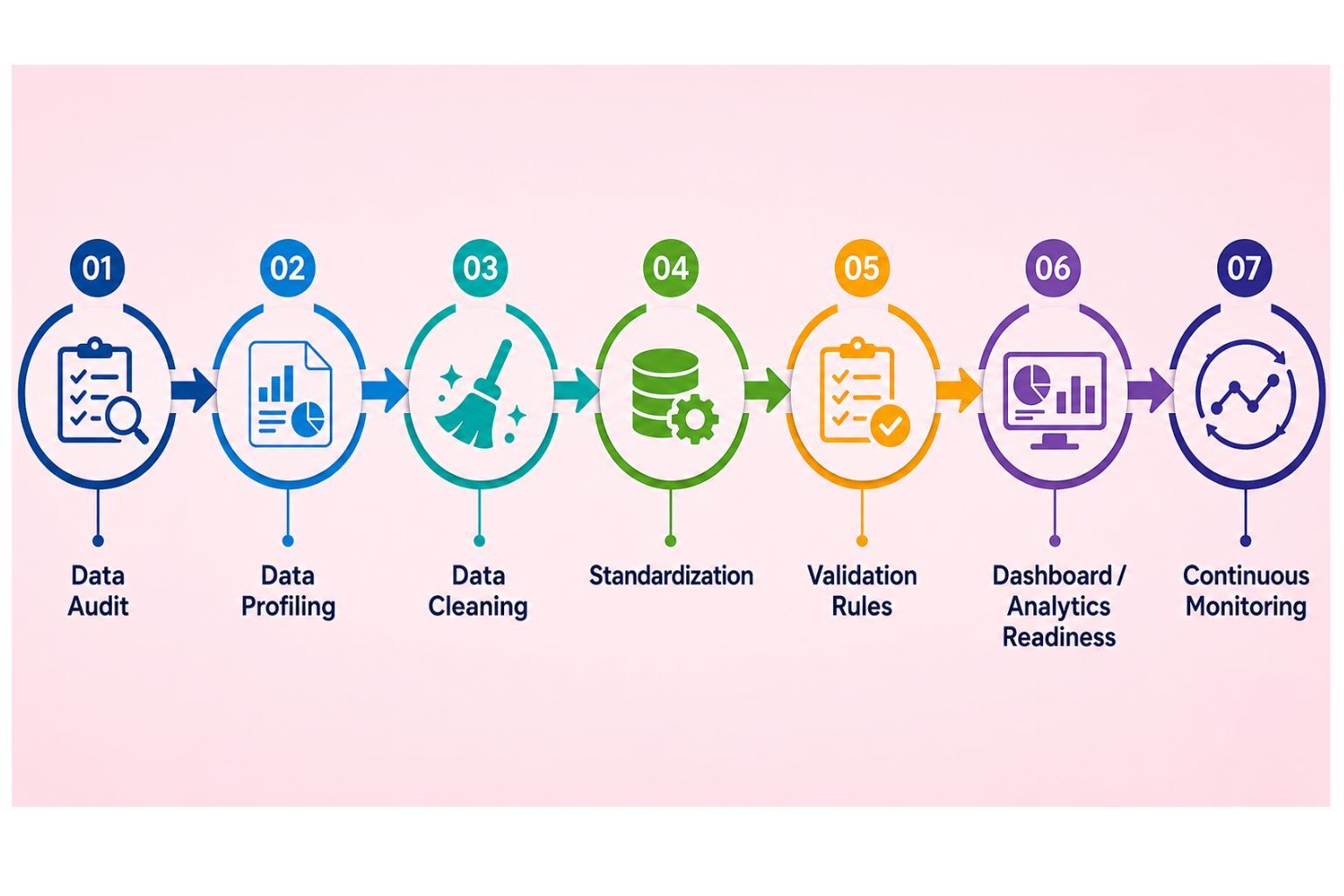
A strong data quality management framework gives your business a repeatable process for improving and maintaining trusted data. The framework should not only clean old data. It should also reduce future errors.
The first step is to define business goals and critical data assets. Your team should identify the reports, dashboards, systems, and decisions that matter most. These may include sales performance reports, customer retention dashboards, revenue forecasting models, inventory reports, finance dashboards, marketing ROI reports, executive KPI dashboards, and CRM customer records.
The second step is to identify systems and data sources. Business data may come from Excel files, CRM systems, ERP platforms, finance software, website analytics, marketing platforms, sales tools, inventory systems, customer support platforms, cloud databases, or SQL databases. Many data quality issues happen because different systems store the same information differently.
The third step is to audit current datasets and reporting workflows. A data audit reviews what is missing, duplicated, inconsistent, outdated, or unclear. This gives the business a clear picture of where reporting problems begin.
After the audit, the data should be profiled for quality issues. Data profiling checks missing values, duplicate records, formats, ranges, outliers, category consistency, and relationships between tables. This helps identify the exact problems affecting analysis and reporting.
The next step is to define data quality rules. For example, every customer should have a unique customer ID, every transaction should have a valid date, every sales record should include product, region, and amount, and campaign names should follow a standard naming convention.
Once the rules are clear, the data can be cleaned and standardized. This may include removing duplicates, fixing date formats, standardizing product names, correcting category labels, cleaning customer records, formatting phone numbers and emails, aligning region names, and preparing files for dashboards or analysis.
Finally, the business should assign data owners, document transformation rules, and monitor data quality continuously. This helps prevent the same errors from returning and gives teams a clear process for maintaining trusted data.
For one-time cleanup or recurring preparation, DataScienceConsultingPro offers Data Cleaning Services for business datasets, spreadsheets, CRM exports, dashboard files, and analysis-ready data.
Data Quality Assessment: How to Know Whether Your Data Can Be Trusted
A data quality assessment helps your company understand whether current datasets are ready for reporting, dashboards, forecasting, or AI. It gives your team a clear view of the problems inside your data before those problems damage decision-making.
A strong assessment reviews dataset structure, missing values, duplicate records, invalid formats, outliers, KPI consistency, data lineage, reporting logic, dashboard readiness, forecasting readiness, AI readiness, and documentation quality. The goal is not only to find errors, but also to understand how those errors affect business decisions.
| Data Quality Issue | How to Detect It | Business Risk | Recommended Fix |
|---|---|---|---|
| Missing customer emails | Count blank email fields | Weak marketing and communication | Required field rules and CRM cleanup |
| Duplicate invoices | Match invoice ID, customer, date, and amount | Inflated revenue | Duplicate detection and invoice validation |
| Inconsistent product names | Compare product categories and spelling | Wrong product performance reports | Product master list |
| Invalid dates | Check date formats and impossible dates | Broken trend analysis | Date validation rules |
| Conflicting revenue totals | Compare finance and sales reports | Low executive trust | KPI definition and source alignment |
| Outdated customer records | Review activity dates | Poor targeting | Data refresh and archive rules |
| Broken relationships | Check unmatched IDs between tables | Incomplete analysis | Referential integrity checks |
Before building dashboards or analytics models, companies should confirm that the underlying data is clean, complete, and structured correctly. This is why many clients start with Data Cleaning Services before moving into reporting, forecasting, or predictive analytics.
Data Quality Management for Dashboards and Business Intelligence
Dashboards are only useful when people trust the numbers. If a Power BI, Tableau, Looker Studio, or Excel dashboard shows inconsistent results, users quickly lose confidence. They may return to manual spreadsheets or create separate reports, which increases confusion.
Data quality management improves dashboard reliability by ensuring that data sources are correct, fields are complete, KPIs are defined consistently, duplicate records are removed, date formats are standardized, relationships between tables work properly, filters behave as expected, refreshes do not introduce errors, and reports match approved business logic.
For example, a sales dashboard may overstate revenue because duplicate transactions were counted. A customer dashboard may show wrong retention rates because cancellation dates are missing. A finance dashboard may produce conflicting monthly totals because date formats differ. A marketing dashboard may misreport campaign ROI because campaign names are inconsistent.
If your company is preparing to build a reporting system, DataScienceConsultingPro can help through Dashboard Development Services, Power BI Dashboard Services,, and Business Intelligence Services.
Data Quality Management for Predictive Analytics, Forecasting, and AI
Predictive analytics and AI depend heavily on data quality. A model can only learn from the data it receives. If historical data is incomplete, duplicated, biased, outdated, or poorly structured, the model may produce weak or misleading predictions.
This matters for sales forecasting, demand forecasting, revenue forecasting, churn prediction, fraud detection, customer segmentation, recommendation systems, predictive maintenance, AI reporting automation, and machine learning model accuracy. Poor data quality can lead to wrong predictions, biased results, and low confidence in automated decisions.
For example, a churn prediction model may fail if cancellation dates are missing. A revenue forecast may become unstable if historical sales records contain duplicates. A fraud detection model may miss risks if transaction labels are inconsistent.
Before investing in AI or machine learning, companies should first assess whether their data is ready. DataScienceConsultingPro supports businesses with Predictive Analytics Services and Machine Learning Services that include data preparation, validation, modeling readiness review, and business-focused interpretation.
Data Quality Management Tools and Technologies
There is no single best tool for every data quality project. The right technology depends on your data volume, number of systems, reporting needs, budget, team skills, compliance requirements, and whether you need one-time cleanup or ongoing monitoring.
Excel can be useful for smaller datasets, quick checks, manual review, and business-team validation. SQL is useful for structured databases because it can detect missing values, duplicate records, unmatched IDs, invalid dates, and inconsistencies across tables. Python is useful for larger datasets, repeatable cleaning workflows, automated profiling, statistical checks, and advanced preparation for analytics or machine learning.
Power BI can support data transformation, data modeling, relationship checks, KPI logic, and dashboard-ready reporting structures. ETL and ELT tools help move, transform, and prepare data from multiple sources, while cloud data warehouses support centralized data storage and enterprise reporting.
For more mature data environments, businesses may need data governance platforms, data observability tools, or master data management systems. These tools help monitor data pipelines, manage metadata, improve data ownership, and maintain consistent customer, product, supplier, location, or employee records across systems.
DataScienceConsultingPro selects tools based on the client’s current systems, business needs, reporting goals, and long-term analytics maturity.
Data Quality Management Services
DataScienceConsultingPro provides data quality management services for companies that need cleaner, more reliable, and more usable business data. Our services can support one-time projects, dashboard preparation, CRM cleanup, analytics readiness, BI improvement, or ongoing data quality management.
Typical deliverables may include a data quality audit, data profiling, duplicate removal, data standardization, validation rules, missing value review, KPI consistency review, dashboard data preparation, forecasting data preparation, AI-readiness review, data governance support, data monitoring setup, documentation, reporting workflow improvement, and executive-ready findings.
Our team combines technical data preparation with business interpretation. We do not only clean files. We help you understand what the issues mean, how they affect decisions, and how to prevent them from returning.
For broader support, explore our Data Science Consulting Services and Data Analysis Services.
What You Receive After a Data Quality Management Project
A data quality project should leave your business with more than a cleaned file. It should give your team a clearer understanding of what was wrong, what was corrected, how the data should be used, and how to reduce future errors.
Depending on the scope, you may receive cleaned datasets, a data quality issue report, duplicate record summary, missing value summary, standardized fields, validation rules, dashboard-ready data models, KPI definition documents, data cleaning documentation, recommendations for long-term monitoring, and an executive summary.
The goal is to leave your team with better data, clearer documentation, stronger reporting logic, and a practical path for ongoing improvement.
Data Quality Management Pricing
Data quality management pricing depends on the size of your dataset, number of data sources, complexity, number of fields, level of cleaning required, dashboard requirements, automation needs, and whether ongoing monitoring is included.
| Package | Best For | Typical Scope | Starting Price |
|---|---|---|---|
| Data Quality Audit | Companies unsure why reports are unreliable | Review datasets, identify quality issues, check missing values, duplicates, structure, and KPI consistency, then provide recommendations | From $300 |
| Data Cleaning & Standardization | Businesses with messy spreadsheets, CRM exports, sales files, or operational data | Clean records, fix formats, remove duplicates, standardize fields, prepare analysis-ready data | From $500 |
| Dashboard-Ready Data Preparation | Teams preparing data for Power BI, Tableau, Looker Studio, or Excel dashboards | Clean data model, KPI logic, validation checks, dashboard-ready structure, reporting consistency review | From $750 |
| Predictive Analytics Data Preparation | Companies preparing data for forecasting, churn prediction, segmentation, or machine learning | Clean historical data, validate key variables, handle missing values, review modeling readiness | From $900 |
| Data Quality Management System | Growing businesses needing repeatable quality control | Rules, monitoring checks, documentation, reporting workflow, data governance support | Custom quote |
| Enterprise Data Quality Consulting | Multi-source, multi-department, or high-volume data environments | Data audit, quality framework, governance support, automation, monitoring, documentation, and stakeholder reporting | Custom quote |
Request a data quality consultation through Contact DataScienceConsultingPro and let our team review your current data challenges.
Data Quality Management for Small Businesses vs Enterprises
Data quality management should match the size and complexity of the business. A small business may need help cleaning spreadsheets, standardizing CRM exports, removing duplicates, and preparing data for monthly reports. A larger enterprise may need a formal data quality framework, data ownership model, automated monitoring, governance workflows, and master data management.
For small businesses, the priority is often speed, clarity, and practical cleanup. These companies usually need clean sales files, organized customer records, simple validation rules, and dashboard-ready data. For mid-size companies, the challenge is often consistency across teams. Different departments may use different KPI definitions, reporting templates, or data sources.
Enterprise environments are more complex because data may come from many systems, departments, regions, and business units. In those cases, data quality management may require data stewardship, metadata documentation, data lineage, cloud analytics checks, automated monitoring, and governance support.
DataScienceConsultingPro supports both one-time cleanup projects and larger data quality management initiatives.
When to Hire a Data Quality Consultant
You should consider hiring a data quality consultant when internal teams are spending too much time fixing data instead of using it. If monthly reports require repeated manual cleanup, dashboards are not trusted, or CRM records are too messy for reliable customer analysis, outside support can help bring structure and speed.
A consultant is also useful when your business is preparing for a major reporting, BI, forecasting, or AI project. These projects depend heavily on clean and reliable data. If the data is not ready, the project may take longer, cost more, or produce weak results.
DataScienceConsultingPro can help assess the current state of your data, identify the most important issues, clean and standardize records, document business rules, and prepare the data for dashboards, forecasting, or machine learning.
Why Choose DataScienceConsultingPro for Data Quality Management?
DataScienceConsultingPro helps businesses improve data quality with a practical, business-first approach. We focus on making data useful for decisions, not only technically clean.
Our team understands that business leaders need clear reports, trusted dashboards, reliable forecasts, and practical recommendations. That is why our data quality work connects technical cleanup with business interpretation. We help clients understand what the data problems mean, how they affect decisions, and what should be fixed first.
We support projects involving Excel, SQL, Python, Power BI, CRM exports, ERP data, dashboard data models, and business reporting workflows. Our deliverables are clear, secure, and designed for real business use. Whether you need a small dataset cleaned or a broader data quality management process, we can help you move toward more reliable analytics.
Industries We Support
Data quality problems affect every industry, but the risks vary depending on the business model. Retail companies may struggle with inconsistent product names, duplicate sales records, and unreliable inventory reports. Finance teams may need cleaner transaction data, stronger audit readiness, and consistent executive reporting.
Healthcare organizations may need better operational, appointment, staffing, or patient-flow data for planning and reporting. SaaS companies often need reliable customer activity data for churn analysis, cohort reporting, and account health scoring. E-commerce businesses depend on clean product, customer, order, and marketing data for conversion analysis and demand planning.
We also support logistics, manufacturing, education, real estate, professional services, nonprofits, marketing agencies, construction companies, and telecommunications businesses. In every case, the goal is the same: make data more reliable, usable, and decision-ready.
Data Quality Management Use Cases
Data quality management can support many business needs. A company may need CRM data cleaned before customer segmentation, sales data prepared for forecasting, finance data standardized for executive dashboards, or marketing campaign data validated before ROI reporting.
It can also help remove duplicate customer records, improve inventory reporting accuracy, prepare data for machine learning, build trusted Power BI dashboards, align finance and sales revenue definitions, clean customer support data for churn analysis, and prepare e-commerce data for product analytics.
Data Quality Management vs Data Governance
Data quality management and data governance are closely related, but they are not the same. Data quality management focuses on whether data is accurate, complete, consistent, valid, timely, unique, and usable. Data governance defines the policies, ownership, accountability, access, standards, stewardship, metadata, and long-term control for data.
In simple terms, data governance sets the rules, while data quality management checks whether the data meets those rules. A company needs both. Governance without quality checks can become policy without action. Data quality without governance can become repeated cleanup without long-term control.
For example, data governance may define who owns customer data and what fields are required. Data quality management checks whether customer records actually follow those rules. When both work together, the business gains better control, stronger accountability, and more trusted reporting.
Data Quality Management vs Data Cleaning
Data cleaning is part of data quality management, but data quality management is broader. Data cleaning fixes current issues, while data quality management prevents, monitors, documents, and improves quality over time.
For example, data cleaning removes duplicate customers, but data quality management creates rules to prevent duplicates from returning. Data cleaning fixes date formats, but data quality management standardizes how dates should be captured in future systems. Data cleaning corrects inconsistent product names, but data quality management creates a product master list and naming rules.
If your business only cleans data once, the same problems may return. Data quality management creates a stronger process for maintaining trusted data.
How to Start Improving Data Quality
The best way to start improving data quality is to focus on the data that affects the most important business decisions. You do not need to fix every dataset at once. Start with the reports, dashboards, and systems that leadership uses most often.
Begin by identifying your most important business reports and listing the data sources feeding those reports. Then check for duplicates, missing values, inconsistent names, unclear KPI definitions, and source-to-dashboard mismatches. Once the main issues are clear, your team can standardize fields, document rules, assign owners, and build recurring checks.
A practical approach is better than a complicated plan that never gets implemented. Start with the data that affects revenue, customers, costs, compliance, or executive decisions.
How DataScienceConsultingPro Can Help
DataScienceConsultingPro helps companies audit, clean, standardize, validate, document, and monitor business data so it becomes reliable for dashboards, reporting, forecasting, analytics, and AI initiatives.
We can support your business with data quality audits, CRM cleanup, spreadsheet standardization, dashboard data preparation, Power BI data modeling, KPI consistency review, forecasting data preparation, AI readiness review, data documentation, and executive reporting improvement.
Whether your company needs a one-time cleanup or a repeatable data quality management process, our team can help you move from unreliable data to trusted business insight.
Frequently Asked Questions About Data Quality Management
Data quality management is the process of assessing, cleaning, validating, standardizing, monitoring, and improving business data so it can be trusted for reporting, dashboards, analytics, forecasting, AI, and decision-making.
Data quality management is important because poor data leads to unreliable reports, weak dashboards, inaccurate forecasts, duplicate records, poor customer insights, wasted staff time, and low trust in business decisions.
The main dimensions of data quality include accuracy, completeness, consistency, validity, timeliness, uniqueness, integrity, relevance, and fitness for purpose. These dimensions help businesses understand whether their data is reliable enough for reporting, dashboards, forecasting, AI, and decision-making.
Businesses measure data quality by checking missing values, duplicate records, invalid formats, inconsistent categories, outdated records, conflicting information across systems, broken relationships, KPI consistency, and dashboard readiness.
Data quality management focuses on improving the reliability and usability of data. Data governance defines the policies, ownership, access, standards, stewardship, and accountability for managing data across the organization.
Data cleaning fixes existing data problems. Data quality management is broader because it includes assessment, cleaning, standardization, validation, monitoring, documentation, ownership, and long-term improvement.
Data quality management services can start from around $300 for a basic data quality audit, $500 for data cleaning and standardization, $750 for dashboard-ready data preparation, and $900 for predictive analytics data preparation. Larger or multi-source projects may require a custom quote.
Yes. DataScienceConsultingPro can clean, standardize, validate, and prepare data before analysis, dashboard development, Power BI reporting, predictive analytics, or machine learning projects.
Conclusion
Data quality management is not only a technical process. It is a business discipline that protects decision-making, improves reporting, strengthens forecasting, supports AI readiness, and builds trust in dashboards and analytics.
When your data is unreliable, every report becomes questionable. Every dashboard becomes less useful. Every forecast becomes weaker. Every business decision carries more risk.
But when your data is clean, consistent, validated, and well-managed, your team can move faster. Leaders can trust reports. Analysts can focus on insight instead of cleanup. Dashboards become more useful. Forecasts become stronger. AI and machine learning projects have a better foundation.
If your reports, dashboards, CRM exports, spreadsheets, or analytics projects are affected by poor data quality, DataScienceConsultingPro can help.
Request a consultation today and turn unreliable data into trusted business insight.
