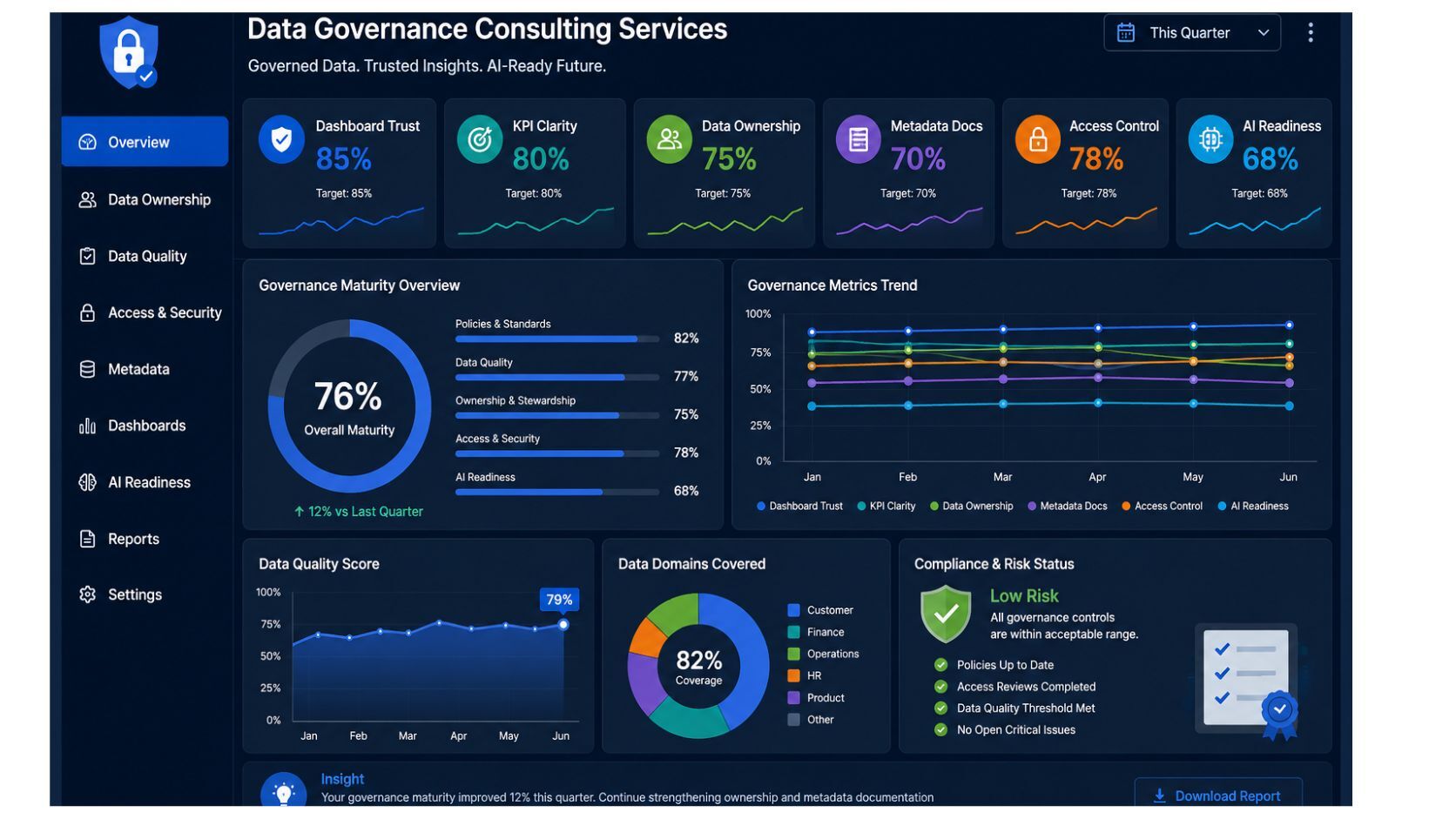
DataScienceConsultingPro.com provides data governance consulting services that help organizations turn messy, scattered, duplicated, and unreliable data into trusted business information.
If your data is spread across spreadsheets, CRMs, dashboards, databases, cloud platforms, marketing systems, financial systems, and operational tools, but your team still struggles to trust the numbers, your business may need a stronger data governance framework.
Many companies collect data every day, but collecting data is not the same as managing it properly. Without clear data ownership, data quality rules, access controls, documentation standards, KPI definitions, metadata management, and reporting governance, your organization can end up with conflicting dashboards, duplicate customer records, compliance risks, weak analytics, and poor AI readiness.
At DataScienceConsultingPro.com, we help businesses build practical data governance frameworks, data policies, ownership models, stewardship processes, data quality standards, access guidelines, metadata documentation, business glossaries, dashboard governance rules, and data governance roadmaps that support better reporting, analytics, compliance, and decision-making.
Request a Data Governance Proposal
When Your Business Needs Data Governance Consulting Services
Build Trusted Data for Reporting, Compliance and AI
Describe your data-quality, ownership or governance challenge and receive a practical recommendation for the next step.
Your business may already have dashboards, databases, reports, spreadsheets, analytics tools, and cloud systems. However, those tools cannot produce reliable insights if the data behind them is inconsistent, duplicated, poorly documented, or owned by no one.
You may need data governance consulting services if your teams are spending more time debating the numbers than using the numbers to make business decisions.
| Warning Sign | What It Usually Means | Business Risk |
|---|---|---|
| Different departments report different numbers | KPI definitions are inconsistent | Leaders lose trust in reports |
| Executives do not trust dashboards | Reporting logic is unclear | Decisions are delayed |
| No one owns key data | Accountability is missing | Data issues remain unresolved |
| Customer records are duplicated | Master data is not governed | Marketing, sales, and service teams use poor data |
| Reports take too long to prepare | Manual reporting is too dependent on spreadsheets | Teams waste time every month |
| AI projects are blocked | Data is not clean, documented, or reliable | AI and analytics initiatives underperform |
| Sensitive data access is unclear | Access controls are weak | Compliance and privacy risks increase |
Common signs your business needs data governance include:
- Different departments report different numbers for the same metric.
- Executives do not fully trust dashboards or reports.
- Sales, finance, operations, and marketing teams define KPIs differently.
- No one knows who owns important business data.
- Data definitions are inconsistent across teams.
- Reports take too long to prepare manually.
- Customer, product, vendor, or financial records contain duplicates.
- Important data fields are missing, outdated, or formatted inconsistently.
- Data access is either too restricted or too open.
- Compliance, privacy, or security risks are increasing.
- AI and machine learning projects are blocked by poor data quality.
- Teams rely heavily on spreadsheets because source systems are not trusted.
- There is no clear process for approving, changing, or documenting data.
- Your company does not have a reliable single source of truth.
When these problems continue, they create hidden costs. Teams waste time cleaning the same data repeatedly, leaders lose confidence in reports, and advanced analytics projects become harder to launch.
Strong governance helps your organization create trusted data, clearer ownership, better documentation, and more reliable decision-making.
Get a Custom Data Governance Quote
What Are Data Governance Consulting Services?
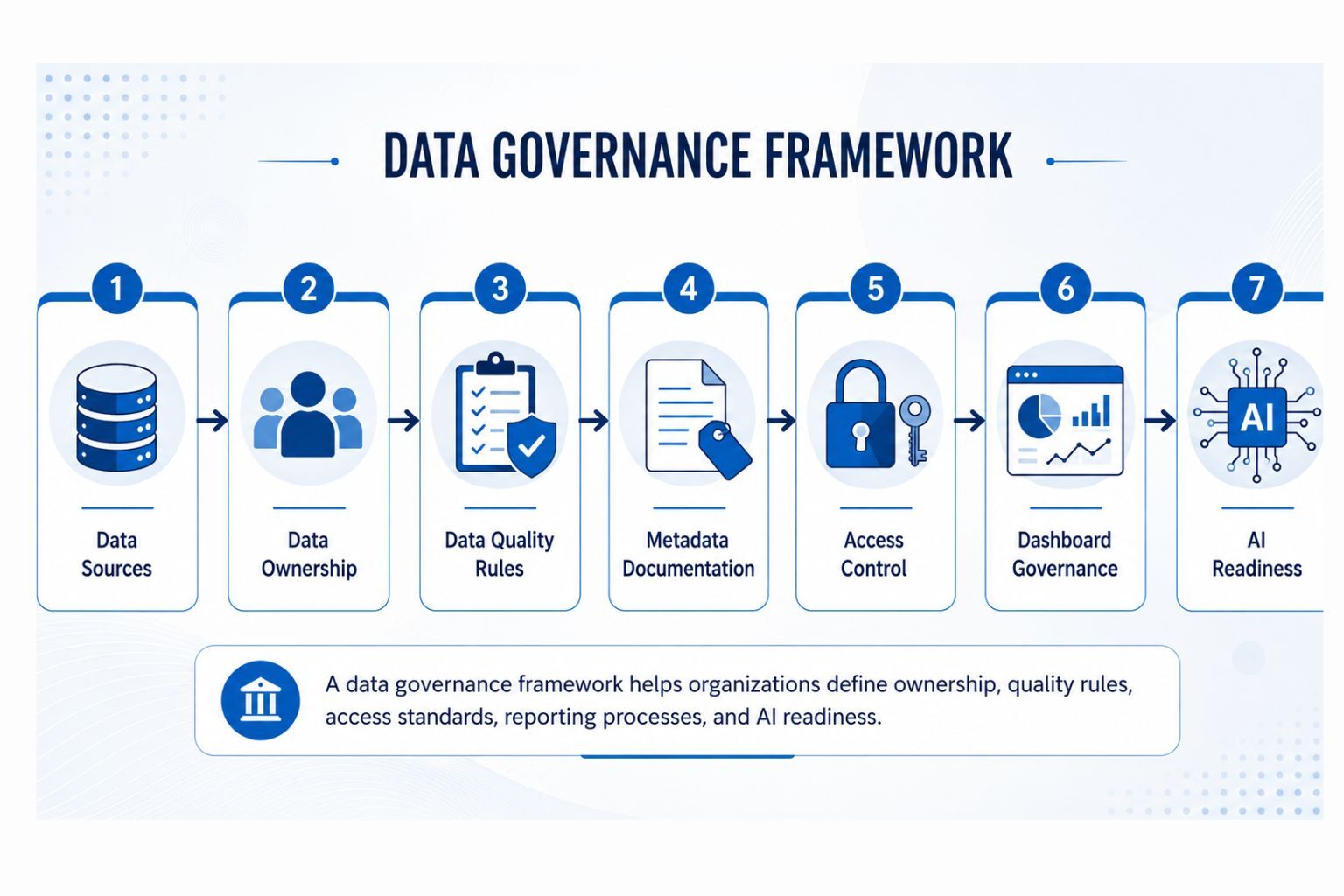
Data governance consulting services help organizations create the rules, roles, processes, standards, and systems needed to manage data as a trusted business asset.
Data governance is not only about technology. It is about making sure the right people are responsible for the right data, the right definitions are used across the business, and the right controls are in place to support accurate reporting, secure access, compliance readiness, analytics, and AI adoption.
| Data Governance Area | What It Means | Why It Matters |
|---|---|---|
| Data ownership | Defines who is accountable for data | Prevents confusion and unresolved issues |
| Data stewardship | Assigns people to maintain quality and documentation | Keeps data usable over time |
| Data quality management | Creates rules for accuracy, completeness, and consistency | Improves reporting trust |
| Metadata management | Documents where data comes from and what it means | Helps teams understand data faster |
| Business glossary | Creates shared KPI and business definitions | Reduces reporting disagreements |
| Access control | Defines who can access what data | Reduces privacy and security risk |
| Dashboard governance | Standardizes KPI logic and report approval | Improves BI trust |
| AI governance | Prepares data for responsible AI and machine learning | Improves AI readiness |
A strong data governance program may include:
- Data ownership
- Data stewardship
- Data quality management
- Data access control
- Data privacy and security
- Metadata management
- Business glossary development
- Data catalog planning
- Master data management
- Dashboard governance
- BI governance
- AI governance
Data governance creates the foundation for stronger Data Analysis Services, cleaner dashboards, more reliable reports, better compliance conversations, and more confident business decisions.
What Strong Data Governance Helps You Achieve
Strong governance helps your organization move from “we have data” to “we trust our data.” That difference matters because leaders need accurate and consistent information before making decisions about customers, finance, sales, operations, marketing, staffing, risk, and growth.
| Business Goal | How Data Governance Helps |
|---|---|
| More trusted dashboards | Defines approved KPIs, sources, and reporting logic |
| Cleaner reporting | Reduces duplicate, incomplete, and inconsistent data |
| Better AI readiness | Improves data quality, lineage, documentation, and access control |
| Reduced compliance risk | Clarifies sensitive data handling, access, and documentation |
| Faster reporting cycles | Reduces manual cleanup and repeated report corrections |
| Clearer ownership | Assigns accountability for data quality and definitions |
| Better business decisions | Gives leaders more confidence in the numbers |
Strong data governance can help your business achieve:
- More trusted dashboards.
- Cleaner reporting.
- Clearer KPIs.
- Better business decisions.
- Reduced compliance risk.
- Better customer data.
- Improved data access control.
- Stronger analytics.
- Better AI readiness.
- Less manual reporting.
- Fewer duplicate records.
- Clearer data ownership.
- More complete documentation.
- More confidence in executive reports.
- A stronger single source of truth.
For example, if different teams report different numbers, data governance helps create shared KPI definitions and reporting standards. If no one owns the data, governance creates a data ownership matrix and stewardship model. If customer records are duplicated, governance supports data quality rules and master data management. If AI projects are delayed, governance helps prepare clean, documented, and controlled data for AI and machine learning use cases.
Data Governance Maturity Levels
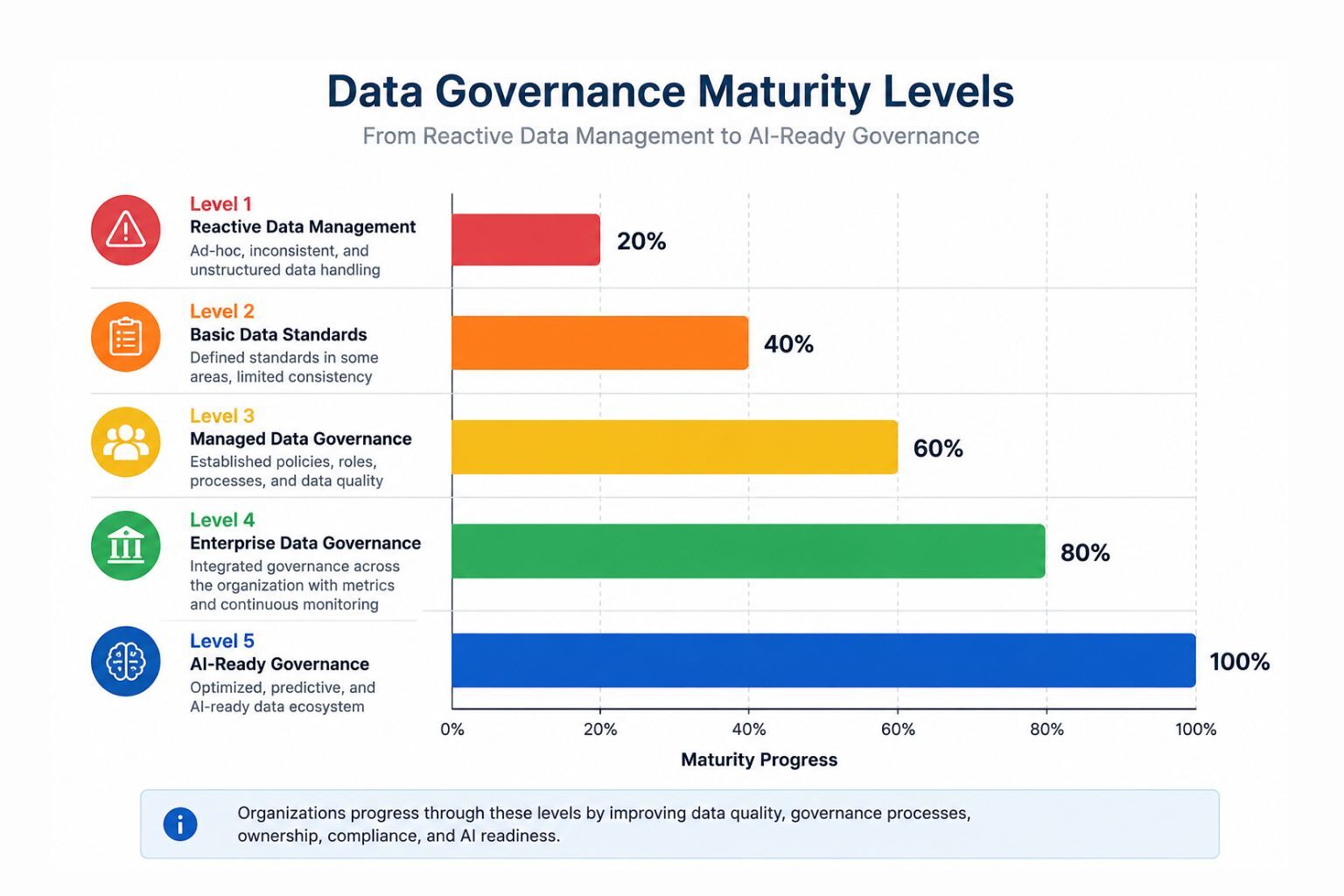
Every organization is at a different stage of data governance maturity. Some companies are just beginning to organize their data, while others already have analytics teams, dashboards, cloud systems, and compliance requirements but need stronger governance controls.
Understanding your maturity level helps us recommend the right roadmap instead of forcing a one-size-fits-all solution.
Level 1: Reactive Data Management
At this stage, teams fix data problems only when they appear. Reports may be built manually, data definitions may be unclear, and important business information may live in spreadsheets, emails, or disconnected tools.
Common signs include:
- Inconsistent reports
- Duplicate records
- Manual cleanup
- Unclear ownership
- No formal governance process
Level 2: Basic Data Standards
At this stage, the organization has started creating basic data standards, but governance is not yet consistent across departments.
Some teams may have their own definitions, dashboards, and data quality checks, but there is no company-wide governance process.
This is where many growing businesses begin to need formal data governance consulting services.
Level 3: Managed Data Governance
At this stage, the organization has defined data owners, data stewards, policies, reporting standards, data quality rules, and documentation processes.
Governance is connected to business goals, dashboards, compliance, and analytics.
Level 4: Enterprise Data Governance
At this stage, data governance is embedded across the organization.
The business may use:
- Data catalogs
- Metadata management
- Master data management
- Data lineage
- Access controls
- Compliance workflows
- Governance councils
Enterprise data governance consulting services are useful for larger organizations, regulated industries, and teams preparing for AI, machine learning, or major digital transformation.
Level 5: AI-Ready and Optimization-Focused Governance
At this stage, governance supports predictive analytics, machine learning, AI automation, responsible AI, real-time dashboards, and advanced decision-making.
Data is not only governed for reporting but also for innovation, automation, and strategic growth.
DataScienceConsultingPro.com helps organizations identify their current maturity level and build a realistic roadmap for moving to the next stage.
Our Data Governance Consulting Services
DataScienceConsultingPro.com provides practical data governance consulting services that connect strategy, documentation, data quality, reporting, compliance, and AI readiness.
| Service Area | What We Help With | Business Outcome |
|---|---|---|
| Data governance strategy | Current-state review, maturity assessment, roadmap | Clear direction |
| Framework design | Roles, policies, stewardship, workflows | Better accountability |
| Data quality rules | Accuracy, completeness, consistency, monitoring | Cleaner data |
| Metadata and glossary | Data dictionaries, definitions, lineage | Better understanding |
| Compliance support | Access, privacy, sensitive data classification | Reduced risk |
| MDM support | Customer, product, vendor, and account data | Fewer duplicates |
| Dashboard governance | KPI definitions, report ownership, BI standards | More trusted dashboards |
| AI governance | Responsible AI readiness and data controls | Stronger AI foundation |
Data Governance Strategy and Roadmap
We help your organization create a practical data governance roadmap that connects directly to business goals. This includes reviewing your current data environment, identifying governance gaps, assessing data maturity, and building a phased implementation plan.
Our strategy and roadmap work may include:
- Current-state data governance review
- Data governance maturity assessment
- Stakeholder interviews
- Data risk and reporting gap analysis
- Future-state governance planning
- Governance operating model design
- Prioritized implementation roadmap
The goal is not to create a complicated strategy that sits unused. The goal is to build a clear plan your team can follow.
Data Governance Framework Design
A data governance framework gives your organization structure. It defines who owns data, who maintains it, who approves changes, and how data decisions should be made.
We can help design:
- Governance councils
- Data owner roles
- Data steward responsibilities
- Escalation paths
- Documentation standards
- Approval workflows
- Operating models
A practical data governance framework can help your organization reduce confusion, improve accountability, and create stronger reporting standards across departments.
Data Quality Rules and Monitoring
Data governance and Data Quality Management work together. Governance defines the standards, while data quality monitoring checks whether the data meets those standards.
We help create data quality rules around:
- Accuracy
- Completeness
- Consistency
- Uniqueness
- Validity
- Timeliness
We can also support data quality scorecards, issue tracking, dashboard monitoring, recurring quality checks, and data quality reporting.
Data Catalog, Metadata, and Business Glossary
Many organizations struggle because employees do not know where data lives, what fields mean, which reports are approved, or which definitions should be trusted.
We help businesses plan and structure:
- Data catalogs
- Metadata documentation
- Business glossaries
- Data dictionaries
- System documentation
- Data lineage notes
- KPI definition guides
A business glossary is especially helpful when different teams use the same word in different ways. For example, sales, finance, and marketing may all define “customer,” “revenue,” “active account,” “qualified lead,” or “churn” differently.
Data Privacy, Security, and Compliance Support
Governance also supports safer and more responsible data use. We help organizations think through sensitive data classification, access control, audit trails, user permissions, and responsible data handling.
This may support readiness for:
- GDPR
- CCPA
- HIPAA
- SOC 2
- Internal audits
- Vendor reviews
- Customer data protection
This work is not legal advice, but it can help your team organize data governance practices that support stronger compliance conversations.
Master Data Management Support
Master data management focuses on the core data your business depends on most. This may include customer data, product data, vendor data, account data, location data, or employee data.
We help businesses identify:
- Duplicate records
- Inconsistent naming conventions
- Missing fields
- Weak matching rules
- Unclear source-of-truth systems
- Poor master record standards
The goal is to create cleaner master records and more reliable business reporting.
Dashboard and BI Governance
Dashboards are only useful when people trust the data behind them. We help businesses improve dashboard governance by defining KPI logic, approval processes, reporting ownership, refresh standards, version control, and executive reporting rules.
This is especially useful for teams using Power BI, Tableau, Looker, Excel, SQL dashboards, and other business intelligence tools.
You can also review our Power BI Sales Dashboard Examples to see how strong dashboard design depends on clear metrics and trusted reporting logic.
AI and Analytics Governance
AI and machine learning depend on reliable data. If the data is incomplete, biased, duplicated, outdated, poorly documented, or poorly controlled, AI outputs may become unreliable.
Our AI and analytics governance support helps organizations prepare data for Predictive Analytics Services, Machine Learning Services, responsible AI, automation, and executive decision support.
Governed data gives AI systems a stronger foundation. It helps your organization understand where data comes from, whether the data is reliable, how sensitive data is handled, and whether the data is ready for modeling.
Request a Data Governance Proposal
Data Governance Tools and Platforms We Can Support
Data governance does not always require expensive enterprise software at the beginning. Many organizations can improve governance by first clarifying ownership, definitions, policies, documentation, and quality rules.
However, the right tools can make governance easier to manage as your data environment grows.
| Tool or Platform | Governance Support |
|---|---|
| Excel and Google Sheets | Spreadsheet reporting standards, quality checks, controlled templates |
| SQL databases | Query logic, validation rules, structured documentation |
| Power BI | KPI governance, dashboard ownership, executive reporting standards |
| Tableau | Approved dashboards, metric definitions, BI documentation |
| Python | Data quality checks, automation, validation scripts |
| CRM systems | Customer data governance, duplicate management, lifecycle definitions |
| Cloud platforms | Data storage, access control, documentation, analytics readiness |
| Marketing platforms | Campaign data, attribution reporting, segmentation governance |
| Operational systems | Vendor data, inventory data, service data, performance reporting |
The goal is not to force your business into a tool too early. The goal is to design governance that fits your current systems while preparing your organization for cleaner reporting, better analytics, and stronger AI readiness.
Data Governance Consulting Services Pricing
Pricing for data governance consulting services depends on your data complexity, number of systems, number of teams, reporting needs, compliance requirements, current documentation, stakeholder involvement, and whether you need strategy only or full implementation support.
The ranges below provide a practical starting point. A custom quote can be prepared after a discovery call.
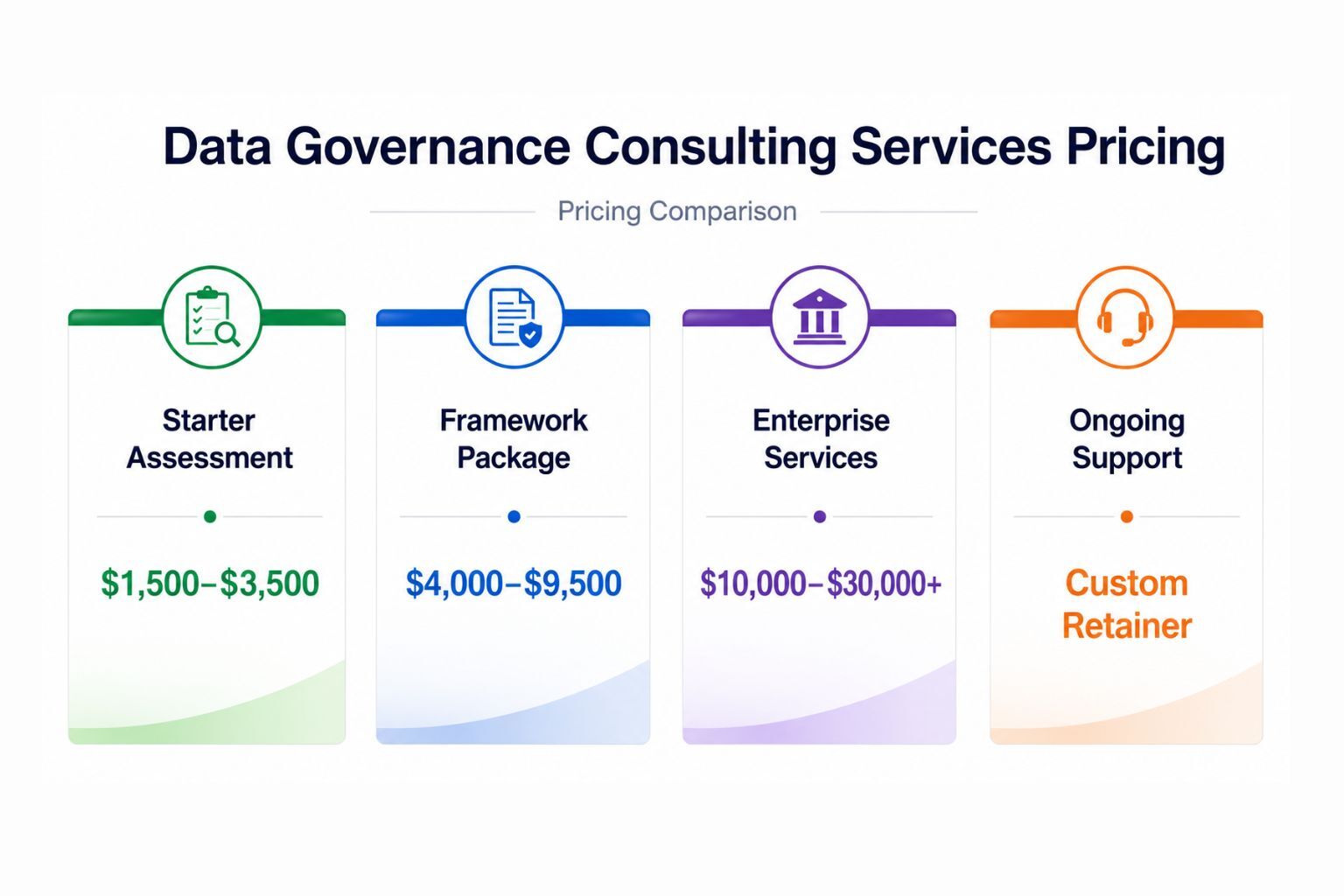
| Package | Best For | Suggested Pricing | Typical Deliverables |
|---|---|---|---|
| Starter Data Governance Assessment | Small teams needing a governance review | $1,500–$3,500 | Current-state assessment, data issues summary, governance recommendations, reporting gap review, priority roadmap |
| Data Governance Framework Package | Businesses needing roles, policies, standards, and documentation | $4,000–$9,500 | Governance framework, ownership matrix, stewardship model, glossary structure, quality rules, access guidelines |
| Enterprise Data Governance Consulting Services | Larger organizations, regulated industries, AI-ready teams | $10,000–$30,000+ | Enterprise operating model, MDM support, BI governance, AI governance, compliance alignment, workshops |
| Ongoing Data Governance Support | Teams needing monthly governance support | Custom monthly retainer | Governance meetings, monitoring, documentation updates, policy support, training |
Starter Data Governance Assessment
Best for small teams or businesses that need a governance review.
Typical deliverables include:
- Current-state assessment
- Data issues summary
- Governance recommendations
- Risk and reporting gap review
- Priority roadmap
This package is a good fit if your business knows there are data problems but needs help understanding what to fix first.
Data Governance Framework Package
Best for businesses that need policies, roles, standards, and documentation.
Typical deliverables include:
- Governance framework
- Ownership matrix
- Stewardship model
- Business glossary structure
- Data quality rules
- Access guidelines
- Implementation roadmap
This package is a good fit if your business needs a practical governance structure that teams can start using.
Enterprise Data Governance Consulting Services
Best for larger organizations, multi-department teams, regulated industries, and companies preparing for AI or advanced analytics.
Typical deliverables include:
- Enterprise governance operating model
- Data catalog planning
- Master data management support
- Compliance alignment
- BI governance
- AI governance
- Stakeholder workshops
- Implementation support
This package is a good fit if your organization has multiple departments, complex systems, compliance needs, or major analytics and AI goals.
Ongoing Data Governance Support
Best for organizations that need monthly governance support.
Typical deliverables include:
- Governance meetings
- Data quality monitoring
- Dashboard governance
- Policy updates
- Documentation support
- Training
- Team enablement
This option is useful for companies that want help maintaining governance after the first project is complete.
Ask About Data Governance Pricing
What Affects Data Governance Consulting Pricing?
Data governance consulting pricing is not based only on the number of hours worked. It is based on the complexity of your data environment, the number of stakeholders involved, and the level of implementation support your organization needs.
| Pricing Factor | Why It Affects Cost |
|---|---|
| Number of data sources | More systems require more review, documentation, and governance planning |
| Number of departments | More teams usually means more definitions, workflows, and stakeholder alignment |
| Existing documentation quality | Missing documentation increases discovery and mapping work |
| Data quality problems | Duplicate records, missing fields, and poor formats increase project scope |
| Compliance requirements | Regulated industries may need stronger privacy and access controls |
| Dashboard complexity | Conflicting dashboards require KPI governance and BI standards |
| AI readiness needs | AI projects require stronger lineage, quality, documentation, and responsible use standards |
| Implementation support | Strategy-only work costs less than hands-on implementation |
This is why DataScienceConsultingPro.com provides pricing ranges and then prepares a custom quote after understanding your systems, goals, risks, and expected deliverables.
Our Data Governance Consulting Process
| Step | What Happens | Business Outcome |
|---|---|---|
| 1. Discovery and business goals | We learn about your systems, teams, pain points, and goals | Clear project direction |
| 2. Data environment review | We review sources, dashboards, workflows, and documentation | Better understanding of current issues |
| 3. Maturity assessment | We assess ownership, quality, access, reporting, and AI readiness | Clear governance baseline |
| 4. Gap analysis | We identify risks, quality issues, unclear definitions, and weak documentation | Prioritized improvement areas |
| 5. Framework design | We design roles, policies, workflows, rules, and standards | Practical governance foundation |
| 6. Roadmap and pricing confirmation | We confirm scope, timeline, deliverables, and budget | Clear plan |
| 7. Implementation support | We help put governance processes into practice | Operational governance |
| 8. Training and improvement | We support adoption, documentation updates, and ongoing governance | Long-term success |
Typical Data Governance Project Timeline
The timeline for a data governance project depends on the size of your organization, the number of systems involved, the current condition of your data, and whether you need strategy only or implementation support.
| Project Type | Typical Timeline | Best For |
|---|---|---|
| Starter assessment | 1–3 weeks | Teams needing a quick review and roadmap |
| Governance framework project | 3–8 weeks | Businesses needing roles, policies, definitions, and documentation |
| Enterprise governance engagement | 2–6 months or longer | Larger organizations with many teams, systems, and compliance needs |
| Ongoing governance support | Monthly | Teams needing continuous documentation, monitoring, and governance support |
The best approach is to start with a focused discovery call. From there, DataScienceConsultingPro.com can recommend a realistic timeline based on your business goals and current data environment.
What You Receive
Depending on your selected package and project scope, your data governance consulting engagement may include:
- Data governance maturity assessment
- Data governance roadmap
- Data ownership matrix
- Data stewardship model
- Data policy templates
- KPI and metric definition guide
- Data quality rulebook
- Data catalog and metadata plan
- Business glossary structure
- Access control recommendations
- Compliance and privacy checklist
- Dashboard governance recommendations
- BI governance recommendations
- AI governance readiness notes
- Data lineage documentation plan
- Master data management recommendations
- Executive summary
- Implementation plan
- Training and team enablement recommendations
Data Governance Success Metrics
A successful data governance project should create measurable business improvement. The goal is not only to create documentation. The goal is to improve how your organization trusts, manages, protects, and uses data.
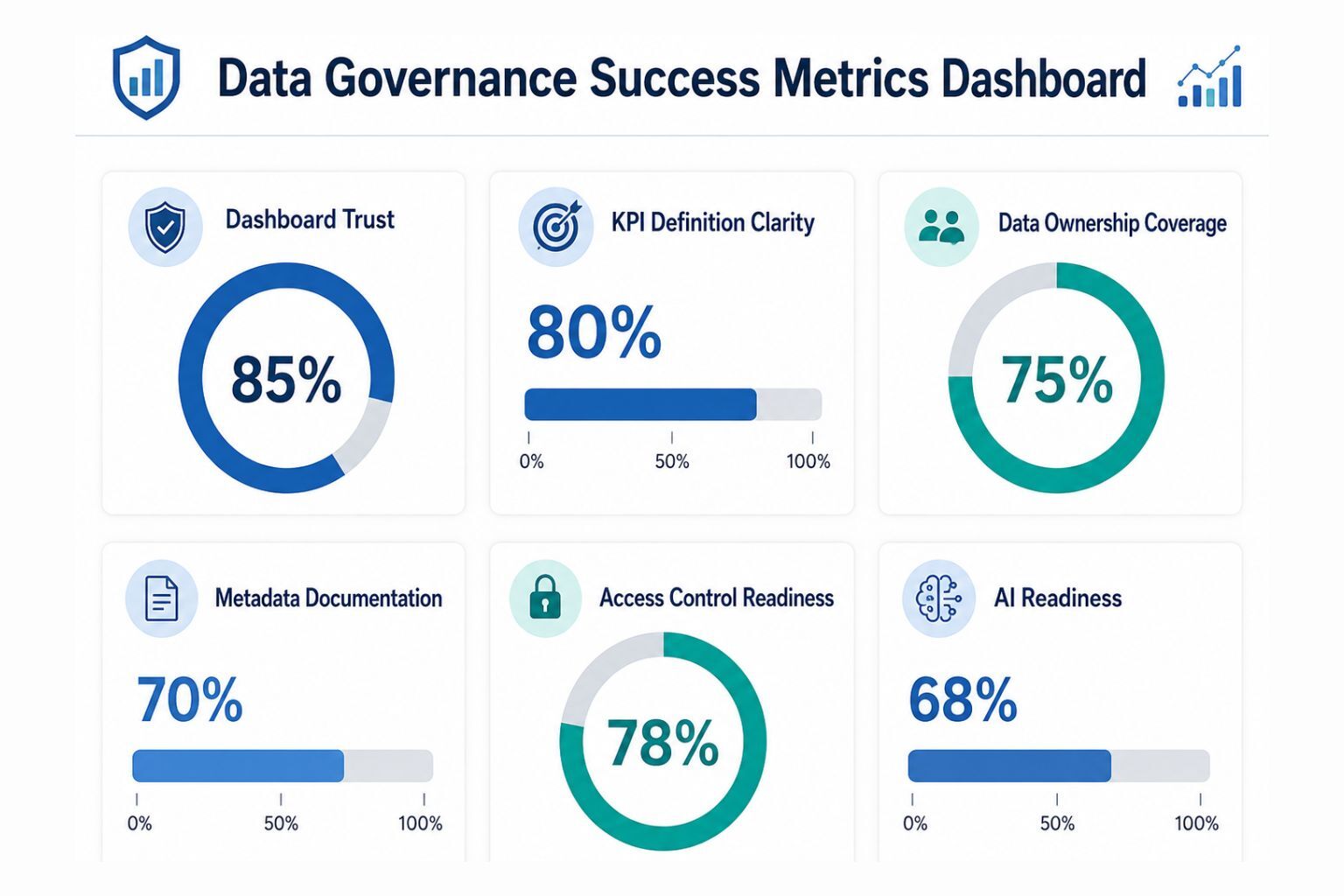
Common success metrics may include:
- Fewer conflicting reports across departments.
- More approved KPI definitions.
- Fewer duplicate customer, product, or vendor records.
- Reduced time spent manually cleaning data.
- Improved dashboard trust from executives and managers.
- Clearer ownership for critical datasets.
- More complete metadata and business glossary documentation.
- Better access control for sensitive data.
- Faster reporting cycles.
- Stronger compliance and audit readiness.
- Improved AI and analytics readiness.
- Higher confidence in business decisions.
Example Data Governance Consulting Use Cases
| Use Case | Problem | Governance Solution | Business Result |
|---|---|---|---|
| Conflicting dashboard numbers | Sales, finance, and operations show different revenue numbers | Define KPI ownership, reporting logic, approved sources, and glossary terms | More trusted executive reporting |
| AI readiness | Data is incomplete, duplicated, or undocumented | Assess data readiness, create quality rules, document fields, define ownership | Stronger foundation for AI and machine learning |
| Customer data spread across systems | Customer data lives in CRM, spreadsheets, marketing tools, and databases | Define source-of-truth systems and master data rules | Better segmentation, reporting, and customer analytics |
| Compliance and access risk | Sensitive data access is unclear | Classify sensitive data, review permissions, document access standards | Stronger privacy readiness and reduced risk |
Industries We Support
DataScienceConsultingPro.com supports organizations across industries that depend on accurate, secure, and well-documented data.
| Industry | Common Governance Need |
|---|---|
| Healthcare | HIPAA readiness, patient data controls, reporting accuracy |
| Financial services | Audit readiness, risk reporting, access controls |
| Insurance | Policy data, claims data, customer records, compliance |
| SaaS and technology | Product analytics, customer data, AI readiness |
| E-commerce | Customer data, product data, marketing analytics |
| Retail | Inventory data, sales dashboards, customer segmentation |
| Education | Student data, compliance, reporting |
| Nonprofits | Donor data, program reporting, impact measurement |
| Real estate | Property data, lead data, operational reporting |
| Professional services | Client data, project reporting, financial dashboards |
Whether your organization needs stronger reporting, cleaner customer data, better compliance readiness, or AI-ready datasets, governance gives your data environment the structure it needs.
Data Governance Consulting Services in the USA
DataScienceConsultingPro.com provides remote and flexible data governance consulting services in the USA for organizations across different regions.
Whether your team needs data governance consulting services in Indianapolis, data governance consulting services in Raleigh, data governance consulting services in Chicago, data governance consulting services in Seattle, data governance consulting services in Boston, data governance consulting services in New York, data governance consulting services in Texas, data governance consulting services in Florida, or another U.S. market, we can help you build trusted data systems, clearer reporting standards, and governance processes that support better decisions.
Common Concerns About Data Governance Projects
Will data governance be too expensive?
Data governance does not have to start with a large enterprise project. Many companies begin with a focused assessment, roadmap, or framework package before expanding into deeper implementation.
Will governance slow down our teams?
Good governance should make work easier, not harder. The goal is to reduce confusion, improve access to trusted data, and create clear processes for reporting and decision-making.
Do we need enterprise software first?
No. Software can help, but governance starts with people, processes, definitions, ownership, and standards. Many businesses can improve governance before investing in large platforms.
Can small businesses benefit from data governance?
Yes. Small businesses often benefit because they can fix data issues before they become expensive problems. Governance can help small teams improve reporting, dashboards, customer data, and operational decisions.
Can governance help if our data is currently messy?
Yes. Messy data is one of the main reasons companies need governance. A practical governance roadmap can help your team prioritize the most important data issues first.
How long does implementation take?
A basic assessment may take a few weeks. A full framework or enterprise governance project may take several weeks or months depending on data complexity, systems, stakeholders, and implementation needs.
Will data governance replace our current tools?
Not necessarily. In many cases, governance improves how your current tools are used. Your business may already have useful systems, but those systems need clearer ownership, definitions, access rules, and documentation.
Can data governance help with dashboards?
Yes. Data governance is one of the best ways to improve dashboard trust. It helps standardize KPIs, define approved data sources, clarify reporting logic, and reduce dashboard confusion.
Start Your Data Governance Roadmap
Why Data Governance Matters Before AI Adoption
Many businesses want to adopt AI, machine learning, automation, and predictive analytics. However, AI projects often fail or underperform when the data is incomplete, inconsistent, duplicated, poorly documented, or difficult to trace.
Data governance helps solve this problem by creating a stronger foundation for AI adoption.
Before your business uses AI models or machine learning workflows, it needs to understand:
- Where data comes from.
- Who owns the data.
- How accurate the data is.
- What the data means.
- Whether the data contains sensitive information.
- Whether the data is appropriate for the intended use case.
- Whether the data is documented well enough for analytics and AI.
Strong AI governance depends on strong data governance. Without governed data, AI systems may produce unreliable recommendations, biased outputs, weak predictions, or confusing results.
DataScienceConsultingPro.com helps organizations connect data governance to AI readiness by improving data quality, documentation, access control, lineage, stewardship, and responsible data use.
If your business is planning to use AI, now is the right time to build a data governance roadmap. You can also read our related article on Why AI Strategy Matters More in 2026.
Helpful Data Governance Resources
For organizations building a stronger data governance program, these external resources may be helpful:
- DAMA-DMBOK Data Management Body of Knowledge
- Microsoft Purview Data Governance Overview
- NIST AI Risk Management Framework
- FTC Privacy and Security Business Guidance
These resources can support broader learning, while DataScienceConsultingPro.com can help your organization turn data governance ideas into a practical business roadmap.
Frequently Asked Questions About Data Governance Consulting Services
Data governance consulting services help organizations create rules, roles, policies, documentation, ownership models, access controls, and quality standards for managing data as a trusted business asset.
Data governance consulting services may range from $1,500 to $3,500 for a starter assessment, $4,000 to $9,500 for a governance framework package, and $10,000 to $30,000+ for enterprise data governance consulting services. Final pricing depends on scope, systems, data complexity, stakeholders, compliance needs, and implementation support.
A data governance framework may include data ownership, stewardship roles, data policies, data quality rules, KPI definitions, access control standards, metadata documentation, business glossary structure, governance workflows, dashboard standards, and reporting rules.
Your company may need data governance if teams report different numbers, dashboards are not trusted, data definitions are unclear, compliance risks are increasing, or AI and analytics projects are blocked by poor data quality.
Data governance defines the rules, roles, ownership, and processes for managing data. Data quality focuses on whether the data is accurate, complete, consistent, valid, unique, and timely.
Data management is the broader practice of collecting, storing, integrating, processing, and using data. Data governance is the structure that defines how data should be controlled, owned, documented, protected, and trusted.
Yes. Data governance improves dashboards by standardizing KPI definitions, reporting logic, ownership, data sources, approval processes, and documentation. This helps teams trust the reports they use.
AI and machine learning need clean, well-documented, and reliable data. Data governance supports AI readiness by improving data quality, lineage, access control, documentation, stewardship, and responsible data use.
Yes. DataScienceConsultingPro.com provides enterprise data governance consulting services for larger organizations, multi-department teams, regulated industries, and companies preparing for advanced analytics, business intelligence, or AI adoption.
Yes. DataScienceConsultingPro.com provides remote and flexible data governance consulting services in the USA for businesses in multiple cities and states, including teams in New York, Texas, Florida, Chicago, Seattle, Boston, Raleigh, Indianapolis, and other markets.
Yes. Small businesses can benefit from data governance by improving reporting accuracy, reducing duplicate records, creating clearer ownership, and building better data habits before the business becomes more complex.
The best way to start is with a discovery call and a data governance maturity assessment. This helps identify current issues, business goals, data risks, reporting gaps, and the right roadmap for your organization.
No. Data governance is useful for small businesses, growing companies, and enterprise organizations. Small companies may need simpler governance, while larger organizations may need more formal governance councils, data catalogs, master data management, and compliance workflows.
Not always. Many organizations can begin with better ownership, definitions, policies, documentation, and quality rules before investing in enterprise governance software.
Start Your Data Governance Roadmap
If your business has data but does not fully trust it, now is the time to build a stronger governance foundation. DataScienceConsultingPro.com can help you create clearer ownership, better dashboards, stronger documentation, improved data quality, reduced risk, and better AI readiness.
Our data governance consulting services are designed to help your organization move from scattered data and unclear reporting to trusted business data that supports confident decisions.
Whether you need a starter assessment, a complete governance framework, enterprise data governance consulting services, or ongoing governance support, we can help you build a practical roadmap that fits your business.