
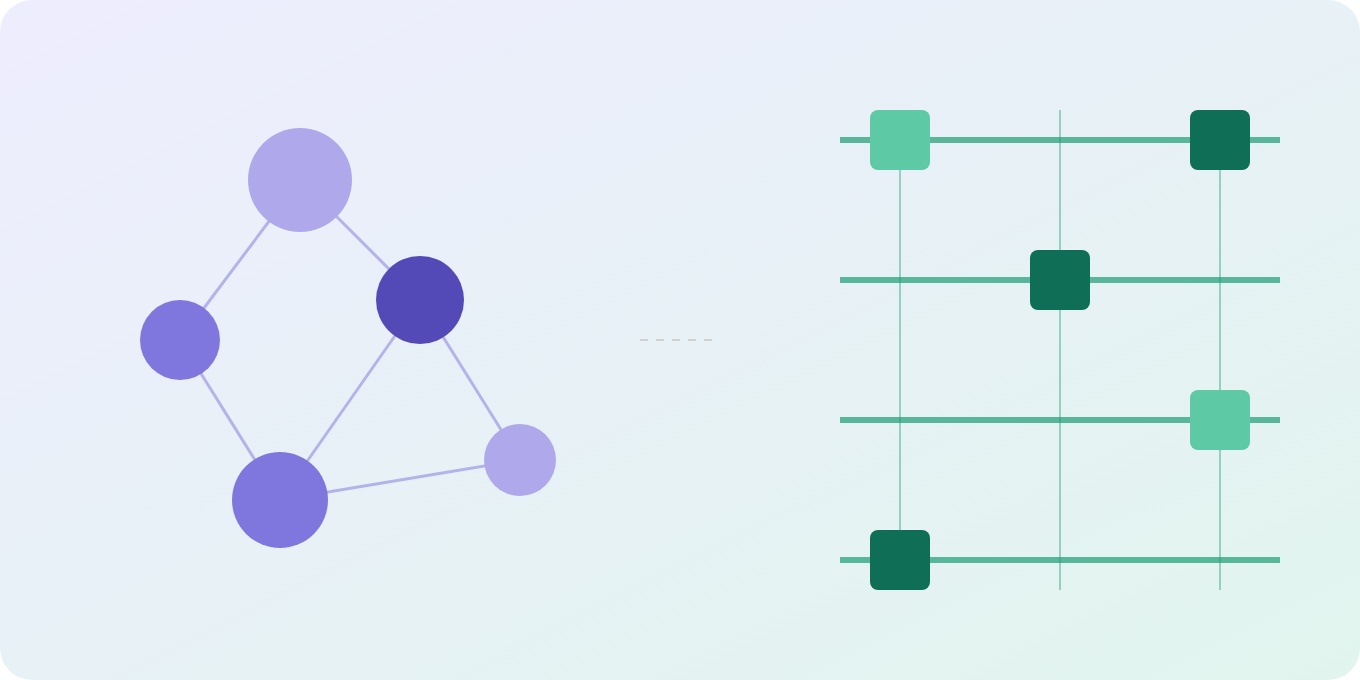
Data Mesh vs Data Fabric: Differences, Costs & Uses
Reviewed and updated: July 2026
Most organizations don’t struggle to store data anymore. They struggle to make it usable: reliably owned, easy to find, properly governed, and accessible to the people and systems that need it. That’s the real problem behind the debate over data mesh vs data fabric.
In short, data mesh primarily changes who owns and delivers data by shifting accountability to the business domains that understand it best. Data fabric primarily changes how distributed data is connected, discovered, governed, and accessed, using metadata and automation as the connective layer. They aren’t interchangeable, and for many organizations the right answer isn’t either/or. It’s a combination shaped by which problem is more painful: organizational bottlenecks or technical fragmentation.
This guide walks through both approaches in plain language, then gets specific: architecture, governance, team structure, realistic costs, a decision scorecard, a 90 day pilot roadmap, and the mistakes that derail implementations. If you’re evaluating where to start, our data engineering services team can help translate any of this into a plan for your specific systems.
Data Mesh vs Data Fabric at a Glance
| Dimension | Data Mesh | Data Fabric |
|---|---|---|
| Primary objective | Distribute data ownership and delivery to business domains | Connect, discover, govern, and deliver data across distributed systems |
| Core orientation | Organizational and operating model | Architectural and technical |
| Data ownership | Domain teams (sales, finance, operations, etc.) | Often centralized platform team, with distributed sources |
| Organizational structure | Federated; domain teams own data products | Typically a central or hybrid platform team |
| Architecture | Decentralized data products on a shared self-service platform | Metadata driven layer connecting distributed data sources |
| Governance model | Federated computational governance | Automated, policy driven governance |
| Data product responsibility | Domain teams | Platform or integration team, sometimes shared with domains |
| Metadata use | Documentation for data products | Active metadata driving automation and policy |
| Integration approach | Domain built pipelines on shared platform standards | APIs, virtualization, streaming, replication |
| Self-service capabilities | Central to the model | Supporting capability, not the core focus |
| Main technology requirements | Platform engineering, catalog, observability tooling | Metadata management, catalog, knowledge graph, integration tooling |
| Cultural change requirements | High. Requires redefining team accountability | Moderate. Mostly technical and process change |
| Ideal organization size | Multiple mature business domains, usually mid-size to large | Any size with fragmented or distributed data sources |
| Best-fit business problem | Central data team bottleneck, domain knowledge trapped outside IT | Data scattered across clouds and systems, poor discoverability |
| Time to initial value | Slower. Organizational change takes time | Often faster for a defined integration or catalog use case |
| Major cost drivers | Domain staffing, platform build, governance design | Integration complexity, metadata and catalog tooling, cloud consumption |
| Main implementation risk | Decentralizing without a shared platform, creating chaos | Buying tools without solving governance or ownership gaps |
| AI and machine learning support | Domain owned, well documented data products aid trust | Metadata, lineage, and discovery aid AI readiness |
| Most appropriate starting point | One well scoped domain pilot | One integration or discovery use case |
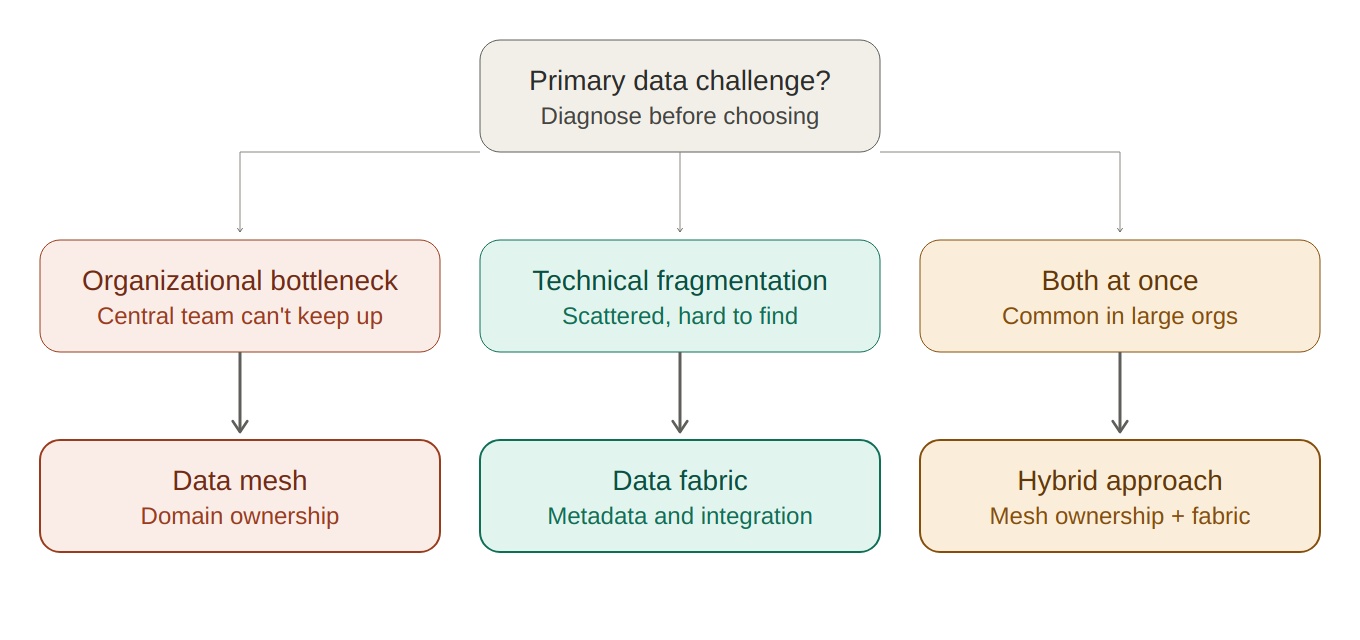
If your biggest problem is that a central data team can’t keep up with domain requests, data mesh vs data fabric largely comes down to organizational bottlenecks, and mesh addresses that directly. If your biggest problem is that data is scattered across systems and nobody can find or trust it, that’s technical fragmentation, which is fabric’s territory. Many organizations have both problems at once, which is why later in this guide we cover a hybrid approach.
What Is Data Mesh?
Data mesh is a decentralized sociotechnical operating model and architectural paradigm, not a piece of software you install. The term was introduced by Zhamak Dehghani, and the original principles remain the clearest reference point for what data mesh actually requires organizationally, as Martin Fowler’s site describes in the original articulation of data mesh principles.
Data mesh rests on four foundational principles.
Domain-oriented data ownership
Instead of a central data team owning all analytical data, business domains such as sales, finance, customer service, logistics, and operations become accountable for the data generated by and relevant to their function. The team closest to the data takes responsibility for its quality and availability, rather than handing it off to a central team that lacks the same context.
Data as a product
Not every dataset qualifies as a data product. A genuine data product has:
- A clear, named owner
- Defined and known users
- A stated business purpose
- Documentation
- Discoverability through a catalog
- Explicit quality expectations
- Access policies
- Freshness commitments
- Service level objectives
- Versioning
- Monitoring
Treating data as a product means applying the same rigor a software team applies to an API or application, not just exporting a table and calling it done.
Self-service data platform
Decentralizing ownership without shared platform capabilities tends to produce duplication, inconsistent tooling, and uneven quality across domains. A shared self-service platform typically provides standardized pipelines, data product templates, cataloging, observability, access management, testing, deployment, documentation, monitoring, and secure data sharing mechanisms, so each domain isn’t reinventing infrastructure.
Federated computational governance
Domains need autonomy, but the organization still needs consistent standards for security, compliance, interoperability, and data definitions. Federated governance balances the two. Enterprise wide policies are agreed upon collectively, often automated through the platform, while domains retain control over their own data products within those guardrails. This is one of the areas where organizations most often need outside structure. Our data governance consulting services team frequently helps define where federation ends and domain autonomy begins.
What data mesh is not
- Not a single product you can buy
- Not a tool that replaces the need for platform engineering
- Not the elimination of central data teams. Their role shifts, it doesn’t disappear
- Not uncontrolled decentralization
- Not a reason for every department to stand up its own separate tech stack
- Not automatically suitable for every small organization
What Is Data Fabric?
Data fabric is a metadata driven architectural approach for connecting, integrating, discovering, governing, and delivering data that lives across distributed environments: on premises systems, multiple clouds, SaaS applications, and data warehouses. It’s not necessarily one product. Most data fabric implementations combine several categories of capability, sometimes from multiple vendors, sometimes built internally.
Data integration and connectivity
This includes APIs, batch pipelines, streaming, replication, and data virtualization, the mechanisms by which data actually moves (or is accessed without moving) between systems. Strong integration is also foundational to a data mesh’s self-service platform, which is why our data pipeline development services work often supports both types of initiatives.
Active metadata
Passive metadata is documentation, such as a catalog entry describing a table. Active metadata goes further. It can trigger recommendations, enforce policies, or drive automation, such as flagging a dataset for a retention rule or automatically classifying a new column as sensitive based on patterns it has seen elsewhere.
Data catalog and discovery
A catalog is how users find, understand, and evaluate what data exists: who owns it, what it means, how fresh it is, and whether they’re allowed to use it.
Knowledge graphs and semantic context
Knowledge graphs capture relationships between data assets and business concepts, improving both discovery (finding related data) and interoperability (understanding how disparate datasets connect conceptually).
Data lineage and observability
Teams need to know where data originated, what transformations it went through, and which downstream reports, dashboards, or models depend on it. This is critical both for debugging and for regulatory accountability.
Automated governance and policy enforcement
This covers classification of sensitive data, access rules, retention policies, and auditability, increasingly automated rather than manually administered.
Data access without unnecessary duplication
Data virtualization and similar techniques can let users query data without physically copying it into a new location. This reduces duplication in many cases, but it’s inaccurate to claim every data fabric avoids movement entirely. Some degree of replication is still common for performance, availability, or compliance reasons.
What data fabric is not
- Not one mandatory vendor platform
- Not simply another data warehouse
- Not a replacement for governance decision making. It’s an enabler of governance, not a substitute for policy
- Not the same as Microsoft Fabric, which is a specific Microsoft analytics product. “Data fabric” is the broader architectural concept, and Microsoft Fabric is one vendor’s implementation of pieces of it
- Not a guarantee that data quality problems disappear
- Not necessarily a fully centralized data environment. The data can, and often does, remain physically distributed
Data Mesh vs Data Fabric: The 12 Most Important Differences
1. Strategic purpose
Data mesh exists to fix organizational bottlenecks: a central team drowning in requests it can’t fulfill fast enough because it lacks domain context. Data fabric exists to fix technical fragmentation: data scattered across systems with no consistent way to find, trust, or access it. Confusing the two leads organizations to expect a metadata platform to fix ownership problems, or a reorg to fix integration problems. Neither works.
2. Organizational ownership
In data mesh, ownership sits with the business domain. In data fabric, ownership of the fabric itself is usually centralized (a platform or architecture team), even though the underlying data sources remain distributed.
Hypothetical example: a retailer with separate sales, inventory, customer, and supplier domains might use data mesh to give each domain accountability for its own data products, while still relying on a data fabric layer underneath to handle cross-domain discovery and governance.
3. Technical architecture
Mesh architecture is organized around domain boundaries and a shared self-service platform. Fabric architecture is organized around a metadata and integration layer that spans systems regardless of domain.
4. Governance
Mesh uses federated computational governance, where standards are agreed centrally but enforced in a distributed way. Fabric tends toward centralized, automated policy enforcement applied consistently across all connected sources.
5. Data integration
Mesh treats integration as something each domain does on top of shared platform tooling. Fabric treats integration as the central technical problem to be solved once, for everyone.
6. Metadata
Metadata in a mesh mainly documents data products for discoverability. In a fabric, metadata is often active. It drives automated decisions, not just documentation.
7. Data products
Mesh formalizes “data product” as a first class organizational concept with a named owner and service level objectives. Fabric doesn’t require this concept at all. It can connect and govern data regardless of whether the source team thinks in product terms.
8. Team structure
Mesh requires domain teams to include or gain data engineering and product management capability. Fabric usually concentrates that capability in a central platform or integration team.
Hypothetical example: a central data team facing a large, growing reporting backlog might find that no amount of additional fabric tooling solves the underlying problem. The bottleneck is organizational capacity and context, which points toward mesh style domain ownership instead.
9. Cultural change
Mesh asks business domains to take on new accountability they may not have wanted, a significant change management task. Fabric’s changes are more technical and process oriented, generally requiring less organizational upheaval.
10. Implementation complexity
Mesh complexity comes from redefining roles, funding models, and accountability. Fabric complexity comes from technical integration across legacy systems, inconsistent metadata, and multiple cloud environments.
Hypothetical example: a multinational business with data spread across several cloud providers may find fabric’s integration and metadata layer solves the immediate discoverability problem, without requiring any change to who owns what.
11. Cost structure
Mesh costs are weighted toward staffing (domain data engineers, product owners) and platform building. Fabric costs are weighted toward integration engineering, catalog and metadata tooling, and cloud consumption.
Hypothetical example: a financial services firm needing consistent policy enforcement across many systems might prioritize fabric’s automated governance capabilities before considering the larger organizational investment mesh requires.
12. Best-fit use cases
Mesh fits organizations with multiple mature domains and a bottlenecked central team. Fabric fits organizations with fragmented, hard to discover data spread across many systems and clouds, including a SaaS company whose product, billing, customer success, and marketing data all live in different tools (a hypothetical scenario common enough to be illustrative).
Data Mesh and Data Fabric Architecture Examples
Simplified data mesh architecture
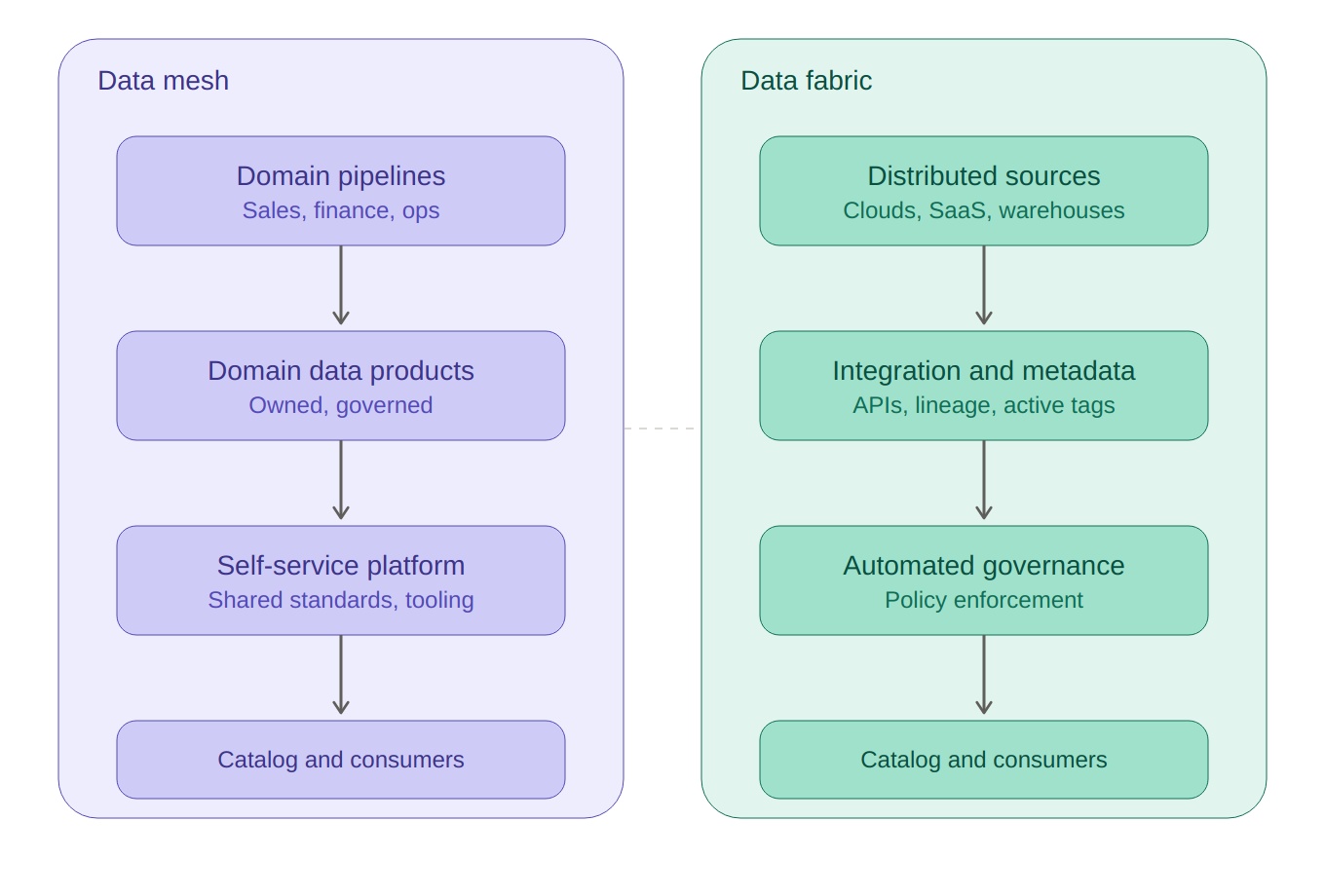
A typical data mesh flow looks like this. Source systems feed into domain owned pipelines. Each business domain (sales, finance, operations, etc.) produces its own governed data products. Those products are built and deployed using a shared self-service platform. Federated governance policies apply across all domains. A central data catalog makes products discoverable. Data consumers, including BI tools, analytics teams, and AI applications, access data products directly rather than waiting on a central team.
Simplified data fabric architecture
A data fabric flow looks different. Distributed data sources (databases, SaaS apps, cloud platforms, warehouses) connect through integration and connectivity services. Metadata is ingested continuously. A catalog and knowledge graph or semantic layer make relationships and meaning discoverable. Lineage tracking runs across the whole environment. Governance and access services enforce policy consistently. Analytics and AI consumers query through this layer. Critically, the physical data can remain in place. The fabric is a connective and governance layer, not necessarily a migration.
Hybrid data mesh and data fabric architecture
In a hybrid model, domain teams still own their data products and remain accountable for quality and business meaning. Underneath, a shared fabric supplies the technical capabilities, including discovery, metadata, integration, security, and policy enforcement, that would otherwise need to be rebuilt by every domain. Central teams maintain enterprise wide standards and platform capabilities, while domains retain the autonomy the mesh model is built around. This combination is increasingly common in practice, and Thoughtworks’ 2026 assessment of the state of data mesh describes organizations moving past initial hype toward more grounded, hard won maturity in how these architectures are actually implemented.
When Should You Use Data Mesh?
Data mesh tends to fit better when:
- The organization has multiple meaningful, mature business domains
- A central data team has become a delivery bottleneck
- Domain teams hold essential business knowledge that a central team lacks
- Demand for data products exceeds what a centralized team can realistically deliver
- The business can fund long term data product ownership (this is an ongoing commitment, not a one time project)
- Leadership genuinely supports organizational change, not just a technical rollout
- Shared platform capabilities already exist, or the organization is willing to build them
- Governance responsibilities can be distributed without losing consistency
Data Mesh Readiness Checklist
- Number of distinct, mature business domains
- Domain maturity (do domains already have engineering capacity?)
- Executive sponsorship for organizational change
- Product management capability within or available to domains
- Engineering capacity to build and maintain data products
- Clarity on who currently owns what data
- Existence of, or willingness to build, shared platform standards
- Governance maturity, meaning can policies be federated without chaos
- Platform maturity, meaning self-service tooling is in place or planned
- Funding model for ongoing domain level ownership
- Change management readiness across the organization
For small organizations with a limited number of systems and a small data team, full data mesh is often excessive. The organizational overhead of standing up domain ownership, governance federation, and a self-service platform can exceed the benefit when there simply aren’t many domains to decentralize across.
When Should You Use Data Fabric?
Data fabric tends to fit better when:
- Data is distributed across many systems and cloud environments
- Teams routinely can’t find or understand the data that already exists
- Integration work is repetitive, manual, and slow
- Metadata is fragmented or missing across systems
- Governance policies are inconsistently enforced
- Hybrid or multi-cloud access is itself the central pain point
- The organization needs one common discovery and access layer
- AI initiatives are stalling because of unreliable or unclear source data
Data Fabric Readiness Checklist
- Metadata availability across major systems
- Data catalog maturity
- Integration maturity (existing APIs, pipelines)
- Architecture documentation
- Identity and access management maturity
- Existing data quality controls
- API availability across source systems
- Clarity of cloud strategy (single cloud, multi-cloud, hybrid)
- Existing governance standards
- Clear platform ownership
- Security requirements defined
Organizations operating across hybrid and multi-cloud environments should also weigh cloud engineering services alongside fabric planning, since cloud architecture decisions directly affect integration complexity.
When Should You Use Data Mesh and Data Fabric Together?
| Organizational Requirement | Data Mesh Contribution | Data Fabric Contribution | Combined Outcome |
|---|---|---|---|
| Data ownership | Assigns clear domain accountability | Not applicable | Owned data with technical support to manage it |
| Data product delivery | Defines product standards and service level objectives | Supplies integration to build products | Faster, more consistent product delivery |
| Metadata | Documents products for discovery | Makes metadata active and automated | Richer, more usable metadata |
| Governance | Federates policy across domains | Automates policy enforcement | Consistent governance without manual bottlenecks |
| Integration | Domain level pipelines | Enterprise wide connectivity layer | Less duplicated integration work |
| Discovery | Domain catalog entries | Cross-domain catalog and knowledge graph | Organization wide discoverability |
| Access control | Domain level access rules | Centralized, automated enforcement | Consistent, scalable access management |
| AI readiness | Trustworthy, owned data products | Lineage, metadata, and context for models | More reliable inputs for AI systems |
| Cross-domain analytics | Domain data products as building blocks | Fabric connects products across domains | Unified analytics without re-building pipelines |
| Platform standardization | Domains follow shared platform standards | Fabric enforces technical consistency | Reduced duplication and technical debt |
The fabric can supply the technical connective tissue, including integration, metadata, and governance automation, while the mesh establishes who owns what and why it matters to the business. Neither replaces the other. They typically address different layers of the same underlying problem.
Not sure whether data mesh, data fabric, or a hybrid architecture fits your organization? Request a data architecture assessment from DataScienceConsultingPro.com.
Data Mesh vs Data Fabric Decision Scorecard
Score each criterion from 1 (low) to 5 (high) based on your current environment.
| Criterion | Score (1 to 5) |
|---|---|
| Number of independent, mature business domains | |
| Severity of central-team bottlenecks | |
| Degree of system fragmentation | |
| Hybrid or multi-cloud complexity | |
| Need for domain level autonomy | |
| Metadata maturity | |
| Governance maturity | |
| Platform engineering capability | |
| Change management capacity | |
| AI and real-time data requirements | |
| Regulatory obligations | |
| Available implementation budget |
How to interpret your score. High scores concentrated in domain bottlenecks, autonomy, and change management capacity suggest data mesh is likely the better starting point. High scores concentrated in fragmentation, multi-cloud complexity, and metadata gaps suggest data fabric is likely the better starting point. High scores across both categories suggest a hybrid approach is worth scoping. Low scores across governance, metadata, and platform maturity suggest the organization should first strengthen data quality management, data modeling, and data governance foundations before committing to either architecture.
Data Mesh and Data Fabric Pricing
Common commercial questions include how much data mesh costs, how much data fabric costs, what affects data architecture implementation pricing, and whether data mesh is more expensive than data fabric.
There’s no single standard price for either approach. Total cost depends on the number of systems involved, data volume, cloud usage, number of vendors, number of domains, governance maturity, staffing levels, integration complexity, and overall implementation scope.
Illustrative Data Architecture Consulting and Implementation Budget Ranges
| Engagement Type | Illustrative Range |
|---|---|
| Architecture and readiness assessment | $2,500 to $7,500 |
| Strategy and implementation roadmap | $7,500 to $20,000 |
| Focused pilot or proof of concept | $20,000 to $60,000 |
| Multi-domain or multi-platform rollout | $60,000 to $250,000 or more |
| Ongoing architecture, governance, and optimization support | $3,000 to $15,000 or more per month |
| Large enterprise transformation | Custom quote |
These figures are illustrative planning ranges, not fixed industry prices or guaranteed DataScienceConsultingPro.com quotes. Final pricing depends on project scope and should be confirmed before publication.
Data mesh cost factors
Number of domains, domain data teams, product owners, self-service platform build, governance design, training, change management, data product monitoring, documentation, and long term ownership.
Data fabric cost factors
Number of source systems, integration complexity, data catalog, metadata management, knowledge graph, data virtualization, lineage, governance automation, cloud consumption, platform licenses, security controls, and ongoing maintenance.
Total cost of ownership formula
Estimated first year cost equals assessment and strategy, plus platform and licensing, plus integration and engineering, plus cloud infrastructure, plus governance, plus staffing, plus training and change management, plus maintenance and support.
Hidden costs to plan for
Poor source data quality, legacy system integration, incomplete metadata, unclear ownership, vendor lock in, duplicate platforms, skills shortages, long term data product maintenance, cloud compute waste, and organizational resistance can all push real costs above initial estimates.
Share your systems, goals, and current data challenges to receive a scoped data architecture estimate.
Is Data Mesh or Data Fabric Better for Small Businesses?
Most small businesses don’t need a full enterprise data mesh. The organizational overhead of domain ownership, federated governance, and a dedicated self-service platform rarely pays off when there are only a handful of systems and a small data team. Smaller organizations typically get more value from clearly assigned data ownership even without formal domains, standardized metric definitions, better and more reliable pipelines, a well governed warehouse or lakehouse, basic data cataloging, lightweight metadata documentation, straightforward cloud integration, and selected data-product principles such as an owner, documentation, and a quality bar, without the full mesh apparatus.
A full-scale data fabric can be similarly excessive for a business with only a few systems. The integration and metadata layer exists to solve fragmentation at scale, and there’s not much fragmentation to solve yet. The better starting point is usually to identify the actual bottleneck, whether it’s poor discoverability, unclear ownership, or slow integration, rather than adopting either architecture’s terminology for its own sake.
Data Mesh vs Data Fabric for Mid-Sized Organizations
Growing businesses often benefit from selectively adopting elements of both, rather than committing fully to either model. A common pattern includes a central platform team, a small number of domain representatives rather than full domain teams, shared governance standards, standardized pipelines, a handful of genuine data products where they matter most, a central catalog, and gradual decentralization as domains mature.
Data Mesh vs Data Fabric for Large Enterprises
Large enterprises typically face a fuller version of both problems at once: multiple domains, multi-cloud environments, legacy systems, regulatory requirements, global teams, the aftermath of acquisitions, internal data marketplaces, the need for federated governance, enterprise wide metadata, and growing AI and machine learning workloads. This is the environment where a deliberate hybrid architecture, using mesh for ownership and fabric for connectivity, tends to matter most, and where the organizational and technical investments described throughout this guide are most justified.
Build vs Buy
| Capability | Build Internally | Buy or Use Commercial/Managed |
|---|---|---|
| Data catalog | Full customization, high maintenance burden | Faster time to value, less flexibility |
| Metadata management | Tailored to internal systems | Broader out-of-box connectors |
| Integration platform | Control over every connector | Pre-built connectors, faster deployment |
| Data virtualization | High technical complexity to build well | Mature commercial tooling available |
| Data quality | Custom rules matched to business logic | Pre-built rule libraries, faster setup |
| Observability | Tightly integrated with internal stack | Broader ecosystem support |
| Access management | Full control, higher security burden | Leverages existing IAM investments |
| Workflow orchestration | Maximum flexibility | Managed reliability, less custom work |
| Data product templates | Matches internal standards exactly | Faster domain onboarding |
| Cloud infrastructure | Full control, higher operational load | Managed services reduce operational burden |
| Governance workflows | Customized to internal policy | Faster compliance standard alignment |
Key trade-offs to weigh include time to value, where buying is usually faster; vendor lock in, which building avoids at a cost; skills requirements, since building demands more specialized internal talent; customization, where building wins out; maintenance, which buying shifts to the vendor; security, which depends heavily on vendor maturity; cost predictability, since commercial licensing is often more predictable than internal engineering time; and interoperability, which varies by vendor and internal architecture.
Most organizations land on a mix: commercial or managed tooling for commodity capabilities like cataloging or virtualization, and internal development for anything tightly coupled to unique business logic.
A 90-Day Data Mesh or Data Fabric Pilot Roadmap
Days 1 to 30: Assess and prioritize
Clarify business goals, document current architecture and data systems, map existing ownership, assess governance and metadata maturity, evaluate data quality and team skills, identify pain points, select one priority use case, and establish baseline metrics before building anything.
Days 31 to 60: Design and build the pilot
Scope a single pilot domain or workflow. Define the target architecture, what a data product means in this context (or what integration and metadata scope a fabric pilot covers), metadata requirements, integration method, governance controls, access policies, quality rules, monitoring, and documentation.
Days 61 to 90: Test, measure, and plan scaling
Run user testing, track adoption, measure data quality and time to access, assess pipeline reliability and policy compliance, capture business value delivered, document lessons learned, and make an evidence-based decision about scaling, including the budget and ownership model that scaling would require.
Figure 3: Data Mesh and Data Fabric 90-Day Implementation Roadmap. Three-stage horizontal timeline covering assessment, pilot build, and testing and scaling.
This phased approach connects naturally to related work. Legacy modernization often needs data migration services, pipeline design benefits from our data pipeline development services, and teams weighing batch versus streaming approaches may find our ETL vs ELT comparison useful during the design phase.
Team Roles Required for Implementation
| Role | Data Mesh Focus | Data Fabric Focus |
|---|---|---|
| Executive sponsor | Champions organizational change | Champions technical investment |
| CDO or data leader | Owns overall strategy and domain funding model | Owns fabric strategy and platform investment |
| Enterprise architect | Aligns mesh with broader enterprise architecture | Aligns fabric with enterprise integration standards |
| Data architect | Designs domain and platform architecture | Designs metadata, catalog, and integration architecture |
| Platform engineering team | Builds and maintains self-service platform | Builds and maintains fabric infrastructure |
| Domain owner | Accountable for domain’s data products | Typically not a mesh-specific role in fabric-only efforts |
| Data product owner | Manages a specific data product’s lifecycle | Not applicable unless mesh elements are present |
| Data steward | Enforces domain level quality and definitions | Enforces cross-system data classification and policy |
| Data engineer | Builds domain pipelines | Builds integration and connectivity services |
| Analytics engineer | Prepares domain data for consumption | Prepares fabric-delivered data for analytics use |
| Security and compliance | Reviews domain level access policies | Reviews and helps automate fabric wide policy enforcement |
| Business users | Define requirements, consume data products | Consume data via catalog and access services |
| Change management lead | Central to mesh adoption | Supporting role, less central |
Common Data Mesh Implementation Mistakes
- Renaming existing IT teams as domains without actually changing accountability
- Decentralizing ownership without building a shared self-service platform
- Creating data products with no defined users
- Treating data products as datasets rather than owned, maintained assets
- Weak or unenforced quality commitments
- Inconsistent definitions of core business terms across domains
- Funding domain ownership as a one time project instead of an ongoing responsibility
- Manual governance processes that can’t scale as domains multiply
- Excessive duplication of pipelines and infrastructure across domains
- Attempting a company wide rollout before validating the model with a single domain
Common Data Fabric Implementation Mistakes
- Purchasing tools before defining the business outcome they’re meant to achieve
- Treating a data catalog alone as a complete data fabric
- Assuming metadata and automation will fix bad source data quality on their own
- Connecting systems technically without resolving underlying access policy questions
- Ignoring semantic consistency, so data is connected but not actually understood the same way across teams
- Standing up the fabric as another isolated platform disconnected from existing tools
- Underestimating the complexity of legacy system integration
- Failing to assign clear ownership of the fabric itself
- Measuring technical deployment milestones instead of actual business adoption
- Over-relying on a single vendor for the entire fabric layer
How to Measure Success
| Metric | What It Measures | Why It Matters | Possible Baseline | Target Direction |
|---|---|---|---|---|
| Time to discover data | How long it takes users to find relevant data | Indicates catalog and discovery effectiveness | Current average search or request time | Decrease |
| Time to receive access | Speed of the access-granting process | Reflects governance and access efficiency | Current approval turnaround | Decrease |
| Time to build a new data product | Speed of domain product delivery | Reflects platform maturity | Current build cycle time | Decrease |
| Data product adoption | Usage by intended consumers | Validates product value | Current usage levels | Increase |
| Pipeline failure rate | Reliability of data delivery | Impacts trust in data | Current failure frequency | Decrease |
| Data freshness | Timeliness of available data | Impacts decision quality | Current update cadence | Improve to meet service level objectives |
| Quality-rule pass rate | Percentage of quality checks passed | Reflects data reliability | Current pass rate | Increase |
| Metadata completeness | Extent of documented assets | Supports discoverability and governance | Current documentation coverage | Increase |
| Lineage coverage | Percentage of data with tracked lineage | Supports trust and debugging | Current lineage coverage | Increase |
| Policy violations | Frequency of governance breaches | Reflects governance effectiveness | Current violation rate | Decrease |
| Duplicate datasets | Redundant copies of the same data | Reflects platform discipline | Current duplication count | Decrease |
| Central data-team backlog | Outstanding requests to central team | Reflects bottleneck severity | Current backlog size | Decrease |
| User satisfaction | Consumer sentiment toward data access | Reflects overall program health | Current survey baseline | Increase |
| Cost per data product | Efficiency of product delivery | Supports budget planning | Current average cost | Optimize, not just decrease |
| Analytics delivery cycle time | Speed from question to insight | Reflects overall architecture effectiveness | Current cycle time | Decrease |
| AI model data incidents | Data related issues affecting AI models | Reflects data reliability for AI use cases | Current incident count | Decrease |
| Business outcome influenced | Downstream business impact tied to data initiatives | Connects architecture to ROI | Qualitative baseline | Demonstrate clear linkage |
Targets should be set against your organization’s own baseline rather than industry benchmarks, since comparable, verified benchmark percentages for these metrics aren’t consistently published across the industry.
Data Mesh and Data Fabric for AI Readiness
Both approaches support AI initiatives, but in different ways. Data mesh contributes domain context and trustworthy, well documented data products, datasets AI teams can reasonably trust because someone is accountable for them. Data fabric contributes metadata, semantic definitions, lineage, and access controls that help AI systems, including retrieval-augmented generation and enterprise search, find and use the right data reliably.
Fabric-style lineage and metadata also support model monitoring and AI governance by making it easier to trace which data fed which model output. Neither architecture automatically makes AI outputs accurate. Both reduce specific categories of risk, such as untrustworthy sources, undocumented data, and unclear access, without eliminating the need for separate model evaluation and governance work. Organizations building AI strategy alongside architecture decisions may find it useful to loop in AI strategy consulting early, since data architecture and AI governance decisions increasingly need to be made together.
Data Mesh vs Data Fabric vs Data Lakehouse
| Concept | What It Is |
|---|---|
| Data mesh | Operating model and architectural paradigm for decentralized data ownership |
| Data fabric | Connective, metadata driven architecture for distributed data |
| Data lakehouse | A storage and processing platform pattern combining lake and warehouse characteristics |
A lakehouse is a technology pattern, not an operating model or organization wide architecture strategy. It can be used within a data mesh as the underlying storage for a domain’s data products, within a data fabric as one of several connected source systems, or as part of a combined architecture. The three concepts operate at different layers and aren’t mutually exclusive. IBM’s comparison of these concepts frames the lakehouse as a data management architecture that combines elements of data warehouses and data lakes, distinct from the organizational and connective concerns that mesh and fabric address.
How DataScienceConsultingPro.com Can Help
Depending on where your organization sits, support might include a current-state data architecture review, a data mesh or data fabric readiness assessment, system and data-flow mapping, data ownership assessment, governance framework design, metadata and catalog planning, data product design, data modeling, pipeline architecture, cloud architecture, pilot selection, implementation roadmap development, technology evaluation, cost estimation, KPI and success metric design, or ongoing implementation and optimization support.
| Client Challenge | Recommended Starting Service | Expected Deliverable |
|---|---|---|
| “We don’t know which architecture we need” | Data architecture assessment | Clear recommendation with rationale |
| “Our systems are too fragmented” | Data fabric readiness assessment | Integration and metadata gap analysis |
| “Our central data team is overloaded” | Data mesh readiness assessment | Domain ownership and bottleneck analysis |
| “We’re not ready for enterprise transformation” | Focused pilot scoping | 90-day pilot plan |
Request a Data Architecture Assessment to start with a scoped, low-commitment first step.
Frequently Asked Questions
Data mesh vs data fabric comes down to organizational versus technical focus. Data mesh is a decentralized operating model that gives business domains ownership and accountability for their data. Data fabric is an architectural approach that uses metadata, integration, and automation to connect and govern data across distributed systems, regardless of who owns it. Many organizations need both: mesh to solve ownership and delivery bottlenecks, and fabric to solve discoverability, integration, and governance across fragmented systems. Neither is a drop-in replacement for the other, and evaluating them as strict alternatives often leads to picking the wrong starting point for the actual problem at hand.
It’s both, but the operating model dimension is primary. Data mesh redefines who is accountable for data, shifting ownership from a central data team to individual business domains, and that organizational shift is what makes the difference. The architectural pattern, meaning domain owned data products on a shared self-service platform, exists to support that ownership model, not the other way around. Organizations that adopt the technical pattern without the accountability shift typically don’t get the intended benefits, which is why data mesh is best understood as a sociotechnical change rather than a purely technical rollout.
No. Data fabric is an architectural approach, typically assembled from multiple capabilities such as integration tools, a data catalog, metadata management, knowledge graphs, lineage tracking, and governance automation, that may come from one vendor, several vendors, open-source tools, or internal development. Some vendors market platforms under the data fabric label, but the underlying concept is broader than any single product. This distinction matters because organizations sometimes assume purchasing one tool completes their data fabric strategy, when in practice most environments need several integrated capabilities working together.
Yes, and for many mid-size to large organizations, that’s the practical answer. Data fabric can provide the technical connective layer, including integration, active metadata, cataloging, and automated governance, while data mesh establishes domain ownership and accountability on top of it. In this hybrid model, domain teams remain responsible for their data products’ quality and meaning, while a shared fabric handles the underlying discovery, integration, and policy enforcement so domains don’t have to rebuild that infrastructure independently.
It depends on scope rather than architecture type. Data mesh costs tend to concentrate in staffing, meaning funding domain teams, product ownership, and platform engineering on an ongoing basis. Data fabric costs tend to concentrate in integration engineering, metadata and catalog tooling, and cloud consumption. A narrow data fabric pilot can cost less than a full organizational mesh rollout, but a narrow mesh pilot in a single domain can also cost less than an enterprise wide fabric implementation across dozens of systems. Total cost depends heavily on scope, system count, and organizational readiness rather than which approach you choose.
A focused, single-domain pilot can typically be scoped and tested within roughly 90 days, based on the readiness-assessment-to-pilot timeline many organizations use. Broader rollouts across multiple domains generally take considerably longer, since data mesh requires organizational change, including new accountability structures, funding models, and platform capabilities, that moves more slowly than pure technology deployment. Timelines vary significantly based on domain maturity, executive sponsorship, and existing platform investment.
A defined integration or catalog use case can often show results faster than an organization wide mesh rollout, since fabric work is more technical than organizational. However, timelines still depend heavily on the number of source systems, legacy system complexity, and how much metadata already exists. A narrow pilot focused on one integration problem might move in weeks to a few months. Connecting an entire distributed, multi-cloud environment is a considerably longer undertaking.
Usually not in its full form. Data mesh’s organizational overhead, including domain ownership structures, federated governance, and a dedicated self-service platform, tends to outweigh the benefit when a business has only a few systems and a small data team. Smaller organizations typically get more value from clear data ownership, a well governed warehouse or lakehouse, basic cataloging, and selected data-product principles applied lightly, rather than adopting the full mesh model.
Typical requirements include data integration and pipeline engineering, metadata management, data catalog administration, knowledge graph or semantic modeling experience, data governance and policy design, cloud architecture especially for multi-cloud environments, security and access management expertise, and data quality engineering. Larger fabric initiatives also benefit from a dedicated platform owner who can coordinate across these specialties rather than treating them as separate, disconnected projects.
The four foundational principles are domain-oriented data ownership, data as a product, self-service data platform, and federated computational governance, as originally articulated by Zhamak Dehghani. Domain ownership shifts accountability to business teams. Treating data as a product means applying ownership, documentation, and quality standards to datasets. The self-service platform provides shared infrastructure so domains aren’t duplicating effort. Federated governance balances enterprise wide standards with domain level autonomy.
No. Microsoft Fabric is a specific commercial analytics platform offered by Microsoft. Data fabric is a general architectural concept describing a metadata driven approach to connecting, governing, and delivering distributed data, and it isn’t tied to any single vendor. Microsoft Fabric implements some data-fabric-style capabilities, but it’s one company’s product, not synonymous with the broader architectural category. Organizations researching data fabric strategy should evaluate the concept independently of any single vendor’s branding.
Data mesh is an operating model for decentralized data ownership. Data fabric is a connective, metadata driven architecture for distributed data. A data lakehouse is a storage and processing platform pattern that combines characteristics of data lakes and data warehouses. These operate at different layers. A lakehouse can serve as the underlying storage within either a mesh or a fabric, or both, rather than competing directly with either concept.
Neither is definitively better. They support AI readiness in different ways. Data mesh contributes trustworthy, well documented, domain owned data products that AI teams can reasonably rely on. Data fabric contributes the metadata, lineage, and semantic context that help AI systems locate and use the right data reliably, including for retrieval-augmented generation and enterprise search. Most organizations pursuing serious AI initiatives benefit from elements of both rather than choosing one exclusively for AI purposes.
Start with a readiness assessment rather than committing to a large transformation. Identify whether your primary pain point is organizational, such as a bottlenecked central team or unclear ownership, or technical, such as fragmented systems or poor discoverability, then scope a focused 90-day pilot around a single domain or integration use case. Use the pilot to validate assumptions, measure real business impact, and make an evidence-based decision about whether and how to scale, rather than assuming a full enterprise rollout of either architecture from the outset.
Support can include a current-state architecture review, readiness assessments for data mesh or data fabric, data ownership and governance framework design, metadata and catalog planning, pipeline and cloud architecture support, pilot scoping, cost estimation, and KPI design, starting with whichever piece matches your organization’s most pressing challenge. Request a Data Architecture Assessment to discuss your specific systems and goals.
Conclusion
The choice between data mesh vs data fabric isn’t really a choice between two competing products. It’s a choice about which problem you’re solving first. Choose data mesh when ownership, accountability, and a bottlenecked central data team are the main obstacles standing between your organization and reliable data delivery. Choose data fabric when integration, discovery, metadata, and governance across fragmented, distributed systems are the dominant pain point. And when both problems exist at once, which is common in larger, more complex organizations, a hybrid approach lets domain teams retain ownership while a shared fabric handles the underlying technical connectivity.
Whichever direction fits your situation, resist the urge to commit to a full-scale transformation on day one. A readiness assessment and a focused, single-domain or single-use-case pilot will tell you more about what actually works in your environment than any amount of upfront architectural planning, and it gives you real data to justify or adjust further investment.
If you’re still weighing data mesh vs data fabric for your organization, or you already know which direction makes sense and need help scoping the first step, our team can help assess your current systems and design a practical path forward.
