Many businesses collect years of historical data but still make future decisions through guesswork. Sales teams may have pipeline records but weak sales forecasts. Finance teams may track revenue and expenses but struggle to estimate future performance. E-commerce brands may have product and order history but still overstock slow-moving items or understock products with rising demand. SaaS companies may see customer activity but miss churn signals until users have already left.
Professional predictive analytics services help businesses move from reactive reporting to forward-looking decision-making. Instead of only asking what happened last month, predictive analytics helps you ask what is likely to happen next, which risks need attention, which customers may leave, which products may rise in demand, and which actions may improve planning.
At DataScienceConsultingPro.com, we provide predictive analytics consulting, forecasting services, and predictive modeling support for businesses that need clearer forecasts, future-focused insights, and better planning tools. We help organizations use historical data to forecast demand, estimate revenue, predict customer behavior, identify risk, improve marketing decisions, support staffing plans, and prepare for future business conditions.
Our predictive analytics work may support demand forecasting, sales forecasting, revenue forecasting, customer churn prediction, risk prediction analytics, marketing predictive analytics, e-commerce predictive analytics, SaaS predictive analytics, healthcare operational forecasting, and operations planning.
We can work with sales data, customer data, transaction records, marketing data, financial data, operational data, healthcare data, e-commerce data, SaaS product data, CRM exports, SQL databases, spreadsheets, dashboard data, and reporting files. When your data needs preparation before modeling, our Data Cleaning Services can help organize, validate, and prepare the dataset before predictive work begins.
Predictive analytics does not promise perfect predictions. Forecasts and models depend on data quality, historical patterns, business context, available variables, and model limitations. The value comes from improving decision support, reducing uncertainty, and giving teams a clearer view of what may happen next.
Request a Predictive Analytics Quote Now
What Are Predictive Analytics Services?
See What Your Business Data Can Predict
Tell us what you need to forecast—demand, revenue, churn, risk or another outcome—and we will assess the available data and suitable approach.
Predictive analytics services use historical data, statistical methods, forecasting models, and machine learning techniques where appropriate to estimate future outcomes. The goal is to help businesses plan better, identify risks earlier, prioritize opportunities, and make decisions using evidence instead of assumptions.
A basic report may show last quarter’s revenue, last month’s customer churn, or last year’s product demand. Predictive analytics goes further by asking what those patterns may suggest about the future. It can estimate future sales, forecast demand, score leads, identify customers at risk of leaving, predict product demand, support staffing plans, or highlight early warning indicators.
Predictive analytics may involve identifying patterns and relationships, preparing data for modeling, selecting suitable forecasting methods, building predictive models, testing model performance, interpreting results, and turning predictions into practical business recommendations.
For example, a sales team may want to know which leads are most likely to convert. An e-commerce company may want to estimate product demand before a seasonal campaign. A SaaS business may want to identify users at risk of churn. A finance team may want revenue forecasts for planning. An operations team may want workload forecasts to prepare staffing and resources.
The best predictive analytics work does not only produce a model. It answers a business question, explains uncertainty, validates performance, and shows how the prediction can support action.
Why Predictive Analytics Matters
Predictive analytics matters because businesses often lose money when they plan only from past reports. Historical reporting is useful, but it does not always show what may happen next. Without predictive insight, teams may react too late to demand changes, customer churn, inventory pressure, budget shifts, staffing needs, and operational risks.
Poor forecasting can lead to wrong inventory decisions, weak staffing plans, missed revenue opportunities, wasted marketing spend, and poor risk management. A retailer may order too much inventory because it does not see demand declining. A SaaS company may miss churn risk until subscriptions are canceled. A sales team may overestimate pipeline value because forecasts are based on optimism rather than historical conversion patterns. A finance team may plan budgets without a reliable view of future revenue trends.
Predictive analytics services help reduce these risks by using data to estimate future possibilities. The goal is not to remove uncertainty completely. The goal is to make planning more informed, timely, and defensible.
| Predictive Analytics Challenge | Business Risk | How Our Predictive Analytics Services Help |
|---|---|---|
| Forecasts based on guesswork | Planning becomes unreliable | We use historical data to support structured forecasts |
| Poor demand visibility | Inventory, staffing, or operations may be misaligned | We identify demand patterns and future demand indicators |
| Weak sales forecasting | Revenue targets may be unrealistic | We review pipeline, sales history, and conversion patterns |
| Unexpected customer churn | Teams react after customers leave | We identify churn risk indicators and customer segments |
| Poor marketing budget allocation | Spend may go to low-value audiences or channels | We support campaign response and lead scoring analysis |
| Revenue uncertainty | Finance and leadership struggle to plan | We build revenue forecasting and scenario-ready outputs |
| Risk detected too late | Operational or financial exposure increases | We help identify early warning indicators where data supports it |
| Underused historical data | Valuable patterns stay hidden | We turn past records into predictive insights |
| Dashboards only show the past | Managers lack future planning support | We prepare forecast outputs for reports or dashboards |
| Model outputs are hard to understand | Teams do not know how to act on predictions | We explain findings in clear business language |
Our Predictive Analytics Services
Predictive Analytics Readiness Review
A predictive analytics project should begin with a readiness review. Not every dataset is ready for forecasting or predictive modeling. We review the business question, available data, historical time period, target outcome, data quality, and whether the dataset contains enough useful patterns to support prediction.
This step helps determine whether your data can support demand forecasting, churn prediction, sales forecasting, lead scoring, revenue forecasting, or another predictive use case. It also helps identify missing variables, weak history, inconsistent records, or unclear outcomes that may affect model quality.
A readiness review gives you a realistic view of what predictive analytics can and cannot do with your current data.
Data Preparation for Predictive Modeling
Predictive models need reliable data. Before modeling, the dataset may require cleaning, restructuring, missing value treatment, variable preparation, date formatting, category standardization, duplicate review, and feature planning.
Data preparation helps reduce modeling errors and improves the usefulness of the final output. For example, a churn model may require customer tenure, usage frequency, support activity, payment history, engagement behavior, and cancellation outcomes. A demand forecast may require time periods, product categories, sales volume, seasonality, promotions, and external business context where available.
This step turns raw data into a structure that can support forecasting or predictive modeling.
Forecasting Model Development
Forecasting model development helps estimate future values such as sales, revenue, demand, workload, product volume, or operational activity. The forecasting approach depends on the type of data, historical period, seasonality, trend behavior, and business question.
We may support time-series forecasting, regression-based forecasting, scenario-based forecasting, or other methods depending on the project. The goal is to create forecasts that are useful for planning, not just technical outputs.
Forecasting can support inventory planning, staffing, budgeting, sales targets, operations planning, and executive reporting.
Demand Forecasting Services
Demand forecasting services help businesses estimate future demand for products, services, resources, or operational capacity. This is useful for retail, e-commerce, manufacturing, healthcare operations, logistics, SaaS, and service businesses.
Demand forecasting can help answer questions such as which products may need more stock, when demand may rise, which services may face higher volume, and where resources may need to be adjusted.
A good demand forecast can reduce overstocking, understocking, missed sales, service delays, and planning uncertainty.
Sales Forecasting Services
Sales forecasting services help businesses estimate future sales by reviewing historical sales data, pipeline records, conversion patterns, seasonality, product performance, regional trends, and customer segments where available.
These forecasts can support monthly planning, quarterly targets, revenue expectations, sales team management, and product strategy. With a stronger forecast, leadership can understand likely performance instead of relying only on optimistic pipeline estimates. We can also support sales forecasting at different levels, including product-level, region-level, channel-level, customer segment-level, or total business-level forecasting.
We can support sales forecasting at different levels, including product-level, region-level, channel-level, customer segment-level, or total business-level forecasting.
Revenue Forecasting Services
Revenue forecasting services help leadership and finance teams estimate future revenue trends using historical revenue, customer activity, product sales, subscription data, transaction records, pricing changes, and seasonal patterns.
These forecasts can support budgeting, investor reporting, resource planning, hiring decisions, and strategic planning. They also help leaders understand uncertainty and prepare for different scenarios. A useful revenue forecast should be clear, explainable, and connected to the business assumptions behind it.
A useful revenue forecast should be clear, explainable, and connected to the business assumptions behind it.
Financial Forecasting Services
Financial forecasting services may support expense forecasting, cash flow indicators, budget planning, cost trends, margin forecasting, and financial performance planning.
Finance teams often need forward-looking insight to support budgets and decision-making. Predictive analytics can help identify patterns in revenue, costs, margins, and financial activity. It can also support scenario planning when leadership needs to compare possible outcomes.
Customer Churn Prediction
Customer churn prediction helps businesses identify customers who may be at risk of leaving, canceling, becoming inactive, or reducing engagement. This is especially useful for SaaS companies, subscription businesses, e-commerce brands, membership organizations, and customer-driven service businesses.
A churn prediction project may review customer activity, product usage, support interactions, purchase behavior, tenure, billing patterns, engagement frequency, and past churn outcomes. The goal is to identify risk indicators and customer segments that may need attention.
Churn prediction can support proactive outreach, retention campaigns, account management, customer success planning, and lifetime value improvement.
Customer Behavior Prediction
Customer behavior prediction helps businesses understand what customers may do next. This may include repeat purchase likelihood, product interest, engagement patterns, buying frequency, customer value, or response probability.
For e-commerce brands, customer behavior prediction may focus on repeat purchase likelihood, product demand patterns, and buying frequency. SaaS companies may use it to understand feature usage, activation, retention behavior, and churn risk. Marketing teams can also apply it to campaign response, lead conversion probability, and audience prioritization.
Customer behavior prediction helps teams prioritize the right customers, offers, campaigns, and actions.
Lead Scoring and Customer Scoring
Lead scoring helps sales and marketing teams identify leads that are more likely to convert. Customer scoring can help rank customers by value, risk, engagement, or likelihood of responding to an offer.
Predictive lead scoring may use historical lead data, source, behavior, firmographics, engagement, prior conversion patterns, and sales outcomes. The goal is to help teams focus effort on leads or customers with stronger potential.
A scoring model should be understandable and practical. It should help teams prioritize action rather than create another confusing metric.
Marketing Predictive Analytics
Marketing predictive analytics helps teams estimate campaign response, prioritize audiences, forecast channel performance, score leads, and improve budget allocation. It can also support conversion probability, funnel forecasting, and customer segmentation where data supports it.
Marketing teams often have large amounts of campaign data but limited clarity about future performance. Predictive analytics can help identify which channels, offers, audiences, or campaigns are more likely to create valuable outcomes.
For projects focused on website behavior, GA4, campaign tracking, funnels, and online user journeys, our Digital Analytics Services can support the measurement layer before predictive work begins.
E-Commerce Predictive Analytics
E-commerce predictive analytics helps online stores forecast demand, predict repeat purchases, identify product trends, estimate revenue, analyze cart and purchase behavior, and support inventory planning.
This service may help answer questions such as which products may rise in demand, which customers are likely to buy again, which segments may generate higher value, and where inventory planning needs attention.
E-commerce predictive analytics can support revenue planning, customer retention, campaign targeting, stock decisions, and product strategy.
SaaS Predictive Analytics
SaaS predictive analytics helps software and subscription businesses understand activation, product usage, churn risk, retention patterns, subscription behavior, and customer lifecycle changes.
A SaaS predictive analytics project may forecast retention, identify churn signals, predict trial-to-paid conversion, score user engagement, or analyze product usage patterns. These insights can support customer success, product development, growth strategy, and retention planning.
For projects that require deeper algorithm development, automated prediction systems, or custom model engineering, Machine Learning Services may be the next step.
Healthcare Predictive Analytics
Healthcare predictive analytics can support operational, administrative, planning, survey, and research-related forecasting. It may help healthcare organizations estimate service utilization, appointment demand, patient experience trends, program outcomes, staffing needs, and quality improvement patterns.
This work should be handled carefully and with appropriate context. We do not position predictive analytics as medical diagnosis. The focus is operational, administrative, research, planning, survey, and service-level forecasting.
Healthcare predictive insights can help teams prepare for demand, monitor service trends, and support better resource planning.
Risk Prediction Analytics
Risk prediction analytics helps organizations identify early warning signals before problems become costly. These risks may involve customer churn, payment behavior, operational delays, financial exposure, service issues, inventory shortages, or unusual activity. The goal is to detect patterns that may indicate higher risk so teams can monitor problems earlier and respond before they grow.
The goal is to detect patterns that may indicate higher risk and help teams monitor those risks earlier. Risk prediction does not eliminate uncertainty, but it can help leaders prepare and respond sooner.
Operations Forecasting
Operations forecasting helps teams estimate future workload, staffing needs, service demand, inventory movement, delivery demand, process pressure, and resource requirements.
This is useful for logistics, service teams, healthcare operations, manufacturing, retail, and any business where demand and capacity must be planned in advance. Operations forecasting can help reduce bottlenecks, improve staffing decisions, and support resource planning.
Predictive Reporting and Model Interpretation
Predictive analytics is only useful when people understand the output. We help interpret forecasts, risk scores, probability scores, model outputs, and prediction results in clear business language.
A predictive report may explain the model goal, data used, method selected, performance summary, forecast values, uncertainty, limitations, and recommended actions. This helps decision-makers use predictive insights responsibly.
Predictive Analytics Dashboard Support
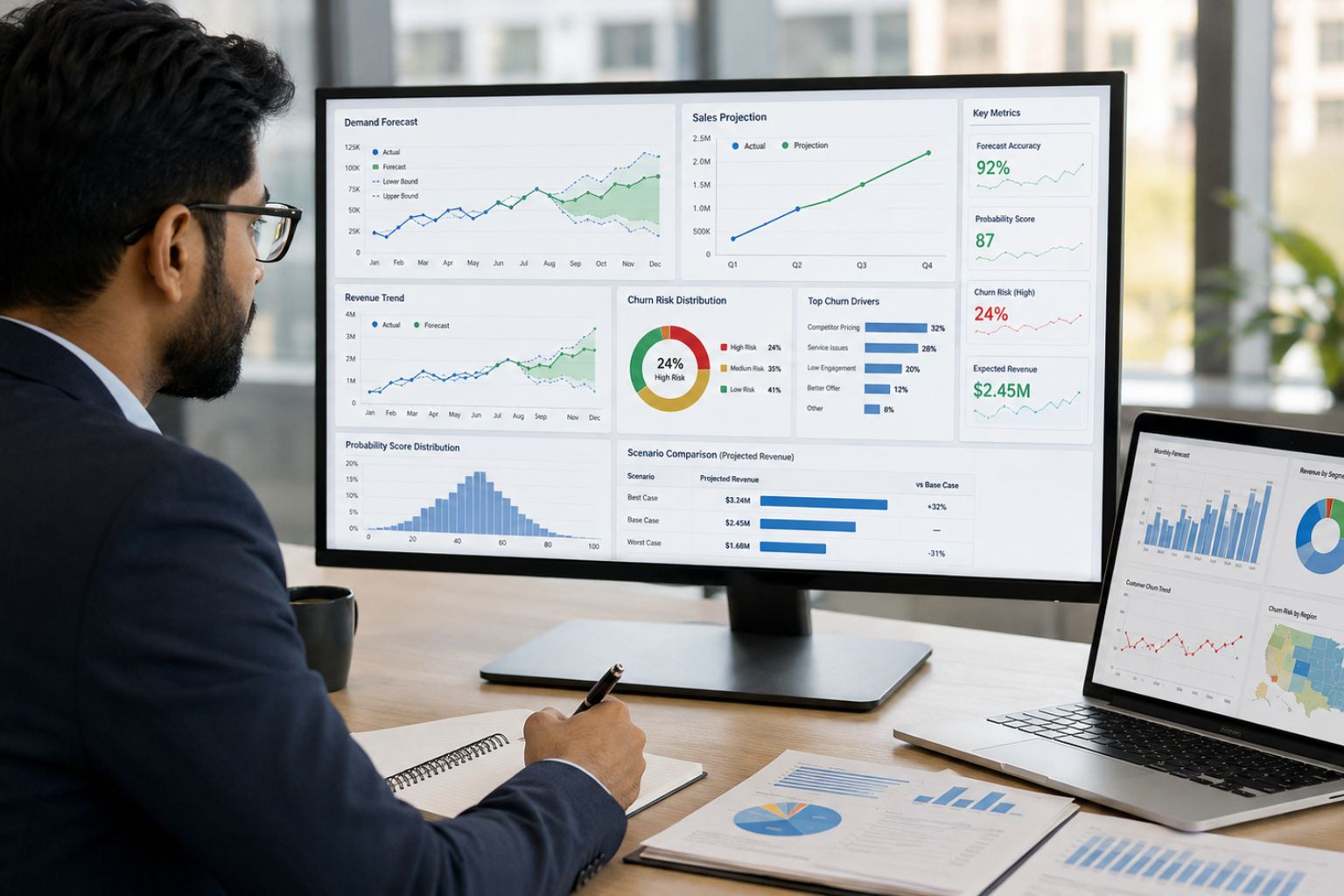
Some businesses need predictive outputs presented through dashboards. Forecast tables, churn risk scores, demand projections, revenue forecasts, and early warning indicators can be prepared for visual reporting.
When predictive outputs need to become interactive dashboards, our Dashboard Development Services can support dashboard design, KPI layout, and visual reporting. If predictive insights need to support broader recurring reporting, Business Intelligence Services can help organize the reporting layer.
Model Monitoring and Refinement
Predictive models may need monitoring and refinement over time. Business conditions change, customer behavior shifts, campaigns change, new products launch, and historical patterns may weaken.
Model monitoring may involve reviewing prediction accuracy, tracking model performance, comparing forecasts against actual results, updating data, and refining assumptions. This helps keep predictive analytics useful after the first project is delivered.
Types of Predictive Models and Forecasts We Support
Different business questions require different predictive approaches. A demand forecast is not the same as a churn model. A lead scoring model is not the same as a revenue forecast. The right approach depends on the question, data, and decision.
| Prediction Type | Common Use Case | Business Value |
|---|---|---|
| Demand forecasting | Estimate future product, service, or resource demand | Improves inventory, staffing, and planning |
| Sales forecasting | Predict sales by period, product, region, or segment | Supports revenue targets and sales planning |
| Revenue forecasting | Estimate future revenue trends | Helps finance and leadership plan ahead |
| Churn prediction | Identify customers likely to leave or cancel | Supports retention and proactive outreach |
| Lead scoring | Rank leads by likelihood to convert | Helps sales teams prioritize effort |
| Customer lifetime value estimation | Estimate future customer or segment value | Supports retention and marketing strategy |
| Risk prediction | Identify higher-risk accounts, cases, or operations | Improves early monitoring and response |
| Inventory forecasting | Estimate stock needs from demand patterns | Reduces stockouts and overstocking |
| Campaign response prediction | Estimate which audiences may respond | Supports targeting and budget planning |
| Product demand prediction | Forecast demand by product or category | Helps product and inventory decisions |
| Operational workload forecasting | Estimate future workload or service volume | Supports staffing and resource planning |
| Healthcare utilization forecasting | Estimate service demand or appointment patterns | Supports healthcare operations planning |
| SaaS retention forecasting | Estimate retention, activation, or churn patterns | Supports customer success and product strategy |
| Early warning indicators | Detect patterns linked to future problems | Helps teams respond before issues grow |
| Financial forecasting | Forecast revenue, costs, margins, or cash flow indicators | Supports budgeting and financial planning |
Our Predictive Analytics Process
Step 1: Business Goal and Prediction Question Review
We begin by clarifying the prediction question. This is one of the most important steps. A vague goal such as “predict customers” is not enough. A stronger question may be, “Which customers are most likely to churn in the next 60 days?” or “What will monthly demand likely look like for each product category?”
The prediction question guides the data needed, the modeling approach, the output format, and the business action that follows.
Step 2: Data Source and Data Quality Review
We review the available data sources and assess whether they can support predictive work. Data may come from CRM systems, sales files, financial reports, e-commerce platforms, SaaS product logs, marketing platforms, SQL databases, spreadsheets, healthcare records, or operational systems.
We check data quality, missing values, time coverage, target variable availability, consistency, and whether the dataset contains enough historical information to support a reliable model or forecast.
Step 3: Predictive Analytics Readiness Assessment
A readiness assessment helps determine whether the project is suitable for predictive analytics. Some datasets may be too limited, too recent, too incomplete, or missing the outcome variable needed for modeling.
If the data is not ready, we explain the limitations and recommend what may be needed before modeling. This may include additional data collection, better tracking, clearer definitions, or data preparation.
Step 4: Data Preparation and Feature Planning
We prepare the data and plan useful features. Features are the variables or inputs used by predictive models. For example, a churn model may use customer tenure, activity frequency, support contacts, usage decline, subscription type, and payment history.
Feature planning helps connect business knowledge with modeling logic. Good predictive analytics depends not only on algorithms but also on meaningful variables.
Step 5: Exploratory Analysis and Pattern Review
Before building a model, we explore the data to understand patterns, relationships, trends, outliers, seasonality, and possible predictors. This helps determine whether the data contains useful signals.
Exploratory analysis also helps identify data issues that could distort the model, such as unusual spikes, duplicate records, inconsistent time periods, or missing fields.
Step 6: Model Selection and Forecasting Approach
We select the modeling or forecasting approach based on the prediction question, data structure, historical patterns, and business goal. A simple forecast may work for a stable time series, while a churn prediction project may require classification methods.
The method should fit the problem. We do not use complex models just to make the project sound advanced. A simpler model may be better when it is easier to validate, explain, and use.
Step 7: Model Development and Testing
We develop and test the predictive model or forecast. This may involve training models, comparing methods, generating forecasts, creating probability scores, or testing classification performance.
Testing helps determine whether the model performs well enough to support decision-making. It also helps identify where the model may be weak.
Step 8: Model Validation and Performance Review
Model validation checks whether the predictive output is reliable enough to use. This may involve train-test validation, forecast error review, classification metrics, comparison against baseline models, or performance checks.
Validation is essential because a model can look impressive but still perform poorly. We review performance in practical terms so the client understands what the model can and cannot support.
Step 9: Interpretation and Business Recommendations
Predictive analytics should lead to business interpretation. We explain what the forecasts, scores, or predictions mean and how they can support decisions.
For example, churn scores may support customer outreach. Demand forecasts may support stock planning. Revenue forecasts may support budgeting. Risk scores may support early monitoring. The goal is to connect model outputs to practical next steps.
Step 10: Delivery of Predictive Outputs
We deliver the agreed outputs. These may include a predictive insights report, forecast tables, model outputs, risk scores, probability scores, charts, executive summary, technical notes, dashboard-ready files, or model documentation.
The output format depends on your team’s needs. Some clients need a written report. Others need dashboard-ready prediction outputs or technical files.
Step 11: Optional Monitoring and Ongoing Forecasting Support
Predictive models may need updates as new data becomes available. We can support monitoring, refinement, recurring forecasts, model performance review, or ongoing reporting structures where needed.
This helps keep predictive analytics useful as business conditions change.
What Makes Our Predictive Analytics Company Different?
DataScienceConsultingPro.com approaches predictive analytics as a business decision-support process, not just a technical modeling task. We begin with the prediction question, review the data, choose an appropriate method, validate performance, and explain the results in practical language.
That difference matters. A cheap model may produce numbers without explaining whether they are reliable. A generic reporting provider may show past performance but fail to support future planning. A software-only platform may generate predictions without enough business context. Predictive analytics becomes more valuable when the model is tied to a real decision.
We focus on consulting-led prediction planning, business-first forecasting, data quality review before modeling, baseline comparison where appropriate, assumption review, model validation, performance checks, practical interpretation, structured deliverables, and confidential handling of client data.
We also explain limitations clearly. A forecast should not be treated as a guarantee. A churn score should not replace human judgment. A predictive model should support decisions, not hide uncertainty. We help clients understand how to use predictive outputs responsibly.
Poor predictive models can become expensive when businesses make staffing, inventory, marketing, finance, or customer decisions based on unreliable forecasts. We aim to create predictive outputs that are explainable, useful, and connected to action.
Predictive Analytics for Sales and Revenue Forecasting
Sales and revenue forecasting help businesses prepare for future performance. Instead of relying only on past sales reports or informal estimates, predictive analytics can use historical sales, pipeline activity, product trends, region performance, customer segments, and conversion patterns to estimate future outcomes.
Sales forecasting may support monthly or quarterly sales planning, product-level forecasting, region-level forecasting, customer segment forecasting, and target setting. It can help sales leaders understand likely performance, pipeline risk, and where additional effort may be needed.
Revenue forecasting helps finance and leadership teams plan budgets, resources, investments, and growth targets. A good forecast should also acknowledge uncertainty so decision-makers understand that forecasts are planning tools, not guarantees.
Predictive Analytics for Customer Churn and Retention
Customer churn prediction helps organizations identify customers who may leave, cancel, become inactive, or reduce engagement. This is valuable because retention efforts often work best before the customer is already gone.
A churn prediction project may identify risk indicators such as declining usage, lower purchase frequency, reduced engagement, support issues, billing changes, or inactivity. Customers can then be grouped by risk level so teams can prioritize outreach.
For SaaS and subscription businesses, churn prediction may support customer success planning, renewal strategy, onboarding improvement, and retention campaigns. For e-commerce businesses, predictive analytics may help identify repeat purchase patterns, inactive customers, and segments that need re-engagement.
Predictive Analytics for Marketing Teams
Marketing predictive analytics helps teams use data to improve targeting, lead prioritization, campaign planning, and budget allocation. It can support campaign response prediction, lead scoring, customer scoring, audience prioritization, channel performance forecasting, conversion probability, and funnel forecasting where data supports it.
Instead of treating every lead or audience segment the same, marketing teams can use predictive insights to focus on prospects or customers with stronger potential. This may help reduce wasted spend and improve campaign planning.
Predictive analytics also helps teams understand which factors may influence conversion, retention, or customer value.
Predictive Analytics for E-Commerce and Retail
E-commerce and retail businesses can use predictive analytics to improve demand planning, product strategy, customer retention, and revenue forecasting. Historical order data, product views, customer segments, promotions, seasonality, and transaction records can reveal patterns that support future planning.
Predictive analytics may help forecast product demand, identify rising product categories, estimate repeat purchase likelihood, predict cart or purchase behavior, support inventory planning, and forecast revenue trends.
For e-commerce teams, predictive insights can support stock planning, campaign timing, product recommendations, customer segmentation, and marketing strategy.
Predictive Analytics for Finance and Risk
Finance teams can use predictive analytics to forecast revenue, estimate expenses, monitor cash flow indicators, support budget planning, review financial trends, and identify potential risk signals.
Risk prediction analytics may help identify unusual patterns, higher-risk accounts, late payment signals, cost pressures, or operational indicators that may affect financial planning. Predictive outputs can also support scenario planning when leadership wants to compare possible future outcomes.
Financial predictive analytics should be clear and carefully explained because business decisions may depend on the assumptions behind the forecast.
Predictive Analytics for Operations and Supply Planning
Operations teams often need to plan ahead for workload, staffing, service demand, delivery demand, inventory needs, resource use, and process pressure. Predictive analytics can help estimate future operational needs using historical patterns and relevant business variables.
Operations forecasting may help identify periods of higher workload, locations that may need more staffing, inventory demand changes, and early warning indicators for bottlenecks.
This helps teams prepare resources earlier and reduce reactive decision-making.
Predictive Analytics for Healthcare
Healthcare predictive analytics can support planning, operations, survey analysis, administrative reporting, and quality improvement analytics. It may help forecast service utilization, appointment demand, patient experience trends, staffing needs, program volume, or workload patterns.
This work should be handled carefully and with appropriate context. We do not position predictive analytics as medical diagnosis. The focus is operational, administrative, research, planning, survey, and service-level forecasting.
Healthcare predictive insights can help teams prepare for demand, monitor service trends, and support better resource planning.
Predictive Analytics Tools and Methods We Use
The tools and methods depend on the prediction question, data size, data quality, historical patterns, and business goal. We may use Excel for simple forecasting where appropriate, SQL for structured data work, Python or R for predictive modeling, SPSS where relevant, and Power BI, Tableau, or Looker Studio where predictive outputs need to be presented visually.
Methods may include time-series forecasting, regression models, classification models, logistic regression, decision trees, random forests, gradient boosting where relevant, machine learning methods where appropriate, model evaluation metrics, train-test validation, baseline comparison, and scenario analysis.
The best method is not always the most complex method. The right method should fit the business question, produce explainable results, and support practical decisions.
Common Predictive Analytics Questions We Help Answer
| Question | Data Needed | Possible Output |
|---|---|---|
| What will sales likely look like next quarter? | Sales, pipeline, product, and time data | Sales forecast and trend summary |
| Which customers are at risk of leaving? | Activity, tenure, usage, support, and churn history | Churn risk scores and customer segments |
| Which leads are most likely to convert? | Lead source, engagement, CRM, and conversion history | Lead scoring model |
| How much inventory should we prepare? | Sales, product, seasonality, and stock data | Demand or inventory forecast |
| Which products may see rising demand? | Product sales, views, orders, and seasonal patterns | Product demand forecast |
| What revenue trend should leadership plan for? | Revenue history, customer data, and assumptions | Revenue forecast and scenario summary |
| Which campaigns may produce higher-value customers? | Campaign, conversion, customer, and revenue data | Campaign response prediction |
| Where may operational workload increase? | Workload history, service volume, and time data | Operations forecast |
| Which customers may repeat purchase? | Purchase history, segments, and engagement data | Repeat purchase prediction |
| Which locations may need more staffing? | Location demand, workload, and service data | Staffing demand forecast |
| What risks should we monitor earlier? | Historical risk events and related indicators | Early warning indicator summary |
| What should managers review monthly? | Business goals and recurring performance data | Predictive report or dashboard output |
What You Receive From Our Predictive Analytics Services
The final deliverables depend on your project scope. You may receive a predictive analytics readiness review, data quality summary, forecasting plan, model development notes, predictive model outputs, forecast tables, risk or probability scores where applicable, charts and visual summaries, predictive insights report, executive summary, model performance summary, technical notes, dashboard-ready prediction outputs, scenario summaries, recommendations, or an optional monitoring and refinement plan.
The goal is to provide predictive outputs that decision-makers can understand and use. A useful deliverable should explain the prediction question, data used, method, assumptions, performance, findings, limitations, and practical next steps.
What We Need From You Before Starting
To review your predictive analytics project and provide a clear quote, we may need your business goal, prediction question, historical data, data sources, file formats, number of records, time period covered, target outcome, existing reports or dashboards, required output format, deadline, and whether ongoing forecasts are needed.
You do not need to know the exact model before contacting us. You can start by explaining what you want to forecast, what decision the prediction should support, and what historical data you currently have.
Who Needs Predictive Analytics Services?
Predictive analytics services are useful for organizations that have historical data but need better forecasting, risk visibility, and future planning. Executives use predictive analytics to plan strategy, revenue, risk, and resources. Business owners use it to understand demand, customer behavior, and future performance. Startups use it to support growth planning, investor reporting, and product decisions.
Sales teams use predictive analytics for pipeline forecasting, lead scoring, and revenue planning. Marketing teams use it for campaign response prediction, audience prioritization, and budget allocation support. Finance teams use it for revenue forecasting, expense forecasting, cash flow indicators, and scenario planning. Operations teams use it for workload forecasting, staffing needs, inventory planning, and service demand.
Healthcare organizations, e-commerce brands, SaaS companies, analysts, nonprofits, and professional service firms may also use predictive analytics to move from reactive reporting to proactive decision-making.
When Should You Hire a Predictive Analytics Service?
You should hire a predictive analytics service when your forecasts are based on guesswork, your sales planning is unreliable, your inventory planning is difficult, or customer churn surprises your team. You may also need predictive support when marketing budgets are hard to allocate, leadership wants forward-looking insights, historical data exists but is underused, or managers need better planning tools.
Predictive analytics is also useful when risk indicators are detected too late, operations teams need workload forecasts, demand changes are difficult to anticipate, or current dashboards report the past but do not support future planning.
The best time to use predictive analytics is before major decisions are made, not after avoidable problems have already appeared.
Predictive Analytics vs Forecasting vs Machine Learning
Predictive analytics uses data to estimate future outcomes and support decisions. It may predict customer churn, estimate demand, score leads, identify risk, or forecast revenue.
Forecasting is a more specific type of prediction that estimates future values such as sales, demand, revenue, expenses, workload, or inventory needs, often across time.
Machine learning uses algorithms to learn patterns from data and make predictions or classifications. Predictive analytics may use machine learning, but not every predictive analytics project requires complex machine learning. Some forecasting or regression methods may be more suitable, depending on the business question and data.
Industries We Support
We support healthcare, finance, retail, e-commerce, SaaS, technology, education, research, marketing, sales, logistics, operations, real estate, nonprofits, professional services, and manufacturing where relevant.
Healthcare organizations may need service utilization forecasting, appointment demand forecasting, patient experience trend analysis, program forecasting, or operational planning. Finance teams may need revenue forecasts, expense forecasts, cash flow indicators, risk scoring, financial trend forecasting, and scenario planning. Retail and e-commerce businesses may need demand forecasting, product demand prediction, inventory planning, repeat purchase prediction, and revenue forecasting.
SaaS and technology companies may need churn prediction, activation forecasting, retention analysis, product usage prediction, and subscription trend forecasting. Education and research organizations may need survey trend analysis, program forecasting, enrollment-related planning, or research forecasting support. Marketing and sales teams may need lead scoring, campaign response prediction, sales forecasting, channel performance forecasting, and customer scoring.
Logistics and operations teams may need workload forecasting, staffing planning, service demand forecasting, delivery demand forecasting, and inventory prediction. Real estate teams may need pricing trend review, lead scoring, market demand analysis, or pipeline forecasting. Nonprofits may need donor behavior prediction, campaign response forecasting, program demand forecasting, and impact planning. Professional service firms may need client demand forecasting, project pipeline forecasting, and resource planning.
Predictive Analytics Pricing
Predictive analytics pricing depends on the complexity of the prediction question, data size, number of data sources, data preparation required, historical time period, target variable availability, modeling methods required, number of forecasts or models, validation requirements, dashboard or reporting needs, documentation needs, timeline, and ongoing monitoring or retraining needs.
A simple forecast based on one clean dataset may cost less than a churn prediction model using multiple data sources, feature engineering, validation, dashboard-ready outputs, and ongoing monitoring. A demand forecasting project may have a different scope from lead scoring, risk prediction, or revenue forecasting.
We review your predictive analytics requirements before quoting so you understand the scope, deliverables, timeline, and expected output.
Request a Predictive Analytics Quote Now
Why Choose DataScienceConsultingPro.com?
DataScienceConsultingPro.com provides predictive analytics services with a data science, forecasting, modeling, and decision-support focus. We do not simply generate technical model outputs and leave you to interpret them alone. We help clarify the prediction question, review data quality, select suitable methods, validate performance, explain findings, and connect predictive insights to business decisions.
Choose us when you need business-first prediction planning, forecasting model development, data quality review, model validation, assumption review, clear explanation of findings, structured workflow, documentation, and practical recommendations.
If your project requires broader analytics planning, AI support, reporting strategy, or end-to-end data guidance, DataScienceConsultingPro.com also provides Data Science Consulting Services for larger data and analytics projects.
Request Predictive Analytics Services
Better predictive analytics can help your organization forecast future outcomes, identify risks earlier, improve planning, and make more confident decisions. Whether you need sales forecasting, demand forecasting, revenue forecasting, customer churn prediction, lead scoring, risk prediction, e-commerce forecasting, SaaS retention analysis, healthcare operational forecasting, or operations forecasting, we can help you turn historical data into predictive insight.
Send us your prediction question, historical data, business goal, data sources, desired output, and deadline. We will review your predictive analytics requirements and provide a clear quote based on the scope, data condition, modeling complexity, validation needs, and deliverables required. Once the scope is clear, we can recommend the right forecasting or modeling approach, explain what data is needed, outline the expected deliverables, and estimate the project timeline.
Request a Predictive Analytics Quote Now
FAQs About Predictive Analytics Services
Predictive analytics services use historical data, forecasting methods, statistical models, and machine learning where appropriate to estimate future outcomes and support business decisions.
You should hire a predictive analytics company when you need more reliable forecasts, churn prediction, demand planning, risk scoring, lead scoring, or future-focused business insight from your data.
We support demand forecasting, sales forecasting, revenue forecasting, churn prediction, lead scoring, customer behavior prediction, risk prediction, inventory forecasting, operations forecasting, and financial forecasting.
Yes. Predictive analytics can use historical sales, pipeline data, product trends, seasonality, and customer segments to support sales forecasting.
Yes. We help businesses forecast demand for products, services, resources, workload, or operational capacity where historical data supports it.
Yes. We can help identify churn risk indicators and customer segments that may be more likely to leave, cancel, or become inactive.
Yes. We can support lead scoring by using historical lead, engagement, source, and conversion data to rank leads by likelihood to convert.
Yes. We can build revenue forecasts using historical revenue, customer data, sales patterns, transaction records, and business assumptions where appropriate.
Yes. Predictive analytics can support inventory planning by forecasting product demand, seasonal patterns, and likely stock needs.
Yes. We support healthcare predictive analytics for operational, administrative, planning, survey, program, and research data. We do not position this work as medical diagnosis.
Yes. Machine learning may be used where appropriate. The method depends on the prediction question, data size, data quality, and business goal.
You usually need historical data related to the outcome you want to predict. This may include sales, customer, transaction, product, marketing, financial, operational, healthcare, or SaaS data.
Model accuracy depends on data quality, historical patterns, available variables, modeling method, and business context. Predictive analytics improves planning, but it does not guarantee perfect predictions.
Yes. Predictive outputs can be prepared for dashboards. For full dashboard design, Dashboard Development Services can support visual reporting.
Yes. We can review an existing forecasting model, assess assumptions, check data quality, evaluate performance, and recommend improvements where appropriate.
The timeline depends on data size, data quality, prediction complexity, number of models, validation requirements, reporting needs, and whether ongoing monitoring is required.
The cost depends on the prediction question, data condition, number of data sources, model complexity, validation needs, deliverables, documentation, timeline, and ongoing support needs.
Yes. We explain predictive outputs, model assumptions, limitations, performance, and recommendations in clear business language.
Yes. We handle client data professionally and use it only for the agreed project scope.
