
Turn Raw Data Into Business Insights
Data Mining Services help businesses uncover patterns, trends, relationships, risks, customer behavior, and hidden opportunities from large or messy datasets. Many companies collect data from websites, CRMs, sales platforms, spreadsheets, databases, transactions, support tickets, financial records, marketing tools, and operational systems. However, that data often stays underused because it is scattered, unstructured, incomplete, or too large to review manually.
At Data Science Consulting Pro, we help businesses turn complex data into clear, useful, and decision-ready insights. Instead of relying only on surface-level reports or manual spreadsheet reviews, we use data mining methods to find patterns that can support better marketing, sales, operations, forecasting, customer retention, risk detection, and business intelligence.
Our goal is simple: help your team understand what your data is trying to tell you. Whether you need customer data mining services, web data mining services, predictive data mining services, data mining consulting services, or data extraction and mining services, we help you move from raw information to practical business recommendations.
If your business has valuable data but no clear way to use it, Data Science Consulting Pro can help you uncover the patterns, trends, and opportunities hidden inside your information.
What You Can Receive From a Data Mining Project
Depending on your project scope, a data mining project can give your team cleaned datasets, customer segments, pattern discovery reports, predictive insights, anomaly findings, market research summaries, dashboard-ready metrics, and clear business recommendations. The goal is not just to produce charts or technical outputs. The goal is to give your business findings that are useful, practical, and connected to real decisions.
For example, a customer data mining project may identify which groups are most likely to buy again, which customers may be at risk of churn, or which products are commonly purchased together. A sales or marketing mining project may reveal which campaigns create the strongest leads, which channels bring better customers, or where your funnel is losing revenue. In addition, an operational mining project may uncover repeated delays, cost drivers, or workflow problems that are difficult to see in standard reports.
| Project Output | What It Helps You Understand |
|---|---|
| Cleaned datasets | Data that is easier to analyze, report, and reuse |
| Customer segments | Groups based on behavior, value, risk, or buying patterns |
| Pattern discovery report | Trends, relationships, and business signals hidden in the data |
| Predictive insights | Forecasting, churn risk, demand signals, or future trends |
| Anomaly findings | Unusual activity, errors, fraud signals, or operational risks |
| Market research summary | Public market patterns, reviews, pricing signals, or competitor trends |
| Dashboard-ready metrics | Insights that can be turned into KPIs and BI reports |
| Recommendation summary | Practical next steps based on the findings |
What Our Data Mining Services Help You Discover
Data mining becomes valuable when it helps your business answer important questions. For example, you may want to know which customers are most likely to churn, which products are often purchased together, which marketing campaigns attract profitable leads, or which operational issues are increasing costs.
Our Data Mining Services can help your business discover:
- customer behavior patterns
- sales trends
- product performance insights
- market opportunities
- fraud or risk signals
- operational inefficiencies
- customer segmentation opportunities
- purchasing patterns
- churn indicators
- hidden relationships in business data
- predictive analytics opportunities
- reporting and dashboard insights
- upsell and cross-sell opportunities
- pricing and demand patterns
- service quality issues
When these patterns are identified clearly, your business can make decisions with more confidence. In addition, the findings can be used to improve dashboards, reports, business intelligence systems, forecasting models, and long-term analytics strategies.
Common Data Mining Problems We Solve
Many businesses already have valuable information inside their systems, but they struggle to see the patterns. The data may be spread across different platforms, stored in inconsistent formats, or hidden inside spreadsheets, documents, web pages, transactions, customer notes, and operational records. As a result, teams may have plenty of data but very little usable insight.
| Business Problem | What It Causes | How Data Mining Helps |
|---|---|---|
| Too much data but not enough insight | Teams collect information but struggle to use it | Finds patterns, trends, and useful business signals |
| Scattered customer records | Customer behavior becomes difficult to understand | Connects customer data for better segmentation |
| Unclear sales trends | Sales teams cannot see what drives growth | Reveals patterns by product, region, channel, or customer group |
| Poor customer segmentation | Marketing campaigns become too broad | Groups customers based on behavior, value, or needs |
| Weak marketing attribution | Teams cannot see which campaigns perform best | Connects campaign activity to leads, conversions, and revenue |
| Hidden churn patterns | Customer loss is noticed too late | Identifies early warning signs and retention signals |
| Manual research overload | Teams spend too much time collecting data | Creates a cleaner and more repeatable mining process |
| Unstructured web data | Market information is hard to organize | Extracts useful insights from permitted public web data |
| Disconnected business systems | Reports do not show the full picture | Combines data sources for better insight discovery |
| Limited forecasting visibility | Teams cannot plan confidently | Finds trends that support forecasting and predictive analytics |
| Missed upsell opportunities | Revenue potential is overlooked | Identifies buying patterns and customer expansion signals |
| Weak understanding of customer behavior | Decisions rely on assumptions | Reveals how customers buy, engage, return, and leave |
What Are Data Mining Services?
Data Mining Services help businesses discover useful patterns, relationships, trends, anomalies, and predictions inside large or complex datasets. Data mining is not just collecting information. It is the process of analyzing data to uncover insights that can improve decisions, strategy, marketing, operations, sales, customer experience, risk detection, product planning, and forecasting.
In simple terms, data mining helps answer questions that ordinary reports may not answer clearly. A dashboard might show that sales dropped last month, but data mining can help explore why sales dropped, which customers changed behavior, which products were affected, which regions declined, and whether the trend is likely to continue.
Data mining can work with structured, semi-structured, and unstructured data. This may include customer records, transactions, website behavior, marketing campaigns, support tickets, operational logs, financial records, reviews, documents, survey responses, product usage data, and sales activity.
For example, an eCommerce company may use data mining to identify products that customers often buy together. A SaaS company may mine product usage data to identify churn risk. A finance team may mine transactions to detect unusual patterns. A marketing agency may mine campaign data to understand which audiences produce better leads. In each case, the goal is to turn raw data into clear business insight.
Why Businesses Need Professional Data Mining Services
Many businesses rely on spreadsheets, basic dashboards, or one-time reports. Those tools can be useful, but they often show only what happened. They may not reveal hidden relationships, deeper behavior patterns, customer segments, or early warning signs. Therefore, professional data mining becomes important when your business needs more than surface-level reporting.
Professional Data Mining Services help your team go deeper into the data. Instead of manually reviewing files or guessing what the numbers mean, your business can use structured methods to uncover patterns, compare groups, detect anomalies, and identify opportunities.
Data mining can help improve:
- decision-making
- insight discovery speed
- customer understanding
- marketing strategy
- sales forecasting
- customer segmentation
- fraud and anomaly detection
- operational efficiency
- product and service planning
- predictive analytics
- reporting accuracy
- market intelligence
- AI and machine learning readiness
For example, if your company wants to reduce customer churn, data mining can help identify behavior patterns that appear before customers leave. If your company wants to improve marketing ROI, data mining can help reveal which campaigns, audiences, and channels produce higher-value customers. If your operations team wants to reduce delays, data mining can help identify bottlenecks, recurring issues, and cost drivers.
Data Mining Use Cases by Business Goal
Data mining becomes more valuable when it connects directly to a business goal. A generic technical project may produce interesting findings, but a business-focused mining project produces insights that can support action.
| Business Goal | Data Mining Use Case | Example Insight |
|---|---|---|
| Revenue growth | Find high-value customer patterns | Customers who buy product A often upgrade within 60 days |
| Customer retention | Identify churn indicators | Low product usage and delayed support responses may signal churn risk |
| Cost reduction | Detect operational inefficiencies | Certain process delays create repeated overtime costs |
| Fraud detection | Find unusual transactions or behaviors | A small group of transactions may not match normal patterns |
| Sales forecasting | Study historical sales trends | Demand may increase during specific seasons or campaigns |
| Market research | Mine public or approved market data | Competitor pricing may reveal category gaps |
| Customer segmentation | Group customers by behavior | Repeat buyers may respond better to loyalty offers |
| Product planning | Analyze product demand and feedback | Reviews may reveal recurring feature requests |
| Operational efficiency | Discover bottlenecks | A workflow step may delay completion across multiple locations |
| Marketing optimization | Compare campaign performance | One channel may produce fewer leads but higher conversion quality |
| Risk management | Detect early warning signals | Payment delays may cluster around certain customer profiles |
| AI readiness | Prepare meaningful features | Clean mined patterns can support machine learning workflows |
Data Sources We Can Mine
The quality of a data mining project depends on the data sources available, the business goal, and the rules around how the data can be used. Some projects focus on internal business data, while others may include permitted public web data, documents, surveys, reviews, or third-party datasets.
| Data Source | Example Data | Possible Insight |
|---|---|---|
| CRM data | Leads, contacts, accounts, deal stages | Best lead sources and sales conversion patterns |
| Sales data | Orders, quotes, invoices, regions | Revenue trends and customer buying behavior |
| Transaction data | Payments, purchases, refunds | Fraud signals, purchase cycles, and product demand |
| Support tickets | Issues, response times, complaints | Service quality problems and churn indicators |
| Website analytics | Sessions, conversions, traffic sources | Digital behavior and funnel performance |
| Marketing data | Campaigns, clicks, spend, leads | ROI, attribution, and audience quality |
| eCommerce data | Products, carts, purchases, returns | Market basket patterns and retention opportunities |
| Survey responses | Ratings, comments, open-ended feedback | Customer needs, sentiment, and satisfaction drivers |
| Customer reviews | Product feedback and ratings | Common complaints and feature requests |
| Spreadsheets | Manual reports and exported files | Trends hidden inside disconnected files |
| Databases | Structured business records | Relationships across customers, products, and operations |
| PDFs and documents | Reports, forms, contracts, notes | Extracted fields, topics, and recurring terms |
| Public web data | Listings, pricing, reviews, market pages | Market signals and competitive research |
| Operational logs | Activity records, errors, timestamps | Process patterns and system issues |
| Financial records | Expenses, payments, budgets, revenue | Profitability, anomalies, and cost drivers |
| Product usage data | Events, sessions, features used | Adoption, engagement, and churn risk |
Data source availability, data quality, privacy requirements, and business goals determine what can be mined. In addition, responsible data mining should use permitted, authorized, or properly sourced data.
Data Mining vs Data Analysis vs Data Extraction
Data mining, data analysis, and data extraction are related, but they are not the same. Understanding the difference helps businesses choose the right service for the right problem.
| Service | What It Means | Best Use Case |
|---|---|---|
| Data Mining | Finds hidden patterns, trends, relationships, and predictions in data | Discovering customer segments, churn signals, fraud patterns, or sales opportunities |
| Data Analysis | Studies data to answer specific business questions | Understanding performance, comparing results, and explaining trends |
| Data Extraction | Pulls data from sources such as websites, PDFs, databases, or files | Collecting structured information from documents, systems, or permitted web sources |
| Data Cleaning | Fixes duplicates, missing values, incorrect formats, and inconsistent fields | Preparing data so reports and analysis are accurate |
| Data Modeling | Organizes data into structured relationships for reporting and analytics | Building dashboards, data warehouses, and BI-ready datasets |
| Predictive Analytics | Uses historical data to estimate likely future outcomes | Forecasting sales, predicting churn, and identifying risk |
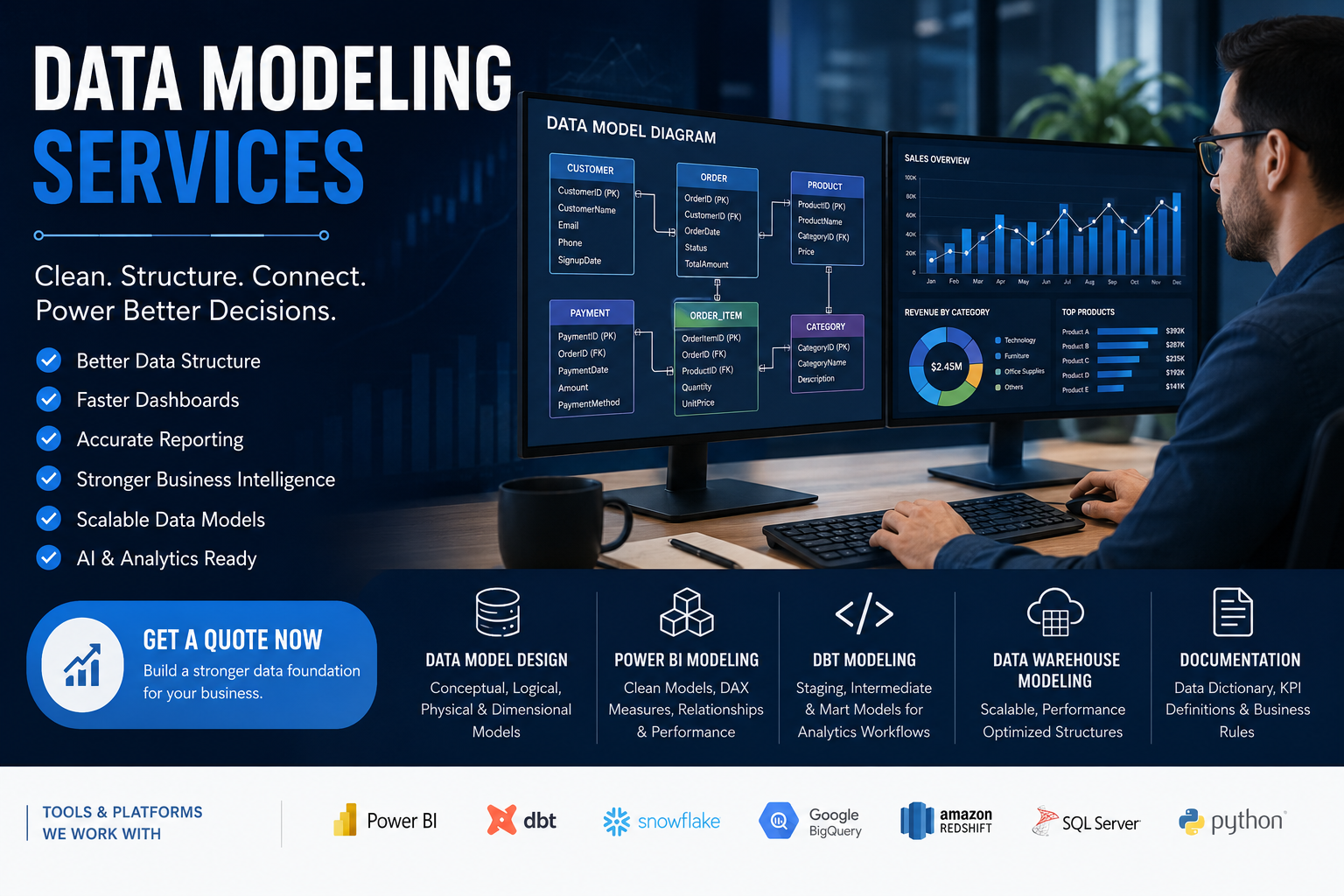
For broader analytics support, visit our Data Analysis Services. If your data needs cleanup before mining, explore our Data Cleaning Services. If your data needs a stronger structure for dashboards or BI, review our Data Modeling Services.
Our Data Mining Services
Data Science Consulting Pro provides data mining and analytics services for businesses that want to uncover useful insight from internal data, customer records, web data, transactions, documents, and operational systems. Each project depends on the business question, available data, quality of the sources, and desired output.
Business Data Mining Services
Our business data mining services help companies mine internal data from CRMs, databases, spreadsheets, ERP systems, customer records, sales platforms, finance tools, and operations systems. This is useful when a company has years of information but does not have a clear way to identify patterns or opportunities.
For example, business data mining may reveal which customer groups produce the most revenue, which products are losing momentum, which departments have recurring cost issues, or which sales channels convert best. As a result, leadership teams can make decisions based on stronger evidence instead of assumptions.
Customer Data Mining Services
Our customer data mining services help businesses understand customer behavior, repeat purchases, churn risk, lifetime value, segmentation, engagement patterns, buying preferences, and retention opportunities. This type of mining is especially useful for companies that want to improve marketing, customer success, loyalty, or revenue growth.
Customer data mining can help answer questions such as: Who are our best customers? Which customers are likely to leave? What products do customers buy together? Which customer groups respond best to certain campaigns? What behaviors appear before a renewal, cancellation, upgrade, or repeat purchase?
Web Data Mining Services
Our web data mining services help businesses collect and analyze permitted, publicly available web data for market research, product research, competitor monitoring, pricing analysis, reviews, listings, and digital trends. This can help companies understand market movement, customer sentiment, product positioning, and competitor activity.
Web data mining should always be handled responsibly. It should respect privacy, website terms, robots.txt where applicable, access restrictions, and applicable laws. We do not support illegal scraping, bypassing website protections, collecting restricted data, or using data in ways that violate privacy or compliance requirements.
Data Extraction and Mining Services
Our data extraction and mining services help businesses pull useful information from websites, PDFs, databases, spreadsheets, documents, forms, reports, and structured or semi-structured sources. After extraction, the data can be cleaned, organized, analyzed, and mined for insights.
For example, a company may need to extract pricing information from product lists, pull fields from PDF reports, collect structured details from forms, or organize information from multiple spreadsheets. Once the data is extracted, mining methods can help identify trends, patterns, and useful relationships.
Predictive Data Mining Services
Our predictive data mining services help businesses use historical data to identify likely future patterns. This may include customer churn, sales forecasts, product demand, risk signals, payment behavior, lead quality, operational delays, or customer opportunities.
Predictive data mining does not guarantee the future. However, it can help your business make better estimates based on past behavior, current patterns, and available data. This is useful for planning, forecasting, resource allocation, marketing strategy, and risk management.
Text Mining and Document Mining
Text mining helps businesses analyze unstructured written information. This may include documents, survey responses, support tickets, reviews, emails, PDFs, reports, call notes, and open-ended feedback. Because text data is often messy, important themes can easily be missed when teams review it manually.
Text mining can reveal common complaints, customer sentiment, recurring topics, service issues, product feedback, and frequently requested improvements. These insights can support customer experience, product development, operations, and executive reporting.
Sales and Marketing Data Mining
Sales and marketing data mining helps teams understand lead quality, campaign performance, buyer intent, conversion drivers, attribution signals, customer segments, upsell opportunities, and weak points in the funnel. This is useful when marketing reports show activity but do not clearly explain what drives revenue.
For example, a marketing team may discover that one campaign produces many leads but few customers, while another campaign produces fewer leads but higher deal value. Similarly, a sales team may discover that certain lead sources, industries, or customer behaviors are more likely to convert.
Operational Data Mining
Operational data mining helps teams identify bottlenecks, cost drivers, delays, quality issues, productivity gaps, process patterns, and performance trends. This is useful for companies that want to improve efficiency and reduce waste.
For example, operations teams may mine service records, delivery logs, production data, support queues, or workflow timestamps to understand where delays happen. In addition, mined insights can help teams improve staffing, scheduling, quality control, and process planning.
Financial Data Mining
Financial data mining helps finance teams mine transactions, invoices, expenses, revenue, budgets, payment patterns, profitability data, risk indicators, and anomalies. This can support budgeting, forecasting, fraud detection, cash flow analysis, and profitability reporting.
For example, a finance team may use data mining to identify unusual transactions, recurring expense increases, late payment patterns, or underperforming customer segments. As a result, finance leaders can gain a clearer view of risk, cost, and revenue behavior.
Machine Learning-Based Data Mining
Machine learning can support data mining through clustering, classification, association rules, anomaly detection, forecasting, recommendation systems, and pattern recognition. These methods are useful when businesses need to analyze larger datasets or identify patterns that may not be obvious through manual review.
Machine learning-based mining can support customer segmentation, churn prediction, fraud detection, demand forecasting, product recommendations, lead scoring, and operational risk detection. However, the quality of the output depends heavily on the quality of the data.
Data Mining Techniques We Use
The right data mining technique depends on the business question, data quality, data type, sample size, and project goal. Some projects need simple pattern discovery, while others may require predictive modeling or machine learning.
| Technique | What It Does | Business Use Case |
|---|---|---|
| Classification | Assigns records into categories | Predicting churn risk or lead quality |
| Clustering | Groups similar records together | Customer segmentation and audience grouping |
| Regression | Estimates relationships between variables | Sales forecasting and price impact analysis |
| Association Rule Mining | Finds items or behaviors that occur together | Market basket analysis and cross-sell opportunities |
| Anomaly Detection | Finds unusual records or behavior | Fraud detection and operational risk monitoring |
| Decision Trees | Splits data into decision paths | Understanding customer or sales outcomes |
| Text Mining | Extracts meaning from written content | Support ticket, review, and survey analysis |
| Sentiment Analysis | Measures positive, neutral, or negative tone | Customer experience and brand feedback |
| Pattern Recognition | Identifies repeated behaviors | Customer behavior and operational trends |
| Predictive Modeling | Uses past data to estimate future outcomes | Forecasting, churn prediction, and risk scoring |
| Market Basket Analysis | Finds products often purchased together | eCommerce bundling and product recommendations |
| Time Series Analysis | Studies changes over time | Sales trends, demand planning, and seasonality |
| Recommendation Modeling | Suggests likely products or actions | Personalization and upsell strategies |
| Customer Segmentation | Divides customers into meaningful groups | Targeted marketing and retention planning |
Data Mining Deliverables
Every data mining project should produce outputs that your business can actually use. Deliverables depend on the project scope, available sources, data quality, and business goals.
| Deliverable | Description | Business Value |
|---|---|---|
| Cleaned and prepared datasets | Organized data ready for analysis | Improves accuracy and reduces manual cleanup |
| Pattern discovery reports | Summary of important patterns found | Helps teams see hidden trends |
| Customer segmentation findings | Groups customers by behavior or value | Supports targeted marketing and retention |
| Predictive model outputs | Forecasts, scores, or probability estimates | Supports planning and risk detection |
| Anomaly detection reports | Unusual records or patterns | Helps identify fraud, errors, or operational issues |
| Trend analysis | Time-based patterns and changes | Supports forecasting and strategy |
| Market research datasets | Organized market or public web data | Improves competitive and market analysis |
| Data mining dashboards | Visual reporting of mined findings | Makes insights easier to understand |
| Statistical summaries | Key metrics and data distributions | Supports deeper analysis |
| Text mining summaries | Themes, sentiment, and recurring topics | Helps analyze feedback and documents |
| Business insight report | Clear explanation of findings | Converts analysis into decision support |
| Recommendation summary | Practical next steps | Helps teams act on the findings |
| Dashboard-ready findings | Metrics and patterns ready for BI tools | Supports reporting and visualization |
| Data quality notes | Issues found in the data | Helps improve future analytics |
| Repeatable mining workflow | Reusable process for future mining | Improves consistency and scalability |
| Documentation | Definitions, assumptions, and limitations | Builds trust and helps future users |
Data Mining Services for Better Business Intelligence
Data mining supports business intelligence by uncovering patterns that dashboards alone may not show. A dashboard may display revenue, leads, churn, or operational performance, but data mining can help explain the deeper behavior behind those metrics.
For example, mined insights can become new KPIs, dashboard filters, executive summaries, scorecards, and business intelligence reports. If a mining project reveals that certain customer groups have higher lifetime value, that segment can become part of a BI dashboard. If mining reveals that delays are linked to specific process steps, those steps can become operational KPIs.
For broader reporting and decision support, explore our Business Intelligence Services.
Data Mining Services for Dashboards and Reporting
Dashboards are stronger when they are built around meaningful patterns, not just available data. Before building a dashboard, data mining can help uncover which metrics matter, which trends are worth tracking, and which customer or operational signals need attention.
For example, a sales dashboard may become more useful after mining reveals the strongest conversion drivers. A customer dashboard may become more valuable after mining identifies churn indicators. An operations dashboard may become more actionable after mining identifies recurring bottlenecks.
If your company needs stronger reporting tools, our Dashboard Development Services can help turn mined insights into clear dashboards.
Data Mining Services for Data Visualization
Data mining findings become easier to understand when they are visualized clearly. Charts, dashboards, heat maps, segmentation visuals, trend lines, and executive summaries can help business users see patterns faster.
For example, customer segments can be shown through visual clusters. Sales trends can be shown through time-based charts. Anomalies can be highlighted in dashboards. Market research findings can be organized into tables and visual reports.
Data Mining for Market Research and Competitive Insights
Businesses can also use Data Mining Services to study market trends, customer reviews, product listings, public pricing data, competitor positioning, and demand signals. This is especially useful for companies that need better market research without relying only on manual browsing, disconnected spreadsheets, or surface-level reports.
With responsible and properly sourced data, market research data mining can help identify pricing gaps, customer complaints, product demand, review patterns, category trends, and competitive positioning. For example, a business may want to understand which product features customers complain about most often, which competitors appear in certain markets, or how pricing changes across different listings and regions.
This type of data mining can support product planning, sales strategy, market entry decisions, marketing campaigns, and pricing reviews. As a result, your team can make decisions based on clearer evidence instead of guessing from scattered online information.
For companies looking for a data mining consulting company or outsourced data mining services, market research mining can provide a structured way to organize public information into usable business insight.
Data Mining Services Across the USA
Data Science Consulting Pro provides remote and project-based data mining services USA businesses can use to uncover insights from customer data, web research, sales systems, operational records, marketing platforms, financial data, and business databases.
Because many data mining projects can be completed remotely, businesses across the United States can get support without needing a full-time in-house data mining team. Companies in major cities and growing markets often need data mining support for customer analytics, business intelligence, market analysis, sales forecasting, web research, and operational reporting.
Whether your business needs a one-time insight report, a repeatable data mining workflow, or dashboard-ready findings, we can help organize the project around your business goals.
Industries We Support
Different industries use data in different ways. A strong data mining project should reflect the business context, data sources, and decisions that matter most.
| Industry | Common Data Sources | Data Mining Benefit |
|---|---|---|
| Healthcare | Appointments, claims, patient records, operations | Better service demand and operational reporting |
| Finance | Transactions, invoices, expenses, risk records | Fraud signals, forecasting, and cost insight |
| Retail and eCommerce | Orders, products, carts, reviews, inventory | Customer behavior and product insights |
| SaaS and Technology | Product usage, subscriptions, accounts, support | Churn, activation, and expansion insights |
| Real Estate | Properties, leads, listings, rent, occupancy | Market trends and investor reporting |
| Education | Enrollment, attendance, grades, programs | Student performance and retention insight |
| Manufacturing | Production, suppliers, inventory, quality records | Downtime, quality, and demand planning |
| Logistics | Shipments, routes, delivery times, costs | Delay patterns and carrier performance |
| Marketing Agencies | Campaigns, leads, spend, conversions, SEO data | ROI, attribution, and client reporting |
| Professional Services | Projects, billing, utilization, clients | Profitability and capacity planning |
Healthcare Data Mining
Healthcare organizations can use data mining to study patient trends, appointment data, claims, operations, service demand, and reporting patterns. For example, mining may reveal appointment bottlenecks, high-demand services, recurring billing issues, or operational patterns that affect patient experience.
These insights can support administrative planning, staffing decisions, service delivery, compliance reporting, and operational improvement.
Finance Data Mining
Finance teams can mine transaction patterns, risk signals, expenses, fraud indicators, revenue trends, and forecasting data. This can help identify unusual activity, cost increases, late payment patterns, profitability issues, and revenue changes.
As a result, finance leaders can improve reporting accuracy, strengthen budgeting, and make better decisions about risk and performance.
Retail and eCommerce Data Mining
Retail and eCommerce businesses can use data mining to understand customer behavior, purchasing trends, market basket patterns, inventory movement, product performance, and retention opportunities.
For example, mining can reveal which products customers buy together, which discounts attract repeat buyers, which products have high return rates, and which customer groups are most profitable.
SaaS and Technology Data Mining
SaaS and technology companies can mine data related to churn, activation, product usage, subscriptions, customer lifecycle, support tickets, and expansion opportunities. This is useful because SaaS performance depends on understanding how users engage over time.
Mining product usage data can reveal which features drive retention, which behaviors appear before churn, and which accounts may be ready for expansion.
Real Estate Data Mining
Real estate companies can mine property data, market trends, leads, rent patterns, occupancy, listings, and investor reporting data. This can help teams identify stronger markets, lead sources, occupancy trends, pricing opportunities, and property performance patterns.
For property managers, investors, and real estate service providers, data mining can support better decisions around pricing, marketing, leasing, and portfolio strategy.
Education Data Mining
Education organizations can mine student performance, enrollment, attendance, retention, course outcomes, and program trends. This helps schools, universities, training programs, and education companies understand where students succeed, where they struggle, and which programs need attention.
These insights can support retention planning, student support, curriculum review, and administrative reporting.
Manufacturing Data Mining
Manufacturing companies can mine production data, quality issues, supplier performance, inventory, downtime, labor patterns, and demand planning data. This helps teams identify production bottlenecks, defect patterns, supplier risks, and inventory issues.
As a result, manufacturers can improve planning, reduce waste, and strengthen operational reporting.
Logistics Data Mining
Logistics companies can mine delivery times, route performance, shipment trends, cost patterns, delays, fleet records, and carrier performance. This can help identify late delivery patterns, expensive routes, unreliable carriers, and operational bottlenecks.
These insights support better planning, cost control, service quality, and customer satisfaction.
Marketing Agency Data Mining
Marketing agencies can mine ad performance, campaign data, lead quality, attribution, SEO trends, client reporting data, and ROI patterns. This helps agencies explain which campaigns are working, which audiences convert, and where clients may be wasting budget.
Data mining can also help agencies build stronger dashboards and more persuasive client reports.
Professional Services Data Mining
Professional service firms can mine project performance, billing, utilization, client profitability, service demand, and team capacity. This helps firms understand which clients are most profitable, which projects use the most resources, and where team capacity may be stretched.
These insights support better pricing, staffing, planning, and client management.
Our Data Mining Process
A clear process makes data mining more accurate, useful, and trustworthy. Instead of jumping straight into tools, we begin by understanding the business goal, data sources, and decisions the project should support.
| Step | Process Stage | What Happens |
|---|---|---|
| 1 | Data Discovery | Review goals, data availability, pain points, and insight needs |
| 2 | Data Source Review | Review databases, spreadsheets, CRMs, documents, APIs, and web sources |
| 3 | Data Cleaning and Preparation | Clean, deduplicate, format, validate, and transform data |
| 4 | Pattern and Trend Exploration | Explore trends, clusters, outliers, and relationships |
| 5 | Method Selection | Choose techniques based on the business question |
| 6 | Analysis and Model Development | Apply analytics, statistics, or machine learning where useful |
| 7 | Validation and Review | Check accuracy, usefulness, and business relevance |
| 8 | Insight Reporting | Summarize findings in reports, dashboards, or tables |
| 9 | Recommendations | Translate findings into practical next steps |
| 10 | Documentation and Next Steps | Document assumptions, definitions, limitations, and recommendations |
1. Data Discovery
We begin by reviewing your business goals, available data, reporting pain points, and insight needs. This step helps clarify what the project should answer and why the findings matter.
For example, your business may want to reduce churn, improve marketing ROI, understand customer behavior, forecast sales, or identify operational inefficiencies. The mining approach depends on the goal.
2. Data Source Review
Next, we review the data sources available for the project. This may include databases, spreadsheets, websites, APIs, CRMs, documents, dashboards, third-party data sources, customer support platforms, or marketing systems.
This step helps determine what data can be used, what data needs cleaning, and whether additional extraction or preparation is required.
3. Data Cleaning and Preparation
Most data needs cleaning before it can be mined. This may include deduplication, formatting, validation, missing value handling, field mapping, and transformation.
Clean preparation matters because poor data quality can lead to weak or misleading findings. Therefore, this step helps improve the reliability of the final insight.
4. Pattern and Trend Exploration
After the data is prepared, we explore trends, clusters, outliers, relationships, repeated behaviors, and unusual patterns. This helps identify what is happening inside the data before deeper modeling begins.
For example, this stage may reveal that a customer segment behaves differently, a product category is changing, or a certain operational issue repeats during specific periods.
5. Data Mining Method Selection
The right data mining method depends on the business problem. Customer segmentation may need clustering. Churn risk may need classification. Sales forecasting may need time series analysis. Product bundling may need association rule mining.
Choosing the right method helps make the project more focused and useful.
6. Analysis and Model Development
Depending on the project, we may use statistical methods, analytics workflows, or machine learning techniques to identify patterns and produce outputs. This may include predictive models, segmentation models, anomaly detection, text mining, or trend analysis.
The goal is not to use complex methods for their own sake. The goal is to produce findings that make sense for the business problem.
7. Validation and Review
We review the findings for accuracy, usefulness, and business relevance. This may include comparing results against known business logic, checking for data quality issues, and reviewing whether the findings are actionable.
Validation is important because data mining results should not be accepted blindly. They should be tested, reviewed, and explained clearly.
8. Insight Reporting
After analysis, we summarize the findings in a way that business users can understand. This may include reports, dashboards, tables, charts, written summaries, or presentations.
The reporting format depends on the project scope and how your team plans to use the results.
9. Recommendations
We translate findings into practical recommendations. For example, if the mining project identifies churn risk patterns, the recommendation may focus on customer retention actions. If it identifies product bundling opportunities, the recommendation may support marketing or sales strategy.
Recommendations help connect the data mining output to business action.
10. Documentation and Next Steps
We document the workflow, assumptions, definitions, limitations, and recommendations. This helps your team understand how the findings were created and how they can be used.
Documentation also makes it easier to repeat, update, or expand the mining process in the future.
Tools and Platforms We May Use
The tools used in a data mining project depend on the business question, data type, data quality, and final deliverable. Some projects may require Python or R, while others may use SQL, Excel, Power BI, Tableau, or cloud data platforms.
Trusted tools and resources may include Python, R Project, Microsoft Power BI, and Google BigQuery.
| Category | Tools and Platforms |
|---|---|
| Programming and Analytics | Python, R, SQL |
| Reporting and BI | Power BI, Tableau, Looker Studio, Excel |
| Cloud Data Platforms | Google BigQuery, Snowflake, Redshift |
| Databases | PostgreSQL, MySQL, SQL Server |
| Data Sources | APIs, web data sources, CRM data, ERP data, Google Analytics, marketing platforms |
| Business Data | Spreadsheets, documents, dashboards, transactions, support tickets |
The tool is not the strategy by itself. A successful project starts with the business question, then uses the right data and method to uncover meaningful insight.
Ethical and Responsible Data Mining
Data mining should be responsible, accurate, and compliant. This is especially important when working with customer data, web data, personal information, financial records, or sensitive business data.
Responsible data mining includes:
- respecting privacy requirements
- respecting website terms
- respecting robots.txt where applicable
- avoiding unauthorized data access
- avoiding bypassing protections or paywalls
- using data responsibly
- validating data quality
- avoiding misleading conclusions
- protecting sensitive information
- documenting assumptions and limitations
- using only permitted, authorized, or properly sourced data
Ethical data mining builds trust. It also helps reduce business risk and supports better long-term data governance.
How We Keep Data Mining Findings Reliable
Data mining findings should be useful, but they should also be reviewed carefully. At Data Science Consulting Pro, we look at data quality, source reliability, missing values, duplicate records, outliers, and business context before turning findings into recommendations. This helps reduce the risk of misleading conclusions and makes the final output easier for your team to trust.
We also document assumptions, limitations, definitions, and methodology where needed. For example, if a project uses customer records, web data, transaction data, or survey responses, your team should understand where the data came from, how it was prepared, and what the findings can reasonably support. This is especially important for predictive data mining, customer segmentation, web data mining, and market research projects.
The goal is not just to produce charts, reports, or technical outputs. The goal is to provide insights your team can review, understand, and apply. Reliable data mining should connect patterns to business context so decision-makers know what the findings mean and how to use them responsibly.
| Reliability Step | Why It Matters |
|---|---|
| Data quality review | Helps identify missing, duplicated, or inconsistent records |
| Source review | Confirms where the data came from and how it can be used |
| Outlier checks | Helps separate unusual activity from normal patterns |
| Business context review | Makes findings more practical and relevant |
| Assumption documentation | Helps teams understand how conclusions were reached |
| Limitation notes | Reduces the risk of overusing or misreading findings |
| Recommendation review | Connects insights to realistic business action |
Why Choose Data Science Consulting Pro?
Choosing the right data mining partner matters because the value of the project depends on more than technical tools. The work must connect to real business questions, reliable data, clear methods, and useful recommendations.
At Data Science Consulting Pro, we focus on practical data mining solutions that help businesses understand patterns, trends, and opportunities. We do not treat data mining as a generic technical task. Instead, we connect the work to your business goals, reporting needs, and decision-making process.
| Reason | What It Means for You |
|---|---|
| Business-first approach | The project starts with the decision or problem you need to solve |
| Clean data preparation | Data is reviewed and prepared before insight discovery |
| Analytics and reporting focus | Findings can support dashboards, BI, and executive reports |
| Predictive analytics support | Projects can support forecasting, churn, risk, and demand planning |
| Ethical methods | Data is handled with privacy, access, and responsible-use awareness |
| Clear documentation | Your team understands assumptions, methods, and findings |
| Custom solutions | The approach depends on your data, goals, and industry |
| Practical recommendations | Findings are translated into business actions |
| USA-wide consulting | Remote project support is available across the United States |
| Dashboard-ready findings | Results can support visual reporting and BI workflows |
Who Should Use Our Data Mining Services?
Our Data Mining Services are useful for businesses and teams that have data but need deeper insight. You may need support if your reports show what happened but not why, your customer segments are unclear, or your team spends too much time manually researching information.
Data mining may help:
- business owners
- executives
- operations teams
- finance teams
- marketing teams
- sales teams
- analysts
- SaaS companies
- startups
- eCommerce companies
- agencies
- companies preparing for AI or machine learning
| Sign You Need Data Mining Help | What It Means |
|---|---|
| You have too much data but not enough insight | Your team may need deeper pattern discovery |
| Reports show what happened but not why | Data mining can help explain behavior and relationships |
| Customer segments are unclear | Mining can group customers by behavior, value, or risk |
| Marketing reports are shallow | Campaign data may need deeper attribution and quality analysis |
| Sales forecasts are weak | Historical trends may need stronger exploration |
| Your team manually researches too much data | A repeatable mining workflow may save time |
| Dashboards do not reveal hidden patterns | Mining can uncover insights before dashboard design |
| You want predictive analytics | Data mining can prepare the foundation |
| You do not know which customers are most profitable | Mining can connect behavior, spend, and value |
| You cannot identify churn or retention signals | Mining can reveal early warning patterns |
What Happens After You Request a Quote?
Requesting a quote is simple. The goal is to understand your business question, review your data sources, and recommend the right project scope.
| Step | What Happens |
|---|---|
| 1. Submit Request | You share your data mining challenge through the quote form |
| 2. Project Review | Data Science Consulting Pro reviews your needs and possible scope |
| 3. Discovery Follow-Up | A call or follow-up may be scheduled for more details |
| 4. Data Source Review | Data sources and business goals are reviewed |
| 5. Recommended Scope | A project approach is recommended based on your goals |
| 6. Project Start | Work begins after the scope is approved |
| 7. Findings Delivery | Results are delivered as reports, summaries, dashboards, or documented recommendations depending on scope |
Data Mining Services Pricing
The cost of Data Mining Services depends on the amount of data, number of sources, data quality, project complexity, analysis methods, and final deliverables. A simple spreadsheet or CRM mining project may require less work than a larger project involving web data, documents, predictive modeling, dashboards, and multiple business systems.
Because every business has different data sources and goals, Data Science Consulting Pro provides custom pricing based on project scope. After reviewing your needs, we can recommend the right approach and provide a quote that matches the work required. This helps you avoid paying for unnecessary work while still getting the insight, reporting, or recommendation support your business needs.
| Project Type | Best For | Pricing Depends On |
|---|---|---|
| Basic Data Mining Review | Small datasets, spreadsheets, CRM exports | Data size, cleanup needs, and insight report depth |
| Customer Data Mining | Segmentation, churn, lifetime value, retention | Customer records, behavior data, and analysis goals |
| Web Data Mining | Public market data, listings, reviews, pricing data | Source access, volume, structure, and compliance needs |
| Predictive Data Mining | Forecasting, risk, churn, demand planning | Data quality, model complexity, and validation needs |
| Dashboard-Ready Mining | BI reports, KPI discovery, visual insights | Data sources, dashboard requirements, and reporting tools |
| Market Research Mining | Competitor data, reviews, pricing, public web data | Data availability, ethical access, and research scope |
If you want a clear price for your project, the best next step is to share your data sources, business goals, and desired deliverables so we can recommend the right scope.
Recommended Images and Alt Text
Add at least 3 images to the page so the service page looks complete and supports SEO.
| Image Placement | Image Idea | Recommended Alt Text |
|---|---|---|
| Hero section | Analyst reviewing dashboards and data patterns | Data Mining Services for business analytics and insight discovery |
| Customer analytics section | Customer segmentation or pattern discovery dashboard | Data Mining Services for customer segmentation and business intelligence |
| Predictive analytics section | Data extraction, databases, and predictive workflow | Predictive Data Mining Services for dashboards and analytics reporting |
| Final CTA section | Team reviewing an insights report | Data Mining Services for executive reporting and business decisions |
Frequently Asked Questions About Data Mining Services
What are data mining services?
Data mining services help businesses discover patterns, trends, relationships, and opportunities inside large or complex datasets. This may include customer data, sales data, marketing data, web data, transactions, documents, reviews, operational logs, and financial records.
The goal is to turn raw data into useful business insight. Instead of only showing what happened, data mining helps explain patterns, identify risks, and uncover opportunities.
How can data mining help my business?
Data mining can help your business understand customers, improve marketing, forecast sales, reduce churn, detect unusual activity, identify profitable segments, and improve operations.
For example, data mining may reveal which customer groups are most likely to buy again, which products are often purchased together, or which process steps create delays.
What is the difference between data mining and data analysis?
Data analysis usually answers specific questions about data, such as how sales changed or which campaign performed best. Data mining goes deeper by finding hidden patterns, relationships, clusters, anomalies, and predictive signals.
In simple terms, data analysis explains performance, while data mining discovers patterns that may not be obvious at first.
What is the difference between data mining and data extraction?
Data extraction focuses on pulling data from sources such as websites, databases, PDFs, forms, spreadsheets, or documents. Data mining analyzes that data to find useful patterns and insights.
Extraction gets the data. Mining helps make sense of it.
Do you offer web data mining services?
Yes. We offer web data mining services for permitted public web data, market research, product information, pricing data, reviews, listings, and digital trends.
Web data mining must respect privacy, website terms, robots.txt where applicable, access restrictions, and applicable laws. We do not support illegal scraping or bypassing protections.
Do you provide customer data mining services?
Yes. Our customer data mining services help businesses understand customer behavior, segmentation, repeat purchases, churn risk, lifetime value, engagement patterns, and retention opportunities.
These insights can support marketing, sales, customer success, and product strategy.
Can data mining help with sales and marketing?
Yes. Data mining can help sales and marketing teams understand lead quality, campaign performance, conversion drivers, customer segments, attribution signals, buyer intent, and upsell opportunities.
This helps teams focus on the campaigns, audiences, and customer groups that are more likely to create value.
Can data mining help with forecasting?
Yes. Data mining can support forecasting by identifying historical trends, seasonal patterns, demand changes, customer behavior shifts, and sales signals.
While forecasting cannot guarantee future results, it can help businesses plan with stronger evidence.
Can you mine data from spreadsheets and databases?
Yes. Data mining projects can use spreadsheets, databases, CRM exports, transaction records, sales reports, customer records, and other structured data sources.
Before mining, the data may need cleaning, formatting, deduplication, and validation so the findings are more reliable.
Can data mining support business intelligence dashboards?
Yes. Data mining can uncover patterns that become dashboard KPIs, filters, charts, scorecards, and executive summaries.
This makes dashboards more useful because they are built around meaningful insights instead of only available fields.
Is data mining useful for AI and machine learning?
Yes. Data mining can prepare your business for AI and machine learning by identifying useful patterns, cleaning data, creating features, and revealing relationships in the data.
Strong data mining work can support churn prediction, recommendation systems, forecasting, risk scoring, and customer segmentation.
What tools do you use for data mining?
The tools depend on the project. Common tools may include Python, R, SQL, Excel, Power BI, Tableau, Looker Studio, Google BigQuery, Snowflake, Redshift, PostgreSQL, MySQL, SQL Server, APIs, and marketing platforms.
The best tool depends on your data sources, business goals, and deliverables.
Is web data mining legal?
Web data mining depends on the data source, access method, website terms, privacy rules, and applicable laws. Responsible web data mining should use permitted or publicly available data and should not bypass access controls, protections, paywalls, or restrictions.
For sensitive or regulated data, legal and compliance review may be needed before collecting or using the data.
How long does a data mining project take?
The timeline depends on the project scope, data quality, number of data sources, and deliverables. A smaller spreadsheet or CRM mining project may be faster than a large project involving web data, documents, predictive modeling, and dashboards.
After reviewing your goals and data sources, a project scope and timeline can be recommended.
How much do data mining services cost?
The cost depends on the amount of data, complexity, tools, data preparation needs, analysis methods, and final deliverables. A simple insight report may cost less than a predictive modeling or dashboard-ready mining project.
The best way to get an accurate estimate is to request a quote and share your business goals and data sources.
Do you provide data mining services in the USA?
Yes. Data Science Consulting Pro provides remote and project-based data mining services USA businesses can use for customer analytics, market research, web data mining, predictive analytics, dashboards, and business intelligence.
Because many projects can be completed remotely, companies across the United States can get support without needing an on-site consultant.
Request Data Mining Services Today
If your business has too much data but not enough insight, our Data Mining Services can help you uncover patterns, trends, risks, customer behaviors, and opportunities that support smarter decisions. At Data Science Consulting Pro, we help turn raw data from customer records, sales systems, websites, spreadsheets, transactions, documents, and operational tools into clear findings your team can understand and use.
Whether you need customer segmentation, predictive analytics, market research, web data mining, dashboard-ready insights, or a business insight report, we can help you move from scattered information to practical recommendations. The right data mining approach can reduce manual research, improve reporting accuracy, reveal hidden opportunities, and give decision-makers a clearer view of what is happening in the business.
Your data should not sit unused or leave your team guessing. With a cleaner and more focused data mining process, your business can find the signals inside the noise and use those insights to improve marketing, sales, operations, customer retention, forecasting, and long-term planning.
To get started, share your project details through our quote form and we will review your data mining needs, available sources, business goals, and recommended next steps.