
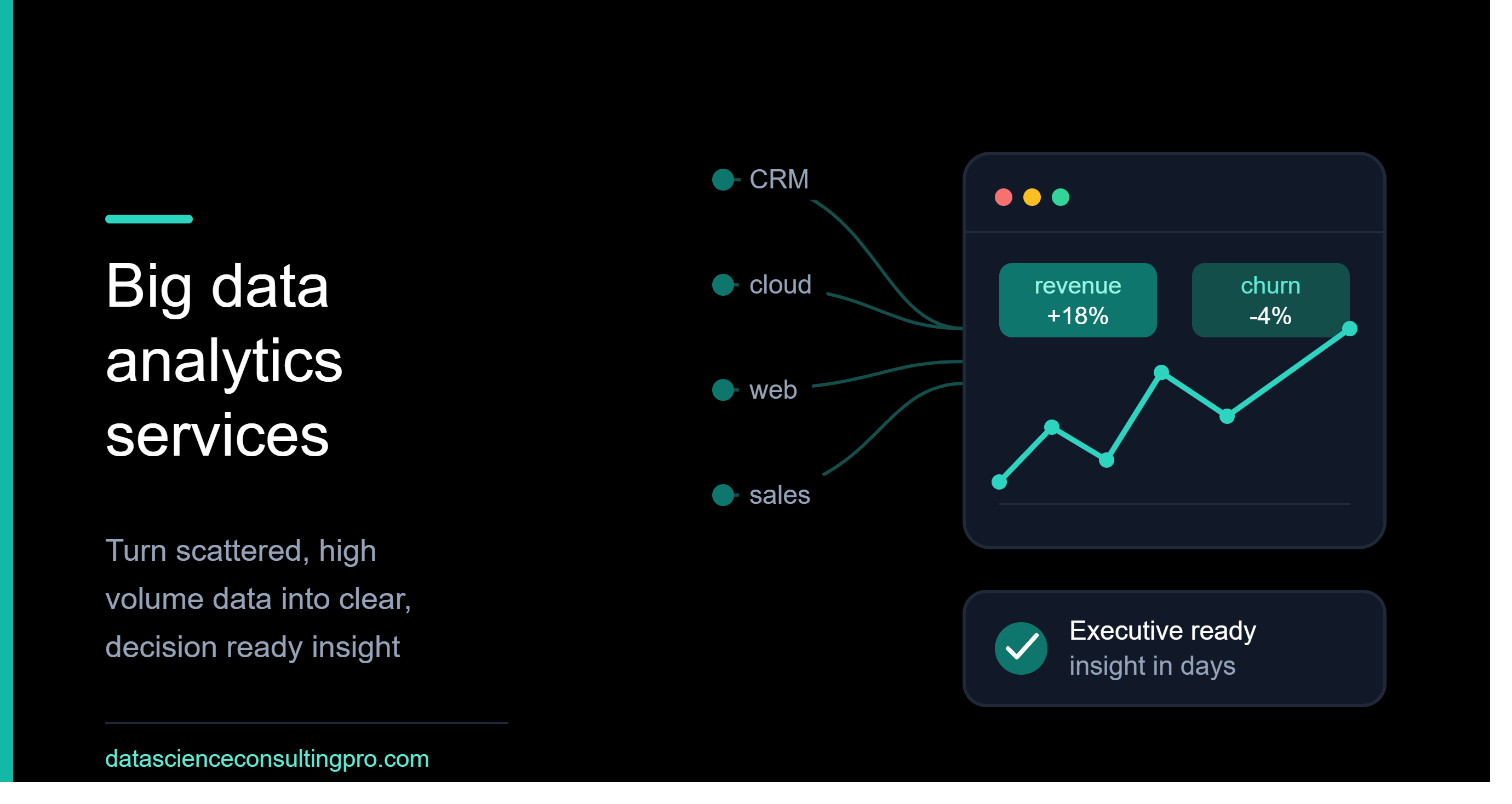
Many organizations collect large amounts of data from CRMs, ERPs, websites, mobile apps, e-commerce platforms, transactions, cloud tools, marketing platforms, finance systems, logistics records, customer touchpoints, and operational systems. However, collecting data is not the same as using data well. The real challenge is turning large, scattered, fast-growing, and complex datasets into insights that leaders can understand and act on.
Poor big data analytics can lead to slow reporting, unclear KPIs, wasted technology spend, inaccurate dashboards, missed opportunities, and weak business decisions. Large datasets can also become difficult to manage when data is spread across many systems, stored in different formats, or not prepared for analysis.
At DataScienceConsultingPro.com, we provide professional Big Data Analytics Services for businesses that need clearer insights from large datasets. We help companies analyze high-volume, multi-source, structured, and semi-structured data so they can improve reporting, understand customers, monitor operations, identify patterns, forecast outcomes, and support better decisions.
Our big data analytics support may include large dataset analysis, cloud big data analytics, data lake analytics, data warehouse analytics, big data dashboards, big data visualization services, predictive analytics, machine learning support, customer analytics, operational analytics, financial analytics, marketing analytics, logistics analytics, and executive reporting.
We focus on business outcomes, not technical complexity for its own sake. Tools such as SQL, Python, R, Apache Spark, Hadoop, Power BI, Tableau, AWS, Azure, Google Cloud, Databricks, Snowflake, and BigQuery may support a project, but the main goal is always the same: turn big data into clear insights, useful reports, and practical decisions.
Request a Big Data Analytics Quote Now
What Are Big Data Analytics Services?
Big data analytics services help companies analyze large, complex, high-volume, high-variety, or fast-moving datasets. These services are useful when normal spreadsheets, basic reports, or disconnected dashboards can no longer provide clear answers.
Big data analytics may involve large dataset analysis, multi-source data analysis, structured and unstructured data review, cloud data analytics, data warehouse analytics, data lake analytics, data preparation, data transformation, big data reporting services, big data visualization services, dashboard development, predictive analytics, machine learning, AI support, and executive recommendations.
A business may need big data analytics when customer data is spread across sales, marketing, product, and support platforms. A SaaS company may need to understand user behavior across millions of product events. An e-commerce company may need to connect orders, products, campaigns, customer segments, refunds, and inventory records. A logistics company may need to analyze delivery records, route performance, shipment delays, fleet activity, and warehouse data.
Professional big data analytics services do not simply process large files. They help answer business questions. Which customers are most valuable? Which processes create delays? Which products are driving revenue? Where are risks increasing? Which marketing channels perform best? What patterns appear across large transaction records? Which KPIs should leadership monitor?
The purpose is to convert complex data into decision-ready outputs such as dashboards, reports, forecasts, customer segments, performance summaries, predictive models, and business recommendations.
Why Big Data Analytics Matters for Modern Businesses
Big data analytics matters because many companies now produce more data than they can manually review. Data may come from websites, apps, sales systems, financial platforms, e-commerce stores, customer support tools, logistics systems, cloud databases, and marketing channels. Without a clear analytics strategy, these data sources remain scattered and underused.
Large files can also slow down reporting. Excel may struggle with big extracts. Dashboards may become unreliable if the data model is weak. Teams may disagree on KPI definitions. Leaders may receive reports that show activity but do not explain performance, risk, or opportunity.
Big data analytics helps companies move from scattered information to structured insight. It can reveal customer patterns, operational issues, financial trends, campaign performance, product usage, inventory movement, churn signals, demand shifts, and other business drivers.
| Big Data Problem | Business Risk | How Our Big Data Analytics Services Help |
|---|---|---|
| Data is spread across many systems | Teams cannot get one reliable view of performance | We connect and analyze data sources based on the agreed scope |
| Reports take too long to prepare | Managers wait too long for decisions | We help structure reporting and dashboard-ready outputs |
| Large files are difficult to analyze | Teams rely on incomplete samples or manual summaries | We support large dataset analysis and scalable analytics workflows |
| Customer behavior is unclear | Companies miss retention, upsell, or churn patterns | We analyze customer segments, behavior, and trends |
| Marketing data is scattered | Campaign performance becomes difficult to compare | We combine and analyze marketing data for clearer insight |
| Financial trends are hidden in transaction records | Finance teams may miss cost, revenue, or margin patterns | We support financial big data analytics and reporting |
| Logistics data is complex | Delays, route issues, and fulfillment gaps remain hidden | We analyze logistics and operational datasets |
| Cloud data is underused | Technology spend does not translate into business value | We help turn cloud data into reports, dashboards, and insights |
| Dashboards are slow or unreliable | Users stop trusting the reports | We support better KPI logic, data preparation, and dashboard-ready outputs |
| Predictive analytics is not ready | Models fail because the data foundation is weak | We review data readiness before forecasting, AI, or machine learning |
Our Big Data Analytics Services
Big Data Analytics Consulting
Big data analytics consulting helps companies decide how to use large datasets for reporting, analysis, forecasting, and decision-making. We review your business goals, available data, current reporting process, pain points, and expected deliverables.
This service is useful when your company has data but does not know which questions to prioritize, which KPIs matter, which systems should be connected, or which analytics approach is realistic.
Big Data Analytics Services Consulting
Big data analytics services consulting focuses on planning the right analytics scope before a project begins. We help clarify whether your company needs a dashboard, data quality review, large dataset analysis, customer segmentation, cloud analytics, predictive modeling, or a broader reporting solution.
This prevents wasted time and budget by aligning the analytics work with the decision your team needs to make.
Big Data Strategy Consulting
Big data strategy consulting helps companies plan how to use big data over time. This may include identifying priority use cases, reviewing data sources, defining KPIs, planning dashboards, assessing data quality, and deciding which analytics outputs should come first.
A strong big data strategy should support business decisions. It should not become a technical roadmap with no clear commercial value.
Large Dataset Analysis
Large dataset analysis helps companies examine data that is too big, detailed, or complex for basic spreadsheet review. This may include transaction records, customer activity logs, product usage events, financial records, logistics records, marketing data, or cloud exports.
We help summarize patterns, identify trends, compare segments, detect anomalies where appropriate, and prepare findings in a format that business teams can understand.
Multi-Source Data Analytics
Many companies need analytics across several systems. Customer data may live in a CRM, sales data in an ERP, marketing data in ad platforms, website data in analytics tools, and finance data in accounting systems.
Multi-source data analytics helps bring these views together so leadership can understand performance more clearly. The goal is to reduce disconnected reporting and support better decision-making.
Cloud Big Data Analytics
Cloud big data analytics helps companies use cloud-hosted data for reporting, dashboards, and analysis. This may involve exported cloud files, databases, data warehouses, data lakes, or cloud analytics platforms.
We can support analytics projects involving AWS, Azure, Google Cloud, BigQuery, Snowflake, Databricks, or other cloud-connected environments depending on your setup and project scope.
Data Warehouse Analytics
Data warehouse analytics helps companies analyze structured data stored in warehouse environments. This may include sales records, customer data, financial tables, product information, operational records, and reporting tables.
Warehouse analytics is useful when your company already has organized data but needs better KPI reporting, dashboards, analysis, or executive summaries.
Data Lake Analytics
Data lake analytics helps companies work with larger and more flexible data storage environments. Data lakes may hold logs, files, raw exports, semi-structured data, customer behavior data, or cloud records.
A data lake can be valuable, but only if the data can be transformed into meaningful reporting and analytics outputs. We help companies turn stored data into usable insight.
Big Data Processing and Transformation Support
Big data often needs preparation before analysis. Data may need joining, filtering, aggregation, deduplication, restructuring, field mapping, date formatting, or transformation into analysis-ready tables.
This step is important because poor preparation can produce misleading dashboards and weak conclusions. Data transformation should support the business question, not create unnecessary technical complexity.
Big Data Reporting Services
Big data reporting services help companies convert large datasets into summaries, recurring reports, executive updates, management reports, KPI reports, and stakeholder-ready outputs.
Reports may include trends, comparisons, segments, forecasts, outliers, performance metrics, and recommendations. The goal is to help decision-makers understand what the data says without reviewing thousands or millions of rows.
Big Data Visualization Services
Big data visualization services help teams communicate complex data patterns through charts, dashboards, maps, scorecards, and interactive reports. Visualization is useful when leaders need to see trends, exceptions, relationships, and performance changes quickly.
Clear visuals help reduce confusion and make big data easier to use.
Big Data Dashboard Development
Big data dashboard development turns large datasets into visual reporting tools. Dashboards can show KPIs, revenue trends, customer segments, product performance, operational delays, risk indicators, forecasts, and drill-down views.
For dashboard-focused projects, our Dashboard Development Services can support dashboard layout, visual design, filters, reporting logic, and user-friendly presentation.
Customer Big Data Analytics
Customer big data analytics helps companies understand customer behavior across touchpoints. This may include purchase history, website behavior, product usage, support tickets, campaign engagement, churn signals, customer lifetime value, and customer segments.
These insights can support retention, personalization, upsell planning, customer experience improvement, and marketing strategy.
Marketing Big Data Analytics
Marketing big data analytics helps companies understand campaign performance across channels. This may include paid ads, website traffic, lead generation, email campaigns, conversion funnels, social media data, and customer acquisition costs.
Marketing analytics can help identify which campaigns, channels, audiences, and messages are contributing to business outcomes.
Financial Big Data Analytics
Financial big data analytics helps companies review revenue, costs, transactions, margins, budgets, payments, risk indicators, and financial trends across large records.
This can support budgeting, forecasting, margin analysis, fraud or anomaly review where appropriate, financial reporting, and performance monitoring.
Operational Big Data Analytics
Operational big data analytics helps companies understand process performance, delays, capacity, resource use, production output, service timing, quality metrics, inventory movement, and workflow efficiency.
This is useful for managers who need to identify bottlenecks, compare teams, monitor service levels, or improve operational planning.
Logistics Big Data Analytics
Logistics big data analytics supports companies that manage shipments, routes, warehouses, fleet activity, inventory, supplier performance, delivery times, and order fulfillment.
A logistics analytics project can help identify late deliveries, route inefficiencies, fulfillment delays, cost patterns, warehouse pressure points, and service-level performance.
E-Commerce Big Data Analytics Services
E-commerce big data analytics services help online sellers understand orders, products, customers, carts, refunds, inventory, traffic, conversion funnels, campaign performance, and repeat purchase behavior.
An e-commerce company may use big data analytics to identify best-selling products, high-value customer groups, seasonal demand, refund patterns, abandoned cart trends, and marketing return.
SaaS Big Data Analytics
SaaS big data analytics helps companies understand product usage, subscriptions, churn, activation, feature engagement, onboarding behavior, trial conversion, support requests, and customer lifetime value.
SaaS companies often collect large volumes of event and customer data. Big data analytics can help convert that activity into product, retention, and revenue insight.
Big Data Predictive Analytics
Big data predictive analytics uses historical and current data to estimate future patterns where the data supports it. This may include demand forecasting, churn prediction, revenue forecasting, risk scoring, anomaly detection, and customer behavior prediction.
For deeper prediction-focused projects, our Predictive Analytics Services can support forecasting and model development.
Big Data Machine Learning and AI Support
Big data machine learning and AI support may be useful when large datasets can support automated pattern recognition, classification, recommendation systems, anomaly detection, or predictive models.
Not every big data project needs AI. The best method depends on the business question, data quality, available variables, sample size, and expected output. For advanced model development, our Machine Learning Services can support a broader scope.
Executive Big Data Reporting and Recommendations
Executives need clear summaries, not technical overload. We help turn big data findings into executive-ready reports, dashboards, summaries, and recommendations.
This may include KPI summaries, trend explanations, performance drivers, risks, opportunities, and next-step roadmaps.
Types of Big Data We Can Analyze
| Data Source | Common Examples | Possible Analytics Output |
|---|---|---|
| CRM data | Leads, accounts, contacts, opportunities, deal stages | Sales funnel analysis, customer segmentation, pipeline reporting |
| ERP data | Operations, inventory, procurement, finance records | Operational performance, cost analysis, inventory trends |
| Transaction records | Purchases, payments, orders, account activity | Revenue trends, customer value, anomaly review |
| E-commerce order data | Products, carts, orders, refunds, customers | Product analytics, conversion insights, repeat purchase analysis |
| Website analytics data | Sessions, traffic sources, pages, conversions | Funnel analysis, traffic performance, campaign reporting |
| App usage data | Events, sessions, feature use, retention | Product engagement and churn signals |
| SaaS product usage data | Logins, subscriptions, feature events, support records | Activation, retention, churn, customer health |
| Marketing campaign data | Ads, email, leads, channels, spend | Attribution review, ROI reporting, campaign comparison |
| Customer support tickets | Issues, categories, response times, satisfaction | Service trends, issue patterns, support performance |
| Financial records | Revenue, costs, payments, transactions | Financial trends, forecasting inputs, margin review |
| Logistics records | Shipments, routes, delivery times, warehouses | Delivery performance, route efficiency, fulfillment delays |
| Inventory data | Stock levels, movements, supplier records | Demand planning, stockout risk, inventory optimization |
| IoT or sensor data | Device logs, machine readings, time-series signals | Monitoring, anomaly detection, operational insight |
| Cloud exports | AWS, Azure, GCP, database exports | Cloud reporting and large dataset analysis |
| SQL databases | Structured business tables | Reporting tables, KPI logic, dashboard outputs |
| Data warehouse tables | Clean reporting layers and business records | BI dashboards, executive reporting, trend analysis |
| Data lake files | Raw logs, event data, large files | Transformation, exploration, and analytics outputs |
| Survey and customer feedback data | Ratings, comments, responses, categories | Satisfaction trends, sentiment themes, segment comparison |
| Social or text data | Reviews, comments, posts, support notes | Text patterns and theme analysis where appropriate |
Big Data Analytics Solutions by Business Need
| Business Need | Big Data Analytics Solution | Example Deliverable |
|---|---|---|
| Customer retention | Analyze churn signals, customer activity, and support patterns | Customer retention insights report |
| Sales performance | Review pipeline, deal movement, customer segments, and sales trends | Sales performance dashboard |
| Marketing attribution | Compare campaign data across platforms | Marketing performance report |
| Revenue forecasting | Analyze historical revenue and transaction patterns | Revenue forecast summary |
| Demand planning | Review product sales, seasonality, and inventory movement | Demand planning dashboard |
| Fraud or anomaly detection support | Identify unusual patterns in transactions or behavior | Anomaly review report |
| Operational performance | Analyze process records, output, timing, and bottlenecks | Operations KPI dashboard |
| Logistics optimization | Review routes, delivery times, shipment delays, and costs | Logistics analytics report |
| Inventory planning | Analyze stock movement and demand patterns | Inventory planning dashboard |
| Product usage analytics | Review SaaS or app feature activity | Product usage insights report |
| Executive reporting | Summarize key performance indicators | Executive dashboard |
| Risk monitoring | Track risk indicators across business data | Risk monitoring report |
| Financial trend analysis | Review revenue, costs, payments, and margins | Financial analytics dashboard |
| Customer segmentation | Group customers based on behavior or value | Segmentation output |
| Personalization support | Analyze customer preferences and behavior | Personalization-ready insights |
Big Data Dashboards and Visualization
Big data dashboards help leaders monitor large datasets without reading thousands or millions of rows. A dashboard can show KPIs, trends, segments, exceptions, forecasts, and drill-downs in one visual reporting interface.
Big data visualization services help teams communicate complex patterns clearly. Instead of overwhelming users with raw tables, visual reports can show what changed, where performance improved, where risk increased, and which segments need attention.
Big data dashboards may be built in Power BI, Tableau, Looker Studio, Python-based dashboards, or custom dashboard tools depending on the project. The right tool depends on data size, data structure, reporting frequency, user needs, and existing systems.
If your main need is dashboard design and reporting presentation, our Dashboard Development Services can help with dashboard structure, filters, visual layout, and user-friendly reporting.
Big Data Analytics for Business Intelligence
Big data analytics can support business intelligence by turning large data sources into recurring reporting systems. BI helps companies define KPI logic, build data models, create executive dashboards, produce management reports, and monitor performance over time.
Many companies need big data analytics services for enhancing business intelligence because leadership wants reporting that is faster, more reliable, and easier to interpret. Big data analytics can help prepare the insights, while BI systems help make those insights repeatable.
For companies that need recurring KPI reporting, management dashboards, and decision-support systems, our Business Intelligence Services can support a broader BI setup.
Big Data Predictive Analytics, AI, and Machine Learning
Large datasets can support advanced analytics when the data is ready. Big data predictive analytics may help with forecasting, churn prediction, recommendation systems, risk scoring, anomaly detection, demand planning, and customer behavior prediction.
AI and machine learning may also support large-scale classification, clustering, personalization, and automated pattern detection. However, not every big data project needs AI. Some companies need better dashboards first. Others need cleaner data, clearer KPIs, or better reporting logic before predictive modeling makes sense.
Predictive analytics and machine learning work best when the data foundation is strong. If your company wants future-focused analytics, our Predictive Analytics Services can help with forecasting and prediction. If you need advanced algorithmic model development, our Machine Learning Services can support AI and machine learning projects.
Big Data Analytics for Companies We Support
SaaS Companies
SaaS companies collect product usage data, subscription records, onboarding activity, feature engagement, billing data, churn signals, support tickets, and customer health indicators. Big data analytics can help identify retention patterns, product adoption issues, upgrade opportunities, and churn risks.
E-Commerce Companies
E-commerce companies collect order data, product records, customer behavior, website traffic, cart activity, marketing performance, refunds, inventory movement, and customer segments. Big data analytics can support product performance reporting, demand planning, customer segmentation, and marketing optimization.
Finance Companies
Finance companies may need analytics for transactions, payments, revenue, expenses, risk indicators, customer activity, and financial reporting. Big data analytics can help reveal trends, anomalies, cost patterns, and performance changes.
Logistics Companies
Logistics companies collect shipment data, delivery records, route information, fleet activity, warehouse logs, supplier records, and cost data. Analytics can help identify delays, route inefficiencies, fulfillment gaps, and cost drivers.
Healthcare Administrative Companies
Healthcare administrative companies may need analytics for patient experience surveys, service utilization, appointment records, quality improvement data, staffing patterns, and operational reporting. We do not provide medical diagnosis or clinical decisions. We provide analytics and reporting support based on available administrative data.
Marketing Agencies
Marketing agencies collect data from campaigns, ads, websites, landing pages, email platforms, CRM systems, and client reports. Big data analytics can help compare performance, track conversions, segment audiences, and report campaign results more clearly.
Retail Companies
Retail companies may collect POS data, inventory records, customer loyalty data, product sales, supplier information, and seasonal demand patterns. Big data analytics can support product planning, inventory visibility, and customer insights.
Insurance Companies
Insurance companies may collect policy records, claim activity, customer data, risk indicators, renewals, and service records. Analytics can help support reporting, segmentation, trend review, and operational monitoring.
Real Estate Companies
Real estate companies may collect property data, listing activity, client records, transactions, rental data, market trends, and operational records. Big data analytics can help identify market patterns, client segments, and performance trends.
Manufacturing Companies
Manufacturing companies may collect production data, quality metrics, machine records, inventory movement, supplier data, and operational logs. Big data analytics can support quality monitoring, process improvement, and production reporting.
Research Companies
Research companies may manage survey datasets, customer studies, program evaluations, longitudinal records, and mixed data sources. Big data analytics can help summarize large research datasets and prepare findings for reporting.
Nonprofit Organizations
Nonprofit organizations may collect donor data, program records, impact measures, survey responses, event records, and beneficiary information. Analytics can support impact reporting, donor segmentation, and program performance review.
Enterprise Companies
Enterprise companies often manage complex data across many departments and systems. Big data analytics can help unify reporting, improve executive visibility, and support large-scale decision-making.
Startups
Startups may collect product usage data, customer behavior, marketing data, subscriptions, sales data, and investor reporting metrics. Big data analytics can help startups identify growth drivers, improve reporting, and prepare scalable analytics foundations.
Big Data Analytics Tools and Technologies
The tools used in a big data analytics project depend on data size, data sources, cloud environment, budget, reporting needs, security expectations, and existing systems. We do not force one platform for every project.
Common tools may include SQL for querying structured data, Python and R for analysis and modeling, Apache Spark for large-scale processing, Hadoop where relevant, Power BI and Tableau for dashboards, Looker Studio for web and marketing reporting, and Excel for smaller extracts or stakeholder-friendly outputs.
Cloud tools may include AWS, Azure, and Google Cloud. Companies may also use Databricks, Snowflake, BigQuery, or other modern analytics environments.
AWS big data analytics services may support companies using AWS-connected storage, databases, and cloud exports. Azure big data analytics services may support companies using Microsoft cloud and analytics environments. GCP big data analytics services may support companies using Google Cloud, BigQuery, and related platforms.
The tool matters, but the business question matters more. The right analytics setup should help your company understand data, monitor performance, and make better decisions.
Our Big Data Analytics Process
Step 1: Project Discovery and Business Question Review
We begin by understanding your business goal. This may include improving reporting, understanding customers, analyzing operations, forecasting demand, monitoring risk, or preparing executive dashboards.
Step 2: Data Source and Access Review
We review the data sources involved. These may include CRMs, ERPs, SQL databases, cloud platforms, data warehouses, data lakes, spreadsheets, SaaS tools, website analytics platforms, or exported files.
Step 3: Data Structure, Volume, and Quality Assessment
We review the size, structure, quality, completeness, and usability of the data. This helps identify whether the data is ready for analysis or needs preparation first.
Step 4: Analytics Scope and KPI Definition
We define the analytics scope and key metrics. Clear KPIs help prevent dashboards and reports from becoming cluttered or disconnected from business needs.
Step 5: Data Preparation, Joining, Filtering, or Transformation
We prepare the data for analysis where included in scope. This may involve joining files, filtering records, aggregating values, restructuring tables, formatting fields, or creating analysis-ready datasets.
Step 6: Exploratory Analysis and Pattern Review
We examine patterns, trends, anomalies, segments, and relationships in the data. This helps identify the most useful findings before final reporting.
Step 7: Advanced Analytics, Modeling, or Segmentation Where Needed
Where appropriate, we may support predictive analysis, customer segmentation, clustering, anomaly review, forecasting, or machine learning-related outputs.
Step 8: Dashboard, Report, or Insight Development
We create the agreed output. This may include a dashboard, visual report, executive summary, analytics report, forecast output, segmentation file, or dashboard-ready dataset.
Step 9: Validation and Stakeholder Review
We review results for consistency, business relevance, and reporting accuracy. Stakeholder review helps confirm that the output answers the intended questions.
Step 10: Final Delivery, Recommendations, and Next-Step Roadmap
We deliver the final outputs and explain what the findings mean. Where included, we also provide recommendations and a next-step roadmap for reporting, dashboards, BI, predictive analytics, or data quality improvement.
Data Quality, Governance, and Security
Big data analytics depends on data quality. Missing values, duplicate records, inconsistent definitions, poor tracking, broken IDs, unclear categories, and weak data structure can reduce the accuracy of dashboards, models, and reports.
Before deeper analytics begins, data may need cleaning, standardization, transformation, or validation. If your data is messy, our Data Cleaning Services can help prepare it for analysis.
Data security also matters. We handle business data professionally and use it only for the agreed project scope. Access should be limited to what is needed. Sensitive data should not be shared until project terms and data-handling expectations are confirmed. Security expectations, file-sharing methods, access levels, and confidentiality needs should be clarified before the project starts.
We do not make unsupported compliance claims. We focus on careful data handling, clear scope, limited access where appropriate, and professional project communication.
Big Data Analytics Pricing
Pricing for Big Data Analytics Services depends on the actual project scope. Big data projects vary widely because they can involve different data sources, volumes, cloud systems, dashboards, reporting needs, data quality issues, predictive analytics, automation, and stakeholder requirements.
We do not use fake fixed prices because a simple large dataset review is very different from a multi-source cloud analytics project with dashboards, predictive modeling, and executive reporting.
Pricing depends on the number of data sources, data volume, data quality, cloud or database access needs, processing complexity, dashboard needs, reporting depth, predictive analytics or machine learning needs, data cleaning needs, number of KPIs, number of users or stakeholder views, automation requirements, security expectations, turnaround time, documentation, and handover needs.
Before quoting, we review your data sources, volume, access method, business questions, reporting requirements, data quality, preferred tools, and deadline so the price matches the actual workload. If you are comparing managed big data analytics services pricing, focus on scope clarity, data security, deliverables, quality review, and business value rather than price alone.
| Project Type | Typical Scope | Pricing Factors |
|---|---|---|
| Big data consultation | Strategy, scope review, data readiness, use case planning | Business questions, data sources, consulting depth |
| Large dataset analysis | Analysis of high-volume records or exported files | Data volume, variables, analysis complexity |
| Multi-source analytics project | Combining several business systems or files | Number of sources, joining logic, data quality |
| Big data dashboard project | Dashboard-ready data and visual reporting | KPIs, dashboard pages, interactivity, tools |
| Cloud big data analytics project | AWS, Azure, GCP, BigQuery, Snowflake, or other cloud data | Access, data volume, cloud setup, reporting needs |
| Customer big data analytics | Customer behavior, segments, retention, churn signals | Customer records, variables, segmentation needs |
| Operational big data analytics | Process, logistics, inventory, workflow, quality metrics | System complexity, KPI logic, reporting depth |
| Predictive big data analytics | Forecasting, risk scoring, churn prediction, demand planning | Data readiness, model complexity, validation needs |
| Big data machine learning support | Model-ready data, feature review, AI support | Data size, features, modeling requirements |
| Enterprise big data analytics project | Multi-department, multi-source analytics and reporting | Stakeholders, governance, automation, documentation |
Request a Big Data Analytics Quote Now
Companies Looking for Big Data Analytics Services
Companies search for big data analytics support in different ways. Some search for big data analytics services companies, while others look for a big data analytics services company that can support complex reporting, dashboards, cloud analytics, and business decision-making.
Businesses may also search for big data analytics services USA, big data analytics services in USA, big data analytics services Boston, big data analytics services in California, big data analytics services in Dubai, big data analytics services in York, or big data analytics services in Corpus Christi. DataScienceConsultingPro.com can support remote and distributed clients through secure data sharing, online communication, project reviews, and digital delivery.
The right provider should be chosen based on analytics capability, data security, business understanding, communication, tool flexibility, and delivery quality rather than location alone.
What We Need From You Before Starting
To review your project and provide a clear quote, we may need your business goal, data sources, data volume if known, file types or systems involved, current reporting problem, preferred tools, cloud platform if applicable, desired outputs, dashboard requirements, report requirements, predictive modeling needs if any, deadline, data access requirements, confidentiality requirements, and sample data where safe and appropriate.
You do not need to know the full technical solution before contacting us. You can explain the problem, describe your data, and tell us what decision or report you need.
What You Receive From Our Big Data Analytics Services
Your deliverables depend on the project scope. You may receive a data source review, data quality findings, KPI and analytics scope, cleaned or transformed analysis dataset where included, big data insights report, dashboard-ready dataset, big data dashboard, visual analytics report, customer segmentation output, forecasting or predictive model output where included, executive summary, technical notes, recommendations, next-step roadmap, or handover documentation.
The goal is to provide outputs that are clear, practical, and useful for business decisions.
When You Should Hire a Big Data Analytics Consultant
You should hire a big data analytics consultant when your data is too large for normal spreadsheets, reports take too long to prepare, or data is spread across many systems.
You may also need support when dashboards are slow or unreliable, leadership needs clearer reporting, customer behavior is difficult to understand, marketing performance is scattered across platforms, operations data is hard to interpret, or cloud data is underused.
A consultant can also help when you want predictive analytics but are not sure whether your data is ready. This prevents wasted time on models before the data, KPIs, and business questions are clear.
What This Service Is Not
Big data analytics is not a guarantee that messy or incomplete data will produce perfect insights. If the data is missing, inconsistent, poorly tracked, or unclear, the results may be limited.
This service is not a full software engineering project unless separately scoped. It is not a full data warehouse build unless included in the project. It does not guarantee ROI, revenue growth, model accuracy, or a specific business outcome.
It also does not replace internal governance, security policies, or professional compliance advice. We provide professional big data analytics, reporting, modeling, visualization, and insight support based on the available data and agreed scope.
Why Choose DataScienceConsultingPro.com?
DataScienceConsultingPro.com is a professional big data analytics company with a data science and analytics background. We help businesses turn large datasets into clearer insights, dashboards, reports, forecasts, models, and decision-support outputs.
Choose us when you need a business-first analytics approach, experience with dashboards and reporting, forecasting and modeling support, large dataset analysis, multi-source data review, clear scope, pricing transparency, confidential data handling, practical recommendations, and tool flexibility.
We can support projects that connect big data analytics with BI, dashboards, predictive analytics, machine learning, data visualization, and data cleaning where needed. For broader analytics planning and strategy, our Data Science Consulting Services can support larger data science and analytics goals.
Request Big Data Analytics Services
Your large datasets should help your company make better decisions, not create more confusion. If you have scattered data sources, slow reports, unclear KPIs, underused cloud data, complex customer records, operational data, marketing data, financial data, or product usage data, we can help.
Send your business goal, data sources, current reporting problem, desired output, preferred tools, deadline, and confidentiality requirements. DataScienceConsultingPro.com will review the scope and provide a clear quote based on the workload, data condition, tools, reporting needs, and timeline.
Request a Big Data Analytics Quote Now
FAQs About Big Data Analytics Services
Big data analytics services help companies analyze large, complex, multi-source, or fast-growing datasets to produce insights, dashboards, reports, forecasts, models, and recommendations.
SaaS companies, e-commerce companies, finance companies, logistics companies, healthcare administrative companies, marketing agencies, retail companies, insurance companies, enterprise companies, startups, and nonprofits may need big data analytics services.
We can analyze CRM data, ERP data, transaction records, e-commerce order data, website analytics, app usage data, SaaS product usage, marketing data, customer support tickets, financial records, logistics records, inventory data, cloud exports, SQL databases, data warehouse tables, and data lake files.
Yes. We can support large dataset analysis depending on the data structure, file size, access method, tools required, and project scope.
Yes. We can support cloud big data analytics projects involving AWS, Azure, Google Cloud, BigQuery, Snowflake, Databricks, or exported cloud data depending on the setup and access requirements.
Yes. We can create big data dashboards that summarize KPIs, trends, segments, exceptions, forecasts, and performance patterns.
Yes. We can support Power BI dashboards, Tableau dashboards, Looker Studio reports, and other dashboard formats depending on the project needs.
Yes. We can analyze e-commerce big data such as orders, products, refunds, customers, carts, inventory, campaigns, traffic, and conversion funnels.
Yes. We can analyze SaaS product usage data such as user activity, subscriptions, activation, churn signals, feature engagement, support activity, and customer health indicators.
Yes. Customer big data analytics may include segmentation, retention analysis, churn signals, lifetime value, support behavior, purchase history, and engagement patterns.
Yes. We can support financial big data analytics for revenue records, cost data, transactions, payments, margins, budgets, and financial trends.
Yes. We can support logistics big data analytics for delivery records, route performance, shipment delays, warehouse activity, inventory movement, supplier performance, and cost per delivery.
Yes. Big data analytics can support predictive modeling when the data is suitable for forecasting, churn prediction, demand planning, risk scoring, or anomaly detection.
Yes. Large datasets can support machine learning when the data is prepared, relevant, and suitable for the model goal.
Clean data improves the quality of big data analytics. Messy data may need cleaning, transformation, or validation before dashboards, reports, or predictive models are created.
Possible tools include SQL, Python, R, Apache Spark, Power BI, Tableau, Looker Studio, AWS, Azure, Google Cloud, Databricks, Snowflake, and BigQuery depending on the project.
Pricing depends on data volume, number of sources, data quality, access method, reporting needs, dashboards, predictive modeling, automation, security requirements, and deadline.
The timeline depends on data access, data size, quality issues, number of sources, analysis complexity, dashboard needs, modeling requirements, and review process.
Yes. We can help define KPIs based on your business goals, available data, reporting needs, and decision-making priorities.
Yes. Most big data analytics projects can be supported remotely through secure data sharing, online meetings, project updates, and digital delivery.
Yes. We handle business data professionally and use it only for the agreed project scope.
Send your business goal, data sources, current reporting problem, desired output, preferred tools, deadline, and confidentiality requirements. We will review the scope and provide a clear quote.