Many businesses want to use machine learning but are not sure where to begin. Some have customer data, transaction records, CRM exports, product usage data, sales files, marketing data, financial records, or operational data, but they do not know whether that data can support a useful model. Others have an AI idea but need proof that the model direction is practical before investing in a full production system.
The Machine Learning Model Prototype Package helps you test whether your data can support a practical machine learning model before committing to a larger AI or machine learning project. This package is designed for businesses that want a focused prototype, feasibility review, early model output, and clear recommendations.
At DataScienceConsultingPro.com, we review your business problem, assess your dataset, define a model objective, build a first-pass prototype model where the data supports it, test model performance, explain limitations, and recommend the next step. The goal is not to promise perfect accuracy. The goal is to help you understand whether machine learning is realistic, useful, and worth developing further.
This package may support prototype use cases such as customer churn prediction, lead scoring, demand prediction, risk scoring, customer segmentation, product recommendation, campaign response prediction, anomaly detection support, revenue prediction, SaaS product usage prediction, and operations workload forecasting.
We can review CRM exports, customer databases, transaction records, sales data, marketing data, e-commerce order data, SaaS product data, financial records, operational files, SQL databases, cleaned spreadsheets, and other structured datasets.
Request a Machine Learning Prototype Quote Now
What Is the Machine Learning Model Prototype Package?
The Machine Learning Model Prototype Package is a focused machine learning proof of concept designed to help your business test a model idea before full-scale development. It helps answer an important question: can your current data support a useful machine learning model for this business problem?
This package may include business problem review, data readiness assessment, model objective definition, data preparation for prototyping, feature planning, first-pass model development, model testing, performance validation, output interpretation, feasibility findings, and next-step recommendations.
A prototype is different from a production-ready machine learning system. A production system may require deployment, automation, monitoring, integrations, security workflows, APIs, user interfaces, retraining pipelines, and long-term maintenance. This package focuses on testing feasibility and model direction first.
That makes it a practical starting point for businesses that want to explore machine learning without committing immediately to a full AI build.
Who This Package Is For
The Machine Learning Model Prototype Package is suitable for startups testing an AI idea, businesses exploring machine learning, product teams testing a predictive feature, SaaS companies reviewing churn or usage signals, and e-commerce brands exploring recommendations or demand prediction.
Finance teams can use this package to test risk scoring, revenue prediction, anomaly signals, or customer scoring ideas. Marketing teams can use it to test lead scoring, campaign response prediction, audience prioritization, or conversion probability models. Operations teams can use it to test workload prediction, service demand forecasting, bottleneck signals, or anomaly detection support.
Healthcare organizations may use this package for operational forecasting, appointment demand review, service utilization patterns, survey analytics, or risk indicators related to planning and administration. This package does not provide medical diagnosis or clinical decision replacement.
Executives can use the package when they need a feasibility review before funding a larger machine learning project. Data teams can also use it when they need early model testing, performance review, or a practical second opinion before moving toward production development.
What This Package Includes
Machine Learning Use Case Review
We begin by reviewing the business problem you want machine learning to solve. A strong machine learning prototype needs a clear use case. For example, “we want to use AI” is too broad. A better model question may be, “Which customers are likely to churn in the next 60 days?” or “Which leads are most likely to convert?”
This review helps define the business goal, target outcome, available data, expected model output, and practical decision the model should support.
Data Readiness and Feasibility Review
Before building a model, we review whether your data is suitable for machine learning prototyping. We check the structure, available fields, number of records, missing values, time period, target variable, data consistency, and whether the dataset contains enough useful patterns.
This step protects your budget. If the data is not ready, we explain why and recommend what may be needed before full model development.
Target Variable and Model Objective Definition
A machine learning model needs a clear target outcome. For churn prediction, the target may be whether a customer left. For lead scoring, the target may be whether a lead converted. For demand prediction, the target may be future product demand. For risk scoring, the target may be a defined risk event.
We help clarify what the model should predict, classify, score, group, or recommend. This makes the prototype more focused and useful.
Data Preparation for Model Prototyping
Machine learning models need structured data. We prepare the dataset enough for prototype modeling. This may include reviewing missing values, standardizing fields, formatting dates, encoding categories, selecting useful variables, removing irrelevant columns, and preparing the model input structure.
If your dataset needs extensive cleaning before modeling, our Data Cleaning Services can support a deeper preparation scope.
Feature Planning
Features are the variables used by the model to detect patterns. Good feature planning can make a major difference in model usefulness.
For example, a churn prediction prototype may use customer tenure, login frequency, usage decline, support tickets, subscription type, payment behavior, and engagement history. A lead scoring prototype may use lead source, website activity, past interactions, company size, campaign source, and previous conversion outcomes.
We review which variables may be useful and explain how they relate to the business problem.
Prototype Model Development
Once the business goal and data structure are clear, we build a first-pass machine learning model where the data supports it. Depending on the use case, this may involve a classification model, prediction model, scoring model, segmentation model, recommendation prototype, or forecasting model.
The goal is to test whether the model direction is promising. We do not overcomplicate the prototype with unnecessary technical complexity. A useful prototype should be understandable, testable, and connected to a real business decision.
Model Testing and Validation
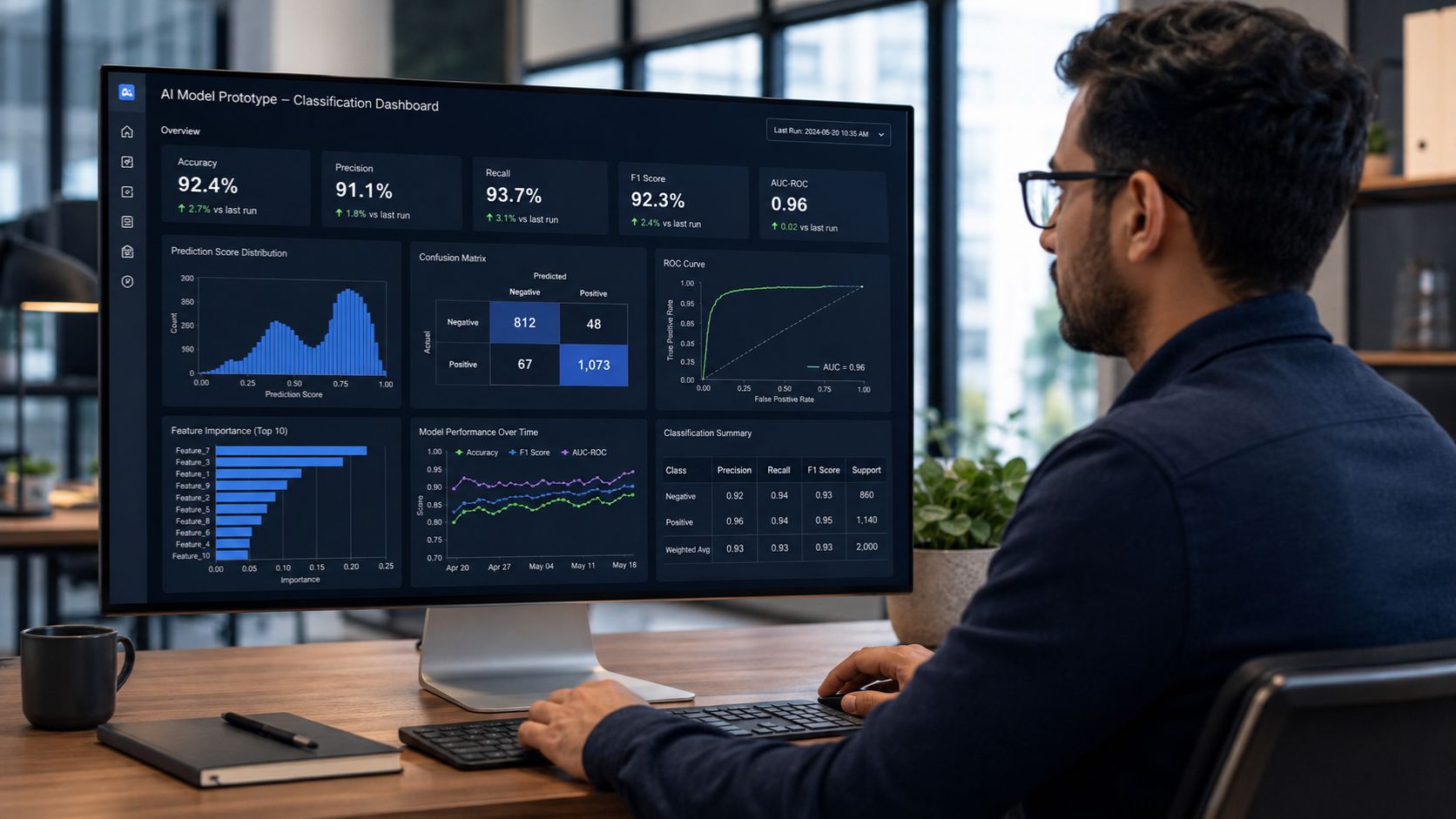
A prototype should not stop at producing numbers. We test model performance using appropriate validation methods where the data allows it. This may include train-test validation, baseline comparison, accuracy review, precision and recall checks, error review, forecast error metrics, or other performance measures depending on the model type.
This helps you understand whether the model is performing meaningfully or whether the data needs improvement before further development.
Model Output Interpretation
Machine learning outputs can be confusing if they are not explained clearly. We interpret model results in plain business language. This may include explaining scores, predicted classes, risk levels, customer segments, forecast outputs, or recommendation logic.
We also explain limitations. A prototype may show useful potential, but it may still need better data, additional variables, validation, refinement, or production engineering before it can be used operationally.
Prototype Findings Report
The package can include a clear prototype findings report. This report may summarize the business question, dataset reviewed, model approach, prototype output, performance indicators, data limitations, feasibility findings, and recommendations.
This helps executives, managers, product teams, and stakeholders understand what the prototype shows without needing to read technical code.
Recommendations for Next Steps
The final recommendation may be to move toward full model development, collect more data, improve tracking, clean the dataset, refine the target variable, test another model approach, build a dashboard for model outputs, or pause until better data is available.
The goal is to reduce uncertainty before you spend more on machine learning development.
Optional Dashboard-Ready Model Output
Some clients need model outputs prepared for reporting. We can prepare dashboard-ready files with scores, predictions, categories, risk levels, or forecast results.
If you need interactive reporting for model outputs, our Dashboard Development Services can help turn prototype outputs into clear dashboards.
Optional Technical Notes
For technical teams, we can provide notes on the modeling approach, variables used, validation method, limitations, assumptions, and recommended production considerations. These notes help your internal team understand what was tested and what would be needed next.
Popular Use Cases for This Package
| Use Case | Business Question | Prototype Output |
|---|---|---|
| Churn prediction prototype | Which customers may leave or become inactive? | Churn risk scores and key risk indicators |
| Lead scoring prototype | Which leads are more likely to convert? | Lead scores or priority groups |
| Demand prediction prototype | What demand may increase or decline? | Product, service, or workload forecast |
| Sales prediction prototype | What sales pattern may appear next? | Sales prediction summary |
| Risk scoring prototype | Which accounts or cases show higher risk? | Risk categories or probability scores |
| Customer segmentation prototype | Which customer groups behave similarly? | Customer segment output |
| Product recommendation prototype | Which products may fit each customer? | Recommendation logic or sample output |
| Campaign response prediction | Which audiences may respond better? | Response probability or audience ranking |
| Anomaly detection support | Which records or patterns look unusual? | Anomaly flags or review list |
| Operations workload prediction | Where may workload increase? | Workload forecast or demand signal |
| SaaS usage prediction | Which users may activate, retain, or churn? | Usage-based prediction output |
| E-commerce repeat purchase prediction | Which customers may buy again? | Repeat purchase probability groups |
Data We Can Review for Machine Learning Prototyping
| Data Source | What We Review | Possible Model Direction |
|---|---|---|
| CRM exports | Leads, accounts, stages, outcomes, activity | Lead scoring or churn prediction |
| Customer databases | Customer profiles, history, value, segments | Customer scoring or segmentation |
| Transaction records | Orders, amounts, dates, repeat activity | Demand prediction or customer value modeling |
| Sales data | Revenue, products, regions, reps, time periods | Sales prediction or revenue modeling |
| Marketing campaign data | Campaigns, channels, conversions, audiences | Campaign response prediction |
| E-commerce order data | Products, orders, carts, customers, revenue | Product demand or repeat purchase prediction |
| Product usage data | Feature use, sessions, engagement, activity | SaaS churn or activation prediction |
| SaaS event data | User events, logins, subscriptions, behavior | Usage scoring or retention forecasting |
| Financial records | Payments, costs, revenue, risk indicators | Risk scoring or financial forecasting |
| Operational data | Workload, timestamps, service records, capacity | Workload prediction or anomaly detection |
| Support tickets | Issues, frequency, resolution, customer history | Churn risk or service risk indicators |
| Survey or coded research data | Responses, groups, outcomes, variables | Classification or segmentation prototype |
| SQL databases | Structured business records | Model-ready dataset extraction |
| Cleaned spreadsheets | Organized structured data | First-pass model prototype |
Deliverables You Can Request
| Deliverable | Best For |
|---|---|
| Machine learning feasibility summary | Teams deciding whether ML is worth pursuing |
| Data readiness review | Clients unsure whether their data can support modeling |
| Prototype model output | Teams that need early prediction, scoring, or classification results |
| Model performance summary | Stakeholders who need evidence of model usefulness |
| Churn prediction prototype | SaaS, subscription, and customer retention projects |
| Lead scoring prototype | Sales and marketing prioritization |
| Risk scoring prototype | Finance, operations, service, or customer risk monitoring |
| Demand prediction prototype | Inventory, staffing, product, or service planning |
| Customer segmentation output | Targeting, retention, or personalization planning |
| Recommendation prototype summary | Product recommendation or content suggestion ideas |
| Model interpretation report | Managers who need clear explanation, not just technical output |
| Dashboard-ready model results | Teams preparing model outputs for visual reporting |
| Technical notes | Internal data teams or development teams |
| Next-step implementation plan | Businesses considering full model development |
Benefits of the Machine Learning Model Prototype Package
The Machine Learning Model Prototype Package helps you test an AI or machine learning idea before investing in a larger build. It gives your team an evidence-based starting point instead of relying on assumptions about what machine learning can do.
| Benefit | Business Impact |
|---|---|
| Tests feasibility before larger investment | Reduces the risk of funding the wrong AI project |
| Reviews whether data can support modeling | Shows whether your current dataset is usable |
| Clarifies the machine learning use case | Turns broad ideas into testable model questions |
| Produces first model outputs | Gives your team early predictions, scores, or segments |
| Shows early performance expectations | Helps stakeholders understand model potential |
| Identifies data gaps | Shows what must improve before production development |
| Reduces development risk | Helps avoid building a full system too early |
| Supports internal decision-making | Gives executives evidence for next-step planning |
| Helps compare model approaches | Shows which methods may be worth deeper testing |
| Creates a roadmap for production | Clarifies what a full machine learning project may require |
For advanced forecasting, churn prediction, risk scoring, or demand planning beyond a prototype, our Predictive Analytics Services can support a deeper predictive analytics scope.
How the Package Works
Step 1: Send Your Business Problem and Dataset
You send your business problem, dataset type, target outcome, data source, current reports, and deadline. You can also explain what you want the model to predict, classify, score, segment, recommend, or forecast.
Step 2: We Review the Use Case and Model Objective
We clarify the model objective and connect it to a real business decision. This keeps the prototype focused and avoids building a model that is technically interesting but not useful.
Step 3: We Assess Data Readiness and Limitations
We review whether the dataset has enough information, enough history, and a clear target outcome. We also identify limitations such as missing values, weak labels, inconsistent categories, small sample size, or poor tracking.
Step 4: We Prepare the Data for Prototype Modeling
We prepare the dataset enough to build a first-pass model. This may include cleaning fields, formatting variables, selecting features, preparing target values, and structuring the modeling file.
Step 5: We Build and Test a First-Pass Model
We build a prototype model based on the agreed objective. Depending on the project, this may involve classification, regression, clustering, scoring, forecasting, recommendation logic, or anomaly detection support.
Step 6: We Review Performance and Limitations
We test the model output and review performance where the data allows it. We explain what the model does well, where it is weak, and what should be improved before further development.
Step 7: We Explain Outputs and Next Steps
We deliver the agreed output and explain the findings in clear language. We also recommend whether to continue toward full model development, improve the data, test another model approach, or pause until the dataset is stronger.
Optional Add-Ons
This package is designed as a focused prototype. However, it can connect to larger services when the project needs more support.
If your dataset is messy, duplicated, incomplete, or inconsistent, Data Cleaning Services can help prepare the data before model prototyping.
If the prototype shows strong potential and you want a deeper or production-oriented machine learning project, Machine Learning Services can support full model development, refinement, and implementation planning.
If the prototype output needs visual reporting, Dashboard Development Services can help present scores, predictions, forecasts, or model outputs in dashboards.
If your organization needs ongoing reporting, KPI tracking, or monitoring around model outputs, Business Intelligence Services can support broader reporting workflows.
For larger analytics strategy, AI planning, or end-to-end data support, DataScienceConsultingPro.com also provides Data Science Consulting Services.
When You Should Order This Package
You should order the Machine Learning Model Prototype Package when you have an AI or machine learning idea but no tested model yet. It is also useful when you are unsure whether your data is good enough for machine learning, or when you need a proof of concept before requesting funding for full development.
This package is a good fit if you want to test churn prediction, lead scoring, customer scoring, demand prediction, risk scoring, segmentation, recommendation logic, anomaly detection support, or forecasting. It is also useful when you have historical data but no machine learning workflow.
You may also need this package if executives want evidence before approving a larger project, if your team needs to identify data gaps, or if you want a realistic recommendation before investing more.
What This Package Is Not
The Machine Learning Model Prototype Package is not a full production machine learning system. It does not include software deployment, API development, automated retraining, real-time monitoring, full integration, or AI platform development unless those items are scoped separately.
It also does not guarantee perfect accuracy. A prototype tests feasibility and early model direction. Model performance depends on data quality, historical patterns, available variables, sample size, labels, and business context.
This package is not a replacement for proper data collection. If the current data is incomplete or does not contain the target outcome, the prototype may show that more data is needed before machine learning can be useful.
This is a risk-reduction package. It helps your team decide whether machine learning is worth building further and what should happen next.
Why Choose DataScienceConsultingPro.com?
DataScienceConsultingPro.com provides machine learning prototype support with a data science, analytics, and business consulting focus. We do not build models simply because they sound advanced. We start with the business problem, review data readiness, define the model objective, test a practical prototype, and explain what the results mean.
Choose us when you need business-first model planning, data readiness assessment, prototype model testing, model performance review, plain-language interpretation, technical notes where needed, and clear recommendations for next steps.
We focus on practical usefulness, not just technical output. We also handle business data professionally and use it only for the agreed package scope.
Request the Machine Learning Model Prototype Package
Your data may hold useful patterns, but a prototype helps you test that potential before making a larger investment. If you want to explore churn prediction, lead scoring, customer segmentation, demand prediction, recommendation logic, risk scoring, anomaly detection support, or another machine learning idea, this package can help you understand what is realistic.
Send us your business problem, dataset type, target outcome, data source, preferred model goal, current reports, and deadline. We will review the package scope and provide a clear quote based on the data condition, model objective, prototype complexity, deliverables, and timeline.
Request a Machine Learning Prototype Quote Now
FAQs About the Machine Learning Model Prototype Package
The Machine Learning Model Prototype Package is a focused proof-of-concept package that tests whether your data can support a useful machine learning model for prediction, classification, scoring, segmentation, recommendation, forecasting, or anomaly detection support.
Businesses, startups, executives, SaaS companies, e-commerce brands, product teams, finance teams, marketing teams, operations teams, healthcare organizations, and agencies can order this package when they want to test a machine learning idea before full development.
You can provide CRM exports, customer data, transaction records, sales data, marketing data, e-commerce data, SaaS product usage data, financial records, operational data, SQL exports, or cleaned spreadsheets.
Yes. We can review your data structure, fields, target outcome, missing values, history, and model feasibility before building a prototype.
Yes. We can build a churn prediction prototype where the data includes customer history, activity patterns, and a clear churn outcome.
Yes. We can build a lead scoring prototype using historical lead data, engagement signals, lead source, CRM status, and conversion outcomes where available.
Yes. We can test recommendation logic where the dataset includes customer behavior, product interactions, purchase history, ratings, or usage patterns.
Yes. We can support demand, sales, revenue, product, or workload prediction prototypes where the historical data is suitable.
No. This is a prototype package. It tests feasibility, model direction, and early performance. A production system requires separate scoping.
Prototype accuracy depends on data quality, sample size, historical patterns, variables, labels, and the business problem. We do not promise perfect accuracy, but we explain performance and limitations clearly.
Yes. We can prepare model scores, predictions, segments, or forecast outputs in a dashboard-ready format where included in the package scope.
Yes. We can prepare data enough for prototype modeling. If extensive cleaning is needed, we may recommend a separate data cleaning scope.
You can request a feasibility summary, data readiness review, prototype model output, model performance summary, interpretation report, dashboard-ready output, technical notes, or next-step implementation plan.
The timeline depends on data size, data quality, model objective, prototype complexity, deliverables, and feedback needs.
The cost depends on the dataset size, data condition, model type, data preparation needs, validation requirements, deliverables, and turnaround time.
Yes. We handle business data professionally and use it only for the agreed package scope.
