
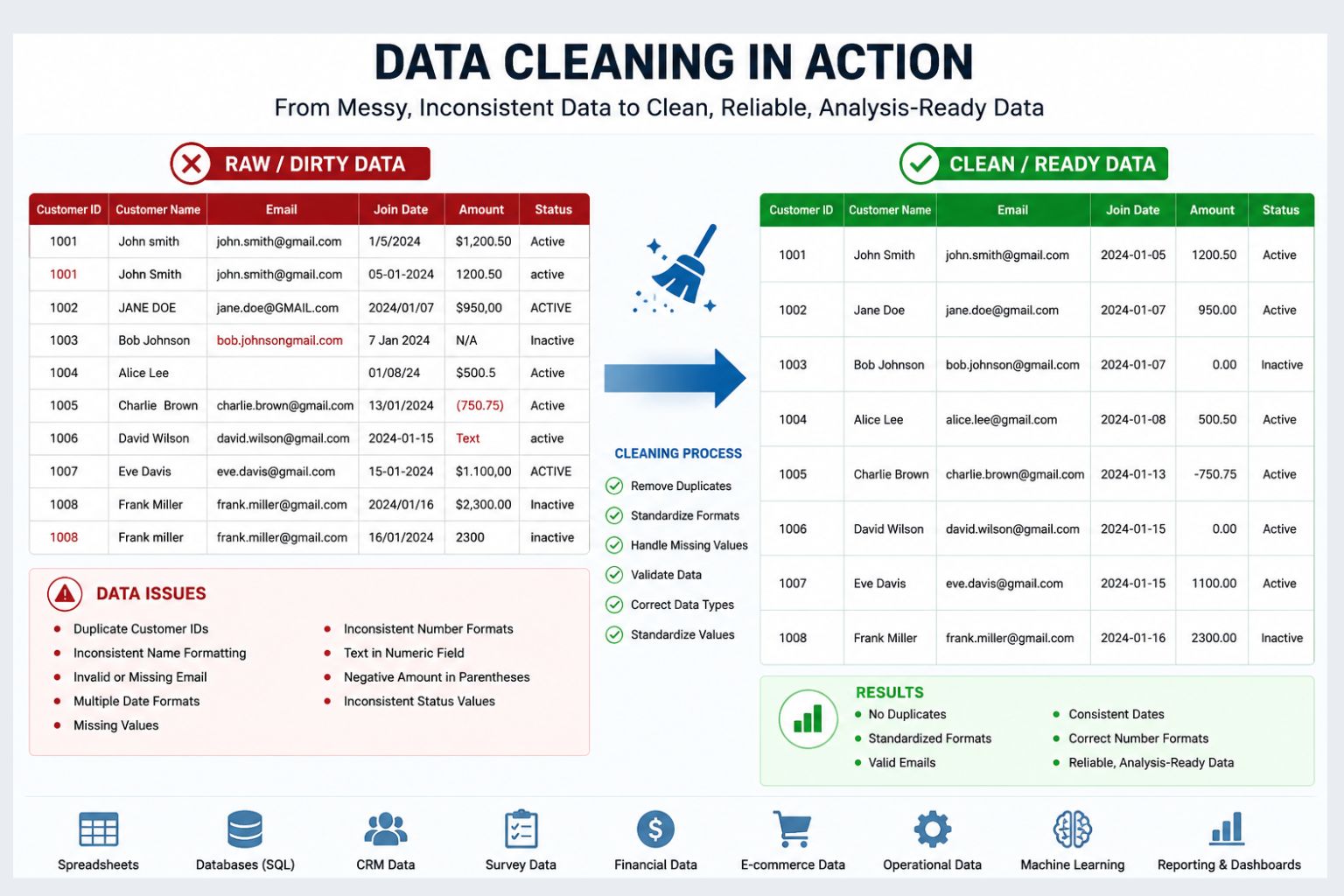
Bad data creates expensive problems.
A dashboard may look impressive and still tell the wrong story. A machine learning model may produce disappointing results because the training data contains hidden errors. A CRM system may appear to contain thousands of customers, only for a closer look to reveal that many of those records are duplicates. In some organizations, reporting problems that seem complicated turn out to have very simple causes buried in the data itself.
Most businesses do not struggle because they lack information. More often, they struggle because they no longer trust the information they already have.
As organizations grow, data naturally becomes scattered across different systems. Customer records may live in spreadsheets, CRM platforms, databases, accounting software, ecommerce systems, survey tools, and cloud applications. Over time, inconsistencies begin to accumulate. Duplicate records appear, date formats change, categories evolve, and missing values become harder to track. Eventually, these issues begin affecting reports, dashboards, and the decisions people make every day.
At DataScienceConsultingPro.com, we help businesses, analysts, researchers, and data teams transform messy datasets into reliable and analysis-ready information. Whether the data lives in Excel files, SQL databases, CRM exports, cloud warehouses, or survey platforms, the objective remains the same: making sure the numbers behind important decisions can be trusted.
Many clients who begin with Data Cleaning Services later continue with Data Analysis Services, Business Intelligence Services, Dashboard Development Services, Machine Learning Services, and Predictive Analytics Services because reliable analysis always starts with reliable information.
What Are Data Cleaning Services?
Data cleaning is the process of improving the quality of data before it is used for reporting, analytics, forecasting, or machine learning.
People often assume data cleaning simply means deleting blank rows or correcting spelling mistakes. In reality, the work goes much deeper. The purpose is not to make the data look tidy. The purpose is to ensure that the information can support reliable analysis and meaningful decisions.
After reviewing hundreds of datasets, certain patterns appear repeatedly. Duplicate records, inconsistent dates, missing values, poorly structured spreadsheets, and invalid entries are among the most common reasons organizations struggle with reporting. These issues rarely attract attention at first. Problems usually emerge later when dashboards stop matching, reports produce conflicting numbers, or teams begin questioning whether the information can be trusted.
One of the most common situations we encounter involves businesses believing there is a problem with Power BI, Tableau, or Excel. In many cases, the software is not the issue. The underlying data has simply evolved over the years without a consistent structure. Product categories change, departments use different naming conventions, and customer information gets imported from multiple systems. Eventually, small inconsistencies turn into larger reporting challenges.
Professional data cleaning helps identify those problems before they spread into dashboards, CRM systems, machine learning models, and executive reports.
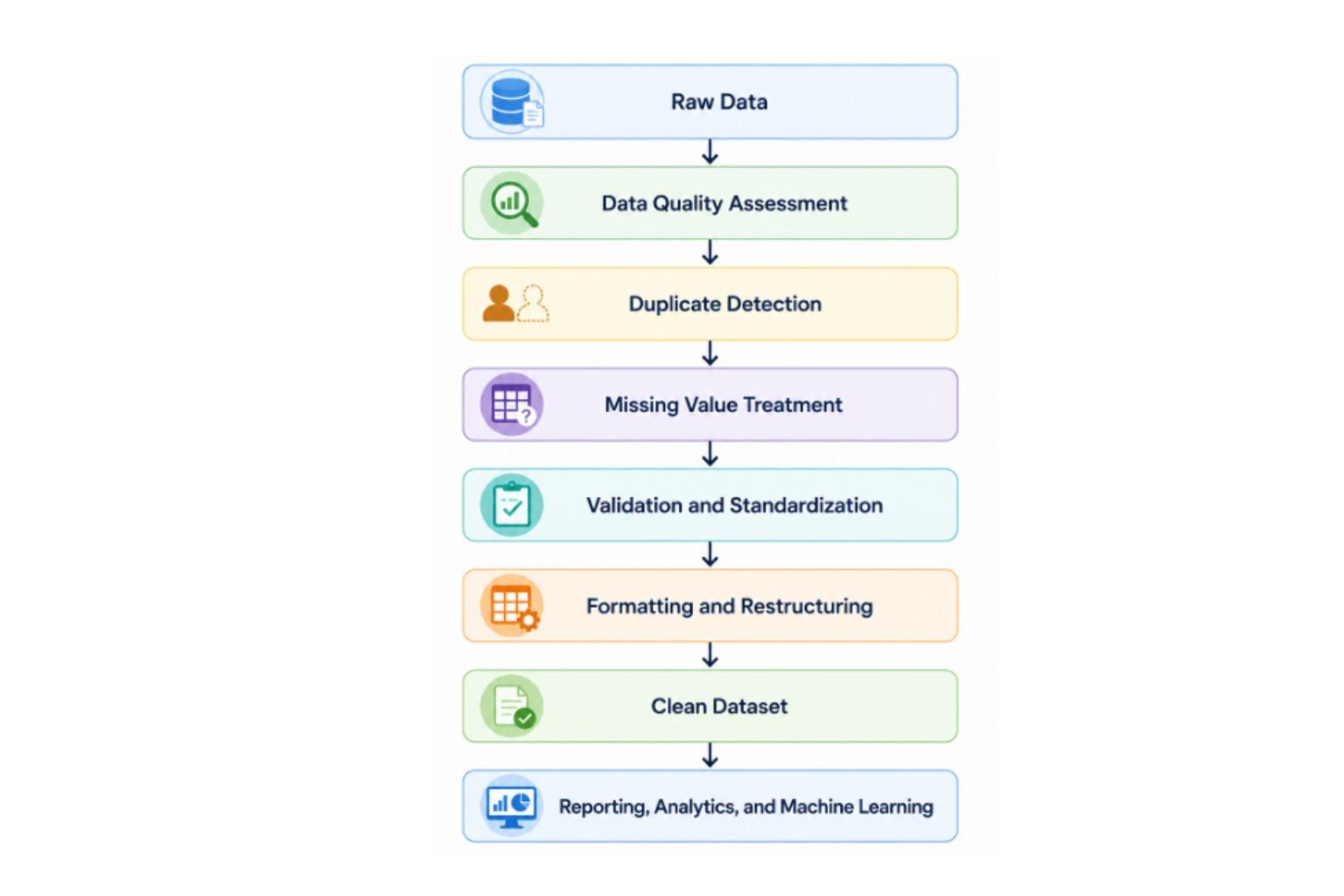
Although the process involves technical tasks such as duplicate removal, missing value treatment, validation, and standardization, the underlying objective is straightforward. Good decisions require reliable information, and reliable information begins with clean data.
Why Data Quality Matters
Every report inherits the strengths and weaknesses of the information behind it.
Sophisticated analytics tools cannot rescue poor data. At some point, every dashboard, forecast, and machine learning model reflects the quality of the source information. When the underlying data contains errors, those errors eventually make their way into reports and business decisions.
A retail client once approached us because different departments were producing different sales figures. Initially, they believed there was a problem with Power BI. After reviewing the source data, we discovered that product categories had evolved over several years. Similar products were being grouped differently across teams, causing revenue summaries to vary significantly.
Once those categories were standardized, the numbers aligned and monthly reporting became much easier. More importantly, teams regained confidence in the reports they were using to make decisions.
Another organization believed it had more than 60,000 active customers. A closer review of the CRM database revealed that thousands of records had been duplicated during previous migrations. Consolidating those records provided a much clearer picture of customer activity and improved the accuracy of the dashboards used by management.
Situations like these are surprisingly common. Analysts often spend hours correcting spreadsheets before they can begin meaningful analysis. Managers lose confidence in reports because numbers change from one month to the next. Teams end up debating which version of a report is correct instead of focusing on the decisions that matter.
Clean data alone does not guarantee good decisions, but reliable decisions rarely happen without reliable information.
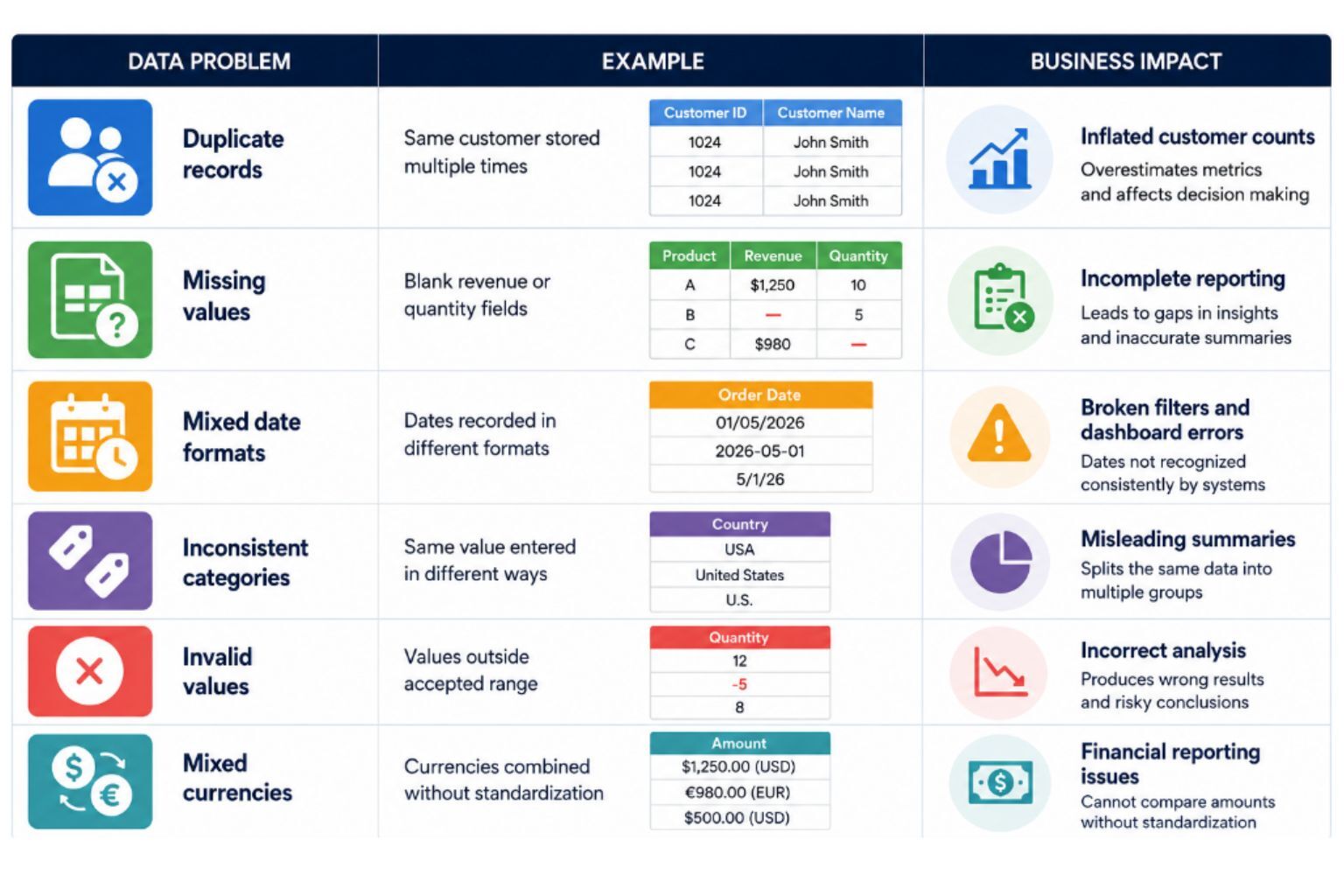
| Data Problem | Example | Business Impact |
|---|---|---|
| Duplicate records | Same customer stored multiple times | Inflated customer counts |
| Missing values | Blank revenue or quantity fields | Incomplete reporting |
| Mixed date formats | 01/05/2026 and 2026-05-01 | Broken filters and dashboard errors |
| Inconsistent categories | USA and United States | Misleading summaries |
| Invalid values | Negative quantities | Incorrect analysis |
| Mixed currencies | USD and EUR combined | Financial reporting issues |
Our Data Cleaning Services
Data cleaning is rarely a one-size-fits-all process.
A dataset prepared for a Power BI dashboard requires a different approach from one being used for machine learning, survey analysis, or CRM migration. Understanding how the information will eventually be used helps determine which records should be preserved, which fields require validation, and how inconsistencies should be handled.
This approach helps avoid one of the most common mistakes in data cleaning: changing information without understanding its purpose.
Removing Duplicate Records
Duplicate records are among the most common issues we encounter. These problems often appear after system migrations, CRM imports, or years of manual data entry. Although duplicate records may seem harmless, they can distort KPIs, inflate customer counts, and make segmentation more difficult.
Recently, we worked with a company whose customer information was spread across several systems. Many customers appeared two or three times under slightly different names. Once those records were reviewed and consolidated, the business gained a much clearer understanding of customer behavior and improved the reliability of its reports.
Rather than deleting records automatically, we evaluate how the information is being used and determine whether records should be merged, preserved, or removed.
Handling Missing Data
Missing values require careful consideration because the right approach depends on how the dataset will ultimately be used.
In some situations, removing incomplete records makes sense. In others, preserving those records provides important context. Understanding that difference helps avoid introducing unnecessary bias or losing valuable information.
Research datasets, operational systems, and forecasting models all have different requirements. Instead of applying the same rule everywhere, we consider the business objective and recommend the most appropriate treatment.
Formatting and Restructuring Data
Not every dataset is organized in a way that supports analysis.
We’ve worked with spreadsheets containing merged cells, inconsistent column names, multiple tables on a single sheet, and information stored in formats that made reporting unnecessarily difficult. While these problems may seem minor, they often create frustration for analysts and increase the risk of errors.
Formatting and restructuring data helps create a foundation for reliable reporting and analysis. Depending on the project, this may involve organizing tables, standardizing column names, converting text fields, restructuring spreadsheets, or preparing information for databases and visualization tools.
A well-structured dataset not only saves time but also makes future reporting easier and more reliable.
Cleaning CRM Data
CRM systems are valuable sources of information, but they often contain years of accumulated inconsistencies.
Duplicate contacts, incomplete records, outdated information, and different naming conventions are common issues. As sales and marketing teams grow, maintaining data quality becomes increasingly challenging.
One client discovered that customer records had been imported from multiple systems over several years. As a result, sales representatives were contacting the same prospects more than once, creating confusion and affecting customer relationships.
After reviewing and consolidating the records, the company gained a clearer view of its pipeline and improved the quality of its reporting.
Reliable CRM data supports better customer segmentation, forecasting, and decision-making.
Cleaning Survey and Research Data
Survey datasets often contain their own set of challenges.
Incomplete responses, inconsistent coding, missing values, and outliers can affect the reliability of statistical analysis. These issues become even more important when research findings influence business decisions or academic conclusions.
Rather than automatically deleting observations, we review the structure of the dataset and recommend an approach that aligns with the goals of the analysis.
Researchers and analysts frequently combine our Data Cleaning Services with Statistical Analysis Services and Data Analysis Services to ensure that findings are based on reliable information.
Preparing Data for Business Intelligence
Business intelligence tools are only as good as the information they receive.
Organizations sometimes assume that dashboards are responsible for reporting inconsistencies. In reality, many problems originate much earlier in the process. Duplicate records, inconsistent categories, and poorly structured data often create conflicting numbers and unreliable KPIs.
Preparing data for business intelligence helps ensure that dashboards tell an accurate story.
Clients frequently combine Data Cleaning Services with:
- Business Intelligence Services
- Dashboard Development Services
- Power BI Services
- Data Visualization Services
Starting with reliable data allows dashboards to become decision-making tools rather than sources of confusion.
Preparing Data for Machine Learning
Many people are surprised to learn that machine learning projects spend far more time preparing data than building models.
Algorithms can only learn from the information they are given. Missing values, inconsistent labels, duplicate observations, and poorly structured features can reduce model performance and produce unreliable predictions.
Over the years, we’ve seen many organizations focus heavily on algorithms while underestimating the importance of data quality. In most cases, improving the quality of the dataset produces greater benefits than changing the model itself.
Whether the objective is customer churn prediction, forecasting, classification, or anomaly detection, reliable data provides the foundation for reliable results.
Many clients pair Data Cleaning Services with Machine Learning Services and Predictive Analytics Services to build stronger analytical solutions.
Case Study: Retail Customer Database Cleanup
A retail company approached us because management had lost confidence in its reports.
Different departments were reporting different customer numbers, and monthly dashboards often produced conflicting metrics. Initially, the team believed there was a problem with Power BI.
After reviewing the underlying data, we discovered that customer information had been imported from several systems over the years. Thousands of customers appeared multiple times under slightly different names, and product categories varied between departments.
Once the records were consolidated and standardized, reporting became significantly more consistent. Management gained a clearer understanding of customer activity, and teams spent less time reconciling numbers.
Perhaps most importantly, confidence in the reporting process returned.
Case Study: CRM Migration and Data Standardization
A growing services company recently migrated its customer records from multiple legacy systems into a new CRM platform. Although the migration itself was successful, reporting problems quickly began to emerge.
Different departments were using different naming conventions, customer records had been duplicated over several years, and historical information was stored in inconsistent formats. Management found it increasingly difficult to understand customer activity because reports produced conflicting numbers.
After reviewing the underlying data, we standardized categories, consolidated duplicate records, and improved the structure of the dataset. Once those changes were implemented, reporting became far more reliable and teams spent less time reconciling information.
The company not only improved its dashboards but also gained greater confidence in the decisions being made across sales, marketing, and operations.
Before and After Data Cleaning Results
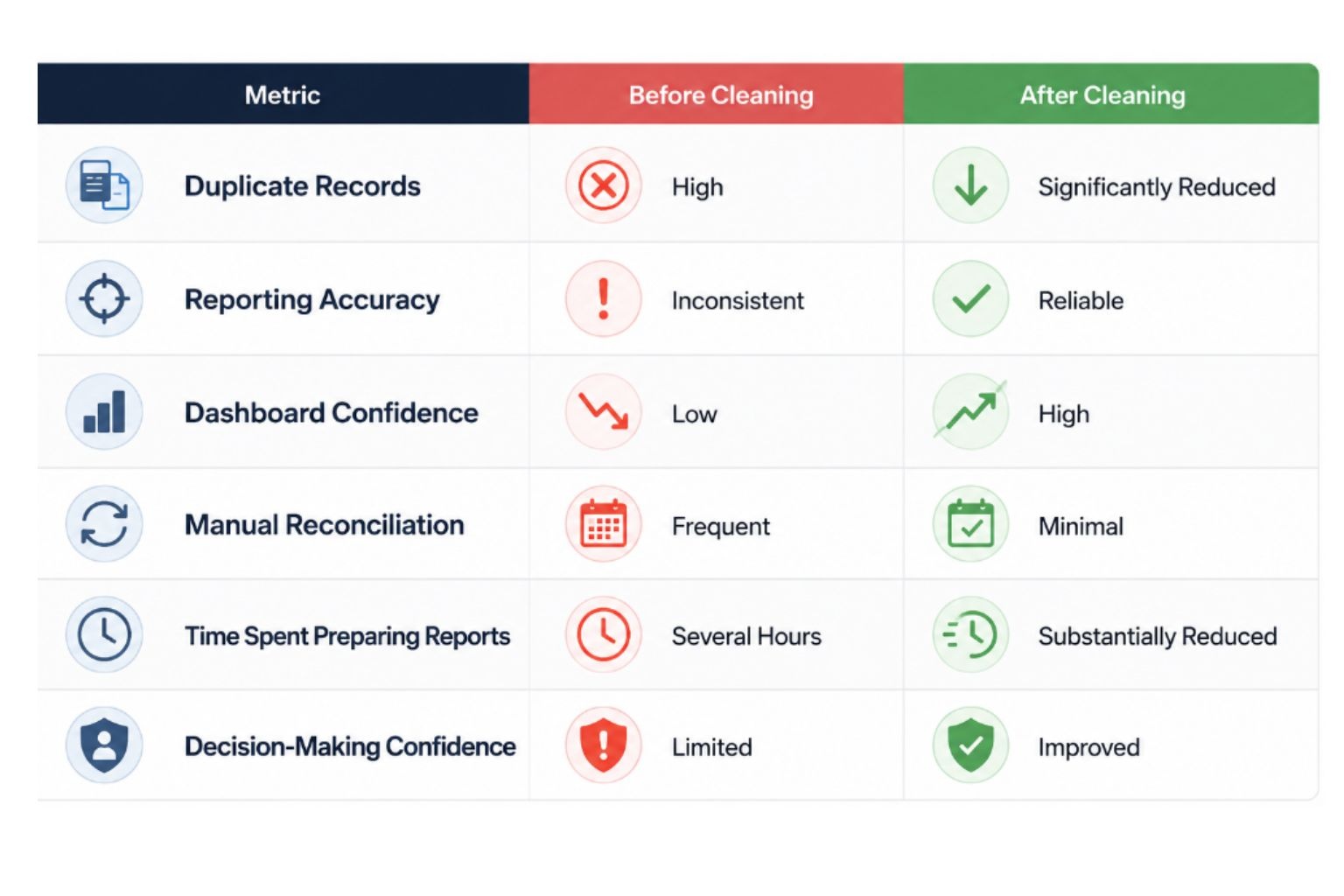
| Metric | Before Cleaning | After Cleaning |
|---|---|---|
| Duplicate Records | High | Significantly Reduced |
| Reporting Accuracy | Inconsistent | Reliable |
| Dashboard Confidence | Low | High |
| Manual Reconciliation | Frequent | Minimal |
| Time Spent Preparing Reports | Several Hours | Substantially Reduced |
| Decision-Making Confidence | Limited | Improved |
Tools We Work With
Every project is different, which means there is rarely a single tool that works for every situation.
Depending on the complexity of the dataset and the objectives of the project, we regularly work with:
- Microsoft Excel
- CSV files
- SQL
- Python
- Pandas
- NumPy
- Power BI
- Tableau
- PostgreSQL
- MySQL
- Snowflake
- R
The choice of tool depends less on technology and more on what will help clients obtain reliable results.
Industries We Support
Data quality challenges are not limited to a particular industry.
Over the years, we have worked with organizations across a wide range of sectors, including:
- Healthcare
- Finance
- Retail
- Ecommerce
- Marketing
- Education
- Research
- Manufacturing
- Professional Services
- Technology
Although the underlying problems are often similar, each industry has its own requirements and reporting challenges. That is why we tailor our approach to the needs of the organization rather than relying on a standard template.
What You Receive
Clients typically receive much more than a cleaned spreadsheet.
Deliverables may include:
- Clean and analysis-ready datasets.
- Documentation of key changes.
- Validation summaries.
- Duplicate removal reports.
- Standardized files.
- Dashboard-ready data.
- Machine-learning-ready datasets.
- Recommendations for improving future data collection processes.
The goal is not simply to fix existing problems but to create a stronger foundation for future analysis.
Why Choose DataScienceConsultingPro.com?
Cleaning data is not just about removing errors. It is about improving the quality of decisions.
Many organizations spend considerable time building dashboards and analytical models without realizing that unreliable source data is limiting the value of those efforts. In our experience, improving the quality of the data often produces greater benefits than changing the tools being used.
We approach every project with that principle in mind.
Rather than applying generic rules, we begin by understanding how the information will ultimately be used. That context helps determine how missing values should be handled, which records should be preserved, and how categories should be standardized.
This approach produces cleaner datasets, more reliable reports, and stronger analytical outcomes.
Frequently Asked Questions
Data cleaning services help improve the quality of data by identifying and correcting issues such as duplicate records, missing values, invalid entries, and inconsistent formats. The objective is to prepare information for reporting, analytics, dashboards, and machine learning.
Poor data quality can lead to inaccurate reports, unreliable dashboards, and poor business decisions. Clean data helps organizations improve confidence in their information and spend less time correcting spreadsheets.
Yes. Many projects involve Excel workbooks, CSV files, and spreadsheets collected from different systems. These datasets are often prepared for reporting, statistical analysis, or business intelligence.
Yes. We regularly work with SQL databases and structured datasets stored in MySQL, PostgreSQL, and cloud environments.
Yes. Data preparation is one of the most important steps in building reliable Power BI dashboards. Many clients combine Data Cleaning Services with Power BI Services and Dashboard Development Services.
Yes. CRM datasets frequently contain duplicate contacts, inconsistent categories, and outdated information. Cleaning and standardizing these records improves reporting and customer management.
Yes. Survey datasets often require validation, coding, missing value treatment, and preparation for statistical analysis.
Yes. Machine learning projects depend heavily on data quality. Preparing the dataset correctly often has a greater impact on model performance than changing the algorithm itself.
We support organizations across healthcare, finance, retail, research, technology, marketing, education, and professional services.
Yes. Confidentiality is extremely important. Client information is handled professionally and used only for the purposes of the project.
Final Thoughts
Most organizations already possess the information they need to make better decisions. The challenge is ensuring that the data behind those decisions is accurate, consistent, and reliable.
Clean data does not guarantee success, but poor data almost always creates unnecessary problems.
By investing in data quality, businesses spend less time fixing spreadsheets, gain greater confidence in their reports, and create a stronger foundation for analytics, dashboards, forecasting, and machine learning.
