Secure, scalable cloud infrastructure for businesses that depend on it
If your cloud environment feels like it grew by accident, with a mix of accounts, manual fixes, and documentation that was always going to happen “later,” you are not alone. Most businesses do not fail at adopting the cloud. They fail at engineering it. That means designing it to be secure, cost predictable, monitored, and ready to support the dashboards, data pipelines, and AI workloads the business actually needs.
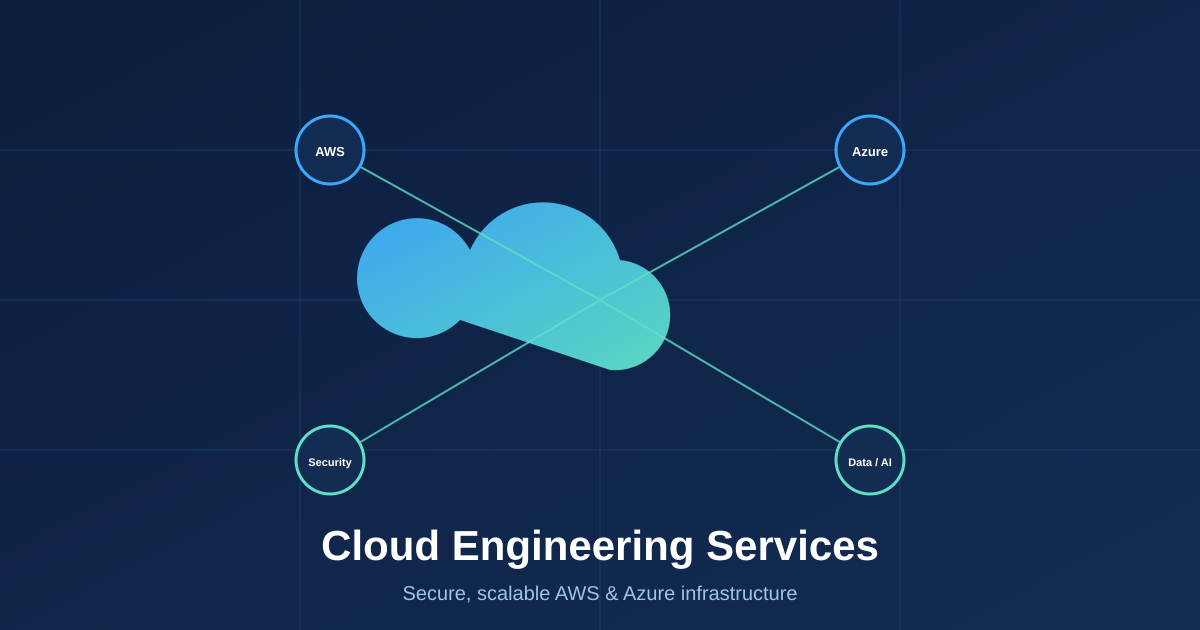
That is the gap Cloud Engineering Services close. At Data Science Consulting Pro, we design, deploy, migrate, secure, automate, and optimize cloud environments on AWS and Microsoft Azure. Our work is built to support real business operations, not just to technically function.
What Cloud Engineering Actually Means
Cloud computing is the raw material. It includes compute, storage, networking, and software delivered on demand. Most businesses already have that. Cloud engineering is what turns that raw material into something reliable. It is an environment that is secure by design, priced predictably, documented well enough that a new hire could support it, and built to scale without a full redesign every eighteen months.
A business can be “in the cloud” for years and still have none of that. That is usually when costs creep up, security reviews turn up gaps nobody knew existed, and every new dashboard or integration takes longer than it should.
Common Cloud Problems We Are Brought In to Fix
| The Problem | What It Costs You | What Good Engineering Does |
|---|---|---|
| Architecture bolted together over time | Downtime risk, scaling walls, slow performance | Rebuilds around a coherent, scalable design |
| No cost visibility | Cloud spend grows faster than usage | Adds monitoring, right sizing, and budget alerts |
| Access controls added ad hoc | Security exposure, audit failures | Applies least privilege access and structured identity management |
| Manual, one off deployments | Configuration drift, slow releases, human error | Introduces repeatable, automated deployment pipelines |
| Little to no documentation | Every handover or hire starts from zero | Produces architecture and operations documentation as a deliverable, not an afterthought |
| No real monitoring | Issues surface when a user complains, not before | Builds alerting and observability into the environment |
| Migration done without a plan | Downtime, data issues, disrupted teams | Sequences migration with testing, validation, and rollback plans |
| Disconnected systems | Dashboards and reports that do not reconcile | Designs infrastructure that supports integration and analytics from day one |
Services
Cloud Readiness Assessment
Before any migration or rebuild, we assess whether your current systems, data, security posture, and team are actually ready for it. This means reviewing existing infrastructure, applications, network setup, access controls, compliance exposure, and migration complexity. We are direct about what should move now, what should wait, and what risks need to be closed first.
You should leave this step with clear answers to which systems move, what platform fits the workload, what security gaps exist, and what it will take to support reporting and data needs once you get there.
Cloud Architecture Consulting for AWS and Azure
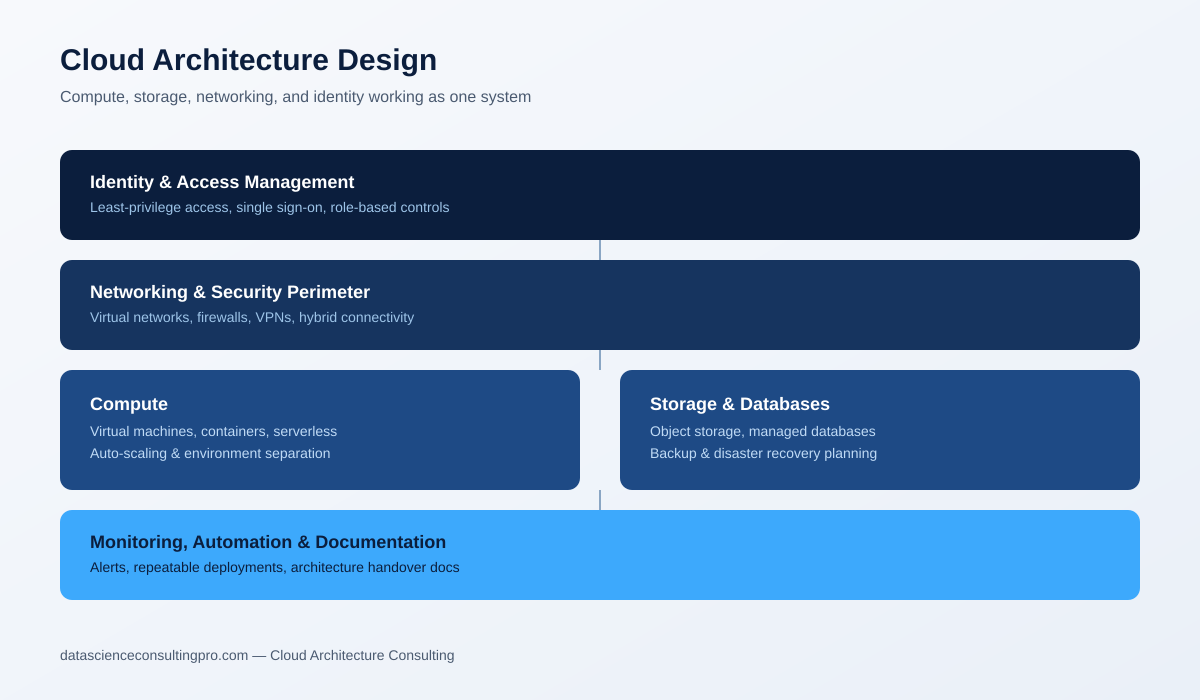
We design environments around your actual workload rather than a generic template. This includes compute and storage design, networking, identity and access management, backup and disaster recovery planning, environment separation across development, staging, and production, and security built in from the start rather than layered on after.
This matters most for businesses running BI dashboards, customer facing applications, or machine learning workloads, since these need infrastructure planned around data flow and access patterns rather than compute alone.
AWS engineering covers environment setup, networking, monitoring, cost optimization, security configuration, and infrastructure suited to analytics and machine learning workloads. It is a common fit for businesses building scalable applications or flexible data platforms.
Azure engineering covers environment setup, migration, networking, monitoring, and security. It tends to be the stronger fit for organizations already running Microsoft 365, Power BI, Dynamics, or SQL Server, since it connects more directly to that existing stack.
Cloud Migration Services
Migration done in a hurry is where most cloud disasters start. Our approach maps dependencies before touching anything, sequences the move to minimize disruption, tests and validates before cutover, and keeps a rollback plan ready in case something does not go as expected.
This covers server to cloud migration, application and database migration, cloud to cloud moves, hybrid setups, and migrating reporting or BI systems without breaking them mid transition.
Cloud Deployment Services
For businesses standing up new environments rather than migrating an old one, we build it correctly from the first resource. That means clear naming conventions, least privilege access from day one, cost visibility built in, monitoring configured before launch, and documentation that explains the reasoning behind the setup, not just the setup itself.
Cloud Networking Services
We design secure, well planned connectivity between your cloud resources, users, applications, and offices, including virtual networks, VPNs, routing, DNS, firewalls, and hybrid connectivity. This is where remote teams, branch offices, and private data systems either work smoothly or become a support headache, depending on how it is built.
Cloud Security Engineering
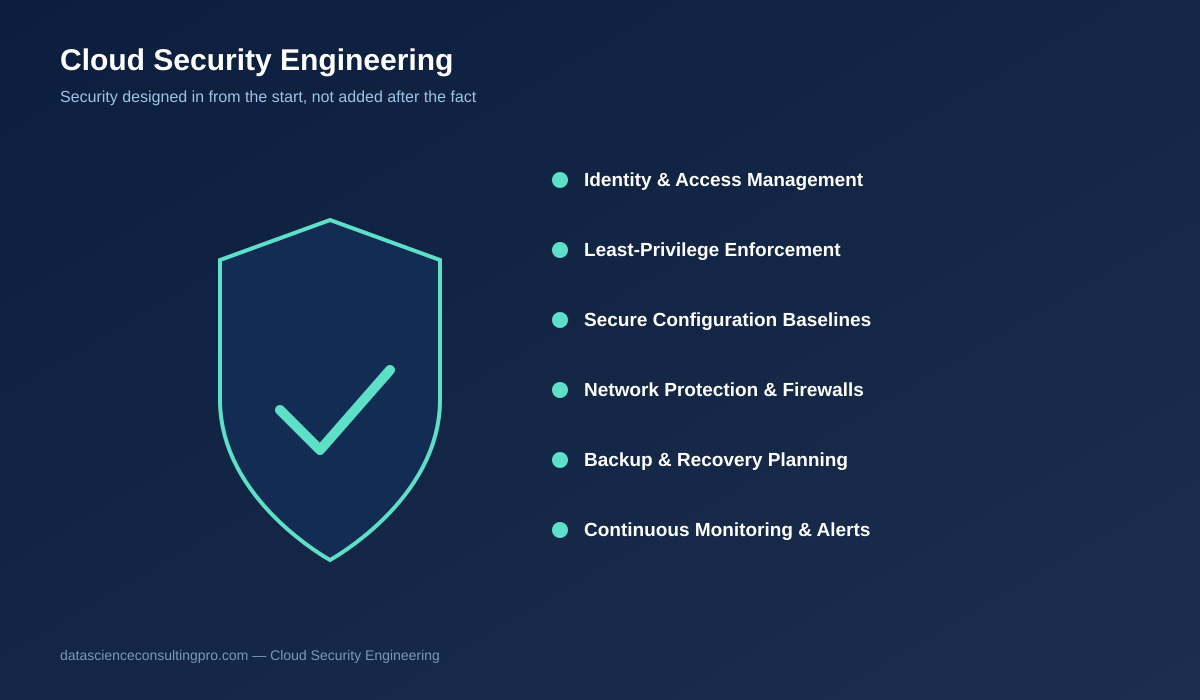
Security should be designed in, not added afterward. This includes identity and access management, least privilege enforcement, secure configuration baselines, network protection, backup planning, and monitoring alerts. For any business handling customer, financial, healthcare, or employee data, this is not optional. It is the difference between passing an audit and explaining a breach.
Cloud Automation Services
Manual cloud work does not scale. It drifts. We build automated, repeatable deployment and configuration processes so environments stay consistent across development, staging, and production, and so new environments can be stood up in hours instead of days.
Cloud Monitoring and Operations Support
You should know about a problem before your users do. We configure resource monitoring, performance and availability tracking, cost alerts, and incident visibility, along with ongoing operations support so issues get caught and documented instead of just discovered.
Cloud Cost Optimization
We review actual usage, including unused resources, oversized instances, storage inefficiencies, and workload scheduling, and give you a realistic picture of where money is going and what can be trimmed. We do not promise guaranteed savings without reviewing your specific environment first. Anyone who does has not looked at your actual usage yet.
Cloud Infrastructure for Analytics, BI, and AI
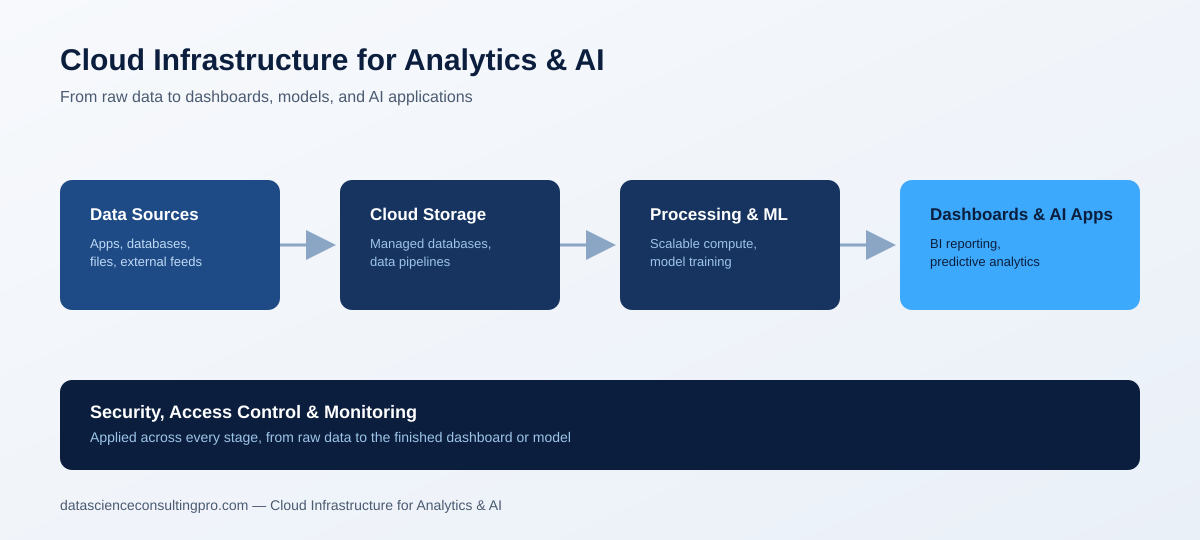
Cloud engineering is not only about hosting applications. For data driven businesses, the infrastructure underneath your dashboards and models matters as much as the models themselves.
A Power BI dashboard is only as reliable as the database, refresh pipeline, and access controls behind it. A predictive model is only as useful as the storage, compute, and monitoring supporting it. We design cloud foundations for data pipelines, BI reporting, machine learning workflows, and AI applications, with the storage, secure access, and scalability those workloads actually need.
If your project also touches data pipelines or modeling work, we coordinate directly with our Data Engineering, Business Intelligence, Dashboard Development, and Machine Learning teams, so the cloud layer and the data layer are designed together rather than handed off separately.
How We Work
| Phase | What Happens |
|---|---|
| Discovery | We learn your goals, current systems, and constraints, without a generic scoping template |
| Assessment | Review infrastructure, applications, data, and cloud readiness |
| Architecture | Design the AWS, Azure, or hybrid environment |
| Migration or Deployment | Move or build the environment, with testing at each stage |
| Security | Configure access controls, monitoring, and governance |
| Automation | Build repeatable deployment and configuration processes |
| Monitoring | Set up alerting and performance visibility |
| Documentation | Deliver architecture and operations docs your team can actually use |
| Optimization | Review cost, performance, and reliability after launch |
Pricing
Pricing depends on scope. This includes the cloud platform, number of workloads, migration complexity, security and networking requirements, and whether ongoing support is included. A readiness review costs meaningfully less than a full migration or a multi environment build, and an enterprise modernization project with multiple integrations will run higher than a straightforward startup setup.
| Package | Best For | Includes |
|---|---|---|
| Cloud Readiness Review | Businesses planning cloud adoption | Current state review, readiness assessment, risk list, recommendations |
| Cloud Setup Package | Businesses needing a new environment | Environment setup, networking, access controls, baseline security, documentation |
| Cloud Migration Package | Businesses moving workloads to the cloud | Migration planning, dependency review, deployment, testing, validation |
| Cloud Optimization Package | Businesses with rising costs or performance issues | Cost review, performance check, monitoring, right sizing |
| Cloud Analytics Infrastructure Package | Businesses building dashboards, BI, or AI systems | Analytics ready storage, secure access, data foundation |
| Ongoing Cloud Support Package | Businesses needing continuous monitoring | Monitoring, reporting, documentation upkeep, issue support |
Request a quote → and we will scope it against your actual systems and timeline, not a generic tier.
Who This Is For
Cloud Engineering Services fit a range of businesses at different stages. Startups building on the cloud from day one need speed without losing cost control. Small businesses moving off local servers need something secure and low maintenance. Growing companies with rising cloud bills need visibility into why. SaaS teams need consistent, automated environments across development, staging, and production. Healthcare and finance teams need real compliance and security work. Data driven businesses building dashboards, machine learning models, or AI workflows need infrastructure designed around those workloads. Enterprise teams need governance, documentation, and multi environment standardization.
Why Data Science Consulting Pro
Most cloud consultancies stop at infrastructure. We do not. Data Science Consulting Pro was built around the connection between cloud engineering and data work, so the cloud environment we design is the same environment that will eventually run your dashboards, your data pipelines, and your AI or machine learning workloads. We are not handing you off to a separate team that has to relearn your setup from scratch.
That shows up in how we scope a project. We do not sell fixed packages before we understand your systems. Every engagement starts with a real assessment of your current environment, your goals, and your constraints, and the recommendation that follows is built around what you actually need rather than a tier we are trying to fill. If a lighter engagement solves your problem, that is what we will recommend.
It also shows up in how we work day to day. You get direct access to the people doing the engineering, not a layer of account managers between you and the work. Architecture decisions are explained, not just delivered. Documentation is treated as part of the deliverable, not an afterthought you have to ask for. And when we talk about cost optimization or security improvements, we describe what we can realistically do for your specific environment rather than leading with a number we have not yet earned the right to promise.
We are still building our public track record, and we would rather be straightforward about that than manufacture proof we do not have yet. What we can offer instead is a clear, honest scoping conversation, a team that treats your infrastructure and your data needs as one connected problem, and a level of communication you can verify for yourself starting with the very first call.
FAQs
Cloud computing is using cloud resources such as compute, storage, and networking. Cloud engineering is designing, securing, automating, and operating those resources so they are reliable, cost controlled, and built to scale.
Cloud engineering handles the infrastructure layer, including architecture, deployment, security, and networking. Data engineering handles the data layer built on top of it, including pipelines, warehouses, and analytics ready data models. Most serious data projects need both, coordinated together.
Both. AWS tends to fit businesses building scalable applications or flexible data platforms. Azure tends to fit organizations already running Microsoft 365, Power BI, or SQL Server. We recommend a platform based on your existing stack rather than a default preference.
It can improve visibility and cut waste through right sizing, unused resource cleanup, and better monitoring. Any specific savings number depends on reviewing your actual usage first, so we will not quote a percentage before we have looked at your environment.
This depends entirely on workload count, data volume, and complexity. A single application migration and a multi system enterprise migration are not comparable timelines. We will give you a real estimate after the readiness assessment rather than before it.
Yes. This includes monitoring, cost review, documentation updates, and issue support, scoped to what your team actually needs after launch.
It helps to share your current cloud platform if you have one, your core business goals, existing systems and workloads, security or compliance requirements, reporting and data needs, your timeline, and a budget range if you have one. The more specific the information, the faster we can scope the work accurately.
Get a Cloud Engineering Quote
Send Data Science Consulting Pro your current setup, goals, timeline, and any constraints, and we will come back with a scoped recommendation rather than a generic package pitch.