
Post

ETL vs ELT: Key Differences, Benefits, and When to Use Each

Your sales dashboard reports $1.2 million in revenue, the accounting system reports $1.1 million, and the CRM shows a different customer total altogether. The problem may not be the dashboard. It may be the

Data Engineering
ETL vs ELT comparison showing how data moves from business systems through ETL or ELT workflows into cloud data platforms, dashboards, analytics, and machine learning.

Your sales dashboard reports $1.2 million in revenue, the accounting system reports $1.1 million, and the CRM shows a different customer total altogether. The problem may not be the dashboard. It may be the process used to collect, clean, combine, and move data between systems.

Businesses generate information through CRMs, accounting platforms, websites, mobile applications, spreadsheets, e-commerce stores, operational databases, enterprise software, and third-party APIs. However, this data is often duplicated, incomplete, inconsistently formatted, or stored across disconnected platforms.

Before the information can support reporting, forecasting, business intelligence, machine learning, or artificial intelligence, it must be moved into a reliable analytical environment. Two of the most common approaches are ETL and ELT.

The ETL vs ELT decision determines whether data is transformed before or after it reaches its destination. That choice can affect loading speed, data quality, security, cloud costs, scalability, raw-data retention, and the ability to change analytical models later.

Neither method is automatically better. The right choice depends on your source systems, target platform, data volume, transformation requirements, governance controls, technical capacity, budget, and business goals.

This guide explains the difference between ETL and ELT, how each process works, their advantages and limitations, and how to choose the most appropriate data pipeline architecture.

What Is the Difference Between ETL and ELT?

The main difference between ETL and ELT is when data transformation occurs.

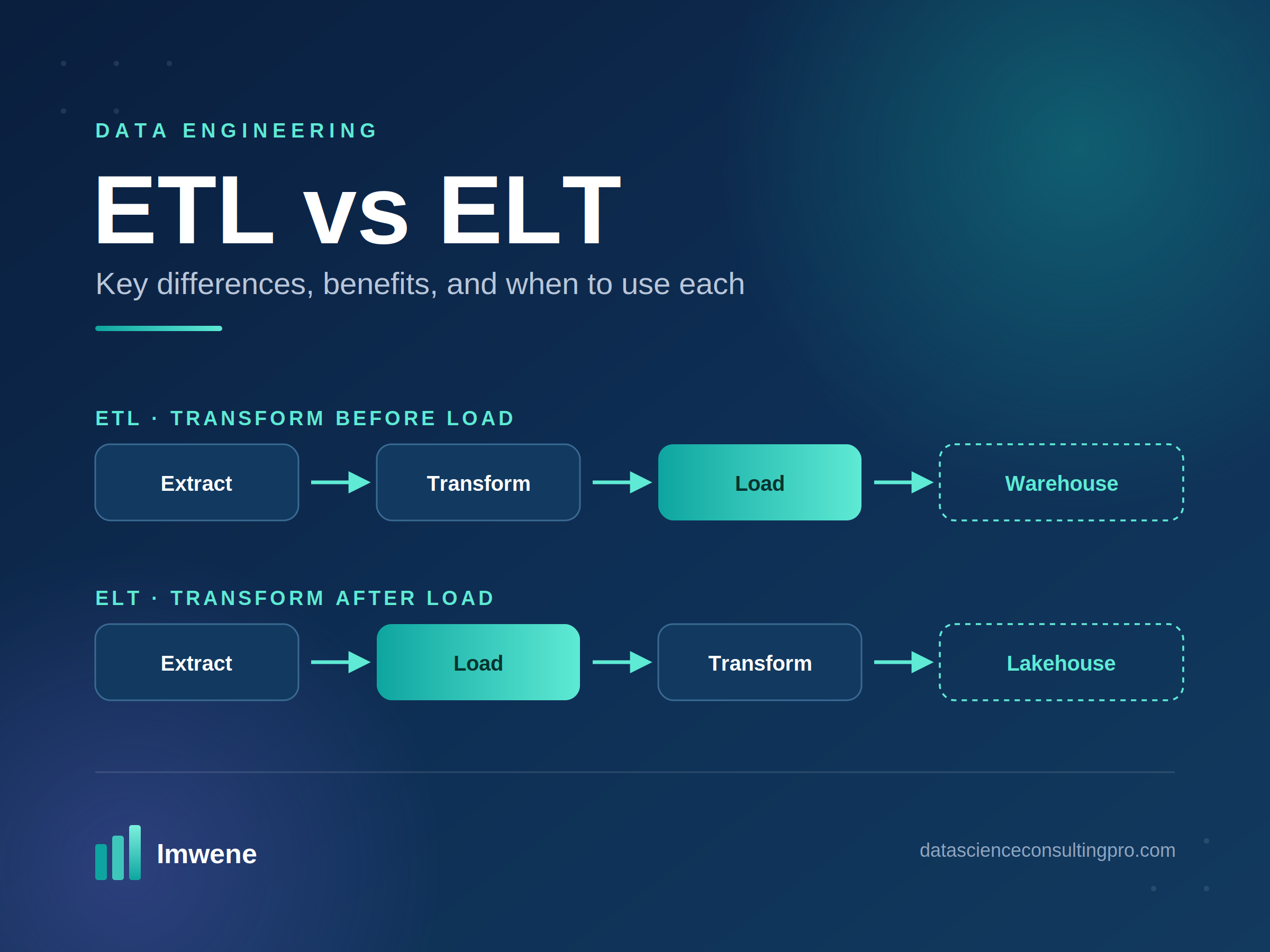
ETL: Extract → Transform → Load

ELT: Extract → Load → Transform

ETL cleans, validates, restructures, and prepares data before loading it into the target system. ELT loads raw or minimally processed data into a warehouse, data lake, or lakehouse and transforms it within that destination.

According to the AWS ETL vs ELT comparison, ETL commonly uses a separate processing environment, while ELT uses the target platform to perform transformations after loading.

Practical Recommendation

  • Choose ETL when control, validation, and protection before loading are the main priorities.
  • Choose ELT when scalable cloud transformation, raw-data retention, and analytical flexibility are more important.
  • Choose a hybrid approach when sensitive information requires pre-load controls but analysts also need flexible transformations inside the destination.

What Is ETL?

ETL means Extract, Transform, Load. It is a data integration process that retrieves information from one or more sources, prepares it according to defined rules, and loads the finished output into a target system.

The AWS explanation of ETL describes it as a process for combining data from multiple sources into a central destination where it can support analytics, reporting, and business decisions.

Extract

During extraction, data is collected from source systems such as:

  • CRM platforms
  • ERP systems
  • Accounting software
  • SQL and NoSQL databases
  • Spreadsheets and CSV files
  • Websites and mobile applications
  • E-commerce systems
  • Marketing platforms
  • Inventory software
  • SaaS applications
  • Sensors and connected devices
  • Internal and third-party APIs

Extraction may happen hourly, daily, weekly, in real time, or whenever a specific business event occurs.

A reliable extraction process should record when the data was collected, which records were retrieved, whether the source changed, and whether any records failed.

Transform

The transformation stage prepares extracted data for its intended use.

Common transformations include:

  • Removing duplicate records
  • Correcting data types
  • Standardizing dates and time zones
  • Handling missing values
  • Validating required fields
  • Standardizing customer and product names
  • Converting currencies
  • Joining tables
  • Calculating business metrics
  • Masking confidential fields
  • Grouping transactions
  • Applying business rules
  • Checking relationships between datasets

Suppose one system records a customer as “ABC Limited,” another uses “ABC Ltd,” and a third uses “A.B.C. Company.” The transformation process can match these entries and create one approved customer record.

Load

After transformation, the prepared data is loaded into a destination such as:

  • A relational database
  • A data warehouse
  • A data mart
  • A reporting platform
  • A business intelligence model
  • A data lake
  • A lakehouse

The pipeline may replace a complete table, append new records, update changed records, or use incremental loading to move only information added or modified since the previous run.

What Is ELT?

ELT means Extract, Load, Transform.

Data is collected from its sources and loaded into the target platform before major transformations are completed. The target warehouse, data lake, or lakehouse then provides the computing resources needed to clean, combine, validate, and model the information.

Google Cloud defines ELT as a pipeline model in which source data is loaded into a target data store before transformations are applied. Read the official Google Cloud explanation of ELT.

Extract

ELT retrieves information from databases, applications, APIs, files, logs, event streams, or business systems.

The pipeline may perform limited preparation during extraction, such as:

  • Adding source timestamps
  • Encrypting data during transfer
  • Checking the file format
  • Recording source metadata
  • Confirming that required files arrived

Major business transformations are generally postponed until after loading.

Load

The information is loaded into the destination in its original or near-original form.

A well-designed ELT environment commonly separates data into layers:

  • Raw layer: Preserves source-level information.
  • Validated layer: Corrects structural and quality problems.
  • Curated layer: Applies approved business rules.
  • Reporting layer: Provides tables for dashboards, analysis, and business users.

Preserving the original data allows teams to investigate errors, repeat transformations, create new models, and reproduce earlier reports without returning to every source system.

Transform

Transformations occur inside the target environment using technologies such as:

  • SQL
  • Python
  • Apache Spark
  • Warehouse functions
  • Stored procedures
  • dbt models
  • Distributed processing frameworks

The same raw dataset can support separate models for finance, marketing, operations, sales, customer success, forecasting, and machine learning.

The dbt documentation on models explains how SQL or Python models can be used to transform source data into structured datasets within modern analytical workflows.

ETL vs ELT process comparison showing transformation before loading in ETL and transformation after loading in ELT.
ETL transforms data before it reaches the destination, while ELT loads data first and transforms it inside the target warehouse, data lake, or lakehouse.

ETL vs ELT Comparison Table

Comparison areaETLELT
Full meaningExtract, Transform, LoadExtract, Load, Transform
Transformation timingBefore loadingAfter loading
Transformation locationSeparate processing or staging environmentTarget warehouse, lake, or lakehouse
Initial loadingMay take longer because data is prepared firstCan make source data available sooner
Raw-data retentionMay retain only selected or transformed dataCommonly preserves source-level data
Target schemaUsually defined before loadingCan support evolving analytical models
Structured dataStrong fitStrong fit
Semi-structured dataPossible but may require additional preparationOften easier to retain and process
Traditional systemsFrequently suitableDepends on destination capabilities
Cloud platformsSupportedCommonly associated with cloud warehouses and lakehouses
ScalabilityDepends on the separate transformation engineCan use scalable target-platform computing
Storage requirementsMay be lower when unnecessary data is excludedMay be higher because raw and intermediate data are retained
ReprocessingMay require another extractionRaw data can often be transformed again
Sensitive informationCan be removed or masked before loadingRequires controls immediately after arrival
FlexibilityStrong for stable and predefined rulesStrong for changing analytical requirements
Cost driversProcessing infrastructure, licences, engineering, maintenanceStorage, warehouse computing, queries, governance
Common usersData engineers and centralized IT teamsData engineers, analytics engineers, analysts
Typical destinationsDatabases, traditional warehouses, data martsCloud warehouses, data lakes, lakehouses
Best useControlled and predictable data workflowsScalable and flexible analytical environments

The Main Difference Between ETL and ELT

The most important difference is not simply the order of the letters. It is where and when the transformation work happens.

In ETL, a separate process prepares the data before it reaches the analytical destination. In ELT, the destination platform performs most transformations after the data has been loaded.

This decision affects:

  • How quickly data reaches the target platform
  • Whether raw information is preserved
  • Where sensitive fields are removed
  • How transformation workloads scale
  • How easily business rules can change
  • How errors are investigated
  • How historical data is reprocessed
  • Which team maintains the logic
  • How cloud costs are controlled
  • How governance responsibilities are distributed

ELT may reduce the need for a separate transformation environment, but it transfers more responsibility to the target platform. The organization must control raw-data access, transformation workloads, storage growth, documentation, and data quality.

ETL Example: Retail Reporting Pipeline

Consider a retailer that needs a daily profitability dashboard.

The company collects data from:

  1. Its e-commerce platform
  2. A CRM
  3. Marketing advertising accounts
  4. An inventory system
  5. Accounting software

Before loading the information, the pipeline:

  • Removes duplicate orders
  • Standardizes customer IDs
  • Converts currencies
  • Validates transaction dates
  • Matches product codes
  • Separates refunds from completed sales
  • Calculates revenue, cost, and gross margin

The approved data is then loaded into a reporting warehouse connected to Power BI.

ETL may be suitable because the reporting definitions are stable, the company wants only validated information in the warehouse, and the dashboard must use consistent financial rules.

ELT Example: SaaS Product Analytics

A software company collects:

  • Application usage events
  • Subscription transactions
  • Website activity
  • Product logs
  • CRM records
  • Customer support data

The source-level information is loaded into a cloud warehouse.

Different teams then create approved transformation models:

  • Finance calculates recurring revenue.
  • Product analysts measure feature adoption.
  • Marketing evaluates acquisition channels.
  • Customer success develops account-health indicators.
  • Data scientists create churn-prediction features.

ELT may be appropriate because the company wants to preserve detailed historical data and support several changing analytical use cases.

Advantages and Disadvantages of ETL

Advantages of ETL

Quality checks occur before loading.
Incomplete, duplicated, or incorrectly formatted records can be corrected or rejected before they enter the target.

The target structure is controlled.
The destination receives data in a predefined format, which is useful for stable reporting and financial models.

Sensitive information can be removed early.
Confidential fields may be masked, tokenized, aggregated, or excluded before storage.

It works with established systems.
ETL remains suitable for traditional warehouses, on-premises infrastructure, and platforms with limited transformation capacity.

Unnecessary storage can be reduced.
The pipeline can exclude fields and records that have no approved analytical purpose.

Disadvantages of ETL

Data may take longer to become available.
Extraction and transformation must finish before loading is complete.

More decisions are required upfront.
The team must define mappings, quality rules, calculations, and target schemas early.

A separate transformation engine can become a bottleneck.
Processing resources may need to grow as data volume increases.

Changing requirements can require pipeline redevelopment.
New business questions may require revised transformations and historical reloads.

Raw information may be lost.
If the organization retains only the transformed output, later investigation and reprocessing may be difficult.

Advantages and Disadvantages of ELT

Advantages of ELT

Source data can reach the destination sooner.
Major transformations do not have to finish before loading.

Raw information is preserved.
Teams can investigate errors, create new models, and repeat transformations.

Analytical models can change more easily.
Several approved outputs can be created from the same source layer.

Cloud processing can support large workloads.
Transformations may use scalable warehouse or lakehouse computing.

It supports experimentation.
Analysts and data scientists can develop new models without rebuilding the extraction process.

Disadvantages of ELT

Raw-data governance becomes critical.
Source-level information must have clear ownership, classification, retention, and access rules.

Storage and processing can grow quickly.
Raw, intermediate, and curated tables may increase platform usage.

Poor management can create a data swamp.
A large repository of undocumented data is difficult to trust or use.

Sensitive information may enter the destination.
Access restrictions and protection must apply from the moment data arrives.

Costs can become unpredictable.
Repeated transformations, inefficient queries, and unnecessary copies can increase cloud expenditure.

ETL vs ELT for Data Warehouses

Traditional data warehouses were often built around predefined schemas and limited storage or processing capacity. Information was therefore cleaned and modeled before loading.

Modern cloud warehouses can provide scalable computing, large storage capacity, and parallel processing. These capabilities make ELT practical because transformations can run inside the destination.

However, a cloud warehouse does not automatically require ELT. ETL may still be appropriate when:

  • Sensitive information must be removed before storage.
  • Data must pass strict validation rules.
  • Only selected records should enter the warehouse.
  • The organization needs tightly controlled reporting tables.

Before selecting a destination, understand the difference between an operational database and an analytical warehouse. This guide on data warehouse vs database explains how their purposes, workloads, and structures differ.

ETL vs ELT in Cloud Computing

Cloud platforms have increased the adoption of ELT by providing:

  • Elastic computing
  • Scalable storage
  • Parallel processing
  • Managed integration services
  • Usage-based pricing
  • Data lake and lakehouse capabilities

Organizations can increase computing resources during demanding transformation jobs and reduce them afterwards. However, cloud architecture also introduces new considerations:

  • Data-transfer charges
  • Data residency
  • Identity and access management
  • Query optimization
  • Workload concurrency
  • Storage lifecycle management
  • Vendor dependence
  • Backup and recovery
  • Monitoring
  • Cost controls

A pipeline can be technically functional but financially inefficient. For example, a transformation that repeatedly scans an entire historical table may consume far more computing resources than an incremental process.

Businesses building cloud-based pipelines should connect the project to broader cloud engineering services covering architecture, security, automation, monitoring, reliability, and cost optimization.

ETL vs ELT Security and Compliance

Neither ETL nor ELT is automatically more secure.

Security depends on how the organization protects data throughout extraction, transfer, storage, transformation, access, and deletion.

Important controls include:

  • Encryption in transit and at rest
  • Role-based access control
  • Least-privilege permissions
  • Data masking
  • Tokenization
  • Secure credential management
  • Network restrictions
  • Audit logs
  • Data-retention policies
  • Backup controls
  • Monitoring and alerts
  • Incident-response procedures

ETL may allow sensitive fields to be removed before they enter the target platform.

ELT can also support strong security, but raw-data layers must be protected immediately. They should not become unrestricted repositories available to every analyst.

Healthcare, finance, insurance, government, education, and other data-sensitive organizations should involve security, privacy, governance, and legal specialists when designing pipelines. Technology alone does not establish compliance.

ETL vs ELT Performance and Scalability

ELT is often described as faster because it loads data before completing major transformations and can use scalable cloud resources.

That advantage is not guaranteed.

Performance depends on:

  • Source-system capacity
  • Network bandwidth
  • Data volume
  • File formats
  • Batch or streaming design
  • Transformation complexity
  • Destination computing
  • Query optimization
  • Partitioning
  • Indexing or clustering
  • Incremental loading
  • Change data capture
  • Workload concurrency
  • Orchestration
  • Failure recovery

An optimized ETL pipeline that processes only changed records may outperform a poorly designed ELT pipeline that repeatedly transforms complete historical datasets.

Loading speed should therefore not be evaluated alone. Measure the time from source extraction to the availability of a trusted, business-ready dataset.

ETL vs ELT Cost

A realistic cost comparison should consider the complete operating model.

ETL cost factors

  • Integration licences
  • Transformation infrastructure
  • Engineering and testing
  • Pipeline orchestration
  • Server maintenance
  • Monitoring
  • Historical reloads
  • Support

ELT cost factors

  • Raw-data storage
  • Warehouse computing
  • Transformation queries
  • Intermediate tables
  • Data transfer
  • Governance tools
  • Monitoring
  • Platform-specific expertise

ELT may reduce separate processing infrastructure but increase storage and query costs. ETL may reduce destination storage but require more development and transformation capacity.

Compare the total cost of ownership rather than focusing only on software licences or monthly cloud storage.

ETL vs ELT for Data Quality

Neither method guarantees accurate information.

Reliable pipelines require defined quality rules for:

  • Accuracy
  • Completeness
  • Consistency
  • Validity
  • Timeliness
  • Uniqueness
  • Integrity
  • Reconciliation
  • Lineage

ETL applies many checks before loading. ELT commonly applies them when converting raw data into validated and curated layers.

The pipeline should also define what happens when a test fails. Invalid records may need to be quarantined, logged, investigated, and prevented from reaching approved reports.

When dashboards contain duplicates, missing fields, inconsistent categories, or conflicting KPIs, the organization may need a broader data quality management framework rather than another transformation script.

ETL vs ELT for Dashboards and Business Intelligence

Both approaches can produce reliable reporting models for:

  • Power BI
  • Tableau
  • Looker
  • Excel
  • Other business intelligence platforms

The final analytical layer may contain:

  • Fact tables
  • Dimension tables
  • Standardized KPIs
  • Customer and product master records
  • Historical snapshots
  • Departmental data marts
  • Semantic models

A dashboard is only as trustworthy as the pipeline beneath it. Duplicate transactions, inconsistent dates, broken relationships, and conflicting KPI definitions can make attractive reports misleading.

Business users should generally connect to approved analytical models rather than uncontrolled raw tables.

Once the information has been prepared, professional data analysis services can help identify trends, compare performance, test assumptions, and convert data into practical recommendations.

ETL vs ELT for Machine Learning and AI

Machine learning projects may require:

  • Detailed historical data
  • Repeatable feature engineering
  • Versioned datasets
  • Data lineage
  • Quality testing
  • Reproducible transformations
  • Secure access
  • Consistent production inputs

ELT can support experimentation because detailed source records remain available for new features and model iterations.

ETL may be appropriate when only approved, de-identified, or standardized data should enter the analytical environment.

Neither approach automatically prevents:

  • Data leakage
  • Sampling bias
  • Missing-value problems
  • Changing source definitions
  • Training-serving differences
  • Weak model monitoring

Organizations developing predictive systems may also require machine learning services that connect data preparation with model development, validation, interpretation, and deployment planning.

Common ETL and ELT Tools

There is no single best tool for every organization. Selection should depend on the existing technology, data volume, budget, team skills, integration requirements, and target platform.

Enterprise ETL and Integration Tools

  • Informatica
  • IBM DataStage
  • Talend
  • SQL Server Integration Services
  • Oracle Data Integrator

Cloud Integration Services

  • AWS Glue
  • Azure Data Factory
  • Microsoft Fabric Data Factory
  • Google Cloud Data Fusion

Microsoft describes Azure Data Factory as a managed service designed for ETL, ELT, and hybrid data-integration projects.

Warehouses and Lakehouse Platforms

  • Google BigQuery
  • Amazon Redshift
  • Snowflake
  • Azure Synapse Analytics
  • Databricks
  • Microsoft Fabric

These platforms do not force one architecture. The workflow depends on where extraction, preparation, loading, and transformation occur.

Transformation and Orchestration Tools

  • dbt
  • Apache Airflow
  • Prefect
  • Dagster
  • SQL
  • Python
  • Apache Spark

dbt primarily handles transformations after data has entered a supported platform. Airflow, Prefect, and Dagster can coordinate several tasks across a broader pipeline.

Is ELT Replacing ETL?

ELT has become more common as cloud warehouses and lakehouses have gained scalable storage and processing capabilities.

However, ETL is not obsolete.

ETL remains useful when:

  • Sensitive data must be removed before loading.
  • The destination has limited processing resources.
  • The organization uses legacy infrastructure.
  • Reporting requirements are stable.
  • Only approved data should enter the target.
  • Pre-load validation is required.

Many businesses use ETL for some sources and ELT for others.

The practical question is not which method has won. It is where each transformation should occur to achieve the required balance of quality, security, speed, flexibility, scalability, and cost.

ETL vs ELT vs Reverse ETL

ETL and ELT move information from operational systems into analytical environments.

Reverse ETL sends curated information from a warehouse into operational tools such as:

  • CRM platforms
  • Marketing systems
  • Customer support software
  • Sales applications
  • Customer success platforms

For example, a company may calculate a customer churn-risk score in its warehouse and send the result into its CRM. The customer success team can then act on the score without accessing a separate analytical tool.

What Is Zero-ETL?

Zero-ETL refers to managed integrations designed to reduce the amount of custom pipeline development required to connect compatible systems.

It does not mean that data management work disappears.

Organizations must still define:

  • Access permissions
  • Data quality rules
  • Transformation logic
  • Monitoring
  • Governance
  • Retention
  • Documentation

The AWS explanation of zero-ETL describes integrations intended to reduce traditional pipeline-building requirements and make data available across systems with less custom movement logic.

When Should You Use ETL?

ETL may be more suitable when:

  • Sensitive information must be masked before storage.
  • The destination has limited processing capacity.
  • The organization uses a traditional warehouse.
  • Reporting requirements are predictable.
  • Data structures are stable.
  • Only selected information should reach the target.
  • Validation must occur before loading.
  • Storage capacity is restricted.
  • Business logic is centrally controlled.

When Should You Use ELT?

ELT may be more suitable when:

  • The target is a scalable cloud warehouse or lakehouse.
  • Data volume is large or increasing.
  • Raw-data retention is important.
  • Analytical requirements change frequently.
  • Several teams need different data models.
  • Fast source ingestion is required.
  • The organization processes semi-structured data.
  • Analysts can work effectively with SQL.
  • Advanced analytics requires detailed history.

Can You Use ETL and ELT Together?

Yes. A hybrid architecture is often the strongest option.

For example:

  1. Sensitive personal information is masked before loading.
  2. Approved source-level data is loaded into a cloud warehouse.
  3. Business transformations occur inside the warehouse.
  4. Curated models are produced for dashboards.
  5. Separate datasets are created for forecasting and machine learning.

This approach combines early security controls with flexible destination-based transformation.

Decision guide for choosing between ETL and ELT based on the target platform, data volume, security, transformation needs, computing resources, and raw-data retention.
The ETL vs ELT decision depends on the target platform, data volume, transformation requirements, governance controls, computing resources, and the need to preserve raw data.

How to Choose Between ETL and ELT

Start with the business requirement rather than the software.

Review these factors:

  1. Target platform
  2. Data volume
  3. Data variety
  4. Transformation complexity
  5. Security requirements
  6. Compliance obligations
  7. Need to retain raw data
  8. Loading-speed requirements
  9. Available computing resources
  10. Storage costs
  11. Reporting requirements
  12. Machine learning needs
  13. Team skills
  14. Governance maturity
  15. Maintenance capacity
  16. Future scalability

ETL vs ELT Decision Table

Business requirementLikely approachReason
Mask sensitive data before storageETLProtection occurs before loading
Preserve complete source historyELTRaw records remain available
Use a traditional on-premises warehouseETLTransformation happens outside the target
Support changing analytical modelsELTNew outputs can be built from retained data
Minimize unnecessary storageETLIrrelevant information can be excluded
Use scalable warehouse computingELTThe target performs transformations
Maintain stable financial reportsETL or hybridApproved rules can be controlled centrally
Support several analytical teamsELT or hybridTeams can use governed source layers
Balance privacy and flexibilityHybridSensitive preparation happens before loading
Prepare data for experimental machine learningELT or hybridHistorical source detail remains available
Modern data pipeline architecture connecting business systems to ETL or ELT workflows, a cloud data warehouse, dashboards, and machine learning.
Modern data pipelines may use ETL, ELT, or hybrid workflows to move information from business systems into reliable reporting, dashboards, forecasting, and machine learning applications.

Common ETL and ELT Mistakes

Choosing tools before defining the objective

Popular technology cannot solve unclear business questions, undefined users, or conflicting metrics.

Loading every available field

Collecting data without an approved purpose increases storage, privacy, and governance risks.

Ignoring data quality

Moving unreliable data faster only produces unreliable reports sooner.

Failing to preserve sufficient history

Discarding source records may make it impossible to investigate errors or reproduce earlier calculations.

Keeping sensitive raw data without controls

Raw layers require encryption, access restrictions, classification, monitoring, and retention rules.

Building pipelines without monitoring

Teams should know when a job fails, how many records moved, which tests failed, and whether the output is current.

Using full reloads unnecessarily

Incremental loading and change data capture may reduce source pressure, processing time, and cloud costs.

Failing to document transformation rules

Undocumented calculations create dependency on individual developers and weaken trust in reports.

ETL and ELT Implementation Checklist

Before implementation, confirm that the project has:

  • A defined business objective
  • Identified source systems
  • Named data owners
  • Classified sensitive fields
  • Documented extraction methods
  • Agreed loading frequency
  • A selected target platform
  • Approved transformation rules
  • A defined target schema
  • Data quality tests
  • Access permissions
  • Secure credential storage
  • Error-handling procedures
  • Logging and monitoring
  • Data lineage
  • Cost controls
  • Backup and recovery plans
  • User acceptance testing
  • Documentation requirements
  • Assigned maintenance responsibilities

How DataScienceConsultingPro.com Can Help

A reliable pipeline requires more than connecting one application to another. The architecture must account for business rules, data quality, security, scalability, reporting needs, monitoring, documentation, and operating costs.

DataScienceConsultingPro.com provides data engineering services and data pipeline development support for organizations that need to:

  • Review existing data sources
  • Map source-to-target requirements
  • Identify duplicated manual processes
  • Select an ETL, ELT, or hybrid architecture
  • Connect spreadsheets, databases, APIs, CRMs, finance platforms, and cloud systems
  • Clean and standardize data
  • Build automated pipelines
  • Create warehouse-ready tables
  • Prepare dashboard-ready datasets
  • Add validation and reconciliation tests
  • Document transformation logic
  • Configure monitoring and error alerts
  • Prepare data for forecasting, machine learning, and AI

Potential Project Deliverables

Depending on the project scope, you may receive:

  • A current-state data architecture assessment
  • A source-system inventory
  • A pipeline requirements document
  • An ETL, ELT, or hybrid architecture recommendation
  • A source-to-target mapping
  • Automated extraction and transformation workflows
  • Cleaned and standardized datasets
  • Data-quality rules
  • Dashboard-ready reporting tables
  • Pipeline monitoring and error logs
  • Technical documentation
  • A maintenance and implementation roadmap

The objective is not to introduce unnecessary technology. It is to build a practical and maintainable system that gives decision-makers timely access to reliable information.

Frequently Asked Questions About ETL vs ELT

What is the main difference between ETL and ELT?

ETL transforms data before loading it into a target system. ELT loads the data first and transforms it inside the target warehouse, data lake, or lakehouse. The choice affects loading speed, raw-data retention, governance, processing, storage, and analytical flexibility.

Is ETL better than ELT?

Neither approach is universally better. ETL may suit stable schemas, legacy systems, pre-load validation, and sensitive-data filtering. ELT may suit scalable cloud platforms, raw-data retention, large datasets, and changing analytical requirements.

Is ELT replacing ETL?

ELT is increasingly common in cloud environments, but it has not replaced ETL. Many organizations continue to use ETL or combine both approaches according to the needs of each data source and business use case.

Is ETL or ELT better for cloud data warehouses?

ELT often uses cloud warehouse computing effectively, but ETL may still be appropriate when data must be protected, filtered, or validated before loading. The best choice depends on security, cost, volume, and transformation requirements.

Is ETL more secure than ELT?

Not automatically. ETL can remove sensitive information before loading, while ELT can use strong security controls within the target environment. Security depends on encryption, access permissions, masking, monitoring, auditing, and governance.

Which is faster, ETL or ELT?

ELT may make source data available in the target sooner because major transformations happen afterwards. Total pipeline performance still depends on data volume, network capacity, transformation complexity, computing resources, query design, and orchestration.

Can ETL and ELT be used together?

Yes. A hybrid pipeline may mask confidential information before loading and perform analytical transformations inside a cloud warehouse. Different sources may also use different approaches.

What are common ETL and ELT tools?

Common tools include Informatica, Talend, IBM DataStage, SQL Server Integration Services, AWS Glue, Azure Data Factory, Microsoft Fabric Data Factory, dbt, Apache Airflow, BigQuery, Snowflake, Redshift, Databricks, and Azure Synapse Analytics.

Is Snowflake ETL or ELT?

Snowflake is a cloud data platform rather than an ETL or ELT process. It can support ELT by transforming data after loading, but organizations may also use external ETL tools before moving information into Snowflake.

Is Azure Data Factory an ETL or ELT tool?

Azure Data Factory supports ETL, ELT, and hybrid integration workflows. It can move data between systems and coordinate transformations using connected Azure and external services.

Is dbt an ETL or ELT tool?

dbt primarily supports the transformation stage of ELT. It creates documented and tested analytical models after information has entered a supported data platform. It does not usually perform source extraction and loading.

What is the difference between ELT and reverse ETL?

ELT moves source data into an analytical platform and transforms it there. Reverse ETL sends curated warehouse data into operational tools used by sales, marketing, customer support, or other business teams.

What is zero-ETL?

Zero-ETL refers to managed integrations that reduce custom data-movement development. It does not eliminate the need for transformation logic, quality checks, governance, security, monitoring, and documentation.

How do I choose between ETL and ELT?

Assess your target platform, data volume, source formats, security requirements, transformation complexity, raw-data retention needs, reporting goals, technical skills, operating costs, governance maturity, and expected growth.

Can ETL and ELT support machine learning?

Yes. ETL can produce controlled model-ready datasets, while ELT can preserve detailed history for flexible feature engineering. The best option depends on data sensitivity, experimentation requirements, production architecture, and governance.

Choosing the Right Data Pipeline for Your Business

The ETL vs ELT decision should follow your business requirements rather than technology trends.

ETL transforms data before loading it into the destination. It can provide strong control over validation, structure, and sensitive information before storage.

ELT loads information before completing major transformations. It can preserve source-level data, support changing analytical requirements, and use the scalable processing capabilities of modern warehouses and lakehouses.

Both approaches involve trade-offs. ETL may require more upfront planning and separate processing resources. ELT may increase storage, governance, and warehouse-computing requirements.

For many organizations, a hybrid architecture offers the strongest balance. Essential quality and security controls can occur before loading, while scalable analytical transformations happen within the destination.

The right architecture should reflect your source systems, reporting goals, data volume, security obligations, technical capacity, budget, and future analytics needs.

Need help choosing or building the right data pipeline? DataScienceConsultingPro.com can review your systems, assess your data quality, map your reporting requirements, and provide an ETL, ELT, or hybrid architecture recommendation with an implementation roadmap. Request a data engineering consultation today.


Pius Imwene

Written by

Pius Imwene

Pius Imwene is a Data Analyst, Data Scientist, and analytics consultant specializing in data analysis, business intelligence, dashboards, data cleaning, predictive analytics, machine learning, and statistical reporting. Through Data Science Consulting Pro, he helps…

View full author details