
Customer expectations have changed dramatically over the past decade. Today’s customers expect businesses to recognize their preferences, understand their needs, and deliver personalized experiences across every digital and physical touchpoint. Organizations that continue making decisions based on assumptions rather than data often struggle to retain customers, improve satisfaction, and compete in increasingly digital markets.
Every interaction a customer has with your organization creates valuable information. Website visits, CRM records, email engagement, purchase history, mobile applications, customer support conversations, surveys, and social media interactions all generate data that can reveal customer behavior, preferences, and future needs. When organizations transform this information into actionable insights, they can create exceptional customer experiences that increase loyalty, improve retention, and drive long-term business growth.
Data-driven customer experience combines business intelligence, customer analytics, artificial intelligence, machine learning, predictive analytics, and real-time dashboards to understand customer behavior and support better business decisions. Instead of reacting to customer issues after they occur, organizations can anticipate customer needs, personalize interactions, and continuously optimize the customer journey.
At DataScienceConsultingPro.com, we help organizations transform customer data into measurable business value through advanced analytics, AI-powered solutions, business intelligence, and enterprise data strategies. Whether you need customer journey analytics, executive dashboards, predictive analytics, or a complete customer data strategy, our consultants deliver scalable solutions that improve customer satisfaction while increasing operational efficiency and return on investment.
Executive Summary
Organizations collect more customer data today than ever before, yet many fail to convert that information into meaningful business outcomes. Without the right strategy, valuable insights remain hidden across disconnected systems, preventing organizations from understanding their customers or responding effectively to changing expectations.
A successful customer experience strategy begins with collecting high-quality data, integrating information from multiple sources, analyzing customer behavior, and transforming insights into business actions. Organizations that adopt this approach often achieve measurable improvements in customer retention, operational efficiency, conversion rates, and long-term profitability.
Modern technologies such as artificial intelligence, cloud analytics platforms, predictive analytics, customer journey analytics, and business intelligence dashboards enable organizations to move beyond traditional reporting. Instead of simply describing what happened, they can identify why it happened, predict what will happen next, and recommend the best actions to improve customer experiences.
This guide explains how organizations can use customer data strategically to personalize experiences, reduce churn, increase customer lifetime value, optimize marketing campaigns, and build long-lasting customer relationships. It also explores the technologies, analytics platforms, implementation strategies, and consulting services that help businesses become truly data-driven.
What Is Customer Experience?
Customer experience (CX) refers to the complete perception customers develop about an organization throughout every stage of their relationship. It includes every interaction before, during, and after a purchase, whether that interaction occurs through a website, mobile application, customer support team, email campaign, retail location, or social media platform.
Customer experience extends far beyond customer service. While customer service focuses on resolving individual issues, customer experience encompasses every touchpoint that influences how customers feel about a business. A single negative interaction can affect customer loyalty, while consistently positive experiences strengthen trust, increase repeat purchases, and encourage customer advocacy.
Organizations that invest in customer experience recognize that exceptional service has become one of the strongest competitive advantages available. Products can often be copied, and pricing can change quickly, but consistently delivering personalized, seamless customer experiences requires a combination of high-quality data, advanced analytics, and strategic decision-making.
Why Customer Experience Matters
Customer expectations continue to rise as digital technologies become more sophisticated. Consumers increasingly expect businesses to provide personalized recommendations, proactive support, consistent communication, and frictionless experiences across every channel. Organizations that fail to meet these expectations risk losing customers to competitors that better understand and respond to customer needs.
Improving customer experience produces measurable business benefits, including increased customer loyalty, stronger brand reputation, higher conversion rates, reduced acquisition costs, improved customer retention, and greater customer lifetime value. Even modest improvements in customer retention can generate substantial revenue growth because retaining existing customers is generally far less expensive than acquiring new ones.
For enterprise organizations, customer experience has evolved from a marketing initiative into a core business strategy. Departments including sales, marketing, customer service, operations, finance, and product development all contribute to delivering consistent customer experiences, making data integration and analytics essential across the organization.
Why Data Is Essential for Improving Customer Experience
Data has become one of the most valuable business assets because it enables organizations to replace assumptions with evidence-based decision-making. Every customer interaction provides valuable insights into preferences, buying behavior, engagement patterns, satisfaction levels, and future intentions.
For example, an e-commerce retailer can analyze browsing history and purchase behavior to recommend products tailored to individual customers. A healthcare provider can identify patients who are likely to miss appointments and implement proactive reminders. Financial institutions can predict customer churn before it occurs and offer personalized retention strategies that improve long-term relationships.
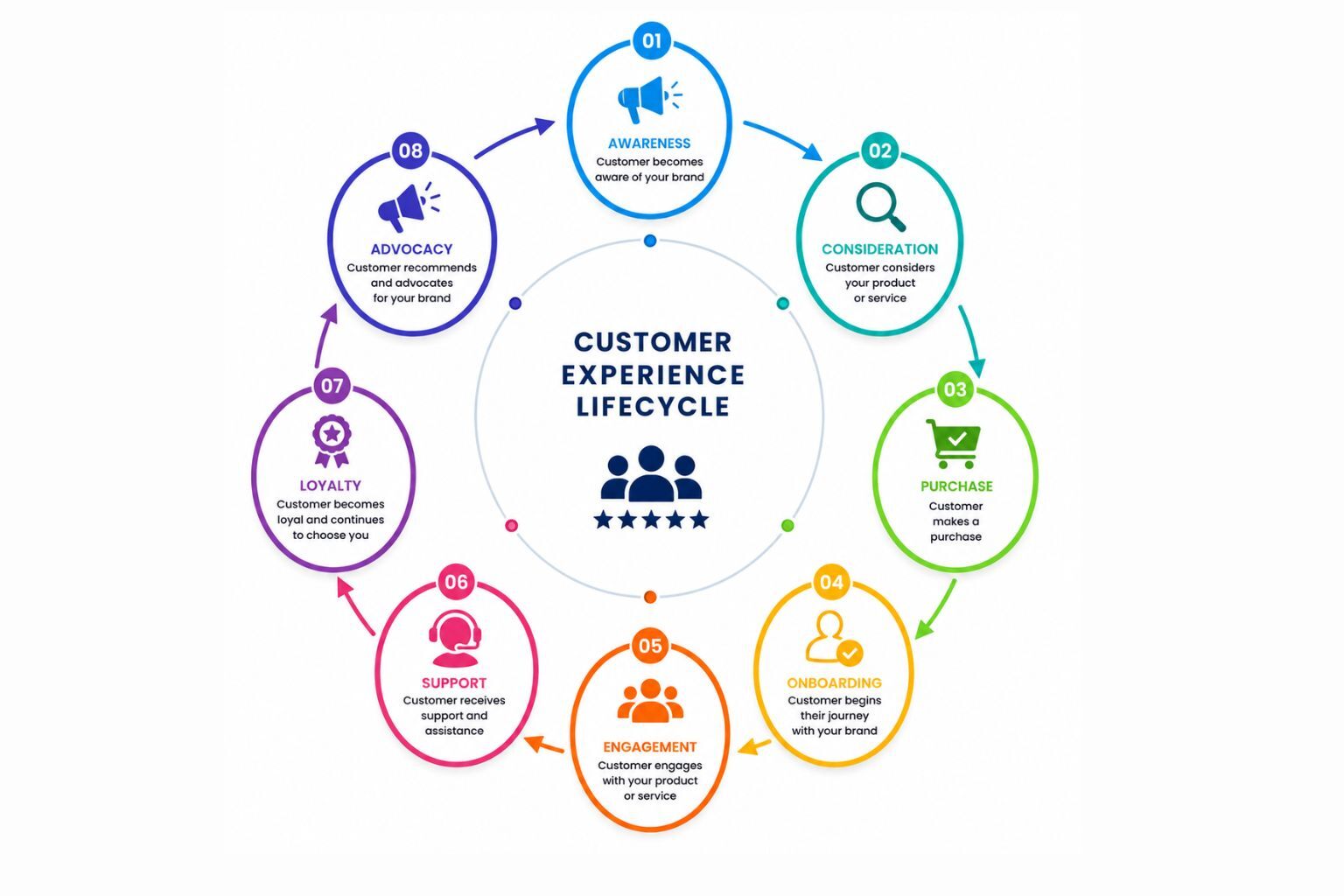
The true value of customer data emerges when organizations integrate information from multiple sources into a unified analytics environment. Customer relationship management (CRM) systems, marketing platforms, support applications, transactional databases, websites, mobile applications, and social media channels each provide valuable insights. When combined, they create a comprehensive view of every customer, allowing organizations to understand behaviors, identify opportunities, and deliver consistent experiences across every touchpoint.
Organizations that successfully implement customer analytics are better positioned to personalize communications, optimize marketing campaigns, improve customer service, predict future behavior, and make strategic decisions that increase both customer satisfaction and business performance.
This is why data-driven customer experience has become a fundamental capability for organizations pursuing digital transformation, sustainable growth, and long-term competitive advantage.
Ready to improve your customer experience strategy? DataScienceConsultingPro.com helps organizations implement customer analytics, AI, business intelligence, and predictive analytics solutions that transform customer data into measurable business results. Contact our consultants to discuss a tailored customer analytics strategy for your organization.
Transforming Customer Data into Exceptional Customer Experiences
Collecting customer data is only the first step toward delivering outstanding customer experiences. The real competitive advantage comes from transforming raw information into meaningful insights that help organizations understand customer behavior, predict future needs, and make better business decisions.
Many organizations collect millions of customer records every year, yet only a small percentage effectively leverage that data to improve engagement, personalize interactions, and increase customer loyalty. Without a structured customer analytics strategy, valuable information remains scattered across CRM systems, websites, support platforms, marketing tools, and transactional databases.
A successful data-driven customer experience strategy integrates multiple data sources into a single, reliable view of each customer. This unified approach allows organizations to understand not only who their customers are but also how they behave, what they value, where they encounter challenges, and what influences their purchasing decisions.
Businesses that successfully implement customer analytics often experience measurable improvements in customer satisfaction, customer retention, operational efficiency, and long-term revenue growth.
Types of Customer Data Every Organization Should Collect
Building an exceptional customer experience begins with collecting the right data. While many organizations focus primarily on sales data or website traffic, truly customer-centric businesses analyze multiple categories of information to develop a complete understanding of every customer.
Each type of customer data serves a different purpose and contributes unique insights that support personalization, predictive analytics, and strategic decision-making.
Behavioral Data
Behavioral data captures how customers interact with your organization across digital and physical channels. It provides valuable insight into customer interests, purchasing intent, and engagement patterns.
Examples of behavioral data include:
- Website visits
- Product page views
- Search queries
- Mobile application activity
- Email open rates
- Click-through rates
- Shopping cart activity
- Video engagement
- Content downloads
- Session duration
Behavioral analytics helps organizations understand which products attract the most attention, identify friction points within the customer journey, and deliver personalized recommendations based on actual customer behavior rather than assumptions.
For example, an online retailer may discover that customers repeatedly view premium products but abandon their shopping carts before completing a purchase. By analyzing this behavior, the organization can implement personalized discounts or improve the checkout experience to increase conversion rates.
Transactional Data
Transactional data records every financial interaction between customers and the business.
This includes:
- Purchase history
- Product categories
- Average order value
- Subscription renewals
- Payment methods
- Refunds
- Product returns
- Purchase frequency
Transactional analytics enables organizations to identify high-value customers, forecast future revenue, optimize pricing strategies, and uncover cross-selling or upselling opportunities.
A software company, for example, may analyze subscription renewal patterns to identify customers likely to upgrade to premium plans, allowing sales teams to proactively engage those customers with personalized offers.
Demographic Data
Demographic data helps organizations understand who their customers are.
Common demographic attributes include:
- Age
- Gender
- Geographic location
- Education
- Occupation
- Industry
- Income level
- Company size
Although demographic information alone rarely predicts customer behavior, combining demographic data with behavioral and transactional analytics creates far more accurate customer profiles.
For example, two customers may share similar demographic characteristics but exhibit entirely different purchasing behaviors. Data integration allows organizations to recognize these differences and personalize experiences accordingly.
Psychographic Data
Psychographic data focuses on the motivations behind customer decisions.
Rather than describing who customers are, psychographic analytics explains why they behave the way they do.
Examples include:
- Personal interests
- Lifestyle preferences
- Brand perceptions
- Personal values
- Buying motivations
- Long-term goals
- Customer expectations
Understanding customer motivations enables organizations to create more compelling messaging, personalized marketing campaigns, and stronger emotional connections with their audiences.
Luxury brands frequently leverage psychographic insights to develop exclusive customer experiences that reinforce prestige, status, and long-term loyalty.
Customer Feedback Data
Customer feedback provides direct insight into customer satisfaction and perceived experience.
Important feedback sources include:
- Net Promoter Score (NPS)
- Customer Satisfaction Score (CSAT)
- Customer Effort Score (CES)
- Product reviews
- Customer interviews
- Online ratings
- Support surveys
- Live chat conversations
- Contact center transcripts
Unlike behavioral data, feedback data captures customer opinions directly, helping organizations understand both strengths and areas requiring improvement.
Leading organizations continuously monitor customer feedback to identify recurring issues before they negatively impact customer retention.
Comparing Customer Data Types
| Customer Data Type | Primary Purpose | Business Value | Example |
|---|---|---|---|
| Behavioral Data | Understand customer actions | Personalization | Website analytics |
| Transactional Data | Analyze purchases | Revenue optimization | Purchase history |
| Demographic Data | Customer profiling | Market segmentation | CRM records |
| Psychographic Data | Understand motivations | Brand engagement | Surveys |
| Feedback Data | Measure satisfaction | Service improvement | NPS and CSAT |
Organizations that combine all five categories create a comprehensive customer profile that supports smarter decision-making throughout the customer lifecycle.
Customer Journey Analytics
Every customer follows a unique journey before becoming a loyal advocate for your brand. Understanding that journey is essential for delivering consistent, personalized experiences across every interaction.
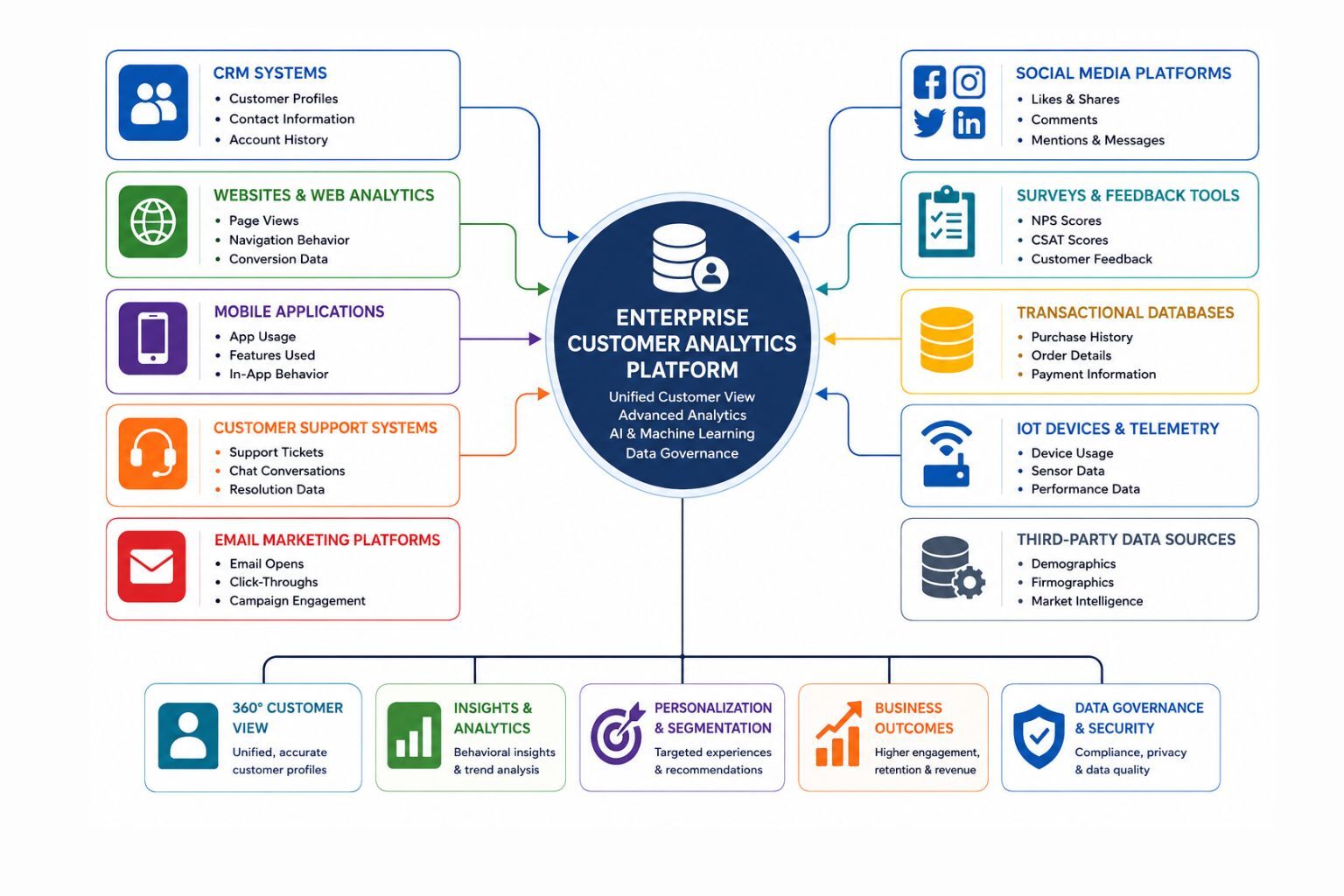
Customer journey analytics connects data from multiple touchpoints to visualize how customers move through the buying process. Rather than analyzing isolated events, journey analytics reveals the complete customer experience from initial awareness through long-term loyalty.
This holistic perspective enables organizations to identify friction points, optimize engagement strategies, and proactively improve customer experiences.
A typical customer journey consists of several interconnected stages.
Awareness
Customers first discover your organization through digital advertising, search engines, referrals, social media, or content marketing.
Analytics at this stage helps organizations understand which marketing channels generate the highest-quality leads and strongest engagement.
Consideration
Prospective customers begin comparing products, researching competitors, reading reviews, and evaluating solutions.
Behavioral analytics identifies which content, product pages, or educational resources influence purchasing decisions.
Purchase
The purchasing stage represents one of the most critical customer interactions.
Organizations should analyze:
- Checkout completion rates
- Cart abandonment
- Payment success
- Product selection
- Promotional code usage
Reducing friction during purchasing significantly improves conversion rates.
Onboarding
The customer experience does not end after a purchase.
Effective onboarding introduces customers to products or services, accelerates adoption, and reduces frustration during the early stages of the relationship.
Organizations that invest in onboarding often experience higher customer retention and lower support costs.
Engagement
During ongoing engagement, organizations monitor product usage, customer interactions, email engagement, feature adoption, and account activity.
These insights help identify opportunities for additional training, product recommendations, or proactive customer support.
Support
Customer support interactions provide some of the richest sources of customer experience data.
Analyzing support tickets, response times, live chat conversations, and customer satisfaction surveys helps organizations continuously improve service quality.
Loyalty
Satisfied customers become repeat buyers.
Organizations should monitor purchase frequency, subscription renewals, referral activity, and customer lifetime value to strengthen loyalty initiatives.
Advocacy
The final stage occurs when customers actively recommend your organization to colleagues, friends, or industry peers.
Positive reviews, referrals, testimonials, and social media recommendations represent valuable indicators of exceptional customer experience.
Organizations that consistently optimize every stage of this journey create stronger customer relationships while maximizing long-term revenue.
Customer Segmentation: Delivering Personalized Customer Experiences at Scale
No two customers are exactly alike. They have different preferences, purchasing behaviors, expectations, and communication styles. Treating every customer the same often leads to generic experiences that fail to build loyalty or drive meaningful engagement.
Customer segmentation allows organizations to group customers based on shared characteristics, making it possible to deliver highly personalized experiences that improve satisfaction and increase conversion rates.
Instead of sending identical marketing messages to every customer, businesses can develop targeted campaigns, personalized recommendations, and customized customer journeys for each audience segment.
Organizations that implement advanced customer segmentation frequently achieve higher marketing ROI, increased customer engagement, and stronger customer retention.
Behavioral Segmentation
Behavioral segmentation categorizes customers according to how they interact with a business.
Examples include:
- Purchase frequency
- Product usage
- Browsing behavior
- Cart abandonment
- Email engagement
- Feature adoption
- Customer support interactions
For example, a SaaS company may identify users who frequently access premium features but remain on a basic subscription plan. These customers represent ideal candidates for personalized upgrade campaigns.
Geographic Segmentation
Geographic segmentation groups customers by location.
Organizations often personalize experiences based on:
- Country
- State
- City
- Climate
- Language
- Regional regulations
- Cultural preferences
Retailers commonly adjust product recommendations, promotions, and shipping options based on customer location.
Demographic Segmentation
Demographic segmentation remains one of the most widely used methods because it provides valuable context about customer groups.
Common variables include:
- Age
- Gender
- Occupation
- Education
- Household income
- Industry
- Business size
While demographics alone should never drive personalization, they become significantly more valuable when combined with behavioral and transactional analytics.
Psychographic Segmentation
Psychographic segmentation focuses on customer motivations rather than observable characteristics.
Organizations analyze:
- Personal interests
- Lifestyle
- Values
- Brand preferences
- Buying motivations
- Customer goals
Luxury brands, travel companies, and lifestyle businesses often rely heavily on psychographic segmentation to create emotionally engaging customer experiences.
Value-Based Segmentation
Not every customer contributes the same long-term value.
Value-based segmentation classifies customers according to profitability, purchase frequency, and lifetime value.
High-value customers may receive:
- Dedicated account managers
- Premium support
- Exclusive promotions
- Early product access
- Loyalty rewards
Meanwhile, lower-value customer groups may receive automated engagement campaigns that maximize operational efficiency.

Measuring Customer Experience with the Right KPIs
Successful customer experience strategies depend on measurable performance indicators. Without clear metrics, organizations cannot determine whether customer experience initiatives are improving satisfaction, reducing churn, or increasing profitability.
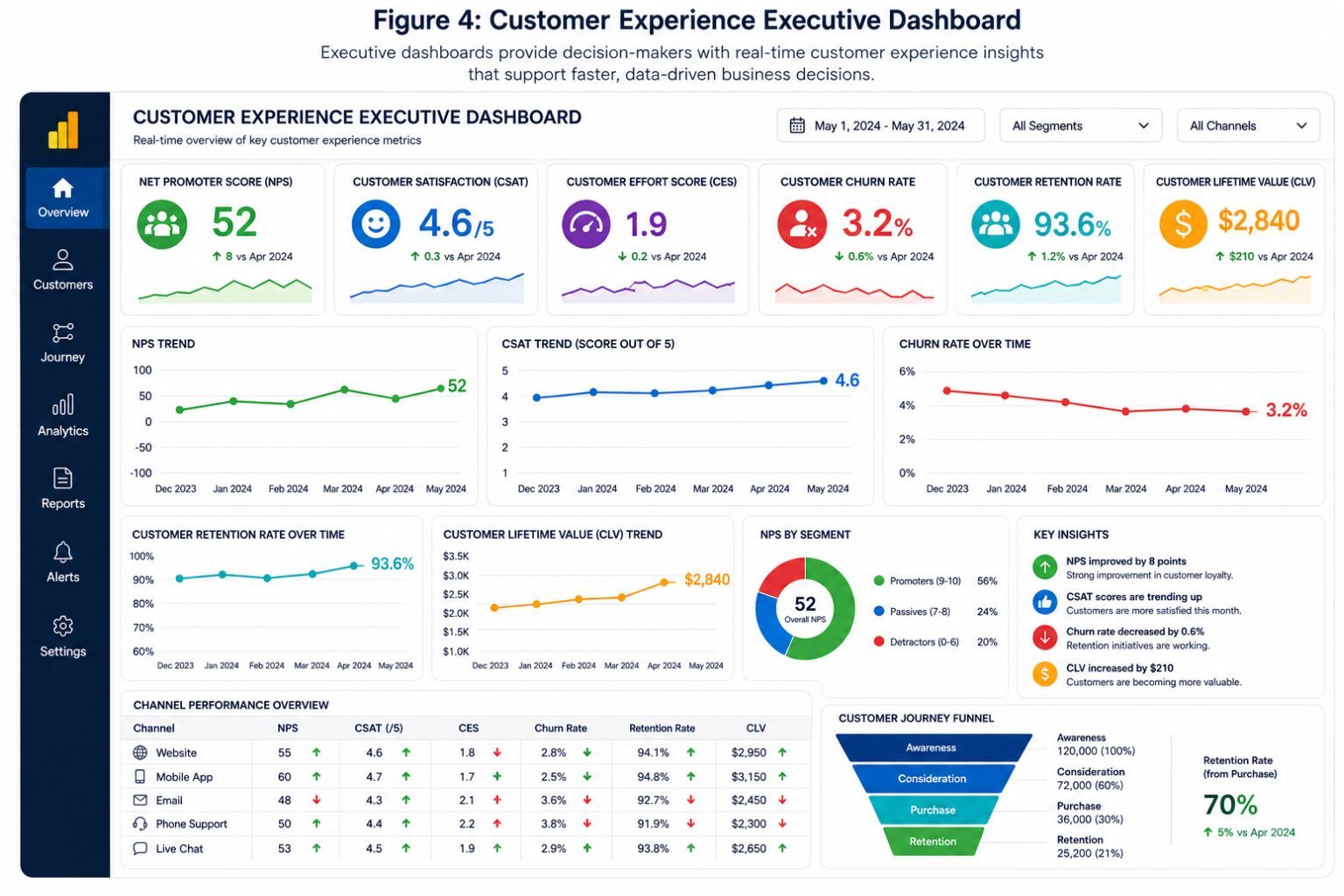
Executive dashboards should continuously monitor key customer experience metrics to support informed decision-making.
Net Promoter Score (NPS)
Net Promoter Score measures customer loyalty by asking one simple question:
“How likely are you to recommend our company to a friend or colleague?”
Customers are classified as:
- Promoters
- Passives
- Detractors
Organizations with consistently high NPS scores typically experience stronger customer retention and greater referral growth.
Customer Satisfaction Score (CSAT)
Customer Satisfaction Score evaluates how satisfied customers are following a specific interaction, purchase, or support experience.
Organizations commonly use CSAT after:
- Customer support tickets
- Product purchases
- Training sessions
- Onboarding programs
- Service requests
Monitoring CSAT helps businesses identify opportunities for continuous improvement.
Customer Effort Score (CES)
Customer Effort Score measures how easy it is for customers to complete a task.
Tasks include:
- Resolving support issues
- Completing online purchases
- Updating account information
- Scheduling appointments
Reducing customer effort significantly improves loyalty because customers consistently prefer simple, frictionless experiences.
Customer Lifetime Value (CLV)
Customer Lifetime Value estimates the total revenue a customer is expected to generate throughout their relationship with the business.
Organizations use CLV to:
- Prioritize customer investments
- Improve retention strategies
- Optimize marketing budgets
- Identify high-value customer segments
Customer Churn Rate
Customer churn measures the percentage of customers who discontinue their relationship with a business over a specific period.
High churn often indicates problems with:
- Customer onboarding
- Product quality
- Customer support
- Pricing
- User experience
Predictive analytics helps organizations identify at-risk customers before they leave.
Customer Retention Rate
Customer retention measures how successfully an organization maintains long-term customer relationships.
Improving retention often produces significantly greater financial returns than continuously acquiring new customers.
Customer Experience Dashboard Metrics
| KPI | Business Purpose | Typical Use |
|---|---|---|
| Net Promoter Score (NPS) | Measure customer loyalty | Customer experience strategy |
| Customer Satisfaction (CSAT) | Evaluate customer satisfaction | Service quality monitoring |
| Customer Effort Score (CES) | Measure ease of interaction | Process improvement |
| Customer Lifetime Value (CLV) | Estimate long-term profitability | Customer segmentation |
| Customer Retention Rate | Measure loyalty | Growth strategy |
| Customer Churn Rate | Identify customer loss | Predictive analytics |
| First Contact Resolution | Evaluate customer support | Service operations |
| Average Resolution Time | Measure efficiency | Support optimization |
How Artificial Intelligence Is Transforming Customer Experience
Artificial intelligence has fundamentally changed how organizations understand and serve customers. Rather than relying solely on historical reports, AI enables businesses to predict future behavior, automate customer interactions, and deliver personalized experiences in real time.
Modern AI-powered customer analytics solutions help organizations move from reactive decision-making to proactive customer engagement.
Predictive Analytics
Predictive analytics uses historical customer data to forecast future behavior.
Organizations use predictive models to:
- Identify customers likely to churn
- Forecast purchasing behavior
- Estimate customer lifetime value
- Predict product demand
- Recommend personalized offers
This enables businesses to intervene before customer issues occur.
Recommendation Engines
Recommendation systems analyze browsing history, purchase patterns, and customer preferences to suggest relevant products or services.
Examples include:
- Amazon product recommendations
- Netflix content suggestions
- Spotify playlists
- Personalized eCommerce offers
These systems improve customer engagement while increasing average order value.
AI Chatbots and Virtual Assistants
AI-powered chatbots provide instant customer support while reducing operational costs.
Modern conversational AI can:
- Answer frequently asked questions
- Schedule appointments
- Track orders
- Resolve simple issues
- Escalate complex cases to human agents
This improves response times while allowing customer service teams to focus on higher-value interactions.
Sentiment Analysis
Sentiment analysis uses natural language processing (NLP) to evaluate customer opinions expressed in emails, surveys, support tickets, and social media.
Organizations use sentiment analysis to:
- Detect customer frustration
- Monitor brand reputation
- Improve customer service
- Identify emerging issues
Marketing Personalization
Artificial intelligence analyzes customer behavior continuously to deliver personalized experiences across multiple channels.
Examples include:
- Personalized email campaigns
- Dynamic website content
- Product recommendations
- Customized promotions
- Personalized pricing strategies
Organizations implementing AI-driven personalization frequently experience improved engagement, higher conversion rates, and increased customer loyalty.

Best Practices for Building a Data-Driven Customer Experience Strategy
Organizations that consistently deliver exceptional customer experiences follow several proven best practices.
Begin by defining measurable customer experience objectives that align with broader business goals. Collect data from multiple customer touchpoints and integrate it into a centralized analytics platform to establish a unified customer view. Maintain strong data governance practices to ensure information remains accurate, secure, and compliant with relevant regulations.
Invest in business intelligence dashboards that provide executives with real-time visibility into customer experience metrics, and use artificial intelligence to identify trends, predict customer behavior, and automate routine processes. Most importantly, establish a culture of continuous improvement by regularly monitoring customer feedback and refining customer journeys based on data-driven insights.
Transform Customer Data into Competitive Advantage
Organizations that outperform their competitors rarely do so because they collect more data. They succeed because they know how to transform data into meaningful customer experiences that strengthen relationships, improve operational efficiency, and drive sustainable growth.
At DataScienceConsultingPro.com, we help organizations unlock the full value of their customer data through advanced analytics, artificial intelligence, business intelligence, predictive modeling, and enterprise data strategies. From customer journey analytics and Power BI dashboards to AI-driven personalization and cloud-based analytics platforms, our consultants deliver tailored solutions that generate measurable business results.
Whether you’re beginning your customer analytics journey or scaling an enterprise-wide customer experience transformation initiative, our team can help you develop a strategy that improves customer satisfaction, increases loyalty, reduces churn, and maximizes long-term return on investment.
Ready to transform your customer experience with data? Contact DataScienceConsultingPro.com today to schedule a free consultation and discover how our data analytics experts can help your organization build smarter, more customer-centric business strategies.
Customer Experience Dashboards: Turning Data into Business Decisions
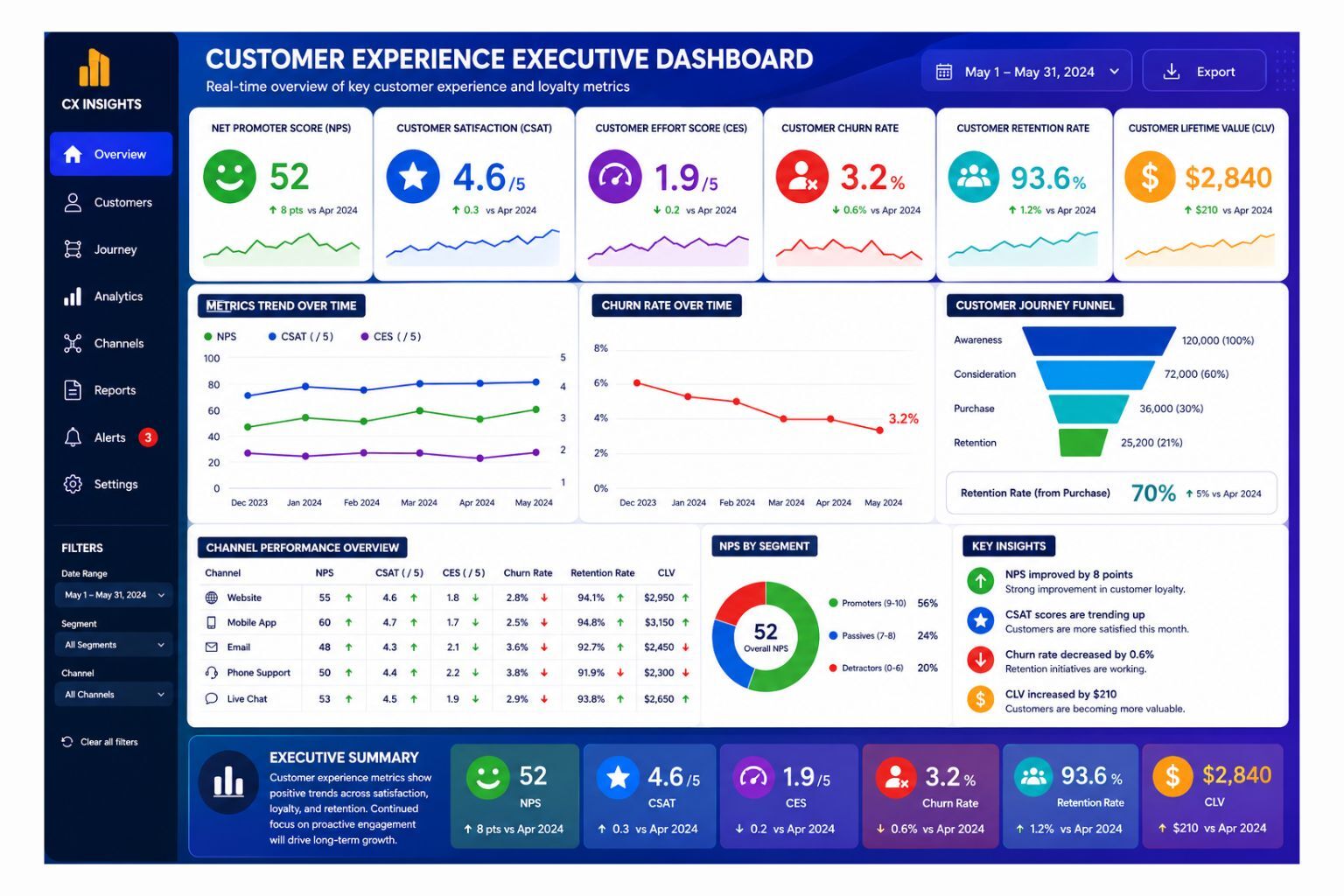
Collecting customer data is valuable only if decision-makers can understand and act on it. Executive dashboards bridge the gap between raw data and strategic action by presenting complex information in an intuitive, real-time format. Rather than manually reviewing reports from multiple systems, business leaders can monitor customer experience metrics through a centralized dashboard that highlights performance trends, identifies emerging risks, and supports faster decision-making.
Business intelligence platforms such as Microsoft Power BI, Tableau, Looker, and Microsoft Fabric enable organizations to consolidate customer analytics from CRM systems, websites, customer support platforms, marketing tools, and transactional databases into interactive dashboards.
A well-designed executive dashboard provides immediate visibility into customer performance and helps answer important business questions, such as:
- Which customer segments generate the highest lifetime value?
- Which marketing channels produce the highest customer satisfaction?
- Where are customers abandoning their journey?
- Which products generate the highest repeat purchases?
- Which customers are at risk of churning?
- How is customer satisfaction changing over time?
Instead of relying on monthly reports, executives can monitor customer experience continuously and make proactive business decisions supported by real-time analytics.
Essential Components of a Customer Experience Dashboard
A modern customer experience dashboard should combine operational metrics with strategic business indicators. Rather than overwhelming users with excessive data, dashboards should present the information most relevant to decision-makers.
Core dashboard components typically include:
- Net Promoter Score (NPS)
- Customer Satisfaction Score (CSAT)
- Customer Effort Score (CES)
- Customer Retention Rate
- Customer Churn Rate
- Customer Lifetime Value (CLV)
- First Contact Resolution (FCR)
- Average Resolution Time
- Customer Journey Funnel
- Channel Performance
- Customer Segmentation
- Customer Feedback Trends
- Revenue by Customer Segment
- AI-generated Insights
These metrics enable organizations to monitor both customer sentiment and business performance within a single environment.
The Role of Artificial Intelligence in Customer Experience
Artificial intelligence has become one of the most transformative technologies for customer experience management. Instead of simply reporting historical performance, AI enables organizations to predict future customer behavior, automate repetitive tasks, personalize customer interactions, and continuously optimize customer journeys.
By combining machine learning, predictive analytics, natural language processing (NLP), and automation, AI helps organizations deliver proactive rather than reactive customer experiences.
Predictive Analytics
Predictive analytics uses historical customer data to forecast future outcomes.
Organizations use predictive models to:
- Predict customer churn
- Forecast purchasing behavior
- Estimate customer lifetime value
- Identify high-value customers
- Recommend next-best actions
- Improve inventory planning
- Optimize pricing strategies
For example, a subscription-based software company can identify customers whose product usage has declined significantly. Rather than waiting for cancellation, AI alerts the customer success team, allowing them to intervene with personalized training, discounts, or support before the customer leaves.
Intelligent Recommendation Engines
Recommendation engines analyze browsing history, purchase behavior, customer preferences, and previous interactions to deliver personalized recommendations.
Popular examples include:
- Amazon product recommendations
- Netflix content suggestions
- Spotify music recommendations
- LinkedIn job recommendations
Organizations implementing recommendation engines frequently experience higher average order values, increased customer engagement, and stronger customer loyalty.
Conversational AI and Intelligent Customer Support
Modern AI-powered chatbots have evolved beyond answering simple questions. They now provide intelligent, context-aware conversations that improve customer service while reducing operational costs.
AI-powered virtual assistants can:
- Answer frequently asked questions
- Track customer orders
- Schedule appointments
- Recommend products
- Process returns
- Escalate complex issues to human agents
This combination of automation and human expertise improves response times while allowing customer support teams to focus on higher-value interactions.
Sentiment Analysis
Natural Language Processing (NLP) enables organizations to analyze customer opinions expressed through:
- Customer surveys
- Product reviews
- Support tickets
- Social media posts
- Live chat conversations
- Email communications
Sentiment analysis identifies positive, neutral, and negative customer opinions, allowing organizations to detect dissatisfaction before it becomes a retention problem.
Marketing Personalization
Artificial intelligence enables organizations to personalize customer experiences at scale.
Examples include:
- Personalized email campaigns
- Product recommendations
- Dynamic website content
- Customized promotions
- Personalized pricing
- Location-based offers
- Individual customer journeys
Rather than delivering identical experiences to every customer, organizations can tailor every interaction according to customer behavior and preferences.

Best Practices for Building a Data-Driven Customer Experience Strategy
Organizations that consistently deliver exceptional customer experiences follow a structured approach to customer analytics and continuous improvement.
Start by defining measurable customer experience objectives that align with broader business goals. Instead of collecting every available data point, focus on information that directly supports decision-making and customer outcomes.
Next, integrate customer data from CRM platforms, websites, mobile applications, support systems, marketing automation tools, and transactional databases into a centralized analytics platform. A unified customer view provides the foundation for meaningful customer insights and personalization.
Maintaining high data quality is equally important. Inaccurate, incomplete, or duplicated records reduce the effectiveness of analytics and AI models. Establishing strong data governance practices helps ensure customer information remains accurate, secure, and compliant with data privacy regulations.
Organizations should also invest in business intelligence dashboards that provide executives with real-time visibility into customer experience metrics. Rather than reviewing static monthly reports, decision-makers should continuously monitor customer satisfaction, loyalty, retention, and operational performance.
Artificial intelligence should complement—not replace—human decision-making. Predictive analytics, machine learning, and automation can identify opportunities and recommend actions, but successful customer experience strategies still require human oversight, strategic thinking, and continuous optimization.
Finally, organizations should treat customer experience as an ongoing process rather than a one-time initiative. Customer expectations evolve continuously, making regular performance reviews, customer feedback analysis, and journey optimization essential for long-term success.
Transform Customer Data into Competitive Advantage
Organizations that outperform their competitors rarely succeed because they simply collect more data. They succeed because they know how to transform customer information into actionable insights that improve customer experiences, strengthen relationships, and support better business decisions.
At DataScienceConsultingPro.com, we help organizations unlock the full value of their customer data through advanced analytics, business intelligence, artificial intelligence, predictive modeling, and enterprise data strategy consulting. Our experienced consultants work closely with businesses to design scalable customer analytics solutions that improve customer satisfaction, reduce churn, increase customer lifetime value, and accelerate digital transformation.
Whether your organization is implementing Power BI dashboards, Microsoft Fabric, Tableau, Azure Data Analytics, Snowflake, SQL, Python, or enterprise AI solutions, our experts provide tailored consulting services designed to deliver measurable business results.
If you’re ready to transform customer data into a strategic competitive advantage, schedule a free consultation with DataScienceConsultingPro.com. Together, we’ll build a data-driven customer experience strategy that drives stronger customer relationships, higher revenue, and sustainable business growth.
Customer Analytics Consulting Services
Successfully improving customer experience requires more than collecting customer data or deploying analytics software. Organizations need a clear strategy, the right technology stack, and experienced professionals who can translate data into measurable business outcomes.
At DataScienceConsultingPro.com, we help organizations transform customer data into strategic assets through enterprise consulting services tailored to their unique business goals. Whether you’re building your first customer analytics platform or modernizing an existing data ecosystem, our consultants provide end-to-end support throughout the entire transformation journey.
Our customer analytics consulting services include:
- Customer experience strategy development
- Customer journey mapping and optimization
- Customer segmentation and personalization
- Business intelligence dashboard development
- Power BI and Microsoft Fabric implementation
- AI and machine learning solutions
- Predictive analytics and forecasting
- Customer churn prediction models
- Customer lifetime value (CLV) analysis
- Data governance and quality management
- Data warehouse modernization
- Executive reporting and KPI development
- Cloud analytics implementation
- Customer experience performance optimization
Every engagement begins with understanding your business objectives, existing data landscape, and customer experience challenges before designing scalable solutions that deliver measurable value.
Industries We Support
Every industry generates customer data, but each sector has unique challenges, regulatory requirements, and customer expectations. Our consultants develop industry-specific analytics solutions that address these differences while improving operational performance and customer satisfaction.
Retail and E-commerce
Retail organizations rely on customer analytics to understand purchasing behavior, personalize recommendations, optimize pricing strategies, forecast inventory demand, and improve customer loyalty.
Typical use cases include:
- Customer segmentation
- Product recommendation engines
- Basket analysis
- Customer lifetime value modeling
- Omnichannel analytics
- Customer retention programs
Financial Services
Banks, insurance providers, and financial institutions use customer analytics to improve onboarding, detect fraud, predict churn, personalize financial products, and strengthen long-term customer relationships.
Solutions include:
- Risk analytics
- Customer profitability analysis
- Fraud detection
- Customer retention strategies
- Digital banking analytics
- Customer behavior modeling
Healthcare
Healthcare organizations leverage customer analytics to improve patient experiences, reduce missed appointments, optimize resource planning, and deliver more personalized care.
Applications include:
- Patient journey analytics
- Appointment optimization
- Patient satisfaction dashboards
- Predictive patient engagement
- Healthcare business intelligence
Manufacturing
Manufacturers use customer analytics to improve customer service, optimize supply chains, forecast product demand, and strengthen distributor relationships.
Common projects include:
- Demand forecasting
- Customer order analytics
- Supply chain dashboards
- Predictive maintenance analytics
- Sales performance reporting
Education
Educational institutions increasingly rely on analytics to improve student engagement, optimize recruitment strategies, enhance learning experiences, and support institutional planning.
Analytics solutions include:
- Student success dashboards
- Enrollment analytics
- Learning engagement analysis
- Performance reporting
- Resource optimization
Enterprise Technology Stack
Delivering exceptional customer experiences requires modern, scalable technologies capable of processing large volumes of structured and unstructured customer data.
Our consultants work with leading enterprise technologies, including:
Business Intelligence
- Microsoft Power BI
- Tableau
- Looker
- Qlik Sense
Cloud Platforms
- Microsoft Azure
- Amazon Web Services (AWS)
- Google Cloud Platform (GCP)
Data Platforms
- Microsoft Fabric
- Snowflake
- Azure Synapse Analytics
- Databricks
- SQL Server
Programming Languages
- Python
- SQL
- R
Artificial Intelligence
- Azure AI
- OpenAI
- Machine Learning
- Natural Language Processing
- Predictive Analytics
Our vendor-neutral approach ensures every recommendation aligns with your organization’s technical environment, scalability requirements, and long-term digital transformation strategy.
Why Choose DataScienceConsultingPro.com?
Organizations partner with us because we combine technical expertise with practical business consulting. We focus on delivering measurable outcomes rather than simply implementing technology.
Our approach emphasizes:
- Business-first analytics strategies
- Enterprise architecture best practices
- AI-powered customer experience solutions
- Scalable cloud-based analytics platforms
- Executive-ready dashboards
- Strong data governance
- Actionable business insights
- Industry-specific expertise
- End-to-end project delivery
- Long-term client partnerships
Whether you’re a growing business or a global enterprise, our consultants help transform customer data into a competitive advantage.
Our Customer Analytics Consulting Process
Every successful analytics initiative begins with a structured implementation methodology.
Step 1: Business Discovery
We work with stakeholders to understand business objectives, customer experience challenges, and desired outcomes.
Step 2: Data Assessment
Our consultants evaluate existing data sources, system integrations, data quality, and reporting capabilities.
Step 3: Strategy Development
We develop a customer analytics roadmap aligned with your organization’s strategic priorities.
Step 4: Solution Design
We design scalable analytics architectures, dashboards, AI models, and reporting frameworks.
Step 5: Implementation
Our team deploys business intelligence platforms, customer analytics solutions, predictive models, and executive dashboards.
Step 6: Optimization
Analytics is an ongoing process. We continuously monitor performance, refine models, and identify new opportunities for improvement.
Customer Analytics Project Pricing
Every customer analytics project is unique. Pricing depends on project complexity, data volume, technology requirements, and implementation scope.
Typical consulting engagements include:
| Service | Typical Engagement |
|---|---|
| Customer Analytics Assessment | Starting from project consultation |
| Power BI Dashboard Development | Custom pricing |
| Customer Journey Analytics | Custom pricing |
| AI-Powered Customer Experience Solutions | Enterprise pricing |
| Predictive Analytics Implementation | Custom pricing |
| End-to-End Customer Analytics Transformation | Tailored enterprise proposal |
We provide customized proposals after understanding your business requirements, ensuring every engagement delivers measurable return on investment.
Frequently Asked Questions
Customer experience analytics is the process of collecting, integrating, analyzing, and interpreting customer data to improve every interaction throughout the customer journey.
Customer data helps organizations understand customer behavior, personalize experiences, improve marketing performance, reduce churn, and make informed business decisions.
Artificial intelligence analyzes customer data to predict future behavior, automate interactions, personalize recommendations, identify customer risks, and optimize customer journeys.
Popular customer analytics tools include Microsoft Power BI, Tableau, Microsoft Fabric, Snowflake, Databricks, Azure AI, SQL, Python, and customer relationship management (CRM) platforms.
Customer analytics delivers value across retail, healthcare, finance, manufacturing, education, telecommunications, hospitality, technology, and government.
Project timelines vary depending on scope, existing infrastructure, and business requirements. Smaller dashboard projects may take a few weeks, while enterprise analytics transformations may require several months.
Yes. Organizations use predictive analytics to identify customers at risk of leaving and implement proactive retention strategies that improve loyalty and customer lifetime value.
We combine enterprise consulting expertise, advanced analytics, business intelligence, artificial intelligence, and industry best practices to deliver measurable customer experience improvements tailored to your business objectives.
Transform Your Customer Experience with Data
Organizations that consistently deliver exceptional customer experiences understand that data is more than a business asset—it’s a strategic advantage. By integrating customer information, applying advanced analytics, and leveraging artificial intelligence, businesses can create personalized experiences that strengthen relationships, improve operational efficiency, and drive sustainable growth.
At DataScienceConsultingPro.com, we help organizations unlock the full value of their customer data through enterprise analytics consulting, business intelligence, AI-powered solutions, and digital transformation strategies. From executive dashboards and customer journey analytics to predictive modeling and cloud analytics platforms, our experts deliver solutions that produce measurable business results.
Ready to improve your customer experience with data-driven insights? Contact DataScienceConsultingPro.com today to schedule a consultation and discover how our analytics experts can help your organization increase customer satisfaction, strengthen loyalty, reduce churn, and build a smarter, more customer-centric future.
