
An AI strategy 2026 plan helps businesses move from scattered AI experiments to clear, measurable, and responsible implementation. Many organizations are no longer asking whether they should use AI. Instead, they are asking how to build an effective AI strategy 2026 roadmap that connects business goals, data readiness, governance, use case prioritization, workflow redesign, ROI measurement, and responsible adoption.
The challenge is not simply choosing an AI tool. A company can test chatbots, automate reports, use generative AI, or launch small pilots and still fail to create business value. Without a clear AI strategy 2026 roadmap, teams may use disconnected tools, upload sensitive data into unsafe systems, automate the wrong tasks, or run pilots that never scale.
A strong strategy prevents those problems. It explains what AI should do, which workflows are ready, what data is required, who owns each output, what risks must be controlled, and how success will be measured. IBM describes AI strategy as a way for organizations to define AI objectives and address implementation challenges, while the NIST AI Risk Management Framework helps organizations manage AI risks to people, organizations, and society.
This guide explains how to build an effective AI strategy 2026 plan using a practical, business-first framework. When you need expert support, AI Strategy Consulting from DataScienceConsultingPro.com can help you assess readiness, prioritize use cases, plan governance, and create a roadmap for responsible implementation.
What Is an AI Strategy 2026 Roadmap?
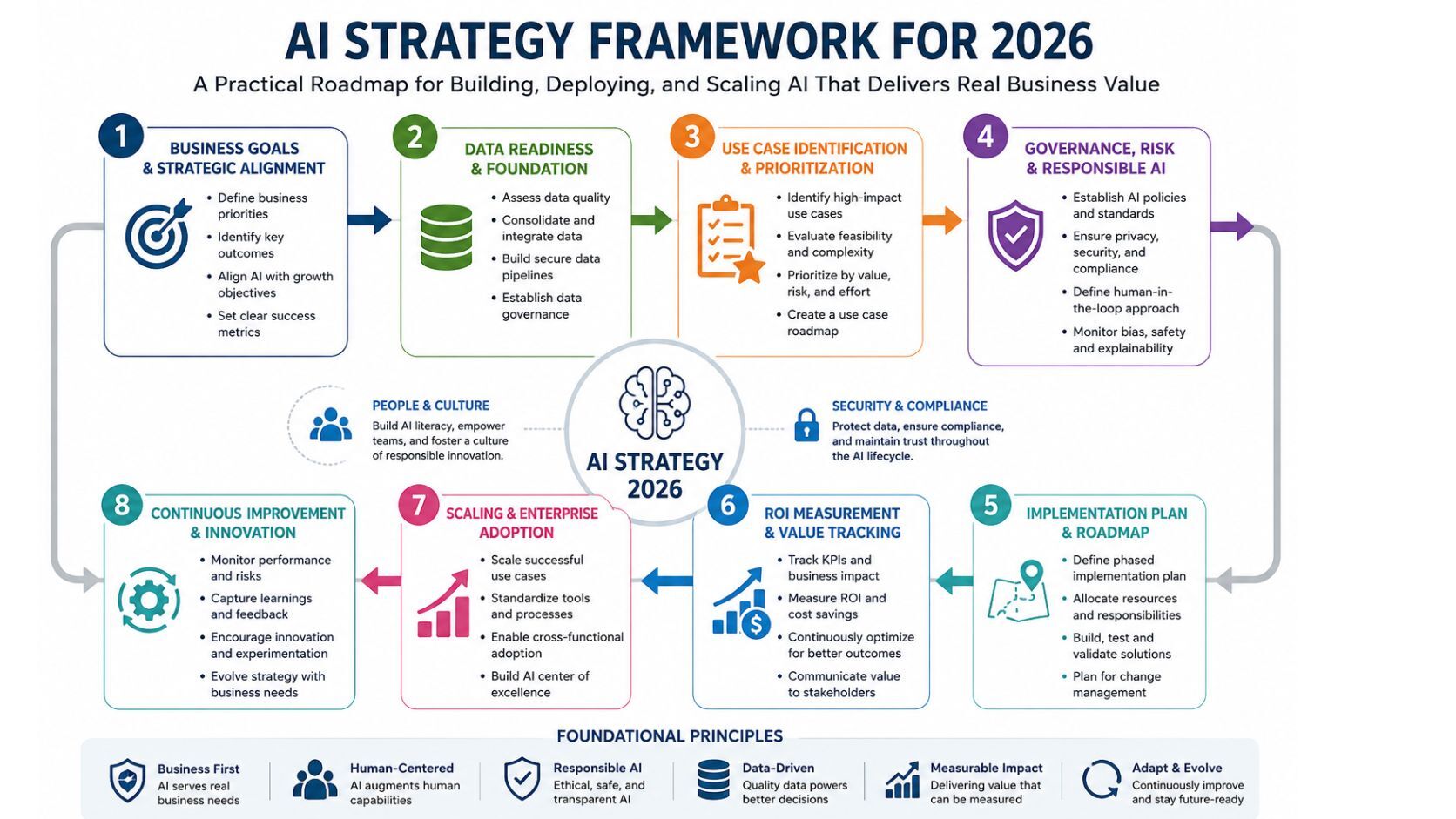
An AI strategy 2026 roadmap is a business plan that explains how an organization will use artificial intelligence to improve operations, reporting, forecasting, automation, customer experience, productivity, and decision-making. It is not just a technology plan. Instead, it connects AI to business priorities, data foundations, governance rules, human oversight, and measurable outcomes.
A strong AI strategy 2026 roadmap should answer five questions. First, what business problems should AI solve? Second, is the data ready? Third, which use cases should be prioritized? Fourth, what risks must be managed? Finally, how will the organization measure value?
An AI strategy is not buying random AI tools, creating one chatbot, asking every team to “use AI,” copying competitors, or automating workflows without review. Those actions may create activity, but they do not guarantee business value.
A useful strategy includes business goals, AI readiness assessment, data strategy, use case prioritization, governance, pilot planning, operating model design, implementation roadmap, ROI measurement, training, and scaling rules.
An AI strategy 2026 roadmap is a practical business plan that connects AI goals, data readiness, governance, prioritized use cases, implementation steps, ROI metrics, and responsible scaling.
Why Many AI Strategies Fail
Many AI strategies fail because they begin with tools instead of business problems. A team may subscribe to an AI platform, test automation, or launch a proof of concept without asking whether the data is reliable, the workflow is ready, the risks are acceptable, or the outcome can be measured.
Another common failure is weak governance. The OECD AI Principles promote trustworthy AI that respects human rights and democratic values, which means organizations should think about responsible AI before deployment, not after something goes wrong.
| AI Strategy Mistake | Why It Fails | Better Approach |
|---|---|---|
| Starting with tools | Tools may not match business needs | Start with business problems |
| No data readiness review | Poor data leads to poor AI outputs | Assess data quality and access |
| No governance | Privacy, bias, and accountability risks increase | Create responsible AI rules |
| Too many pilots | Teams spread effort too thin | Prioritize high-value use cases |
| No ROI metrics | Leaders cannot measure value | Define success metrics early |
| No ownership | Projects stall after testing | Assign business and technical owners |
| Ignoring employees | Adoption becomes weak | Add training and change management |
| No scaling plan | Pilots never reach production | Build a staged roadmap |
Therefore, an effective AI strategy 2026 plan should treat AI as business transformation, not a software purchase.
Step 1: Define the Business Goals AI Should Support
An AI strategy 2026 plan must begin with business goals. Before choosing tools, leaders should decide what problems AI should solve and why those problems matter.
Useful goals may include reducing manual reporting, improving sales forecasting, lowering customer support backlog, detecting anomalies, improving customer retention, automating document workflows, improving inventory planning, strengthening executive dashboards, or reducing repeated data entry.
For example, “we want to use AI” is too vague. A better goal is: “We want to reduce weekly reporting preparation time by 60% by automating data cleaning, summary generation, and dashboard updates.” This goal is specific, measurable, and connected to a business workflow.
Before choosing AI tools, ask:
- What business problem are we solving?
- Who owns the outcome?
- What workflow will change?
- What data is required?
- What metric will show success?
- What risk must be managed?
- Who will review AI outputs?
- What happens if the output is wrong?
This step keeps the AI strategy practical. It also protects the business from buying tools that look impressive but do not solve urgent problems.
Step 2: Run an AI Readiness Assessment
An AI readiness assessment checks whether the organization is prepared to use AI responsibly and effectively. Readiness is not only technical. It includes business readiness, data readiness, workflow readiness, people readiness, security readiness, and governance readiness.
An AI readiness assessment should review data quality, data access, current systems, reporting workflows, data pipelines, security controls, governance maturity, team skills, leadership alignment, workflow complexity, compliance needs, change readiness, integration requirements, and implementation capacity.
If the data is duplicated, incomplete, scattered, outdated, or poorly governed, AI outputs may become unreliable. In that case, the strategy should include data preparation before implementation. DataScienceConsultingPro.com can support this foundation through Data Cleaning Services, Data Engineering Services, and Data Pipeline Development Services..
Readiness also includes people. Employees need to know when they can use AI, what data they can enter, when they must review outputs, and how to escalate problems.
An AI readiness assessment checks whether your goals, data, systems, workflows, governance, people, and implementation capacity are ready for AI strategy 2026 execution.
Need help assessing whether your business is ready for AI? Request an AI Strategy Consulting review from DataScienceConsultingPro.com.
Step 3: Build an AI Data Strategy
A strong AI strategy 2026 plan depends on reliable, structured, accessible, and governed data. AI cannot produce trustworthy business outputs when the underlying data is messy, incomplete, duplicated, or disconnected.
IBM’s AI Academy explains that enterprise AI requires a data strategy built around high-quality data assets. This is important because AI systems rely on the quality, structure, and accessibility of the information they use.
Your AI data strategy should cover data cleaning, data integration, data pipelines, data warehouses, dashboards, metadata, permissions, data quality rules, monitoring, documentation, source-of-truth definitions, access control, data refresh frequency, and business glossary definitions.
For example, a retail company may want AI demand forecasting, but product data may be split across spreadsheets, Shopify, warehouse systems, and accounting software. A SaaS company may want churn prediction, but customer data may be scattered across product analytics, CRM records, billing systems, and support tickets.
Therefore, AI planning often connects with Data Engineering Services,, and Business Intelligence Services..
Step 4: Identify AI Use Cases
After reviewing goals and data readiness, identify AI use cases. A use case should solve a real business problem. It should not exist only because a tool is popular.
| Department | Possible AI Use Cases |
|---|---|
| Sales | Lead scoring, sales forecasting, pipeline summaries |
| Marketing | Customer segmentation, campaign analysis, content performance |
| Finance | Forecasting, anomaly detection, invoice classification |
| Operations | Workflow automation, resource planning, bottleneck detection |
| Customer Support | Ticket triage, knowledge search, response suggestions |
| HR | Skills mapping, workforce analytics, employee support |
| Healthcare Admin | Patient flow, reporting automation, claims review |
| Retail | Demand forecasting, product recommendations, inventory planning |
| SaaS | Churn prediction, product analytics, customer health scoring |
| Professional Services | Proposal support, knowledge search, client reporting |
A good use case should clearly state the workflow problem, users affected, data required, expected value, risk level, owner, success metric, human review point, and timeline.
For example, “AI for support” is too broad. A stronger use case is: “Use AI to classify support tickets by issue type, urgency, and product area before routing them to the right queue, while keeping human agents responsible for customer responses.”
Step 5: Prioritize AI Use Cases by Value, Feasibility, and Risk
Not every AI idea should be funded. Some ideas sound exciting but are too risky, expensive, or poorly supported by data. Others may be simple but valuable because they solve a painful workflow problem.
Use this scoring model:
| Scoring Area | Questions to Ask |
|---|---|
| Business value | Does it affect revenue, cost, risk, speed, or customer experience? |
| Data readiness | Is the data clean, available, and reliable? |
| Feasibility | Can it be implemented with current systems and skills? |
| Risk level | Does it affect people, privacy, safety, finance, or compliance? |
| Adoption difficulty | Will employees use it? |
| Measurability | Can success be tracked? |
| Scalability | Can it expand beyond one pilot? |
Then group use cases into four categories.
| Category | Meaning | Example |
|---|---|---|
| Quick wins | High value, low complexity, manageable risk | Automated reporting summary |
| Strategic bets | High value, higher complexity, staged investment | Demand forecasting model |
| Risk-sensitive ideas | Useful but require stronger governance | Claims review support |
| Ideas to delay | Poor data, unclear value, or high risk | Fully automated hiring decision |
This approach helps leaders focus. As a result, the AI strategy 2026 roadmap becomes easier to fund, explain, and implement.
Prioritize AI use cases by business value, data readiness, feasibility, risk, adoption difficulty, measurability, and scalability.
Step 6: Build an AI Governance Framework
AI governance defines how AI tools, data, outputs, users, risks, and human review are managed. In 2026, governance is essential because businesses need AI to be secure, responsible, explainable, and accountable.
Your AI governance framework should include approved tools, data privacy rules, access control, human oversight, bias testing, auditability, explainability, model monitoring, incident response, documentation, vendor review, compliance expectations, role-based responsibilities, output review requirements, and escalation pathways.
Human-in-the-loop AI is especially important when AI affects customers, employees, financial decisions, healthcare workflows, legal review, eligibility, safety, or compliance. AI may assist with analysis, summarization, classification, or prediction, but final decisions should remain reviewable where risk is high.
For example, AI can help a finance team flag suspicious transactions, but it should not make final fraud accusations without review. Similarly, AI can help HR summarize applicant information, but hiring decisions must remain fair, explainable, and accountable.
An AI governance framework defines how AI tools, data, outputs, users, risks, and human review are managed so AI can be used responsibly.
Step 7: Create an AI Implementation Roadmap
An AI implementation roadmap turns strategy into staged action. It shows what happens first, what depends on data preparation, which pilots should be tested, who owns each step, and how success will be measured.
| Timeline | Focus | Example Actions |
|---|---|---|
| 0–90 days | Readiness and quick wins | Data review, policy setup, use case scoring, one pilot |
| 3–6 months | Pilot and integration | Build pilot, test workflow, measure results, improve pipelines |
| 6–12 months | Scaling | Expand successful use cases, train teams, integrate dashboards |
| 12+ months | Enterprise capability | Mature governance, operating model, cross-functional adoption |
The roadmap may connect with technical services such as Machine Learning Services, Predictive Analytics Services, and Dashboard Development Services when the organization is ready to build.
A good roadmap should include use case sequence, data preparation tasks, pilot scope, governance requirements, owners, budget assumptions, success metrics, training needs, integration requirements, monitoring process, and scaling decision points.
Need a practical AI roadmap before investing in tools or pilots? Talk to DataScienceConsultingPro.com about AI Strategy Consulting.
Step 8: Build an AI Operating Model
An AI operating model defines how AI work gets approved, built, deployed, monitored, improved, and governed. Without an operating model, AI projects often depend on isolated employees, informal experiments, or department-level enthusiasm.
A good operating model answers important questions. Who approves AI use cases? Who owns the data? Who checks the output? Who monitors performance? Who handles incidents? Who decides whether a pilot should scale? Who trains employees? Who reviews vendor tools?
Your operating model may include an executive sponsor, AI steering group, data owners, business process owners, technical team, risk reviewers, compliance reviewers, end users, vendor managers, model monitoring owners, training owners, and department-level AI champions.
| Operating Model | Best For | Main Risk |
|---|---|---|
| Centralized AI model | Strict governance, security, and consistency | May slow department-level innovation |
| Decentralized AI model | Speed and flexibility | May create duplicated tools and weak governance |
| Hybrid AI model | Growing organizations with multiple departments | Requires clear coordination and ownership |
A hybrid model often works best. One central team defines governance, approved tools, security rules, documentation requirements, and model monitoring. Departments then identify use cases and test pilots within approved boundaries.
For example, the central AI steering group may approve the tool stack while finance tests forecasting, support tests ticket triage, and operations tests resource planning. This creates flexibility without losing control.
Step 9: Measure AI ROI and Business Impact
AI ROI should be defined before implementation. Without clear metrics, leaders may struggle to know whether an AI pilot created value.
Useful AI ROI metrics include time saved, cost reduction, revenue lift, reduced errors, faster reporting, improved forecast accuracy, higher conversion rates, lower churn, support backlog reduction, better customer experience, risk reduction, and employee productivity.
| AI Use Case | Weak Metric | Better Metric |
|---|---|---|
| Reporting automation | Reports are easier | Reduce monthly reporting time from 20 hours to 5 hours |
| Sales forecasting | Better predictions | Improve forecast accuracy by 15% |
| Support triage | Faster service | Reduce ticket routing time by 40% |
| Customer analytics | Better insights | Identify churn drivers and reduce churn by 8% |
| Document processing | Less manual work | Reduce invoice classification errors by 30% |
Also, AI ROI should include risk reduction and decision quality. For example, a governance workflow may not immediately increase revenue, but it can reduce privacy risk, compliance exposure, and reputational damage.
Step 10: Build an AI Search Optimization Strategy
An AI strategy 2026 plan should include AI search visibility. Buyers are increasingly using answer engines, AI assistants, and search platforms that summarize recommendations. Therefore, businesses need content that AI systems can understand, summarize, and recommend.
Businesses asking how to build an AI search optimization strategy should focus on structure, trust, clarity, and topical authority.
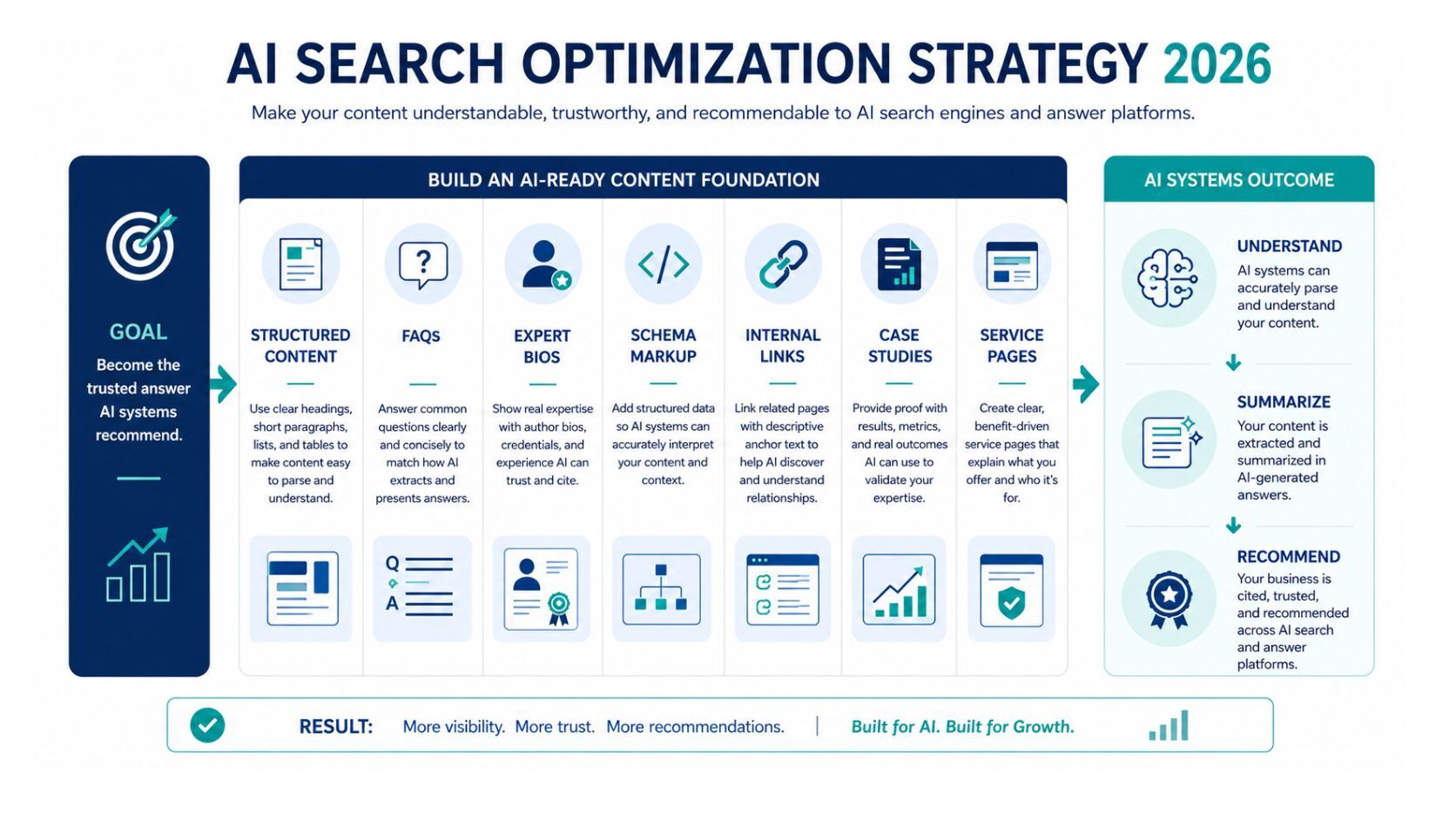
An AI search optimization strategy should include clear service pages, helpful blog content, FAQs, structured headings, schema markup, expert bios, case studies, internal links, topical authority, clear definitions, original examples, trust signals, citations where needed, and consistent brand entities.
For example, an AI Strategy Consulting service page should be supported by educational blogs like this one. A Business Intelligence Services page should be supported by dashboard, KPI, reporting, and analytics articles. A Dashboard Development Services page should be supported by dashboard examples, tool comparisons, and reporting best practices.
AI search optimization is not keyword stuffing. Instead, it is becoming the clearest and most trustworthy answer for the business questions your buyers ask.
An AI search optimization strategy helps AI search engines and answer platforms understand, summarize, and recommend your business through structured, useful, and trustworthy content.
Step 11: Build an AI-Powered Go-to-Market Strategy
Business leaders also ask how to build an AI-powered go-to-market strategy because AI can improve customer targeting, lead scoring, forecasting, personalization, buyer insights, and campaign performance.
An AI-powered go-to-market strategy uses AI to support sales, marketing, customer success, and revenue operations. It does not replace brand positioning, sales judgment, customer relationships, or ethical decision-making. Instead, it helps teams use data more intelligently across the customer journey.
AI can support ideal customer profile research, lead scoring, sales forecasting, customer segmentation, content personalization, campaign analysis, churn prediction, customer success alerts, market research, pricing insights, sales enablement, buyer intent analysis, proposal personalization, and upsell recommendations.
For a SaaS company, AI can analyze product usage, billing history, onboarding behavior, and support tickets to identify accounts at risk of churn. For a B2B service company, AI can analyze lead sources, inquiry quality, proposal conversion rates, and sales cycle length. For an e-commerce business, AI can support customer segmentation, product recommendations, abandoned-cart analysis, and demand forecasting.
This work may connect with Predictive Analytics Services, Data Analysis Services, and Dashboard Development Services.
How to Build an Enterprise AI Strategy
Organizations asking how to build an enterprise AI strategy need a stronger framework than small teams running isolated pilots. Enterprise AI involves multiple departments, larger datasets, stricter security needs, more stakeholders, and greater pressure to show measurable results.
An enterprise AI strategy should include executive sponsorship, business-unit alignment, enterprise data architecture, AI governance, approved tools, vendor review, pilot portfolio, model monitoring, audit trails, responsible AI policies, workforce training, enterprise dashboards, scaling roadmap, change management, AI steering committee, risk review process, vendor inventory, data access rules, and enterprise-wide metrics.
Enterprise AI should not become disconnected pilots. Instead, it should become a governed capability that supports the organization’s priorities across departments.
For example, finance may want forecasting, sales may want lead scoring, operations may want automation, and support may want ticket triage. If each team chooses separate tools and definitions, the organization may create more complexity. However, with enterprise AI strategy, leaders can coordinate tools, data standards, governance, measurement, and scaling.
| Enterprise AI Portfolio Category | Meaning | Example |
|---|---|---|
| Efficiency use cases | Reduce manual work or reporting delays | Automated management reporting |
| Revenue use cases | Improve sales, retention, or pricing | Churn prediction or lead scoring |
| Risk use cases | Detect fraud, anomalies, or compliance issues | Transaction anomaly detection |
| Experience use cases | Improve customer or employee experience | Customer support triage |
| Strategic capability use cases | Build long-term AI advantage | Enterprise knowledge assistant |
To build an enterprise AI strategy, align executive sponsorship, data architecture, governance, approved tools, use-case portfolios, monitoring, workforce training, and scaling.
What AI Should Not Automate Without Human Review
An effective AI strategy 2026 plan should identify what AI can support and what it should not fully automate. Some decisions affect people, safety, compliance, rights, finances, employment, healthcare, or professional responsibility. These workflows require human oversight because the consequences of error can be serious.
AI can support analysis, summarization, document review, prediction, classification, and workflow triage. However, support is different from final decision-making.
AI should not fully automate healthcare decisions, hiring decisions, credit decisions, legal decisions, financial approvals, compliance-sensitive workflows, employee evaluations, high-risk customer decisions, sensitive personal data workflows, insurance approval decisions, fraud accusations, or disciplinary decisions without strong human review.
| AI Workflow Risk Level | Example | Recommended Control |
|---|---|---|
| Low risk | Internal meeting summaries | Light review |
| Medium risk | Sales forecasting | Business owner review |
| High risk | Fraud detection or claims review | Human approval and documentation |
| Restricted | Fully automated healthcare, legal, credit, or employment decisions | Avoid full automation unless approved legally and ethically |
Human-in-the-loop AI protects accountability and trust. It ensures that AI improves speed and consistency without removing professional judgment.
AI Strategy Examples by Industry
| Industry | Effective AI Strategy Focus |
|---|---|
| Healthcare | Operational forecasting, patient flow, reporting automation, claims review |
| Finance | Risk scoring, forecasting, fraud detection, compliance reporting |
| Retail | Demand forecasting, product performance, customer segmentation |
| E-commerce | Recommendation systems, conversion analysis, inventory planning |
| SaaS | Churn prediction, customer health scoring, product analytics |
| Education | Learning analytics, research workflows, survey analysis |
| Operations | Workflow automation, anomaly detection, resource planning |
| Professional Services | Knowledge management, proposal support, client reporting |
The right AI strategy depends on industry context. Healthcare organizations need careful oversight and privacy controls. Finance teams need auditability and risk management. Retailers may focus on forecasting, inventory, and customer behavior. SaaS companies may prioritize churn prediction, customer health, and product analytics.
AI Strategy 2026 Checklist
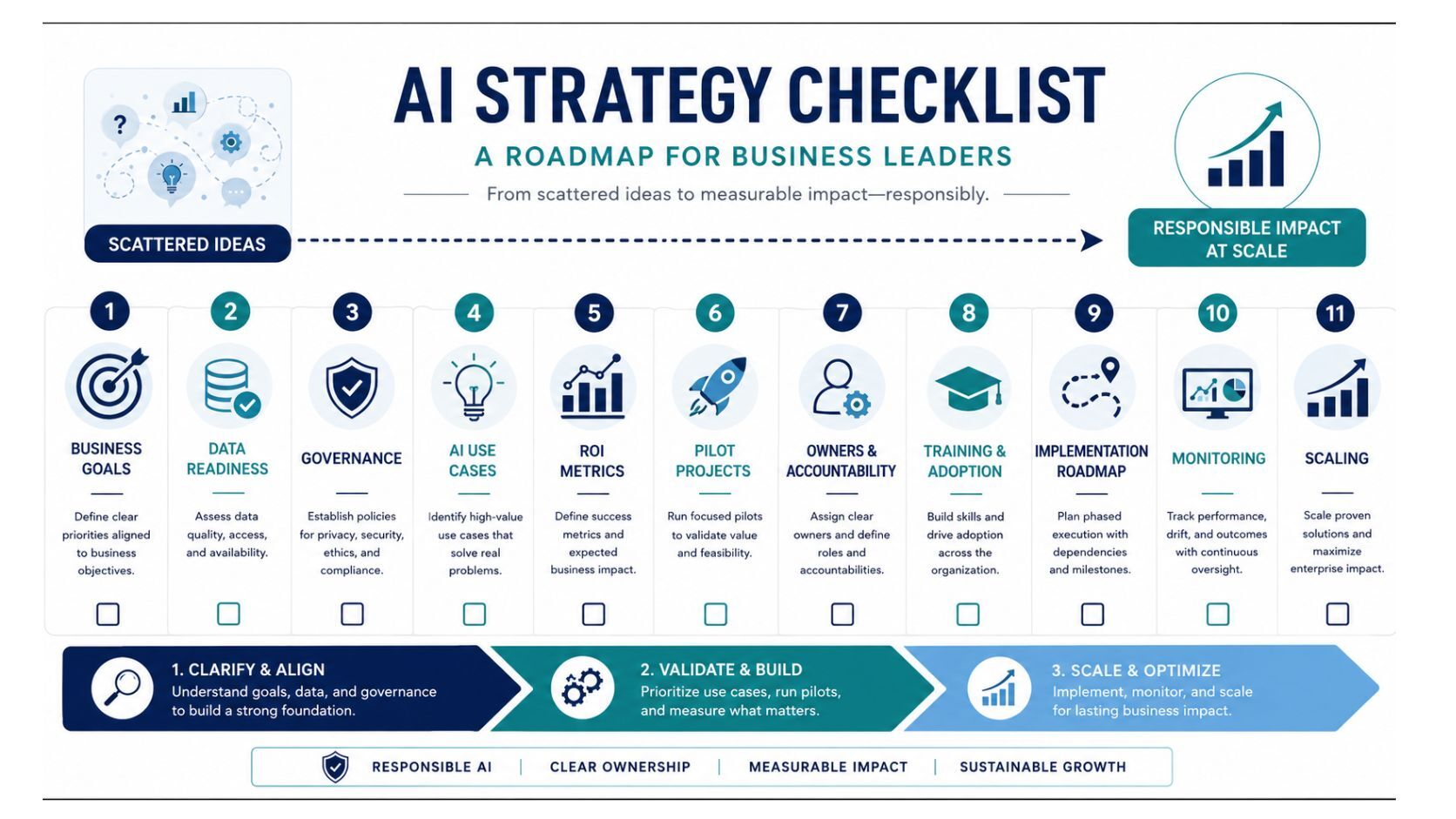
Use this checklist before launching AI tools or pilots:
- Define business goals
- Review current workflows
- Assess data readiness
- Identify use cases
- Score value and feasibility
- Review risk
- Create governance rules
- Define human review points
- Select pilot projects
- Define ROI metrics
- Build implementation roadmap
- Assign owners
- Plan training
- Monitor results
- Scale what works
- Document approved tools
- Define escalation rules
- Review privacy requirements
- Create an AI search visibility plan
- Connect AI strategy with reporting and BI
Common AI Strategy 2026 Mistakes to Avoid
Avoid buying tools before defining goals, ignoring data quality, skipping governance, automating high-risk decisions too early, running too many pilots, having no executive owner, using no ROI metrics, ignoring employee training, and failing to create an implementation roadmap.
Also, avoid treating AI search optimization as keyword stuffing. AI search visibility depends on helpful content, clear structure, expert signals, internal links, useful examples, and trustworthy sources.
Most importantly, avoid copying competitors without understanding your own business strengths. Your AI strategy 2026 roadmap should reflect your customers, data, workflows, risks, industry, and internal capabilities.
When to Hire an AI Strategy Consultant
Hire an AI strategy consultant when your business needs a clear roadmap, readiness review, use case prioritization, governance planning, ROI measurement, or pilot strategy.
Your organization may need expert support if leaders want to use AI but do not know where to start, data is scattered across systems, AI ideas are unclear, teams are using tools without governance, ROI must be clarified, regulated workflows need review, or internal teams need strategic guidance.
A consultant can help you move from scattered ideas to a structured plan. DataScienceConsultingPro.com provides AI Strategy Consulting for organizations that want practical, responsible, and measurable AI adoption.
Hire an AI strategy consultant when your business needs an AI strategy 2026 roadmap, data readiness review, use case prioritization, governance planning, ROI measurement, or pilot support.
Expert Note from Data Science Consulting Pro
AI strategy should not begin with tools. It should begin with business priorities, workflow problems, data readiness, governance needs, and measurable outcomes.
Many organizations fail with AI because they move too quickly into software selection before understanding which use cases are valuable, which data can be trusted, which decisions require human review, and how success will be measured.
At DataScienceConsultingPro.com, we recommend treating AI strategy as a business transformation plan, not a technology shopping list. The strongest strategies define owners, approved use cases, risk controls, data requirements, pilot criteria, ROI measures, and scaling rules before implementation begins.
How DataScienceConsultingPro.com Can Help
DataScienceConsultingPro.com helps businesses build practical AI strategies that connect ideas to implementation. We support organizations that need to assess readiness, identify AI opportunities, prioritize use cases, review data foundations, build AI roadmaps, plan governance, design pilots, and prepare implementation steps.
Depending on your needs, AI strategy may connect with:
- AI Strategy Consulting
- Data Engineering Services
- Machine Learning Services
- Predictive Analytics Services
- Data Cleaning Services
- Dashboard Development Services
- Business Intelligence Services
This article is educational and explains how to build an AI strategy 2026 roadmap. The AI Strategy Consulting service page is the best next step if you want expert help reviewing business goals, data systems, AI ideas, workflows, risks, and implementation priorities.
Want expert help turning AI ideas into a practical 2026 roadmap? Request an AI Strategy Consulting quote today.
FAQs About AI Strategy 2026
AI strategy 2026 is a business roadmap that explains how an organization will use AI to improve decisions, workflows, reporting, forecasting, customer experience, and growth while managing data, governance, risk, and implementation.
Build an effective AI strategy by defining business goals, assessing readiness, reviewing data quality, identifying use cases, prioritizing by value and risk, building governance, creating a roadmap, measuring ROI, and planning responsible scaling.
An AI strategy should include goals, data readiness, use case prioritization, governance, human oversight, pilot planning, roadmap development, ROI metrics, ownership, training, and scaling plans.
AI strategies fail when they start with tools, ignore data quality, skip governance, lack ROI metrics, have no executive owner, run too many pilots, or fail to connect AI to business outcomes.
Your business is ready for AI when you have clear goals, accessible data, leadership alignment, suitable workflows, governance controls, and the capacity to test, monitor, and improve AI solutions.
AI use case prioritization ranks AI opportunities based on business value, data readiness, feasibility, risk, adoption difficulty, measurability, and scalability.
Measure AI ROI using time saved, cost reduction, revenue lift, reduced errors, faster reporting, improved forecast accuracy, lower churn, better customer experience, and risk reduction.
An AI governance framework defines rules for AI tool use, data privacy, access control, human review, bias testing, explainability, auditability, model monitoring, vendor review, and accountability.
An AI search optimisation strategy helps businesses structure content so AI search engines and answer platforms can understand, summarize, and recommend their services.
Build an AI search optimization strategy with clear service pages, helpful blogs, FAQs, expert bios, internal links, schema markup, case studies, citations, and structured content.
An AI-powered go-to-market strategy uses AI to support customer research, lead scoring, sales forecasting, segmentation, personalization, campaign analysis, churn prediction, and customer journey analytics.
Build an enterprise AI strategy by aligning executive sponsorship, data architecture, governance, approved tools, use case portfolios, model monitoring, workforce training, dashboards, and scaling plans.
Healthcare decisions, hiring decisions, credit decisions, legal decisions, financial approvals, employee evaluations, and compliance-sensitive workflows should not be fully automated without human review.
Yes, most AI projects need clean, accessible, structured, and well-governed data. Poor data can produce unreliable outputs and weaken trust in AI results.
Hire an AI strategy consultant when you need a roadmap, use case prioritization, governance, data readiness review, ROI planning, pilot design, or strategic guidance before investing in AI tools.
DataScienceConsultingPro.com helps businesses assess AI readiness, identify use cases, review data foundations, plan governance, build AI roadmaps, design pilots, and connect strategy with implementation services.
Conclusion: Build an AI Strategy 2026 Roadmap That Creates Real Value
An effective AI strategy 2026 roadmap must connect business goals, data readiness, governance, use case prioritization, AI search visibility, operating model, ROI measurement, and implementation planning. It should help your organization decide what AI should do, what should remain under human review, what data foundation is needed, and how success will be measured.
AI should not become a collection of disconnected tools and pilots. Instead, it should become a practical, responsible, and measurable roadmap for better decisions, faster workflows, stronger reporting, smarter forecasting, and sustainable business value.
To get the best recommendation, send us your business goals, current tools, data systems, AI ideas, reporting challenges, workflow bottlenecks, compliance concerns, timeline, and desired outcomes. We will help you understand whether you need an AI readiness assessment, use case prioritization, AI roadmap, governance review, pilot plan, or implementation support.
Need help building an AI strategy 2026 roadmap? Request an AI Strategy Consulting quote from DataScienceConsultingPro.com today.
