
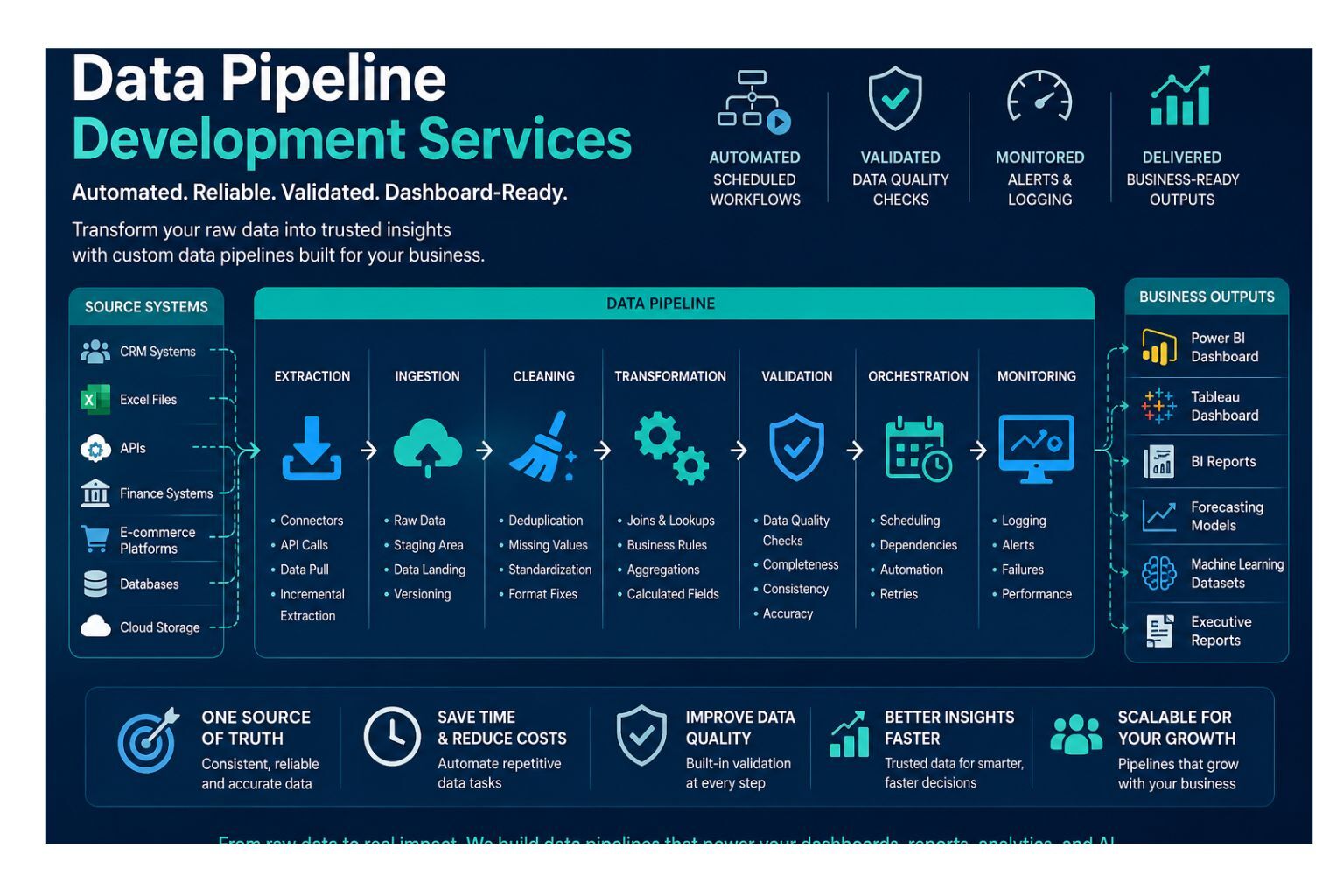
Many businesses collect data from CRMs, spreadsheets, finance systems, sales platforms, e-commerce tools, marketing platforms, APIs, websites, operational systems, databases, and cloud storage. The problem is that this data often remains scattered, delayed, inconsistent, or difficult to trust when leaders need it most.
Dashboards may fail to refresh. Teams may copy and paste the same files every week. Sales, finance, and operations may report different numbers. APIs may break without warning. Excel workbooks may become too fragile. Forecasting models may use incomplete inputs. Managers may lose confidence in reports because the data behind them is unclear.
DataScienceConsultingPro.com provides data pipeline development services that help businesses build clean, automated, validated, and dashboard-ready data flows. We help move data from source systems into reliable structures for reporting, business intelligence, dashboards, analytics, forecasting, and machine learning.
Request a Data Pipeline Development Quote
What Are Data Pipeline Development Services?
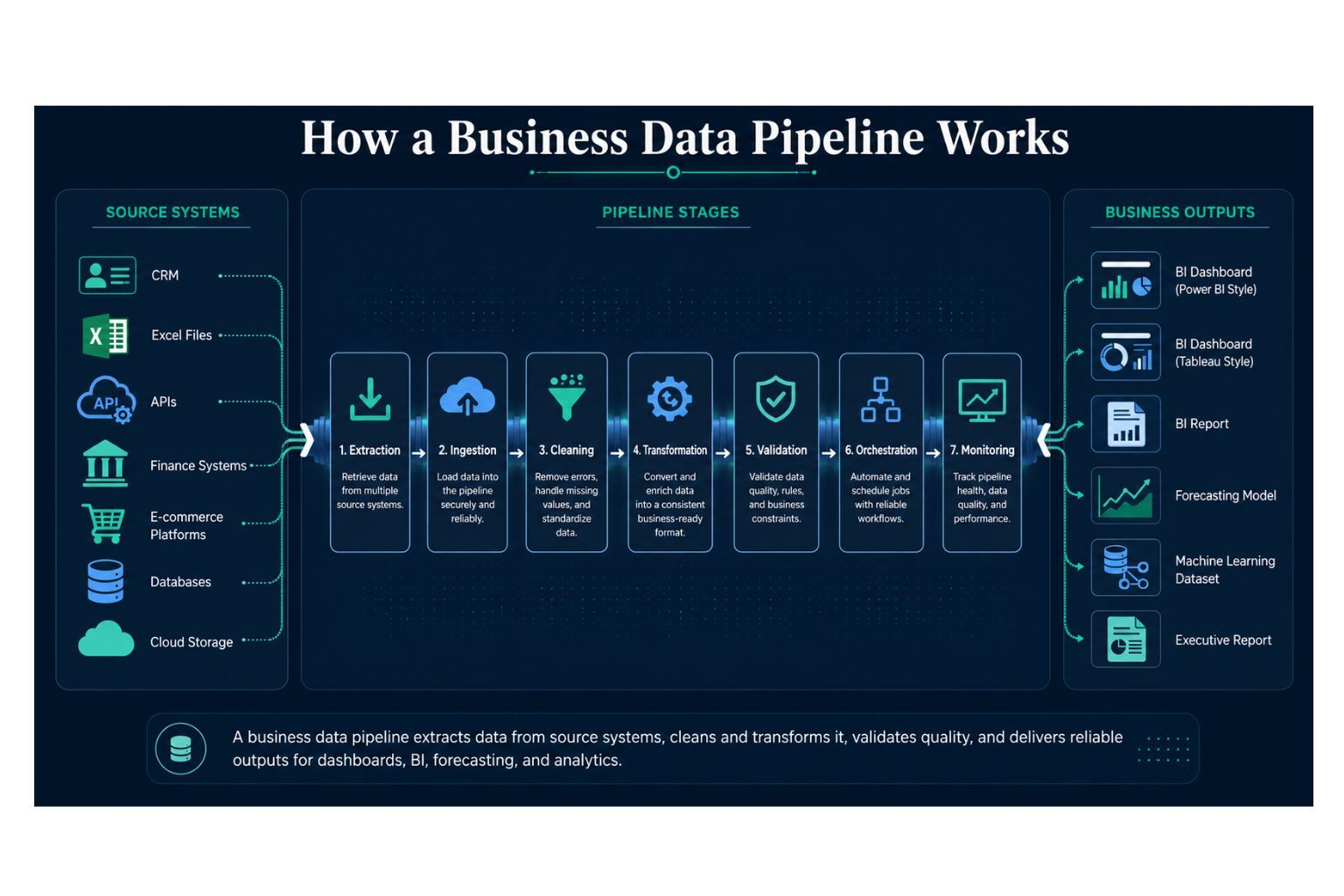
Data pipeline development services help businesses move data from where it is collected to where it can be used. A data pipeline extracts data from source systems, cleans it, transforms it, validates it, organizes it, and delivers it to a useful destination.
That destination may be a database, data warehouse, Power BI dashboard, Tableau dashboard, Excel report, Looker Studio dashboard, machine learning dataset, forecasting model, business intelligence system, or executive report.
A strong pipeline does more than move data. It creates a repeatable process that reduces manual work, improves reporting consistency, and gives teams more confidence in their numbers. Instead of rebuilding the same report every week, your data can refresh through a structured workflow.
Why Reliable Data Pipelines Matter
A data pipeline is not only technical infrastructure. It affects decision speed, reporting accuracy, team productivity, and trust in business numbers.
When pipelines are weak or missing, reporting becomes reactive. Teams wait for exports, fix errors manually, and argue over which spreadsheet is correct. When pipelines are reliable, teams spend less time preparing data and more time using it.
| Problem | Business Risk | How Our Data Pipeline Development Services Help |
|---|---|---|
| Manual reporting | Wasted analyst time | Automates extraction, cleaning, and refresh workflows |
| Inconsistent KPIs | Teams disagree on performance | Applies standardized business logic |
| Duplicate records | Revenue and customer counts become distorted | Adds deduplication and matching rules |
| Missing values | Reports become incomplete | Adds validation and exception checks |
| Broken API pulls | Reports fail without warning | Adds monitoring, retries, and error handling |
| Slow dashboards | Leaders wait too long for updates | Builds scheduled or near-real-time refreshes |
| Poor forecasting inputs | Predictions become unreliable | Prepares cleaner, model-ready datasets |
Reliable pipelines help teams work from the same data foundation. They reduce reporting confusion, improve decision-making, and make dashboards easier to trust.
Common Data Pipeline Problems We Help Fix
Many reporting problems are not caused by the dashboard itself. They come from weak data flows behind the dashboard.
Common pipeline issues include broken refresh schedules, API failures, changed column names, inconsistent date formats, duplicate customer records, mismatched revenue totals, incomplete imports, slow queries, poor documentation, and dashboards that still depend on manually uploaded files.
Another common issue is invisible failure. A report may refresh successfully, but the source file may be incomplete. A column name may change upstream, but nobody notices until the dashboard looks wrong. A revenue table may include duplicate transactions, but the error only appears during month-end review.
Our approach focuses on prevention. We help design pipelines with validation rules, schema checks, logging, monitoring, documentation, and testing. A reliable pipeline should not only move data; it should also make problems easier to detect, explain, and fix.
How We Build Reliable Data Pipelines
Reliable data pipelines need more than data movement. They need clear business rules, repeatable workflows, validation checks, error handling, documentation, and a structure that your team can maintain after deployment.
At DataScienceConsultingPro.com, we review your source systems, define expected outputs, document transformation logic, test refresh behavior, check for missing or duplicated records, and prepare handover notes. This makes the pipeline easier to understand, monitor, and support.
We also focus on business meaning. A sales table should not only load correctly; it should reflect how your business defines leads, customers, revenue, refunds, product categories, and reporting periods. A finance pipeline should not only move data; it should preserve the logic needed for margin, expense, revenue, and cash flow reporting.
This helps reduce dashboard errors, reporting confusion, broken refreshes, and repeated manual fixes.
Our Data Pipeline Development Services
Our data pipeline development services cover the full flow from source systems to business-ready outputs. The goal is to create practical, reliable workflows that support reporting, analytics, dashboards, forecasting, and AI.
Data Source Review and Pipeline Planning
We start by reviewing your current data sources, reporting goals, pain points, and desired outputs. This may include CRMs, spreadsheets, finance systems, accounting tools, sales platforms, marketing platforms, APIs, databases, cloud storage, SaaS tools, e-commerce systems, and operational platforms.
This stage helps answer important questions. Where does the data come from? How often should it refresh? Which fields matter? What business rules should be applied? Which dashboards, reports, or models depend on the output? What errors are causing the most frustration?
A pipeline should not be built blindly. It should match the business decision it supports.
Data Ingestion Pipeline Development
Data ingestion is the process of collecting data from source systems and bringing it into a controlled workflow. We can support batch ingestion, scheduled ingestion, API extraction, database extraction, file-based ingestion, cloud ingestion, and structured data collection.
Examples include pulling daily sales data from a CRM, importing weekly finance files, extracting product records from an e-commerce platform, collecting marketing data from campaign tools, or connecting operational records from business systems.
The aim is to reduce repeated manual extraction and create a consistent path from raw data to usable output.
ETL and ELT Pipeline Development
ETL means extract, transform, and load. ELT means extract, load, and transform. Both methods help move raw data into a reliable structure, but the best option depends on your tools, data volume, storage setup, and reporting needs.
ETL is often useful when data must be cleaned and transformed before it enters the destination system. ELT is often useful when data is loaded first into a database, warehouse, or cloud platform and transformed there.
We help choose the right workflow for your situation. The goal is clean, explainable, reusable data for reporting, dashboards, analytics, forecasting, or storage.
Data Cleaning and Transformation Logic
Raw business data often contains missing values, duplicate records, inconsistent dates, unclear categories, spelling variations, wrong formats, and mismatched IDs. A pipeline should handle these issues consistently.
We can build transformation logic for cleaning, joining, deduplication, formatting, standardization, calculated fields, KPI tables, revenue reconciliation, category mapping, missing value handling, and business rules.
For deeper cleaning projects, our Data Cleaning Services can support one-time or recurring cleaning needs before data enters reports, dashboards, or models.
Data Integration Across Business Systems
Many businesses have useful data trapped in separate systems. Sales data may sit in a CRM. Finance data may sit in spreadsheets. Marketing data may sit in campaign platforms. Operations data may sit in internal tools. Customer data may sit in support systems.
A data pipeline can connect these systems into a unified reporting structure. This makes it easier to compare performance across departments, track customer journeys, analyze revenue, monitor operations, and build complete dashboards.
Data integration is especially useful when leaders want one version of the truth instead of separate reports that tell different stories.
Dashboard-Ready Data Pipelines
Dashboards are only as useful as the data behind them. If the pipeline is weak, the dashboard becomes slow, inconsistent, or misleading.
We develop dashboard-ready data pipelines that prepare clean tables for Power BI, Tableau, Looker Studio, Excel, Google Sheets, and custom reporting systems. These outputs can include KPI tables, sales summaries, financial summaries, customer tables, product tables, operational metrics, and time-based trend datasets.
For dashboard design and reporting interfaces, see our Dashboard Development Services and Business Intelligence Services.
Real-Time and Streaming Data Pipelines
Not every business needs real-time data. In many cases, daily or hourly refreshes are enough. However, some workflows need real-time or near-real-time pipelines.
Real-time pipelines may support fraud monitoring, live sales tracking, product analytics, logistics monitoring, IoT data, campaign performance, customer events, and operational alerts. These pipelines capture and process events as they happen or close to when they happen.
We help determine whether real-time processing is necessary or whether a simpler scheduled pipeline would be more practical and cost-effective.
Pipeline Automation, Validation, and Monitoring
A pipeline should not depend on someone remembering to run a file every Monday morning. Automation and orchestration help data workflows run on a defined schedule with clear dependencies, refresh logic, retries, notifications, monitoring, logs, and automated updates.
A useful pipeline should also check whether data makes sense before it reaches a report. This can include duplicate checks, missing value checks, schema checks, date validation, category validation, revenue reconciliation, row count checks, and exception reporting.
Data pipelines should be understandable after they are built. We provide data dictionaries, handover notes, refresh instructions, business rule documentation, error handling notes, and monitoring recommendations.
Talk to Us About Building a Reliable Data Pipeline
Custom Data Pipeline Development Services for Different Business Needs
Custom data pipeline development services should match your business problem, data sources, reporting goals, tools, and decision-making process. A generic pipeline template is rarely enough because every organization defines customers, revenue, products, operations, and performance differently.
Examples of business-specific pipelines include:
- Sales pipeline data for revenue, leads, conversion rates, deal stages, and pipeline reporting
- Finance data for revenue, expenses, cash flow, margins, and budget reporting
- Marketing data for campaign ROI, leads, attribution, traffic, and conversions
- E-commerce data for orders, customers, inventory, product performance, and revenue
- SaaS data for MRR, churn, activation, retention, and product usage
- Healthcare administrative data for operations, utilization, surveys, and quality reporting
- Logistics data for delivery, routing, inventory, and service performance
- Operations data for workload, productivity, bottlenecks, and process tracking
The right pipeline turns scattered records into structured data that supports the way your business actually works.
Data Pipeline Development for Analytics, Dashboards, Forecasting, and AI
Data pipelines create the foundation for better decision-making. They help ensure that reports, dashboards, models, and analytics workflows use clean and consistent data.
A well-built pipeline can support business analysis, BI reporting, executive dashboards, financial dashboards, sales dashboards, predictive analytics, machine learning models, customer segmentation, revenue forecasting, churn prediction, and anomaly detection.
For example, a churn prediction model needs reliable customer history, product usage, billing data, and support activity. A revenue forecast needs clean historical sales, time periods, product categories, and seasonality indicators. A BI dashboard needs consistent KPI logic and timely refreshes.
Depending on your goal, our pipeline work can connect naturally with our Data Analysis Services, Predictive Analytics Services, Machine Learning Services, and Big Data Analytics Services..
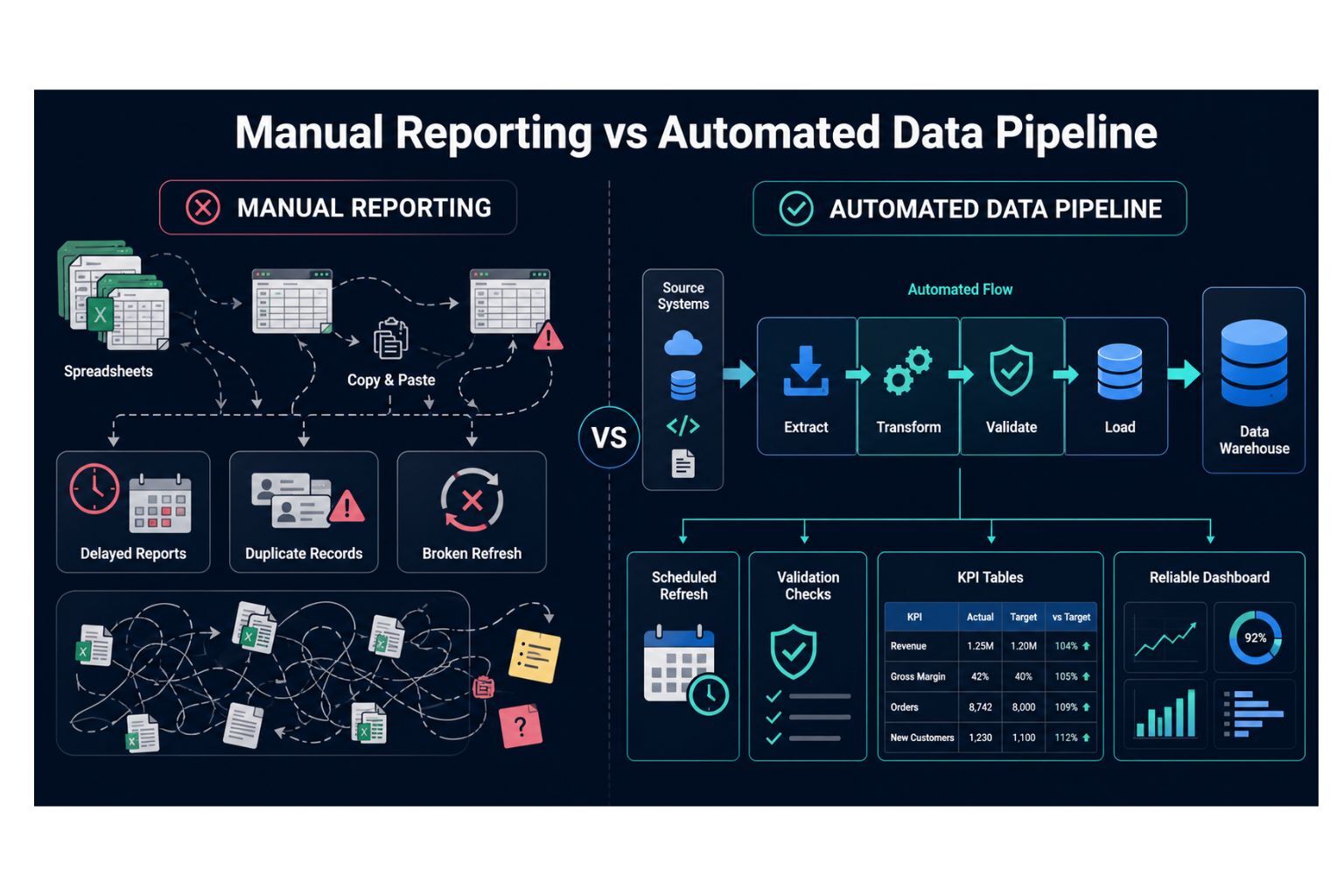
Manual Reporting vs Custom Data Pipelines
Manual reporting may work when a business is small. But as data sources increase, manual workflows become slower, riskier, and harder to maintain.
| Manual Reporting | Custom Data Pipeline Development Services |
|---|---|
| Repeated file preparation | Automated data workflows |
| Inconsistent calculations | Standardized transformations |
| Late reports | Scheduled refreshes |
| Hidden spreadsheet errors | Validation rules |
| Disconnected systems | Integrated data sources |
| Dashboard distrust | Reliable reporting foundation |
| Undocumented logic | Clear documentation |
| Limited scalability | Reusable data infrastructure |
Custom pipelines are especially useful when the same reports are prepared repeatedly, several departments depend on the same numbers, or leaders need faster access to reliable data.
Data Pipeline Development vs Data Engineering vs Data Integration vs Data Migration
These services are related, but they are not the same.
Data pipeline development focuses on building automated flows that move, clean, transform, validate, and deliver data from source systems to useful destinations.
Data engineering is broader. It can include data architecture, infrastructure, storage, transformation, modeling, integration, governance support, and delivery systems. See our Data Engineering Services for the parent service.
Data integration focuses on connecting multiple systems into one usable structure. It is often part of pipeline development when data needs to be combined across sales, finance, marketing, operations, or customer systems.
Data migration focuses on moving data from one system, platform, database, or format to another. See our Data Migration Services if your main need is system-to-system movement.
This page focuses specifically on pipeline development, automation, monitoring, and reliable data flow. That helps it support the broader data engineering page without competing with it.
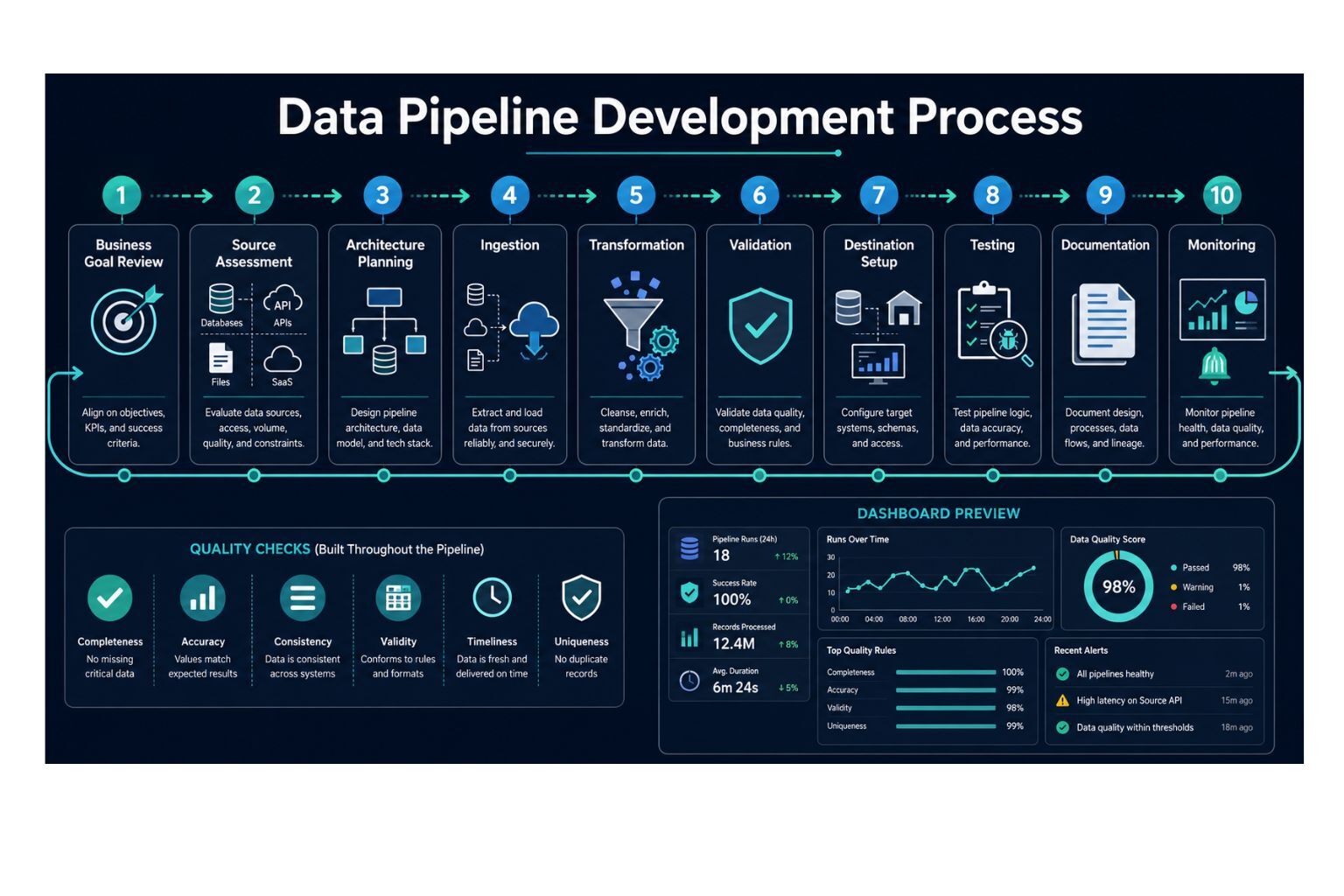
Our Data Pipeline Development Process
We use a structured process to understand your business goal, review your current data, and build a pipeline that supports practical outputs.
- Business goal and reporting needs review – We clarify what the pipeline should support, such as dashboards, BI reports, analytics, forecasting, or machine learning.
- Data source assessment – We review where your data comes from, how it is stored, and how it currently moves.
- Current workflow and pain point review – We identify manual steps, broken reports, inconsistent KPIs, slow refreshes, and recurring errors.
- Pipeline architecture planning – We plan how data should move from source to destination.
- Data extraction and ingestion setup – We create the process for collecting data from files, databases, APIs, cloud storage, or systems.
- Data cleaning and transformation logic – We apply formatting, deduplication, joins, business rules, and calculated fields.
- Data validation and quality checks – We add checks for missing values, schema issues, duplicates, row counts, and exceptions.
- Destination setup – We prepare outputs for dashboards, databases, warehouses, BI tools, analytics workflows, or models.
- Testing and error handling – We test refresh logic, output accuracy, edge cases, and failure points.
- Documentation and handover – We provide notes that explain the data flow, rules, refresh process, and output structure.
- Optional monitoring and support – We can support ongoing checks, improvements, and troubleshooting.
Request a Pipeline Review and Quote
What You Receive From Our Data Pipeline Development Services
The exact deliverables depend on your data sources, tools, complexity, and desired output. A typical project may include a data source review, pipeline plan, cleaned and transformed datasets, ETL or ELT workflow, API or database extraction setup, dashboard-ready tables, KPI-ready reporting tables, validation rules, refresh schedule, error handling notes, monitoring recommendations, data dictionary, documentation, handover notes, executive summary, and optional ongoing monitoring plan.
The goal is to leave you with a working pipeline and a clear understanding of how your data moves, what transformations are applied, how the output is refreshed, and how the final dataset should be used.
Tools and Technologies We Can Work With
The right tools depend on your systems, data sources, budget, security needs, reporting goals, and project scope. We select tools based on what is practical for the business problem.
We can work with tools and environments such as Python, SQL, Excel, Google Sheets, PostgreSQL, MySQL, SQL Server, APIs, cloud storage, AWS, Azure, Google Cloud, Snowflake, Databricks, Power BI, Tableau, Looker Studio, dbt, Airflow, and other tools depending on project scope.
The technology stack should support the workflow, not complicate it. For some clients, a simple scheduled workflow may be enough. For others, a more advanced cloud pipeline may be required.
Who Should Hire Data Pipeline Developers?
You should consider hiring data pipeline developers if your business depends on data but your current reporting process feels slow, manual, or unreliable.
This service may be a good fit if reporting takes too long, dashboards depend on manual files, data comes from many disconnected systems, finance and sales use different numbers, APIs break often, data needs scheduled refreshes, your business is preparing for BI, you want forecasting or machine learning, managers do not trust current reports, or analysts spend more time cleaning data than using it.
Outsourced data pipeline development can also help when your internal team is busy, your reporting needs are growing, or you need a practical pipeline built without hiring a full-time data engineer.
Why Choose DataScienceConsultingPro.com?
The best data pipeline development services are not just about moving data from one place to another. They make business data easier to trust, refresh, explain, and use.
DataScienceConsultingPro.com focuses on practical, business-ready pipeline development. We help connect messy data sources, apply clear transformation logic, prepare dashboard-ready outputs, and document the workflow so your team understands how the data is produced.
Our approach is built around business-first data planning, practical data engineering, clear documentation, clean deliverables, support for dashboards and analytics, simple explanations for non-technical decision-makers, careful handling of messy business data, and a focus on validation, reliability, and handover.
We do not build pipelines for technical appearance alone. We build them to support real reporting, analysis, forecasting, and decision-making needs.
Data Pipeline Development Pricing
Data pipeline development pricing depends on project size and complexity. A simple workflow that cleans and refreshes spreadsheet data will not require the same effort as a multi-source cloud pipeline with APIs, validation rules, monitoring, and BI outputs.
Pricing may vary based on the number of data sources, data volume, data quality, API complexity, database complexity, batch versus real-time needs, transformation logic, destination system, dashboard or BI requirements, documentation needs, support level, and project urgency.
The best way to estimate cost is to review your current workflow, sample data, source systems, desired output, and deadline.
Request a quote so we can review your data sources, workflow, and desired output.
FAQs About Data Pipeline Development Services
Data pipeline development services involve building workflows that extract, clean, transform, validate, and deliver data from source systems to destinations such as databases, dashboards, data warehouses, reports, analytics tools, or machine learning models.
Your business may need a data pipeline if reports take too long to prepare, dashboards rely on manual files, data comes from many systems, or teams do not trust the numbers they use for decisions.
ETL extracts data, transforms it, and then loads it into the destination. ELT extracts data, loads it first, and transforms it inside the destination system. The right option depends on your data structure, tools, and reporting needs.
Yes. Custom data pipeline development services can be designed around your data sources, reporting goals, business rules, refresh needs, and preferred tools.
Yes. Depending on access and project scope, pipelines can connect data from Excel files, Google Sheets, CRMs, APIs, databases, finance tools, cloud storage, and other systems.
Yes. A data pipeline can prepare clean, structured, dashboard-ready tables for Power BI. This helps dashboards refresh more reliably and use consistent business logic.
Yes, when real-time or near-real-time data is needed. However, not every business needs real-time processing. We help determine whether real-time, hourly, daily, or weekly refreshes are the best fit.
Yes. Existing pipelines can be reviewed for broken connections, slow queries, schema issues, failed refreshes, missing validation, unclear logic, and poor documentation.
Yes. Machine learning and AI workflows often need clean, consistent, well-structured data. A pipeline can prepare model-ready datasets for forecasting, classification, churn prediction, segmentation, and other analytics use cases.
Helpful materials include sample files, source system details, current reports, dashboard goals, data problems, business rules, preferred tools, refresh needs, and deadlines.
Request Data Pipeline Development Services
If your team depends on scattered files, disconnected systems, manual reports, slow dashboards, inconsistent KPIs, unreliable refreshes, or data that managers no longer trust, it may be time to build a cleaner pipeline foundation.
DataScienceConsultingPro.com can help you create automated, validated, and business-ready data pipelines for reporting, dashboards, business intelligence, analytics, forecasting, and machine learning.
To get started, send us your current data sources, reporting process, data problems, preferred tools, dashboard or analytics goals, deadline, sample files or system details if available, and your desired final output.