
Most companies do not lack data. They lack a reliable way to turn it into decisions.
Sales numbers live in one system, marketing numbers live in another, and finance has its own version of the truth. Reports take days to build and are outdated the moment they arrive. Forecasts are really just guesses dressed up in a spreadsheet. A machine learning proof of concept from last year is still sitting on a laptop somewhere, never deployed. And nobody on staff has the time, or the specialized background, to fix any of it properly.
This is the point where most businesses start searching for data science service providers: outside specialists who can look at messy, disconnected data and turn it into something usable, whether that is a clean dataset, a working dashboard, a forecast, or a deployed machine learning model.
DataScienceConsultingPro.com works across that entire range, from the first pass of cleaning and organizing data through to building, deploying, and monitoring models in production. The rest of this page explains what these providers actually do, how to evaluate one properly, what things tend to cost, and why businesses choose to work with us.
Describe your challenge or share a sample of your data. We will tell you honestly what is possible before you commit to anything.
What Are Data Science Service Providers?
Data science service providers are teams or companies that help businesses collect, clean, analyze, and model their data in order to answer specific business questions and support better decisions. A full service provider typically combines statistics, machine learning, data engineering, and business interpretation, rather than offering only one narrow skill.
The distinction that matters most to buyers is this: a report tells you what happened. An operational data solution, such as a live dashboard, a deployed model, or an automated pipeline, keeps working and keeps informing decisions long after the initial project ends. Good providers are clear about which one you are paying for.
Depending on the engagement, a provider’s work can include business problem definition, data collection, data cleaning, exploratory analysis, statistical testing, predictive modeling, machine learning, visualization, data engineering, forecasting, deployment, ongoing monitoring, and plain language recommendations for leadership.
What Does a Data Science Service Provider Actually Do?
The table below breaks down the core services under this umbrella, the business problem each one solves, and what you should expect to receive at the end.
| Service | Business Problem | Typical Deliverable | Example |
|---|---|---|---|
| Data strategy | No clear plan for what to measure or why | Roadmap and priority list | Defining which three metrics actually predict churn |
| Data cleaning and preparation | Data is inconsistent, duplicated, or incomplete | Clean, structured dataset | Merging CRM and billing records into one usable table |
| Exploratory data analysis | Nobody knows what the data actually shows | Findings summary with visuals | Discovering that 20 percent of customers drive most revenue |
| Statistical analysis | Need to test whether a pattern is real | Statistical report with confidence levels | Testing whether a pricing change actually affected conversion |
| Business intelligence | Reporting is manual and slow | Automated reports | Weekly sales summary generated without spreadsheets |
| Dashboard development | Executives see conflicting numbers | Interactive Power BI or Tableau dashboard | One dashboard combining sales, marketing, and finance |
| Predictive analytics | Can’t anticipate customer or demand behavior | Predictive model | Scoring leads by likelihood to convert |
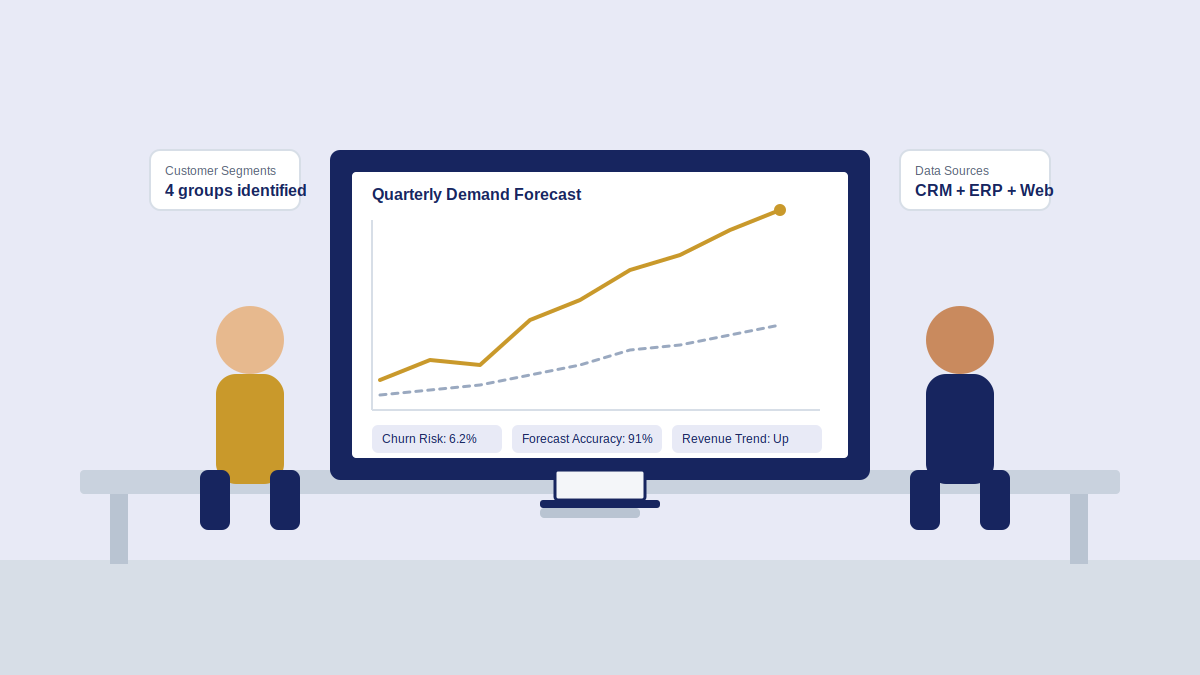
| Forecasting | Planning is based on guesswork | Forecast model and report | Projecting next quarter’s demand by region |
| Machine learning | Rules based systems can’t keep up with complexity | Trained and validated model | Detecting fraudulent transactions in real time |
| Customer segmentation | All customers are treated the same | Segment profiles | Grouping customers by value and behavior |
| Churn prediction | Losing customers with no warning | Churn risk scores | Flagging accounts likely to cancel next month |
| Fraud and risk analytics | Manual review can’t scale | Risk scoring system | Ranking transactions by fraud likelihood |
| Recommendation systems | Generic offers underperform | Recommendation engine | Suggesting relevant products at checkout |
| Natural language processing | Unstructured text data goes unused | Text classification or extraction tool | Categorizing support tickets automatically |
| AI automation | Repetitive analytical tasks eat staff time | Automated workflow | Auto generating monthly variance reports |
| Data engineering | Data lives in disconnected systems | Reliable data pipeline | Syncing CRM, ERP, and web analytics daily |
| ETL and data pipelines | Manual data transfer is error prone | Automated ETL pipeline | Loading daily sales data into a warehouse overnight |
| Big data analytics | Data volume exceeds spreadsheet limits | Scalable analytics setup | Analyzing years of transaction logs |
| Cloud analytics | On premise systems can’t scale | Cloud based analytics environment | Migrating analytics workloads to AWS or Azure |
| Model deployment | Models never leave the testing stage | Production ready model or API | Deploying a pricing model into the live checkout flow |
| MLOps | Deployed models degrade silently | Monitoring and retraining setup | Alerting when model accuracy drops below a threshold |
| Ongoing analytics support | No one maintains the system after launch | Monthly support and reporting | Retraining a demand forecast every quarter |
Several of these are covered in more depth on our dedicated pages, including data cleaning services, machine learning services, predictive analytics services, and dashboard development services.
Our Data Science Services
Data Cleaning and Preparation
Problem: raw data is duplicated, mismatched, or missing key fields. Service: standardizing formats, resolving duplicates, and validating fields across sources. Deliverable: a clean dataset with documentation of what was changed and why. Business value: every analysis built afterward stands on solid ground instead of guesswork. See our full data cleaning services page for detail.
Data Analysis
Problem: leadership has questions the raw numbers cannot answer on their own. Service: structured exploratory analysis to surface patterns, outliers, and relationships. Deliverable: a findings report with visuals and plain language interpretation. Business value: decisions get made based on evidence rather than instinct.
Statistical Analysis
Problem: a pattern looks real but nobody can confirm it. Service: hypothesis testing, regression, and significance testing appropriate to the question. Deliverable: a statistical report stating confidence levels and limitations. Business value: fewer decisions based on coincidence. Related: statistical analysis services.
Business Intelligence and Reporting
Problem: reports take days to compile and are inconsistent between departments. Service: consolidating data sources and building repeatable reporting logic. Deliverable: automated, standardized reports. Business value: leadership works from one shared version of the numbers.
Power BI and Tableau Dashboards
Problem: static reports go stale the moment they are sent. Service: building interactive dashboards connected directly to live data. Deliverable: a Power BI or Tableau dashboard with defined KPIs. Business value: teams can explore current data themselves instead of waiting for the next report. See dashboard development services.
Predictive Analytics
Problem: the business reacts to events instead of anticipating them. Service: building models that estimate future outcomes from historical patterns. Deliverable: a predictive model with documented accuracy and assumptions. Business value: earlier, better informed action. Full detail on our predictive analytics services page.
Forecasting
Problem: planning relies on rough estimates. Service: statistical or machine learning based forecasting tailored to the data available. Deliverable: a forecast model and accompanying report. Business value: more realistic budgeting, staffing, and inventory decisions.
Machine Learning
Problem: patterns are too complex for manual rules or simple statistics. Service: designing, training, and validating machine learning models suited to the problem. Deliverable: a trained model with performance metrics and documentation. Business value: automated, data driven decisions at scale. See our machine learning services page.
Artificial Intelligence Solutions
Problem: repetitive analytical or classification work consumes staff hours. Service: applying AI techniques, including natural language processing where relevant, to automate specific tasks. Deliverable: a working AI component integrated into existing workflows. Business value: staff time redirected toward higher value work.
Data Engineering
Problem: data lives scattered across CRM, ERP, spreadsheets, and marketing platforms. Service: building pipelines that move and structure data reliably. Deliverable: a working data pipeline with monitoring in place. Business value: every other analytics effort becomes possible and repeatable.
Big Data Analytics
Problem: data volume has outgrown spreadsheets and simple databases. Service: setting up scalable storage and processing suited to the volume and speed of the data. Deliverable: a working big data analytics environment. Business value: analysis that would be impractical manually becomes routine. See big data analytics services.
Customer Analytics
Problem: all customers are marketed to and served the same way. Service: segmentation, lifetime value modeling, and behavior analysis. Deliverable: customer segments and profiles tied to business outcomes. Business value: more targeted retention and growth strategy.
Marketing Analytics
Problem: it is unclear which campaigns actually drive revenue. Service: attribution analysis and campaign performance modeling. Deliverable: attribution report and recommendations. Business value: marketing spend directed toward what actually works.
Financial Analytics
Problem: financial reporting is backward looking only. Service: forecasting, variance analysis, and risk modeling applied to financial data. Deliverable: financial models and forecasts. Business value: more confident budgeting and risk planning.
Data Visualization
Problem: technical findings do not land with non technical stakeholders. Service: designing charts and dashboards that communicate results clearly. Deliverable: visual reports or dashboard components. Business value: faster, better understood decisions. Related page: data visualization services.
Model Deployment and Monitoring
Problem: models are built but never used in production. Service: deploying models into live systems and setting up ongoing performance monitoring. Deliverable: a production model with monitoring and retraining triggers. Business value: the investment in modeling actually pays off in daily operations.
Business Problems We Help Solve
Many first conversations with clients sound like this:
“Our sales data exists, but we cannot predict next quarter.” This usually means the data is there but has never been structured for forecasting. We start with a data review, then build a forecasting model once the inputs are reliable.
“Our executives receive different numbers from different dashboards.” This is almost always a data integration problem, not a reporting tool problem. We trace the discrepancy back to its source and build one consistent pipeline.
“We have customer data but cannot identify customers likely to leave.” This calls for a churn model, which requires historical examples of both retained and lost customers to learn from.
“Our reports take several days to prepare manually.” This points to automation potential. Once the underlying data is connected, most recurring reports can run on a schedule.
“We collect large amounts of data but do not know what decisions to make from it.” This is a strategy gap more than a technical one. We start with an exploratory analysis focused on the specific decisions leadership needs to make.
“We want machine learning but do not know whether our data is ready.” A short data review can usually answer this honestly, often before any modeling work begins.
“Our CRM, accounting, marketing and operational data do not match.” This is a data engineering problem. Building a single connected pipeline resolves the mismatches at the source.
“We built a model, but it has never reached production.” This is common and usually comes down to deployment being treated as an afterthought rather than part of the original project plan.
When Should You Hire a Data Science Service Provider?
Bringing in outside help tends to make sense when:
- You lack specialist talent in house for a specific project
- You need a specialist temporarily rather than as a permanent hire
- You want to validate an idea before committing to building an internal team
- You are facing a difficult data integration problem
- The project needs advanced modeling beyond your team’s current experience
- You want an independent, outside perspective on your data
- Reporting has become a bottleneck for decision making
- You need to move faster than your current hiring timeline allows
- An existing model is underperforming and needs review
- You need forecasting capability you do not currently have
- You want to automate a decision process that is currently manual
[Discuss Your Data Challenge] No obligation. We will tell you plainly whether outsourcing or hiring internally makes more sense for your situation.
Data Science Provider vs In House Data Science Team
| Factor | External Provider | In House Team |
|---|---|---|
| Initial cost | Lower, scoped to the project | Higher, includes salaries and benefits |
| Recruitment time | Immediate or within days | Weeks to months |
| Access to specialists | Broad, across disciplines | Limited to who you hire |
| Scalability | Flexible, scale up or down per project | Fixed until you hire or lay off |
| Infrastructure | Often provided or advised on | You must build and maintain it |
| Knowledge retention | Requires documentation and handover | Stays with the team long term |
| Flexibility | High, project by project | Lower, tied to existing staff skills |
| Project speed | Often faster for defined scopes | Depends on internal capacity |
| Long term suitability | Strong for defined, recurring, or specialist projects | Strong when data science is core to daily operations |
| Best use cases | Proof of concept, specialist gaps, temporary surges | Ongoing, mission critical, high volume data work |
Neither option is automatically correct. A company running continuous, high volume machine learning as a core part of its product usually benefits from an internal team long term. A company that needs a forecast, a dashboard rebuild, or a well defined model, without daily ongoing data science work, is often better served by a provider.

Freelancer vs Boutique Data Science Company vs Large Consulting Firm
| Factor | Freelancer | Boutique Company | Large Consulting Firm |
|---|---|---|---|
| Typical project size | Small to medium | Small to large | Large, enterprise scale |
| Cost structure | Lowest, hourly | Mid range, project or retainer | Highest, often bundled |
| Specialist access | Limited to one person’s skills | Team covering multiple disciplines | Very broad, but less personal |
| Flexibility | High | High | Lower, more process heavy |
| Communication | Direct but limited availability | Direct with a dedicated team | Often layered through account managers |
| Enterprise resources | Minimal | Moderate | Extensive |
| Customization | High | High | Can be templated |
| Project management | Often informal | Structured | Highly structured |
| Speed | Fast for small tasks | Fast to moderate | Slower to start, built for scale |
| Best suited for | Very small, well defined tasks | Most small to mid sized businesses and growing companies | Very large, multi year enterprise programs |
DataScienceConsultingPro.com operates as a boutique data science company: small enough for direct communication and flexible scoping, structured enough to cover data cleaning, statistics, machine learning, and deployment under one roof.
How to Choose the Right Data Science Service Provider
This is the part of the decision most guides skip past. Here is a twelve point framework worth working through before you sign anything.
- Understanding of the business problem. Can they explain your problem back to you in plain terms, not just in technical jargon?
- Relevant technical expertise. Do they have real experience with the type of analysis or modeling you need, not just general data experience?
- Industry familiarity. Have they worked with data similar to yours, even if not your exact industry?
- Data preparation capabilities. Do they treat cleaning and structuring data as real work, or skip straight to modeling?
- Statistical rigor. Do they validate findings properly, or present correlations as guaranteed facts?
- Machine learning expertise. Can they explain their modeling choices and the tradeoffs involved?
- Deployment capability. Can they get a model into actual production use, not just a testing notebook?
- Communication and interpretation. Can they explain results to non technical stakeholders clearly?
- Data security. Do they have a clear process for handling your data safely?
- Transparent scope and pricing. Is the quote based on a real understanding of your data, or a generic package?
- Documentation and knowledge transfer. Will you receive documentation you can actually use later, with or without them?
- Post project support. What happens if a model’s performance drifts or a dashboard needs updating six months later?
Before hiring, ask these questions directly.
| Question to Ask | Why It Matters | Strong Answer Should Include |
|---|---|---|
| Who owns the final code and models? | Determines what you can do after the project ends | Clear statement that you own the deliverables |
| How will model performance be evaluated? | Prevents vague or unmeasurable results | Specific metrics tied to your business question |
| What happens when the model’s performance declines? | Models degrade over time as data changes | A monitoring or retraining plan, not silence |
| How will my data be protected? | Confirms basic security discipline | Access controls, secure transfer, and retention terms |
| What exactly is included in the quote? | Avoids scope disputes later | A written breakdown of deliverables, not just a total price |
| What files and documentation will I receive? | Ensures usable handover | Code, data dictionaries, and plain language summaries |
| How are revisions handled? | Prevents unlimited scope creep on either side | Clear terms on what counts as a revision |
| Can the solution integrate with our existing systems? | Determines real world usability | A specific answer referencing your actual tools |
Warning Signs When Choosing a Data Science Company
Watch for providers who:
- Guarantee a specific model accuracy before seeing your data
- Guarantee financial outcomes such as revenue increases
- Quote a price before understanding your data or business question
- Talk about algorithms before asking about your business problem
- Never mention data quality as a factor in the project
- Provide little to no documentation
- Skip validation and simply present results as final
- Leave code and model ownership unclear
- Have no confidentiality procedure for your data
- Present a model with no explanation of how it works
- Have no plan for what happens after deployment
None of these automatically disqualify a provider, but each one is worth a direct conversation before you sign a contract.
Our Data Science Delivery Process
1. Discovery. We start by understanding your objectives, constraints, KPIs, and the stakeholders involved.
2. Data Review. We assess your data sources, variables, formats, and overall quality before proposing an approach.
3. Solution Design. We determine the right methods, tools, and deliverables, and define what success looks like.
4. Data Preparation. We clean, combine, transform, and validate the data so it is ready for real analysis.
5. Analysis and Modeling. We build the statistical, analytical, or machine learning solution the problem calls for.
6. Validation. We test performance and reliability before anything is presented as final.
7. Visualization and Interpretation. We turn technical results into plain language, business ready insights.
8. Deployment or Delivery. We deliver dashboards, models, APIs, reports, or code, depending on the engagement.
9. Documentation and Handover. You receive documentation you can actually use, whether or not you continue working with us.
10. Monitoring and Support. Where applicable, we monitor models, dashboards, or pipelines on an ongoing basis.
At each stage, you know exactly what you are receiving and why.

What Deliverables Can You Expect?
Depending on your project, deliverables can include: clean datasets, data dictionaries, analysis scripts, SQL queries, statistical reports, trained machine learning models, forecasts, interactive dashboards, Power BI files, Tableau workbooks, APIs, model documentation, executive summaries, automated data pipelines, scheduled reports, written recommendations, technical documentation, and a handover session for your team.
You should know exactly what you are paying for before work begins. If a deliverable is unclear in a proposal, ask for it to be spelled out.
Data Science Services Pricing
Pricing for data science work depends on several factors, including dataset size, the number of data sources involved, the current condition of the data, how much cleaning is required, the number of business questions being answered, the complexity of the analysis or model, cloud infrastructure needs, dashboard requirements, integration with existing systems, deployment requirements, automation, reporting needs, documentation depth, timeline, security requirements, and whether ongoing support is included.
| Engagement | Typical Scope | Pricing Approach | Best For |
|---|---|---|---|
| Initial consultation or data review | Assessing data readiness and defining scope | Often free or low cost, scope based | Businesses unsure what they need |
| Data cleaning project | Structuring and validating existing data | Scope based fixed price | Companies with messy or scattered data |
| Statistical analysis project | Testing a specific hypothesis or pattern | Scope based fixed price | Confirming whether a pattern is real |
| Dashboard project | Building one or more interactive dashboards | Fixed price per dashboard scope | Teams needing consistent reporting |
| Forecasting project | Building and validating a forecast model | Scope based fixed price | Demand, revenue, or resource planning |
| Machine learning proof of concept | Testing feasibility before full build | Fixed price, smaller scope | Validating an idea before larger investment |
| Predictive analytics project | Building a model for a specific prediction task | Scope based fixed price | Churn, lead scoring, risk assessment |
| End to end data science implementation | Full project from data to deployment | Milestone based pricing | Companies ready for a complete solution |
| Monthly analytics support | Ongoing reporting, monitoring, or retraining | Monthly retainer based on workload | Companies needing continuous support |
| Enterprise or custom engagement | Large scale, multi phase projects | Custom quote | Organizations with complex, layered needs |
Most engagements fall into one of these structures: fixed price projects with a defined scope and deliverable, hourly or time and material arrangements for open ended or exploratory work, monthly retainers for ongoing support, and milestone based pricing for larger implementations paid out in stages as work is completed and approved.

What makes a data science project more expensive?
Larger or messier datasets, more data sources to reconcile, tighter timelines, complex modeling requirements, custom deployment and integration work, and ongoing monitoring all add cost. A project with clean, well organized data and a narrowly defined question is almost always cheaper than one starting from scattered, undocumented data.
How can a business reduce the cost of a data science project?
Organizing your data before requesting a quote, narrowing the initial scope to your highest priority question, being clear about what deliverable you actually need, and phasing a larger project into smaller stages can all reduce upfront cost and risk.
Why the cheapest provider is not always the lowest cost option
A low quote based on a shallow understanding of your data often leads to scope changes, delays, or a deliverable that does not actually solve your problem, which usually costs more in the end than a properly scoped project from the start.
[Request a Data Science Project Quote] Scope is reviewed before pricing is finalized, so the number you receive reflects your actual data and goals.
Industries We Support
Finance: fraud detection, credit risk scoring, financial forecasting, and portfolio analysis.
Healthcare: patient outcome analysis, operational efficiency modeling, and demand forecasting for staffing and supplies.
Retail: demand forecasting, inventory optimization, customer segmentation, and pricing analysis.
E-commerce: recommendation engines, cart abandonment analysis, and customer lifetime value modeling.
SaaS: churn prediction, usage pattern analysis, and product analytics.
Telecommunications: network usage forecasting, churn prediction, and customer segmentation.
Manufacturing: predictive maintenance, quality control analytics, and production forecasting.
Logistics and supply chain: demand forecasting, route optimization analysis, and inventory planning.
Real estate: pricing models, market trend analysis, and demand forecasting by region.
Insurance: risk scoring, fraud detection, and claims analysis.
Education: student outcome analysis, enrollment forecasting, and program effectiveness reporting.
Energy: demand forecasting, usage pattern analysis, and predictive maintenance for equipment.
Professional services: utilization analysis, client profitability modeling, and demand forecasting.
Startups: early stage data infrastructure, growth metric analysis, and investor ready reporting.
Data Science Use Cases
| Business Function | Data Science Use Case | Potential Output |
|---|---|---|
| Sales | Lead scoring | Ranked list of highest priority leads |
| Marketing | Attribution modeling | Clear view of which channels drive conversions |
| Finance | Revenue forecasting | Projected revenue by period |
| Operations | Predictive maintenance | Early warning before equipment failure |
| Customer service | Sentiment analysis | Automated flagging of at risk conversations |
| Supply chain | Inventory optimization | Reduced stockouts and overstock |
| Product | Feature usage analysis | Clear view of which features drive retention |
| Risk | Risk scoring | Ranked risk levels for transactions or accounts |
| HR | Attrition analysis | Early identification of flight risk employees |
| Executive reporting | Consolidated dashboards | One reliable source of company wide metrics |
Additional common use cases include customer churn prediction, demand forecasting, fraud detection, pricing analysis, and recommendation engines, all covered in more depth on our individual service pages.
Technology Stack
Tool choice should follow the business problem, not the other way around. We do not force every client into a single technology ecosystem.
Programming and statistics: Python and R for analysis, modeling, and statistical testing.
Data and databases: SQL and appropriate relational or non relational database technologies depending on the data structure.
Machine learning: scikit-learn, TensorFlow, and PyTorch, selected based on the modeling task and deployment requirements.
Visualization: Power BI and Tableau for interactive dashboards, along with custom visualization where needed.
Cloud: AWS, Microsoft Azure, and Google Cloud, chosen based on where your existing infrastructure already lives.
Modern data platforms: Snowflake and Databricks for larger scale or more complex data environments.
How We Measure Data Science Project Success
Technical metrics alone rarely tell the full story. We look at three layers.
Model metrics: accuracy, precision, recall, F1 score, AUC, MAE, RMSE, and MAPE, depending on the type of model and problem.
Operational metrics: processing time, automation rate, time saved on reporting, and how well the solution gets adopted by the team using it.
Business metrics: the actual outcomes a project was meant to influence, such as retention, cost reduction, conversion rate, inventory performance, or risk detection.
Results depend on data quality, how well a solution is implemented and used, market conditions, and the business decisions built on top of the analysis. We do not guarantee outcomes, and any provider who does should be questioned closely on how they can make that promise before ever seeing your data.
Data Security and Confidentiality
We treat client data with the same care we would want applied to our own. This includes access controls limiting data exposure to only the people working on your project, secure file transfer methods, minimum necessary access rather than broad, unrestricted access, non disclosure agreements where required, secure cloud environments for storage and processing, clearly defined data retention terms, and documentation of how data was handled throughout the project. Specific compliance requirements are defined during project scoping based on your industry and data type.
Why Choose DataScienceConsultingPro.com?
Here is what you should expect from us.
End to end support. From the first messy dataset through deployment and monitoring, without handing you off between separate vendors.
Business first analysis. We start with your business question, not with a favorite algorithm looking for a use case.
Multiple analytical disciplines under one roof. Statistics, machine learning, business intelligence, and data engineering, applied together rather than in isolation.
Flexible technology stack. We work with your existing tools and infrastructure rather than requiring you to switch systems.
Clear deliverables. You know upfront exactly what you will receive.
Scope based pricing. Quotes are built around your actual data and question, not a generic package.
Direct communication and interpretation. Results are explained in terms your team can act on, not just presented as numbers.
Remote delivery. We work with businesses regardless of location.
Support across company sizes. From small businesses needing a first dashboard to larger organizations running recurring analytics programs.
Example Engagement
Challenge: A mid sized retail business had sales data spread across three systems and no reliable way to forecast demand by location.
Data: Point of sale records, inventory logs, and regional sales history going back two years, inconsistent in format across locations.
Approach: Data was consolidated into a single structure, cleaned, and validated before a forecasting model was built and tested against historical performance.
Deliverable: A location level demand forecast delivered through an interactive dashboard, along with documentation for the internal team to maintain going forward.
Result: The business gained a single, consistent forecasting view it did not have before, replacing separate spreadsheets that previously did not agree with each other.
This is presented as an illustrative example engagement. As verified client case studies become available, they will be added here with specific, documented results.
What Information Should You Send Before Requesting a Quote?
To get an accurate scope and quote, it helps to share:
- Your core business problem
- Approximate dataset size
- File format or system your data lives in
- Number of data sources involved
- Deliverables you are expecting
- Preferred software, if any
- Deadline or timeline
- Any existing analysis already done
- Systems you need the solution to integrate with
- Confidentiality requirements
- The business outcome you are hoping to achieve
The more of this you can share upfront, the more accurate your scope and quote will be.
Frequently Asked Questions
A data science service provider is a company or team that helps businesses collect, clean, analyze, and model data to answer specific questions and support decisions, often combining statistics, machine learning, and data engineering.
Typical services include data cleaning, statistical analysis, business intelligence and dashboards, predictive analytics, forecasting, machine learning, data engineering, and model deployment and monitoring.
Cost depends on dataset size, data quality, project complexity, and whether the engagement includes deployment or ongoing support. Most providers use scope based, fixed price, or retainer pricing rather than one flat rate.
Look for a provider who understands your business problem, has relevant technical expertise, is transparent about scope and pricing, and has a clear plan for deployment, documentation, and support after the project ends.
Prioritize clear communication, statistical rigor, real deployment capability, transparent pricing, and a defined process for handling your data securely.
It depends on your needs. Outsourcing tends to suit well defined, temporary, or specialist projects. An internal team tends to suit ongoing, high volume data science work that is central to daily operations.
Timelines vary widely based on data readiness and project scope, ranging from a few weeks for a defined dashboard or analysis to several months for a full machine learning implementation.
Share your business problem, approximate data volume, the systems your data lives in, and the outcome you are hoping to achieve. A provider can advise further once they understand your situation.
Yes, a full service provider should be able to build, validate, and deploy models into production, along with setting up monitoring for ongoing performance.
Yes. Many engagements are scoped specifically for smaller datasets and budgets, such as a single dashboard or a focused analysis rather than a full enterprise implementation.
Reputable providers use access controls, secure transfer methods, and confidentiality agreements where required. Ask any provider directly how they handle data security before sharing sensitive information.
Model performance should be monitored over time, since real world data changes. A good provider will have a plan for retraining or adjusting the model as needed.
Data analytics typically focuses on understanding past and present data through reporting and analysis. Data science extends further into predictive and machine learning methods that estimate future outcomes.
Yes, we build around your existing tools and infrastructure wherever possible rather than requiring a full system change.
Yes, reviewing and improving an existing model or dashboard is a common engagement, especially when performance has declined or requirements have changed.
Turn Your Data Challenge Into a Clear Plan
You might have a dataset with no clear plan for what to do with it. You might need a dashboard, a forecast, or a machine learning idea tested before investing further. You might have an existing model that has stopped performing well, or a need for recurring analytics support, or several systems that need to work together properly for the first time.
Whatever the starting point, here is what happens after you reach out.
- Share your objective.
- Describe or securely provide information about your data.
- Receive a scope recommendation based on what you have shared.
- Confirm deliverables, timeline, and pricing before work begins.
- Begin the project.
No obligation. Scope is reviewed before any pricing is finalized.