What Is Machine Learning? Simple Business Examples
Machine learning is a type of artificial intelligence that helps computers learn from data and use patterns to make predictions, recommendations, or decisions. Instead of being manually programmed with every rule, a machine learning system studies examples and improves how it responds to similar situations.
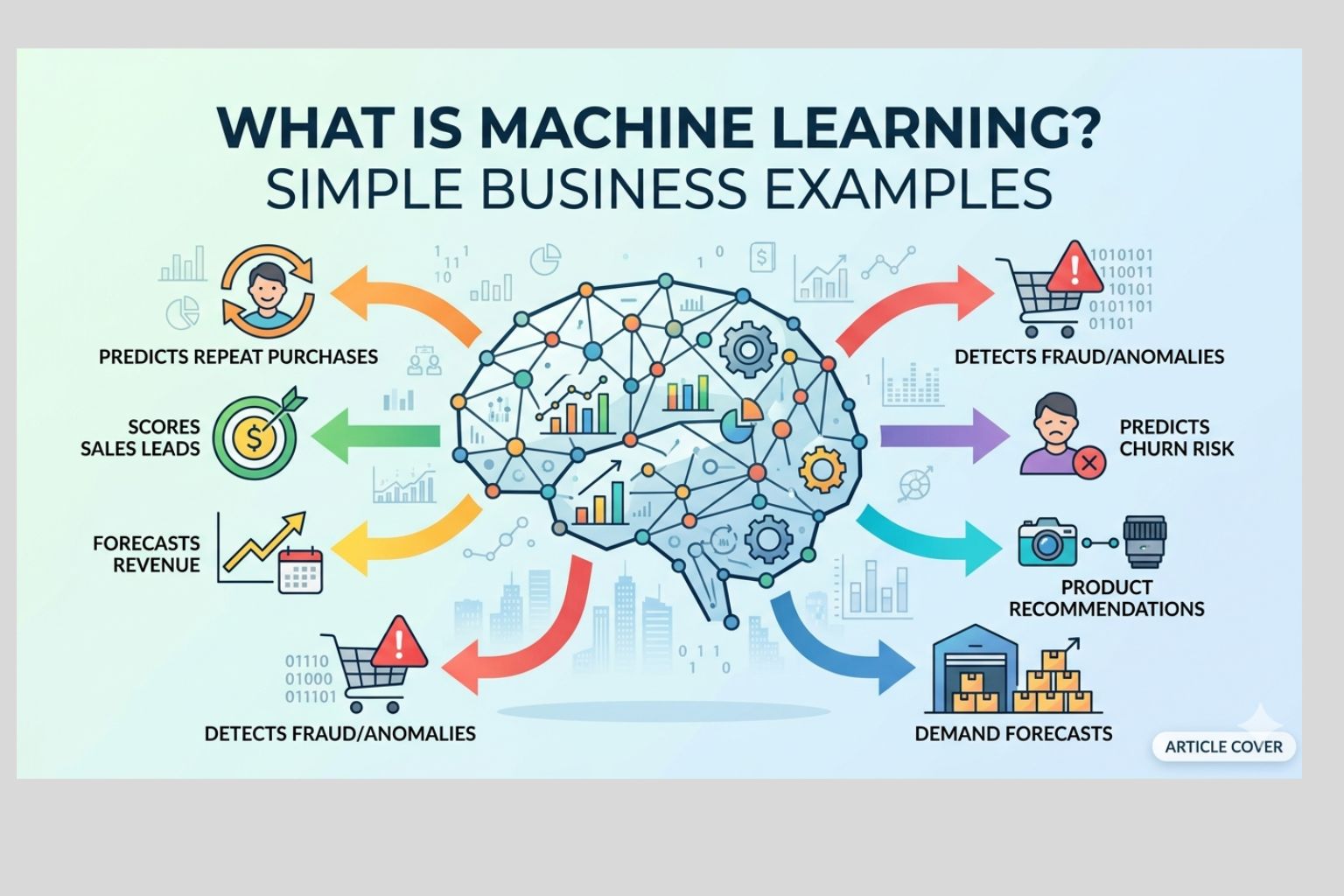
For a business, machine learning can help answer practical questions. It can identify customers who are likely to buy again, sales leads that may convert, and revenue patterns for the next month. It can also flag unusual transactions, predict products that may run out of stock, and show which customers are at risk of leaving.
The idea can sound technical, but the business purpose is simple. Machine learning helps companies use past data to make better decisions about the future.
A small business does not need to start with a complicated AI system. In many cases, the first step is cleaning the data, understanding the business question, building simple reports, and then deciding whether machine learning is needed. Some businesses may only need a dashboard or forecast. Others may benefit from a prediction model, recommendation system, or AI-powered workflow.
If your business needs help turning messy data into clear reports, dashboards, forecasts, or AI-ready insights, our Data Analysis Services can help.
Quick Answer: What Is Machine Learning?
Machine learning is a method where computers learn patterns from data and use those patterns to make predictions, classifications, or recommendations.
In simple terms, machine learning helps a business use past information to make smarter future decisions.
| Business Question | How Machine Learning Can Help |
|---|---|
| Which customers may buy again? | Predicts repeat purchase behavior |
| Which leads are most likely to convert? | Scores leads based on past sales patterns |
| What will sales look like next month? | Forecasts revenue using historical trends |
| Which transactions look suspicious? | Flags unusual behavior or possible fraud |
| Which customers may leave? | Predicts churn risk |
| Which products should we recommend? | Suggests items based on customer behavior |
For example, if a business has 2 years of sales data, machine learning can study past customer behavior and identify patterns. It may find that customers who buy a certain product, visit a certain page, or respond to a certain email are more likely to purchase again. The business can then use that insight to improve marketing, sales follow-up, inventory planning, and customer retention.
The main goal of machine learning is not to make data look complex. The goal is to help a business make better decisions with the data it already has.
Machine Learning in Simple Terms
Machine learning is like teaching a computer by showing it examples. Instead of telling the computer every rule by hand, you give it data and let it learn patterns.
For example, imagine a business wants to predict which customers are likely to cancel a subscription. A traditional rule-based system may say, “Flag customers who have not logged in for 30 days.” That rule can be useful, but it may miss other important patterns.
A machine learning model can look at many signals at once. It may review login activity, customer support tickets, payment history, product usage, email engagement, account age, and purchase behavior. Over time, it can learn which patterns are linked to customers who leave.
That does not mean machine learning is magic. It still depends on good data, a clear business question, and careful review. If the data is messy or the goal is unclear, the model may give weak or misleading results.
For small businesses, machine learning works best when it is connected to a real decision. The question should not be “How do we use AI?” A better question is “What decision do we want to improve?”
Machine Learning Is Useful Only When It Supports a Business Decision
Machine learning becomes valuable when the prediction leads to a real business action. A model that predicts something but does not help anyone decide what to do is not very useful.
For example, predicting customer churn only matters if the business has a plan to contact at-risk customers, offer support, improve onboarding, or create a retention campaign. Forecasting demand only matters if the business can use that forecast to plan inventory, staffing, cash flow, or marketing spend.
This is why a good machine learning project should always start with the decision, not the tool. The business should know what it wants to predict, who will use the prediction, and what action will happen next.
| Machine Learning Output | Business Decision It Should Support |
|---|---|
| Lead score | Which leads should sales contact first? |
| Churn risk score | Which customers should receive retention outreach? |
| Sales forecast | How should the business plan staffing, inventory, or budget? |
| Product recommendation | Which product should be shown to each customer? |
| Fraud or anomaly alert | Which transactions should finance review? |
| Demand forecast | How much inventory or capacity is needed? |
The strongest machine learning projects are not the most complicated ones. They are the ones that improve a repeated decision in a measurable way.
Why Machine Learning Matters for Businesses
Machine learning matters because many business decisions depend on patterns that are hard to see manually. A spreadsheet can show what happened. A dashboard can show current performance. Machine learning can help estimate what may happen next.
A business may already know how many customers it has, how much revenue it made last month, or which products sold best. Machine learning goes further by helping teams predict future behavior and spot problems earlier. It can show likely repeat buyers, products that may become popular next season, marketing leads that need attention, and expenses or transactions that look unusual.
This matters because businesses often waste time and money reacting late. They wait until customers leave, inventory runs out, campaigns fail, or sales targets are missed. Machine learning can help spot patterns earlier so teams can act sooner.
| Benefit | Business Impact |
|---|---|
| Better predictions | Helps estimate sales, demand, churn, or risk |
| Smarter prioritization | Helps teams focus on the best leads, customers, or opportunities |
| Faster pattern detection | Finds trends that may be hard to see manually |
| Better customer targeting | Helps personalize offers, emails, and recommendations |
| Improved forecasting | Supports planning for revenue, inventory, staffing, and cash flow |
| Reduced manual review | Helps automate repetitive checks or classifications |
| Stronger decision-making | Uses data to guide action instead of guesswork |
Machine learning is especially useful when a business has enough historical data and a repeated decision to improve. If the same decision happens every week or month, machine learning may help make that decision faster, more consistent, or more accurate.
If your business is not sure whether machine learning is the right next step, a data project review can help you understand whether you need data cleaning, dashboards, forecasting, or an AI-ready model.
Machine Learning vs Artificial Intelligence
Machine learning and artificial intelligence are closely related, but they are not exactly the same.
Artificial intelligence, often called AI, is the broader idea of making machines perform tasks that normally require human intelligence. This can include understanding language, recognizing images, making recommendations, generating text, planning actions, or automating decisions.
Machine learning is one way to build AI. It focuses on helping computers learn from data instead of relying only on fixed rules.
| Term | Simple Meaning | Business Example |
|---|---|---|
| Artificial intelligence | Technology that performs tasks that seem intelligent | A chatbot answering customer questions |
| Machine learning | A type of AI that learns patterns from data | A model predicting which customers may leave |
| Predictive analytics | Using data to estimate what may happen next | Forecasting next month’s sales |
| Data analytics | Using data to understand and improve decisions | Building reports, dashboards, and insights |
For example, a customer support chatbot may use AI to understand and respond to questions. A machine learning model may help that chatbot improve responses by learning from past conversations. A predictive analytics model may estimate which customers are most likely to contact support again.
For a broader beginner guide on using business data, read What Is Data Analytics? A Simple Guide for Businesses.
Machine Learning vs Data Analytics
Machine learning and data analytics often work together. Data analytics helps a business understand what happened, why it happened, and what should be reviewed. Machine learning can go further by helping predict future outcomes or automate decisions based on patterns.
A business may use data analytics to discover that customer churn increased last quarter. Machine learning can then help predict which customers are most likely to churn next.
A business may use data analytics to see that one marketing channel has better conversion rates. Machine learning can then help score new leads based on how likely they are to become customers.
| Topic | Data Analytics | Machine Learning |
|---|---|---|
| Main purpose | Understand business performance | Learn from data and make predictions |
| Main question | What happened and why? | What is likely to happen next? |
| Common output | Reports, dashboards, insights | Predictions, scores, recommendations |
| Example | Revenue dashboard | Revenue forecast model |
| Best for | Business reporting and analysis | Pattern-based predictions and automation |
Machine learning usually depends on strong data analytics first. If the business does not understand its data, KPIs, and reporting process, it may be too early to build a machine learning model.
That is why many businesses should start with clean data, dashboards, and simple forecasting before moving into more advanced AI or machine learning projects.
Machine Learning vs Predictive Analytics
Machine learning and predictive analytics are closely connected. Predictive analytics is the practice of using data to estimate what may happen next. Machine learning is one method that can be used to make those predictions.
A simple forecast in Excel may be predictive analytics. A more advanced model that learns from many variables and improves as more data becomes available may use machine learning.
For example, a business may use predictive analytics to forecast next month’s sales based on past revenue. If the forecast also considers seasonality, lead volume, ad spend, customer behavior, and pipeline history, machine learning may help find deeper patterns.
| Topic | Predictive Analytics | Machine Learning |
|---|---|---|
| Main focus | Estimating future outcomes | Learning patterns from data |
| Complexity | Can be simple or advanced | Usually more model-driven |
| Example | Sales forecast from past revenue | Lead scoring model using many signals |
| Best use | Planning and forecasting | Prediction, classification, recommendations, automation |
The two often work together. A business may start with predictive analytics, then use machine learning when the problem becomes more complex or when there is enough data to support a stronger model.
How Machine Learning Works
Machine learning works by training a model on data. The model looks for patterns in the data and uses those patterns to make predictions or decisions on new information.
The process usually starts with a business question. For example, a company may ask, “Which customers are most likely to buy again?” or “What will demand look like next month?”
After the question is clear, the business needs the right data. This could include customer records, sales history, website activity, marketing data, product data, finance data, support tickets, or operations records.
The data must then be cleaned. This is one of the most important steps. Machine learning models depend heavily on data quality. If the data has duplicates, missing values, inconsistent categories, or incorrect fields, the model may learn the wrong patterns.
Once the data is prepared, the model can be trained. Training means the model studies past examples and learns patterns. After training, the model is tested to see how well it performs. If the model is useful, it can be used to support business decisions.
| Step | What Happens | Business Example |
|---|---|---|
| Define the question | Decide what the model should help predict | Which leads are likely to convert? |
| Collect data | Gather relevant business data | CRM, sales, marketing, website, finance data |
| Clean data | Fix errors and prepare the dataset | Remove duplicates and standardize fields |
| Train the model | Let the model learn from past examples | Learn patterns from past converted leads |
| Test the model | Check if predictions are useful | Compare predictions with real outcomes |
| Use the output | Apply predictions to decisions | Prioritize high-quality leads |
| Monitor results | Review performance over time | Update the model when patterns change |
Machine learning is not a one-time magic button. It is a process. The model needs a clear goal, good data, testing, and regular review.
Simple Machine Learning Example
Imagine a company wants to improve sales follow-up. The sales team has hundreds of leads, but not all leads are equally likely to become customers. The team wants to know which leads deserve attention first.
A machine learning model can study past leads and look for patterns. It may review lead source, company size, industry, website behavior, email engagement, previous purchases, sales calls, and deal outcomes. Over time, it can learn which patterns are common among leads that became customers.
The model may then assign a lead score to new leads. A lead with a high score may deserve faster follow-up. A lead with a low score may still be valuable, but the team may choose a different approach.
This does not replace sales judgment. It supports it. The sales team still needs to understand the buyer, ask good questions, and manage the relationship. Machine learning simply helps the team prioritize better.
That is how machine learning creates value in business. It helps teams make repeated decisions with better information.
Machine Learning Examples for Businesses
Machine learning can be used in many areas of a business. The best use cases are usually tied to repeated decisions, predictions, or patterns.
| Business Area | Machine Learning Example | Decision It Supports |
|---|---|---|
| Sales | Lead scoring | Which leads should sales contact first? |
| Marketing | Customer segmentation | Which audience should receive which offer? |
| Finance | Fraud or anomaly detection | Which transactions look unusual? |
| Operations | Demand forecasting | How much inventory or staffing is needed? |
| Customer service | Ticket classification | Which support requests should be prioritized? |
| Ecommerce | Product recommendations | Which products should customers see next? |
| Retention | Churn prediction | Which customers may leave soon? |
| Executive planning | Revenue forecasting | What performance should leadership expect? |
Machine learning is most useful when there is enough data and a clear action attached to the prediction. A prediction that does not lead to a decision is not very useful.
For example, predicting customer churn only matters if the business has a plan to follow up with at-risk customers. Forecasting demand only matters if the business can use the forecast to plan inventory, staffing, or budget.
Sales Machine Learning Example
Sales teams can use machine learning to identify which leads or deals are most likely to convert. This is often called lead scoring or opportunity scoring.
A traditional sales team may treat all leads equally. But not every lead has the same value. Some leads are more likely to buy, some need more education, and some may not be a good fit at all.
Machine learning can review past sales data and learn which factors are linked to closed deals. These factors may include company size, industry, lead source, website visits, email engagement, job title, previous conversations, or product interest.
For example, the model may find that leads from a certain industry who visited the pricing page and opened 2 emails are more likely to convert. Sales can then prioritize those leads.
This helps sales teams work smarter. It does not guarantee every high-scoring lead will close, but it gives the team a better starting point.
Marketing Machine Learning Example
Marketing teams can use machine learning to improve targeting, segmentation, personalization, and campaign performance.
For example, a business may want to know which customers are likely to respond to a new offer. A machine learning model can study past customer behavior and identify patterns. It may look at purchase history, email clicks, website visits, product interests, location, and customer value.
The model can then help segment customers into groups. Some customers may be more likely to buy premium products. Others may respond better to discounts. Some may be ready for a follow-up offer, while others may need more education.
This helps marketing teams avoid sending the same message to everyone. Instead, they can create more relevant campaigns based on customer behavior.
Machine learning can also help marketing teams predict which leads are likely to become customers. This allows the business to focus budget on channels and audiences that create real revenue, not just traffic or clicks.
Finance Machine Learning Example
Finance teams can use machine learning to detect unusual transactions, forecast cash flow, review risk, and identify patterns in expenses.
One common use case is anomaly detection. A machine learning model can learn what normal financial activity looks like and flag transactions that appear unusual. This can help with fraud detection, billing review, expense monitoring, and risk management.
For example, if a company normally spends $2,000 per month on a vendor and suddenly sees a $12,000 charge, the system may flag it for review. If a transaction appears outside normal timing, amount, vendor, or category patterns, the finance team can investigate.
Machine learning can also support cash flow forecasting. By reviewing past revenue, expenses, payment timing, and seasonality, a model may help estimate future cash needs.
Finance machine learning works best when the data is clean and categories are consistent. If expenses are not labeled properly or revenue data is incomplete, the model may not be reliable.
Operations Machine Learning Example
Operations teams can use machine learning to forecast demand, improve scheduling, reduce delays, and identify bottlenecks. For example, a business may need to estimate how many orders, appointments, deliveries, or service requests it will receive next week. Machine learning can review past activity, seasonality, day of week, promotions, weather, location, or other business factors to predict demand.
This can help the business plan staffing, inventory, delivery routes, or production schedules. Machine learning can also help identify where delays are likely to happen. If certain order types, vendors, locations, or days tend to create delays, the model can help managers prepare earlier. This is valuable because operations problems often become customer problems. Late deliveries, slow service, stockouts, and errors can damage customer trust. Machine learning can help spot risks before they become bigger issues.
Customer Service Machine Learning Example
Customer service teams can use machine learning to organize support tickets, identify urgent issues, predict customer dissatisfaction, and improve response time.
For example, a support system may receive hundreds of customer messages. Machine learning can classify tickets by topic, urgency, product, sentiment, or likely resolution path. This helps the team route requests faster.
A model may also detect patterns in customer complaints. If many complaints mention the same product, delay, billing issue, or service problem, leadership can identify the root cause faster.
Machine learning can also help predict which customers may be unhappy or likely to leave. If a customer has repeated support issues, low product usage, delayed payments, or negative feedback, the business may choose to follow up before the customer leaves.
Good customer service machine learning should support the team, not replace the human relationship. The goal is to help people respond faster and with better context.
Ecommerce Machine Learning Example
Ecommerce businesses use machine learning for product recommendations, demand forecasting, customer segmentation, pricing insights, and fraud detection. A product recommendation system is one of the most common examples. It studies what customers viewed, added to cart, purchased, or ignored. Then it suggests products that similar customers may like.
For example, if customers who buy Product A often buy Product B, the website may recommend Product B after someone adds Product A to the cart. This can increase average order value and improve the shopping experience. Machine learning can also help forecast demand. If a product usually sells more during certain months or after certain promotions, the business can prepare inventory earlier.
For ecommerce, machine learning can be useful because there are many repeated decisions: what to recommend, which customers to target, which products to restock, which orders to review, and which campaigns to prioritize.
Machine Learning for Forecasting
Forecasting is one of the most practical machine learning use cases for businesses. A forecast uses historical data to estimate what may happen next. Businesses can use machine learning to forecast revenue, demand, inventory needs, staffing needs, customer churn, cash flow, or sales pipeline.
For example, a company may use the last 24 months of sales data to predict next quarter’s revenue. The model may consider seasonality, past growth, marketing activity, customer behavior, and sales trends. A forecast will never be perfect. But it can still be much better than guessing. The goal is not to predict the future with complete certainty. The goal is to give the business a more informed starting point for planning.
Forecasting is especially valuable when decisions need to happen before the final result is known. A business may need to hire staff, order inventory, adjust budget, or prepare cash flow before the month is over.
Machine Learning and Business Intelligence
Machine learning and business intelligence can work together. Business intelligence helps a company monitor what is happening through dashboards and reports. Machine learning can help estimate what may happen next.
For example, a BI dashboard may show that revenue is down, lead volume is flat, and conversion rate is declining. Machine learning may help predict whether the trend is likely to continue and which leads or customers are most likely to drive future revenue.
Business intelligence is often the foundation. It helps the business organize data, track KPIs, and understand performance. Once the reporting process is strong, machine learning can add predictive value.
| Business Intelligence | Machine Learning |
|---|---|
| Shows what is happening | Predicts what may happen |
| Uses reports and dashboards | Uses models and algorithms |
| Tracks KPIs | Finds patterns and estimates outcomes |
| Helps leaders monitor performance | Helps leaders prioritize future action |
A business that does not have reliable dashboards or clean data may not be ready for machine learning yet. In many cases, BI and data cleaning should come first.
Types of Machine Learning
There are several types of machine learning, but business owners do not need to memorize complex technical terms. The main idea is to understand what each type does.
| Type | Simple Meaning | Business Example |
|---|---|---|
| Supervised learning | Learns from examples with known outcomes | Predicting which leads will convert |
| Unsupervised learning | Finds patterns without a known answer | Grouping customers into segments |
| Reinforcement learning | Learns through rewards and feedback | Optimizing pricing or recommendations |
| Classification | Sorts things into categories | Flagging high-risk transactions |
| Regression | Predicts a number | Forecasting sales revenue |
| Clustering | Groups similar items together | Segmenting customers by behavior |
Supervised learning is common in business because many companies have past examples. For example, a business may know which leads became customers and which did not. A model can learn from that history.
Unsupervised learning is useful when the business wants to find groups or patterns. For example, it may group customers based on purchase behavior without being told what the groups should be.
Most small businesses do not need to start with advanced machine learning. They should begin with a clear business question and decide whether a simple analysis, dashboard, forecast, or model is the best fit.
What Data Does Machine Learning Need?
Machine learning needs data that is relevant, organized, and clean enough to trust. The model can only learn from the information it receives. Useful business data may include sales history, customer records, website activity, marketing campaigns, product data, support tickets, invoices, transactions, inventory, or operations logs.
The best data depends on the question. If the business wants to predict customer churn, it may need customer activity, purchase history, support tickets, email engagement, and cancellation history. If the business wants to forecast sales, it may need historical revenue, seasonality, lead volume, pipeline data, and marketing activity.
| Machine Learning Goal | Useful Data |
|---|---|
| Predict customer churn | Customer activity, purchase history, support tickets |
| Score sales leads | CRM data, lead source, email engagement, deal history |
| Forecast revenue | Sales history, pipeline data, seasonality, marketing activity |
| Recommend products | Product views, purchases, cart behavior |
| Detect unusual transactions | Transaction amount, vendor, timing, category |
| Forecast demand | Sales history, inventory, seasonality, promotions |
Data quality matters more than most people think. A small amount of clean, relevant data can be more useful than a large amount of messy data. If your business data is scattered across spreadsheets and tools, it may be better to start with data cleaning and reporting before building a machine learning model.
Do You Need Machine Learning or Just Better Reporting?
Many businesses think they need machine learning when they actually need better reporting, cleaner data, or a simple forecast first. This is not a bad thing. It just means the business should solve the right problem in the right order.
Leaders should first check whether the business has clean data and clear reporting. When revenue, profit, leads, conversion rates, retention, or cash flow are hard to see, a dashboard may create more value than a machine learning model. Once the data is reliable, a simple predictive analytics project can help with one clear forecasting need.
| Your Business Situation | Best Starting Point |
|---|---|
| Reports take too long to update | Dashboard or automated reporting |
| Teams do not trust the numbers | Data cleaning |
| Leadership needs monthly KPIs | Business intelligence dashboard |
| You need to estimate sales next quarter | Forecasting or predictive analytics |
| You want to prioritize leads | Machine learning lead scoring |
| You want to detect unusual transactions | Machine learning anomaly detection |
| You are unsure what to build | Data project review |
Machine learning is powerful, but it should not be used just because it sounds advanced. The right solution is the one that helps the business make a better decision.
When Machine Learning Is Useful
Machine learning is useful when a business has a repeated decision, enough historical data, and a clear action that can be taken from the prediction. For example, lead scoring is useful because sales teams repeatedly decide which leads to contact first. Churn prediction is useful because customer success teams can follow up with at-risk customers. Demand forecasting is useful because operations teams can adjust inventory or staffing.
Machine learning is less useful when the business has no clear decision to improve. A prediction should lead to action. If no one will use the output, the model may not create value.
| Good Fit for Machine Learning | Poor Fit for Machine Learning |
|---|---|
| Repeated decisions | One-time question with little data |
| Enough historical examples | No reliable data |
| Clear business action | No plan to use the prediction |
| Patterns may exist in the data | Problem is mostly manual or process-based |
| Prediction can improve results | Simple report would be enough |
Machine learning should solve a real problem. It should not be added just because AI sounds exciting.
When Machine Learning May Not Be the Right First Step
Machine learning is powerful, but it is not always the best first step. Some businesses need basic reporting, cleaner data, and stronger KPI tracking before they invest in AI. When teams cannot trust their numbers or see revenue, profit, leads, conversion rates, and customer trends clearly, a dashboard may be more useful than a model. Once the data is reliable and the business has one clear prediction goal, machine learning can create real value.
For example, a business may ask for an AI model to forecast revenue. But if historical sales data is inconsistent, expenses are not categorized properly, and lead sources are not tracked, the forecast may not be reliable.
The best first step is often a data project review. This helps the business understand what data exists, what needs to be cleaned, what reports are missing, and whether machine learning is actually the right solution. If your business is not sure whether it needs machine learning, forecasting, dashboards, or data cleaning, our Data Analysis Services can help you choose the right starting point.
Step-by-Step: How to Start With Machine Learning
The best way to start with machine learning is to begin with a practical business question. Do not start with the tool. Start with the decision. First, define the problem clearly. For example, “Which customers are likely to leave?” is better than “We want to use AI.” A clear question gives the project direction.
Next, identify the decision the prediction will support. For example, if the model predicts churn, the business should decide whether to contact those customers, send a special offer, or ask customer success to review their accounts. After that, review where the data is stored, whether it is clean, and whether there are enough past examples to train a useful model.
After that, start simple. A basic forecast, lead score, or customer segment may be more useful than a complex model. The model should be tested and compared against real outcomes.
Finally, monitor the results. Business patterns change. A model that works today may need updates later.
| Step | What to Do |
|---|---|
| 1 | Define the business question |
| 2 | Decide what action the prediction will support |
| 3 | Identify the data sources |
| 4 | Clean and organize the data |
| 5 | Start with a simple model or forecast |
| 6 | Test the results |
| 7 | Use the output in a real business process |
| 8 | Monitor and improve over time |
A good machine learning project should be practical, measurable, and connected to a decision.
Machine Learning Project Checklist for Businesses
Before starting a machine learning project, it helps to review whether the business is ready. This prevents wasted time and avoids building a model that no one uses.
| Question | Why It Matters |
|---|---|
| What business question are we trying to answer? | Keeps the project focused |
| What decision will the model support? | Makes sure the output leads to action |
| Do we have enough historical data? | Helps determine if a model can learn useful patterns |
| Is the data clean enough to trust? | Prevents misleading predictions |
| Where does the data come from? | Identifies source systems and gaps |
| How will predictions be used? | Connects the model to a workflow |
| How will success be measured? | Defines whether the project worked |
| Who will maintain the model? | Ensures the model stays useful over time |
For example, if a business wants to predict sales next quarter, it should review historical sales, seasonality, lead volume, pipeline value, marketing activity, and known business changes. If those inputs are missing or unreliable, the forecast may be weak. Machine learning works best when the business question, data, and action are aligned.
Common Machine Learning Mistakes
Many businesses make the mistake of starting with machine learning before they are ready. They may want AI because it sounds advanced, but the real problem may be messy data, unclear reporting, or weak business processes.
One common mistake is building a model without a clear business question. If the team cannot explain what decision the model will improve, the project is likely to become confusing.
Another mistake is using messy data. Machine learning models can learn the wrong patterns if the data is incomplete, duplicated, or inconsistent.
Some businesses also expect machine learning to be perfect. It is not. A model can support decisions, but it should be tested, monitored, and reviewed. Predictions can be wrong, especially when business conditions change.
| Mistake | Why It Hurts | Better Approach |
|---|---|---|
| Starting with AI instead of a business question | Creates unclear projects | Define the decision first |
| Using messy data | Leads to weak predictions | Clean and validate data first |
| Expecting perfect accuracy | Creates unrealistic expectations | Use models to support decisions, not replace judgment |
| Building a model no one uses | Wastes time and money | Connect predictions to a workflow |
| Ignoring simple solutions | Overcomplicates the project | Start with reports, dashboards, or forecasts when enough |
| Not monitoring the model | Performance may decline over time | Review results and update when needed |
| No success metric | Hard to know if the model helped | Define KPIs before starting |
The best machine learning projects are not the most complicated. They are the ones that solve a clear business problem.
Machine Learning Benefits for Businesses
Machine learning can create value by helping businesses make faster, smarter, and more consistent decisions. It can help teams see patterns earlier, prioritize better, and plan with more confidence.
One major benefit is prediction. A business can use machine learning to estimate future sales, demand, churn, or risk. This can support planning and reduce surprises.
Another benefit is prioritization. Sales teams can prioritize leads. Marketing teams can target customer segments. Customer success teams can focus on accounts at risk. Operations teams can plan inventory or staffing.
Machine learning can also reduce manual work. Instead of manually reviewing every transaction, support ticket, or lead, a model can help flag the items that deserve attention.
| Benefit | Business Impact |
|---|---|
| Better forecasting | Helps plan sales, demand, inventory, and cash flow |
| Smarter targeting | Helps marketing reach better customer segments |
| Better lead prioritization | Helps sales focus on higher-quality opportunities |
| Faster risk detection | Flags unusual transactions or behavior |
| Improved retention | Identifies customers who may leave |
| More personalization | Recommends products or offers based on behavior |
| Less manual review | Helps teams focus on the most important items |
| Better decisions | Uses patterns in data to guide action |
The real value of machine learning is not the model itself. The value comes from the better decisions the model supports.
Machine Learning for Small Businesses
Small businesses can use machine learning, but they should start carefully. The first step is not always building a model. The first step is understanding the business question and the condition of the data.
A small business may use machine learning to forecast sales, identify high-value customers, predict repeat purchases, prioritize leads, recommend products, or spot unusual expenses. These are practical use cases that can support real decisions.
For example, a local service business may want to predict which leads are most likely to book. An ecommerce store may want to recommend products or forecast inventory needs. A consulting company may want to forecast revenue based on pipeline and project history.
Small businesses should avoid starting with complex AI projects that are expensive and hard to maintain. A simple forecast, dashboard, or customer analysis may create value faster.
The best machine learning project for a small business is usually focused, practical, and tied to revenue, cost savings, customer retention, or time savings.
When to Request a Machine Learning or AI Project Review
A machine learning or AI project review is useful when your business wants to use AI, but you are not sure what the right first step should be.
The review can help identify whether you need machine learning, predictive analytics, data cleaning, dashboards, forecasting, or a simpler reporting system. This matters because many businesses jump into AI too quickly before checking whether their data is ready.
You should consider a project review if your business has useful data but does not know how to use it, if your team is manually reviewing too many records, if you want to predict future outcomes, or if leadership wants AI but the use case is not clear.
A review can help answer questions like: What business problem should we solve first? Do we have enough data? Is the data clean? Should we build a dashboard first? Is machine learning the right solution? What would success look like?
Sometimes the best first step is not machine learning. It may be cleaning the data, building a dashboard, creating a forecast, or defining the right KPIs. If your business needs help choosing the right data or AI project, you can request a data project review.
Best First Step: Clean the Data Before Using Machine Learning
Machine learning depends on data quality. If the data is messy, the model will not be reliable. A business may have customer data in a CRM, sales data in spreadsheets, marketing data in ad platforms, and finance data in accounting software. If those systems do not connect cleanly, it may be hard to build a useful model.
Common data problems include duplicate customers, missing values, inconsistent product names, incorrect dates, unclear lead sources, and different teams defining metrics differently.
For example, if one file says “Google Ads,” another says “Paid Search,” and another says “Google PPC,” the model may treat them as different channels unless the data is cleaned. If customer names are duplicated or revenue fields are inconsistent, predictions may become weaker.
Before building a machine learning model, the business should review the data, clean obvious issues, standardize important fields, and confirm that the data supports the business question. Clean data creates stronger predictions. Messy data creates confusion.
Request a Data Project Review
If your business has data but is not sure how to use machine learning, the best next step may be a data project review. This review can help you understand whether you need machine learning, data cleaning, a dashboard, a KPI report, a forecast, customer segmentation, lead scoring, or a broader AI strategy. The right answer depends on your business goal and the condition of your data.
A data project review is especially helpful if your team is working from messy spreadsheets, manually updating reports, switching between too many tools, or trying to use AI without a clear business question. Instead of starting with assumptions, start with a review of the data you already have.
Frequently Asked Questions About Machine Learning
Machine learning is a type of artificial intelligence that helps computers learn patterns from data and use those patterns to make predictions, recommendations, or decisions. In business, machine learning can help with forecasting, lead scoring, customer retention, fraud detection, and product recommendations.
A simple example of machine learning is lead scoring. A model can study past sales data and learn which leads were most likely to become customers. It can then score new leads so the sales team knows which opportunities may deserve attention first.
Machine learning helps businesses predict outcomes, find patterns, prioritize work, personalize marketing, forecast demand, detect unusual activity, and make better decisions from data.
No. Artificial intelligence is the broader field of making machines perform tasks that seem intelligent. Machine learning is a type of AI that learns from data.
No. Data analytics focuses on understanding business data through reports, dashboards, and analysis. Machine learning goes further by learning patterns from data and making predictions or recommendations.
No. Predictive analytics is the practice of using data to estimate what may happen next. Machine learning is one method that can be used to create predictive models, especially when the business has enough data and many signals to analyze.
Your business may need machine learning if you have a repeated decision, enough historical data, and a clear action that can be taken from the prediction. If your data is messy or your reporting is unclear, you may need data cleaning or dashboards first.
The data needed depends on the business question. Common data sources include sales history, customer records, marketing data, website activity, support tickets, product data, finance data, and operations records.
Yes. Small businesses can use machine learning for practical use cases such as sales forecasting, lead scoring, customer segmentation, churn prediction, product recommendations, and demand forecasting. The project should start with a clear business question.
The first step is to define the business question and review the data. Before building a model, the business should know what decision the model will support, whether the data is clean, and how the predictions will be used.
You should consider hiring help when your business wants to use AI or machine learning but is not sure where to start, whether the data is ready, which model is needed, or how to connect predictions to real business decisions.
Machine Learning Helps Businesses Predict and Decide Better
Machine learning helps businesses use data to make better predictions, recommendations, and decisions. It can support sales, marketing, finance, operations, customer service, ecommerce, forecasting, and executive planning. The clearest way to understand machine learning is this: it helps computers learn from past data so they can support future decisions. A business can use machine learning to predict which customers may leave, which leads may convert, what sales may look like next month, or which transactions look unusual.
But machine learning is not always the first step. Many businesses need clean data, clear KPIs, dashboards, and reliable reporting before they are ready for AI models. A model built on messy data can create misleading results. The best projects begin with a clear business question, a defined decision, a planned action, and data that is clean enough to trust.
When machine learning is done well, it can help businesses act earlier, plan better, reduce manual work, and make smarter decisions with more confidence. For a broader guide to using business data, read What Is Data Analytics? A Simple Guide for Businesses. You can also read What Is Business Intelligence? Examples and Benefits to understand how dashboards and reporting support better decisions.
If your business needs help turning messy data into clear reports, dashboards, forecasts, or AI-ready insights, our Data Analysis Services can help you understand your numbers and choose the right next step.
