
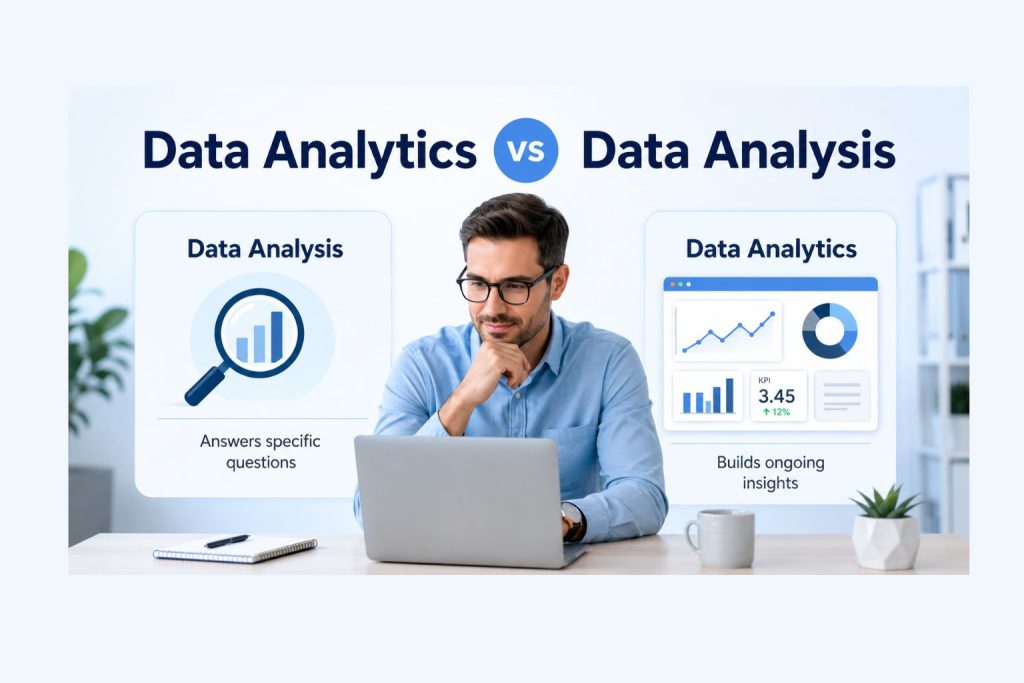
Data analytics vs data analysis is a common question because the 2 terms sound almost the same. Many people use them interchangeably, especially in business conversations. Both involve working with data, finding patterns, and helping people make better decisions. But they are not exactly the same.
Data analysis usually focuses on studying data to answer a specific question. A business may use data analysis to understand why sales dropped last month, which product made the most profit, which marketing campaign performed best, or which customers spent the most money. It is usually focused, direct, and tied to one clear issue.
Data analytics is broader. It includes the full process of using data to improve decisions over time. This can include collecting data, cleaning data, analyzing it, building reports, creating dashboards, tracking KPIs, forecasting results, and helping the business decide what to do next.
A simple way to understand the difference is this: data analysis answers a specific question, while data analytics helps a business use data as an ongoing decision system.
For small business owners, managers, founders, finance teams, marketing teams, sales teams, and operations leaders, this difference matters. If you only need to investigate one issue, data analysis may be enough. If you need regular reports, dashboards, forecasting, and clearer business visibility, you may need data analytics.
If your business needs help turning messy data into clear reports, dashboards, or forecasts, our Data Analysis Services can help.
Quick Answer: Data Analytics vs Data Analysis
Data analysis is the process of examining data to answer a specific question. Data analytics is the broader process of using data to understand business performance, track important metrics, build dashboards, find patterns, forecast outcomes, and support better decisions.
Data analytics vs data analysis: Data analysis studies data to answer a specific question, while data analytics is the broader process of using data to improve decisions over time. In business, data analysis may explain why sales dropped last month, while data analytics may create dashboards, KPI reports, and forecasts to track performance every month.
| Term | Simple Meaning | Business Example |
|---|---|---|
| Data analysis | Studying data to answer a specific question | Why did sales drop last month? |
| Data analytics | Using data to improve decisions over time | Building dashboards, KPI reports, forecasts, and performance insights |
The easiest way to separate them is by thinking about scope. Data analysis is usually narrower and more focused. Data analytics is wider and more ongoing. For example, reviewing one sales spreadsheet to find out which product sold the most last month is data analysis. Building a monthly reporting system that tracks sales, profit, marketing performance, customer behavior, and revenue forecasts is data analytics.
Both are useful. The right one depends on the business problem.
Data Analysis Answers a Question. Data Analytics Builds a System.
The simplest way to understand the difference is to think about a question versus a system. Data analysis helps a business answer one clear question, such as why revenue dropped, which product sold best, which customer group is most profitable, or which campaign performed better. It is focused and usually tied to one decision.
Data analytics helps a business build a repeatable system for using data. That system may include dashboards, KPI reports, forecasts, automated reporting, and regular performance reviews. Instead of starting from zero every time someone asks for numbers, the business has a clearer way to track performance and act faster.
For example, a one-time review of last month’s sales is data analysis. A monthly sales dashboard that tracks revenue, leads, close rate, pipeline value, profit margin, and forecasted revenue is data analytics. One explains a specific result. The other helps the business monitor performance over time.
| If Your Business Needs To… | You Probably Need… |
|---|---|
| Answer one specific question | Data analysis |
| Investigate one issue | Data analysis |
| Compare one report or campaign | Data analysis |
| Understand why something changed | Data analysis |
| Track performance every month | Data analytics |
| Build dashboards | Data analytics |
| Forecast revenue or demand | Data analytics |
| Automate reporting | Data analytics |
| Give leadership a regular KPI view | Data analytics |
This matters because many businesses ask for the wrong thing. They may ask for a dashboard when they first need a clean analysis of the problem. Others ask for a one-time report when they actually need an ongoing analytics system. The better starting point is to understand the business decision first, then choose the right type of data project.
Start With the Business Question
Before deciding whether your business needs data analytics or data analysis, start with the business question. Many companies make the mistake of starting with tools, dashboards, software, or reports before they understand what decision they are trying to improve.
A better starting point is not “Do we need analytics?” The better question is, “What are we trying to understand or decide?” That question gives the project direction and prevents the business from building reports that look good but do not solve the real problem.
For example, a company may want to know why revenue dropped, which customers are most profitable, which product line deserves more attention, which campaign produced real buyers, or how much revenue to expect next quarter. These are business questions. Once the question is clear, it becomes easier to decide whether the company needs a one-time analysis or a broader analytics system.
A question like “Why did sales drop in April?” usually points to data analysis because it is specific and focused. A question like “How do we track sales, profit, leads, and forecasted revenue every month?” usually points to data analytics because it requires an ongoing reporting process.
If you are unsure where to start, a data project review can help your business understand what data you already have, what problems need to be fixed, and which project should come first.
What Is Data Analysis?
Data analysis is the process of inspecting, cleaning, organizing, and studying data to answer a specific question or solve a specific problem. It is usually focused, direct, and tied to one decision.
A business may use data analysis when something has changed and leadership wants to know why. Revenue may have dropped. Expenses may have increased. Website conversions may have declined. Customer complaints may have gone up. A marketing campaign may have produced many leads but few customers. In each case, data analysis helps the business understand what happened and why.
For example, a company may have 12 months of sales data in a spreadsheet. The owner notices that February revenue was lower than expected. A data analysis project may compare sales by product, customer, region, sales rep, and lead source. After reviewing the numbers, the business may discover that 2 large customers paused orders, or that one product category slowed down.
That is data analysis. It answers a defined question.
Data analysis is useful because it helps businesses avoid guessing. Instead of assuming sales dropped because the sales team underperformed, the data may show that lead quality declined. Instead of assuming marketing failed, the data may show that website traffic was strong but the checkout process caused people to leave. Instead of assuming expenses are generally too high, the data may show that one cost category is causing most of the increase.
Good data analysis helps a business find the real cause behind a number.
What Is Data Analytics?
Data analytics is the broader process of using data to support better business decisions over time. It includes data analysis, but it also includes the systems, reports, dashboards, KPIs, forecasts, and processes that help a business use data regularly.
Data analytics is not only about answering one question. It is about creating a repeatable way for the business to understand performance and act faster.
A company may use data analytics to track revenue, profit, customer behavior, marketing performance, sales pipeline, website conversions, operating costs, inventory, cash flow, customer retention, and future forecasts. Instead of waiting until something goes wrong, analytics helps the business monitor important numbers regularly.
For example, a business may build a monthly analytics process that combines sales data, marketing data, and finance data into one dashboard. That dashboard may show revenue, leads, conversion rate, profit margin, customer acquisition cost, average order value, repeat purchase rate, and forecasted revenue.
That is broader than a one-time analysis. It gives the company a system for reviewing performance, finding problems earlier, and making decisions with clearer information.
Data analytics is especially useful when a business wants better visibility, automated reporting, dashboard development, KPI tracking, forecasting, executive reporting, or a clearer view of the numbers that drive growth and profit.
Data Analytics vs Data Analysis: The Main Difference
The main difference between data analytics and data analysis is scope. Data analysis is usually a focused task. Data analytics is a broader business process.
Data analysis answers a specific question. Data analytics helps the business use data continuously to understand performance, find patterns, monitor KPIs, and plan what to do next.
| Comparison Area | Data Analysis | Data Analytics |
|---|---|---|
| Main purpose | Answer a specific question | Improve decisions using data over time |
| Scope | Narrower | Broader |
| Timeframe | Often one-time or project-based | Often ongoing and repeatable |
| Output | Findings, summary, explanation | Reports, dashboards, forecasts, insights, recommendations |
| Example question | Why did sales fall in March? | How can we track and improve sales performance every month? |
| Best for | Specific investigations | Business reporting and decision systems |
| Common tools | Excel, spreadsheets, SQL, reports | Excel, Power BI, Tableau, dashboards, databases, BI tools |
| Business value | Finds answers | Creates clarity and better decisions over time |
A helpful way to think about it is this: data analysis is a task, while data analytics is a capability.
A company can run a data analysis project once and get a useful answer. But when it builds data analytics into its normal reporting process, it can keep learning from the numbers every week or month.
For example, a one-time review of last month’s sales is data analysis. A recurring sales dashboard that tracks revenue, leads, close rate, pipeline value, and forecasted sales is data analytics.
Why the Difference Matters for Businesses
The difference between data analytics vs data analysis matters because it helps a business choose the right type of project, tool, budget, and support.
Some businesses only need a one-time answer. They may want to understand why sales dropped, which customer segment is most profitable, which campaign worked best, or which expense category increased. In that case, a focused data analysis project may be enough.
Other businesses need more than one answer. They need a repeatable reporting system. They may want dashboards, monthly KPI reports, automated reporting, forecasting, sales performance tracking, marketing ROI reports, or executive reporting. In that case, data analytics is the better fit.
Choosing the wrong approach can waste time and money. A business may ask for a dashboard when it really needs data cleaning first. Another business may ask for a one-time analysis when it actually needs a recurring dashboard. A company may buy expensive reporting software when the real issue is that its source data is messy, duplicated, or inconsistent.
That is why it helps to understand the difference before starting a data project.
A clear project starts with a clear business need. The goal is not to use the most advanced tool. The goal is to get the right answer in the right format so the business can make a better decision.
The Real Business Difference: One-Time Clarity vs Ongoing Visibility
The real business difference between data analysis and data analytics comes down to one-time clarity versus ongoing visibility.
Data analysis gives clarity when a business needs to understand a specific situation. It is useful when something changed, something failed, or leadership needs a clear answer before taking action. For example, a company may use data analysis to understand why profit dropped, why a campaign underperformed, why customer complaints increased, or why a certain product stopped selling.
Data analytics gives ongoing visibility. It helps the business stop waiting for problems to appear before reviewing the numbers. With dashboards, KPI reports, forecasts, and automated reporting, leaders can see performance regularly and respond faster.
A business that only uses data analysis may still make good decisions, but those decisions are often reactive. The team waits for a problem, investigates it, and then takes action. A business that uses data analytics can become more proactive because it sees patterns, trends, and warning signs earlier.
For example, data analysis may show that a company lost revenue because one product went out of stock. Data analytics may prevent the same issue from happening again by tracking inventory, sales velocity, demand, and forecasted stock needs every week.
That is why the strongest businesses often use both. They use data analysis to answer important questions and data analytics to build a better decision system.
What a Good Data Project Should Deliver
A good data project should not only produce charts. It should make the business easier to understand. Whether the work is data analysis or data analytics, the final result should help leaders make better decisions.
If the project is data analysis, the output may be a clear explanation of what happened and why. It may include a summary, a table, a chart, and a recommendation. For example, the analysis may show that revenue declined because repeat customer purchases fell, not because lead volume dropped.
If the project is data analytics, the output may be a dashboard, a KPI report, a monthly performance report, a cleaned dataset, or a forecast. The goal is to create a system that the business can use repeatedly.
| Project Output | Best Fit | What It Should Help You Do |
|---|---|---|
| One-time sales review | Data analysis | Understand a specific sales issue |
| Campaign performance review | Data analysis | Compare marketing results |
| Expense review | Data analysis | Find rising costs |
| KPI dashboard | Data analytics | Track performance regularly |
| Executive report | Data analytics | Give leadership a clear monthly view |
| Sales forecast | Data analytics | Plan revenue, staffing, or inventory |
| Cleaned dataset | Both | Make numbers easier to trust |
| Automated report | Data analytics | Reduce manual reporting work |
The best data work is practical. It should reduce confusion, save time, and help the business decide what to do next.
If your current reports are unclear, inconsistent, or too manual, our Data Analysis Services can help you choose the right starting point.
What This Looks Like in a Real Business
A growing business may start with simple reports, but as the company adds customers, employees, tools, and marketing channels, the numbers become harder to manage. Sales data may live in one system. Marketing data may live in another. Finance may use accounting software. Operations may rely on spreadsheets. Leadership may ask for updates every week, but the team may spend hours copying numbers from different places.
At that point, the business does not only need more reports. It needs a better data process.
A focused data analysis project can help answer urgent questions. For example, it can show why sales slowed, which campaign produced better customers, or why expenses increased. But if the same questions come up every month, the business may need data analytics instead. That could mean building a dashboard, creating a recurring KPI report, cleaning source data, or setting up a forecast.
The right project depends on the problem. If the business needs one answer, data analysis may be enough. If the business needs regular visibility, data analytics is usually the stronger solution.
This is also why a data project review is helpful. Before building anything, the business can review what data exists, what decisions matter most, which reports are taking too long, and which project would create the most value first.
A Simple Business Example
Imagine a small ecommerce company notices that revenue dropped by 18% last month. The owner wants to understand what happened.
A data analysis project may review product sales, website traffic, ad spend, conversion rate, customer orders, refunds, and inventory. After reviewing the data, the business may discover that traffic stayed steady, but conversion rate dropped because one top-selling product went out of stock.
That is data analysis. It answers a specific question: why did revenue drop?
Now imagine the same company wants to avoid the same issue in the future. It wants a dashboard that tracks revenue, product inventory, website conversion rate, customer orders, refunds, ad spend, and forecasted demand every week.
That is data analytics. It creates a system that helps the business monitor performance, catch problems earlier, and make better decisions over time.
Both are valuable. The difference is that data analysis solves the immediate question, while data analytics creates ongoing visibility.
Data Analysis Examples
Data analysis is useful when a business needs to investigate a specific issue or answer a specific question. It can be simple or complex depending on the data, but the goal is usually clear.
A sales manager may use data analysis to find out why a team missed its monthly target. The analysis may compare lead volume, close rate, average deal size, sales cycle length, and sales rep activity. The result may show that the team had enough leads, but the close rate dropped because many leads were poor quality.
A marketing manager may use data analysis to compare 2 campaigns. One campaign may have produced more clicks, while another produced fewer clicks but more customers. The analysis can show which campaign created better business results.
A finance team may use data analysis to review expenses. The company may notice that costs increased by 12%, but the analysis may show that most of the increase came from delivery fees, software subscriptions, or overtime.
| Business Area | Data Analysis Question | Possible Finding |
|---|---|---|
| Sales | Why did sales drop last month? | Fewer qualified leads or lower close rate |
| Marketing | Which campaign performed better? | One channel produced fewer leads but more customers |
| Finance | Why did expenses increase? | Labor, delivery, or software costs rose |
| Operations | Why are orders delayed? | One workflow step is creating a bottleneck |
| Customer service | Why did complaints increase? | One product or process caused most issues |
| Website | Why are visitors not converting? | Traffic is coming from the wrong audience |
Data analysis is powerful because it helps a business find the cause behind a number. Instead of reacting to symptoms, the business can understand what is actually happening.
Data Analytics Examples
Data analytics is useful when a business wants ongoing visibility, regular reporting, dashboards, KPI tracking, forecasting, or decision support.
A company may build a sales dashboard that updates every week. The dashboard may show revenue, leads, close rate, pipeline value, average deal size, and forecasted revenue. This allows the sales team to monitor performance instead of waiting until the end of the month.
A marketing team may use data analytics to connect website traffic, ad spend, leads, customers, and revenue. Instead of only tracking clicks and impressions, the team can see which channels produce real business results.
A finance team may use data analytics to track monthly revenue, expenses, gross margin, net profit, cash flow, and forecasted revenue. This helps leadership plan with better information.
| Business Goal | Data Analytics Output | How It Helps |
|---|---|---|
| Track sales performance | Sales dashboard | Shows revenue, pipeline, close rate, and trends |
| Improve marketing ROI | Marketing performance report | Connects channels to leads, customers, and revenue |
| Monitor profitability | Finance dashboard | Tracks revenue, expenses, margins, and cash flow |
| Plan for demand | Forecasting model | Estimates future sales, inventory, or staffing needs |
| Improve operations | Operations dashboard | Shows delays, workload, output, and bottlenecks |
| Support leadership | Executive KPI report | Gives leaders a clear view of business health |
Data analytics is especially useful when a business does not want to keep guessing. It helps teams see performance clearly, review the right numbers regularly, and take action faster.
Data Analytics vs Data Analysis in Sales
In sales, data analysis may answer a focused question. A manager may want to know why revenue dropped last month, which sales rep closed the most deals, or which product created the highest average order value.
For example, a sales manager may review last month’s data and discover that revenue dropped because the team received fewer qualified leads. The analysis may also show that average deal size stayed the same, but close rate declined.
Data analytics in sales is broader. It may include a dashboard that tracks lead volume, pipeline value, win rate, average deal size, sales cycle length, rep performance, and forecasted revenue.
The difference is timing and visibility. Data analysis may help explain what happened after the month ends. Data analytics can help the sales team spot warning signs before the month is over.
A sales team that only uses data analysis may solve problems after they happen. A sales team using data analytics can often catch problems earlier and respond faster.
Data Analytics vs Data Analysis in Marketing
In marketing, data analysis may focus on comparing campaign results. A team may analyze Google Ads, Facebook Ads, SEO, email, and social media to find which channel produced the most leads or customers.
But data analytics goes further. It connects marketing activity to business results. Instead of only looking at traffic, clicks, impressions, or leads, analytics can connect marketing spend to customers and revenue.
For example, one campaign may generate many leads at a low cost, but those leads may rarely become customers. Another channel may generate fewer leads, but the customers may spend more and stay longer. Without analytics, the business may keep investing in the wrong channel.
Marketing data analytics helps the business move beyond vanity metrics. The real question is not only which campaign brought the most leads. The better question is which campaign brought the most profitable customers.
Data Analytics vs Data Analysis in Finance
In finance, data analysis may investigate a specific issue such as rising expenses, falling margins, or cash flow pressure. A finance team may review expenses and discover that software costs, labor costs, or vendor costs increased faster than revenue.
Data analytics in finance is broader. It may include recurring reports that track revenue, cost of goods sold, gross profit, net profit, cash flow, customer profitability, and forecasts.
For example, a business may look strong based on revenue, but a finance analytics dashboard may show that margins are shrinking. This helps leadership make better decisions about pricing, staffing, expenses, and growth.
Finance analytics is valuable because it connects performance to profitability. A business should not only know how much money came in. It should also know what is left after costs.
Data Analytics vs Data Analysis in Operations
In operations, data analysis may help investigate one specific problem. A business may analyze delivery delays and discover that most delays happen on Fridays because staffing is too low or one approval step takes too long.
Data analytics in operations may involve a dashboard that tracks output, workload, delays, error rates, capacity, and service times. This gives managers a clearer way to monitor performance and fix issues earlier.
Operations analytics can reduce waste, improve service quality, and make work more predictable. It can also help teams avoid solving the wrong problem.
For example, a manager may assume delays are caused by employees working too slowly. But the data may show that delays come from poor scheduling, unclear handoffs, or a broken approval process. That changes the solution completely.
Data Analytics vs Data Analysis in Customer Data
Data analysis may help a business answer a customer-related question, such as which customers spent the most last quarter or why customer complaints increased.
Data analytics creates a broader view of customer behavior. It may track customer retention, churn, repeat purchases, customer lifetime value, average order value, complaints, and customer segments.
For example, a business may discover that repeat customers are much more profitable than new customers. With that insight, the company may invest more in retention campaigns, loyalty offers, or customer follow-up.
Customer analytics helps a business understand not only who bought once, but who is likely to buy again, who is most profitable, and which customers may need attention.
Which One Does Your Business Need?
Your business may need data analysis if you have a specific question to answer. For example, you may want to know why revenue dropped, which product is most profitable, why a campaign failed, or which expenses increased.
Your business may need data analytics if you need a better system for using data over time. This may include dashboards, recurring reports, KPI tracking, forecasting, automated reporting, or executive reporting.
| Your Situation | Better Fit |
|---|---|
| You have one specific question | Data analysis |
| You need to investigate one problem | Data analysis |
| You need a one-time report | Data analysis |
| You need ongoing dashboards | Data analytics |
| You need monthly KPI tracking | Data analytics |
| You need forecasting | Data analytics |
| You need to combine data from multiple tools | Data analytics |
| You need leadership reporting | Data analytics |
| Your team does not trust the numbers | Start with data cleaning, then analytics |
| You are not sure where to begin | Request a data project review |
In many cases, the best answer is both. A business may start with data analysis to understand one problem, then build a data analytics system to keep tracking performance over time.
If you are unsure what your business needs, our Data Analysis Services can help you review your data and choose the best starting point.
Quick Decision Guide for Business Owners
A business owner does not need to know every technical term to make the right choice. The question is simple: do you need an answer, or do you need a system?
If you need to investigate one issue, data analysis is usually the right starting point. This could include reviewing why sales dropped, why profit changed, which product performed best, or which marketing campaign produced better customers.
If you need recurring reports, dashboards, KPI tracking, forecasting, or leadership visibility, data analytics is usually the better fit. This is especially true when your team is spending too much time updating spreadsheets or when leaders do not trust the numbers.
| Business Situation | Best Starting Point | Why |
|---|---|---|
| Revenue dropped last month | Data analysis | You need to understand one specific issue |
| Reports take hours to update | Data analytics | You need a better reporting system |
| Marketing leads are not converting | Data analysis | You need to investigate lead quality and follow-up |
| Leadership wants a weekly KPI view | Data analytics | You need recurring visibility |
| Profit is unclear | Data analysis first | You need to understand revenue, costs, and margins |
| Different teams have different numbers | Data analytics | You need cleaner, more consistent reporting |
| You want to forecast next quarter | Data analytics | You need repeatable forecasting and trend review |
| You are unsure what to build | Data project review | You need clarity before choosing the solution |
This prevents one of the biggest mistakes in business reporting: building something before understanding the decision it is supposed to support.
Step-by-Step: How to Decide Between Data Analytics and Data Analysis
The best way to decide between data analytics and data analysis is to start with the business decision. The decision should come before the tool, report, or dashboard.
First, define the problem. A specific problem like “Why did sales drop last month?” may only require data analysis. A recurring problem like “How do we track sales performance every month?” usually requires data analytics.
Next, review where the data is stored. If the data is in one clean spreadsheet, a focused analysis may be simple. If the data is spread across a CRM, accounting software, ad platforms, spreadsheets, and website analytics, a broader analytics project may be needed.
Then, decide what output the business needs. A one-time summary, table, or explanation may be enough for data analysis. A dashboard, recurring report, forecast, or KPI system points more toward data analytics.
Finally, decide how often the business needs the answer. A one-time question may only need analysis. A weekly or monthly question usually needs analytics.
| Step | Question to Ask | What It Tells You |
|---|---|---|
| 1 | What decision are we trying to make? | Defines the purpose of the project |
| 2 | Is the question one-time or ongoing? | Helps choose analysis or analytics |
| 3 | Where is the data stored? | Shows how complex the project may be |
| 4 | Is the data clean enough to trust? | Identifies whether data cleaning is needed first |
| 5 | What output do we need? | Clarifies whether you need findings, a report, or a dashboard |
| 6 | Who will use the result? | Helps design the right format |
| 7 | What action should happen next? | Keeps the project tied to business value |
A good data project should always connect to a decision. If the report does not help anyone take action, it may not be worth building.
Data Project Review Checklist
A data project review helps your business decide whether you need data analysis, data analytics, data cleaning, dashboards, forecasting, or something else. It is useful because many businesses know they need help with data, but they do not know the best first step.
| Review Question | Why It Matters |
|---|---|
| What business question are we trying to answer? | Keeps the work focused on value |
| Is this a one-time question or recurring need? | Helps separate analysis from analytics |
| What data do we already have? | Identifies available sources |
| Is the data clean and consistent? | Prevents wrong conclusions |
| Which reports take too long to create? | Shows where automation may help |
| Which KPIs matter most? | Keeps dashboards focused |
| Who will use the final report? | Helps match the output to the audience |
| What decision should happen after the review? | Connects the project to action |
For example, a leadership team reviewing falling profit should focus on revenue, costs, margins, products, customers, and trends. A marketing team reviewing lead quality should connect lead sources to conversions and revenue. An operations team trying to reduce delays should review workflow, timing, bottlenecks, and output.
When the best starting point is not clear, a data project review can help your business choose the highest-value project to begin with.
Common Mistakes Businesses Make
One common mistake is using the terms data analytics and data analysis without knowing what is actually needed. This can lead to unclear project scopes, wrong tools, and disappointing results.
Another mistake is asking for a dashboard before cleaning the data. A dashboard built on messy data will only make bad numbers look more polished. Before building reports, the business should make sure the data is accurate, consistent, and trustworthy.
Some businesses also track too many metrics. A dashboard with too many charts can confuse the team instead of helping them make decisions. The goal is not to show every number. The goal is to show the right numbers.
Another mistake is focusing only on revenue. Revenue is important, but it does not show the full picture. A business also needs to understand costs, profit, margins, customer quality, and cash flow.
| Mistake | Why It Hurts | Better Approach |
|---|---|---|
| Asking for analytics without a clear goal | Creates unfocused reports | Start with the business decision |
| Building dashboards before cleaning data | Makes unreliable numbers look official | Clean and validate the data first |
| Tracking too many KPIs | Confuses the team | Focus on decision-making metrics |
| Only looking at revenue | Hides margin and cost problems | Track revenue, cost, and profit together |
| Using one-time analysis for ongoing problems | Creates repeated manual work | Build a recurring analytics process |
| Buying tools too early | Wastes money if the real issue is process or data quality | Review data needs first |
| Not taking action | Turns reports into decoration | Connect every report to a next step |
The best data work is practical. It should make the business clearer, not more complicated.
When to Request a Data Project Review
A data project review is useful when your business needs better data, but you are not sure whether the right next step is data analysis, data analytics, data cleaning, a dashboard, forecasting, or executive reporting.
The review helps you understand what data you already have, what is messy or missing, which reports are taking too long, and which project would create the most value first. This matters because many businesses waste time building dashboards before fixing their source data or buying tools before understanding the real reporting problem.
You should consider requesting a data project review if your team is manually updating reports, working from different spreadsheets, questioning whether the numbers are accurate, or struggling to connect sales, marketing, finance, and operations data.
A review can help clarify whether you need data analysis or data analytics, whether your data is clean enough to use, which KPIs should be tracked, what dashboard would help leadership, which reports should be automated, and whether your business can forecast revenue or demand.
The goal is to avoid wasting time on the wrong project. Sometimes the best first step is not a dashboard. It may be cleaning the data, building a simple KPI report, reviewing sales performance, or creating one clear monthly report for leadership.
If your business needs help understanding what to do with your data, you can request a data project review through our Data Analysis Services.
How Data Analysis Can Help Your Business
Data analysis can help your business answer specific questions with more confidence. It is useful when something has changed, something is unclear, or leadership needs a clear explanation before making a decision.
For example, if profit dropped, data analysis can help identify whether the issue came from lower sales, higher costs, weaker margins, fewer repeat customers, or poor campaign performance.
If a marketing campaign underperformed, data analysis can show whether the problem was traffic, targeting, conversion rate, lead quality, or sales follow-up.
If operations are slow, data analysis can reveal where delays are happening and which process step needs attention.
Data analysis is often the best starting point when a business has a clear problem and needs an answer quickly. It can help leadership understand what happened before spending money on the wrong fix.
How Data Analytics Can Help Your Business
Data analytics can help your business build a better decision system. Instead of only answering questions after problems happen, data analytics helps teams monitor the right numbers regularly.
This can include dashboards, automated reports, KPI tracking, monthly performance reviews, forecasting, and executive reporting.
For example, a business may use data analytics to track revenue, profit, leads, conversion rate, customer retention, and forecasted sales every month. When something changes, leadership can spot it early and respond faster.
Data analytics can also reduce manual reporting work. If your team spends hours copying numbers from different tools into spreadsheets, a dashboard or automated report can save time and reduce errors.
The value of data analytics is consistency. It helps the business stop starting from zero every time someone asks for a report.
Data Analytics vs Business Intelligence
Data analytics and business intelligence are closely related, but they are not exactly the same.
Business intelligence usually focuses on dashboards and reporting. It helps a business monitor what is happening. Data analytics is broader because it can include deeper analysis, forecasting, and recommendations.
| Topic | Business Intelligence | Data Analytics |
|---|---|---|
| Main focus | Dashboards and reporting | Insights, analysis, forecasting, and decisions |
| Main question | What is happening? | What happened, why, what may happen next, and what should we do? |
| Common output | BI dashboard | Dashboard, analysis, forecast, recommendation |
| Best for | Monitoring performance | Understanding and improving performance |
Business intelligence is often part of data analytics. A company may use BI dashboards to monitor KPIs, then use data analytics to investigate why those KPIs changed.
For example, a dashboard may show that leads dropped by 25%. Data analytics can help explain whether the drop came from SEO, ads, email, seasonality, website conversion issues, or sales follow-up.
Data Analytics vs Data Science
Data science is another term people often confuse with data analytics. Data science is usually more technical and may involve machine learning, advanced statistics, predictive modeling, and large datasets.
Data analytics is often more business-focused. It helps companies understand performance, improve reporting, build dashboards, and make better decisions.
| Term | Main Focus | Example |
|---|---|---|
| Data analysis | Answering a specific question | Why did sales fall last month? |
| Data analytics | Using data to support business decisions | Building dashboards and reports |
| Data science | Advanced modeling and prediction | Creating a machine learning model to predict churn |
A small business may not need data science right away. In many cases, clean data, useful reports, dashboards, and basic forecasting provide more immediate value.
Data Analytics vs Data Analysis: Which Is More Valuable?
Neither data analytics nor data analysis is automatically more valuable. The value depends on the business problem.
Data analysis is valuable when you need an answer to a specific question. It can help explain a drop in sales, compare campaign performance, review customer behavior, or identify rising costs.
Data analytics is valuable when you need a repeatable system for decision-making. It can help track KPIs, automate reporting, forecast performance, and give leadership a clear view of the business.
For many businesses, data analysis is the first step and data analytics is the long-term system.
A business may begin by analyzing sales performance. After the business understands the key drivers, it may build a sales dashboard to monitor those drivers every month.
That is how data work often grows: first you answer the question, then you build the system.
Best First Step: Review the Data Before Building the Dashboard
Many businesses rush into dashboard development because they want clearer reporting. A dashboard can be valuable, but it should not be the first decision if the source data is messy, incomplete, or inconsistent.
A dashboard built on bad data only makes bad numbers look official. Before creating a dashboard, the business should understand whether the data is clean, where it comes from, how often it changes, and which numbers leadership actually needs to see.
This is where data analysis and data analytics often work together. Data analysis can help review the current data and identify what is wrong. Data analytics can then turn the cleaned and organized data into a repeatable reporting system.
For example, a business may want a sales dashboard. But before building it, the team may need to clean customer names, standardize product categories, remove duplicate records, fix date formats, and confirm which revenue numbers should be used. Once the data is trustworthy, the dashboard becomes much more useful.
The best first step is not always the most advanced tool. The best first step is the one that creates clarity.
Request a Data Project Review
If your business has data but does not have clear answers, the best next step may be a data project review.
This review can help you understand whether you need data analysis, data analytics, data cleaning, a dashboard, a KPI report, a sales review, a marketing performance report, or a forecast. The right answer depends on your business goal and the condition of your data.
A data project review is especially helpful if your team is working from messy spreadsheets, manually updating reports, switching between too many tools, or making decisions without a clear view of the numbers.
Instead of starting with assumptions, start with a review of the data you already have.
Frequently Asked Questions About Data Analytics vs Data Analysis
What is the difference between data analytics and data analysis?
Data analysis is the process of examining data to answer a specific question. Data analytics is broader and includes collecting data, cleaning it, analyzing it, building reports, tracking KPIs, creating dashboards, forecasting, and using insights to make better business decisions.
Is data analysis part of data analytics?
Yes. Data analysis is often part of data analytics. Analysis helps answer specific questions, while analytics includes the larger process of using data to support decisions over time.
What is an example of data analysis?
An example of data analysis is reviewing sales data to find out why revenue dropped last month. The business may compare sales by product, customer, region, or lead source to identify the cause.
What is an example of data analytics?
An example of data analytics is building a monthly dashboard that tracks revenue, leads, conversion rate, profit margin, customer behavior, and forecasted sales. This helps the business monitor performance and make decisions regularly.
Which is better, data analytics or data analysis?
Neither is automatically better. Data analysis is better for specific questions. Data analytics is better for ongoing reporting, dashboards, KPI tracking, forecasting, and decision-making systems.
Does a small business need data analytics or data analysis?
A small business may need either one. If it has a specific question, data analysis may be enough. If it needs better reports, dashboards, forecasting, or ongoing visibility, data analytics is a better fit.
Is data analytics the same as business intelligence?
No. Business intelligence usually focuses on dashboards and reporting. Data analytics is broader and can include deeper analysis, forecasting, and recommendations.
Is data analytics the same as data science?
No. Data science is usually more technical and may involve machine learning, advanced statistics, and predictive models. Data analytics is usually more focused on business reporting, dashboards, insights, and decisions.
When should I request a data project review?
You should request a data project review when your reports are messy, your data is spread across multiple tools, your team does not trust the numbers, or you are unsure whether you need data analysis, dashboards, data cleaning, forecasting, or a broader analytics system.
Can data analytics help increase profit?
Yes. Data analytics can help increase profit by showing which products, services, customers, and marketing channels produce the best margins. It can also help identify waste, rising costs, and poor-performing activities.
Data Analytics vs Data Analysis
Data analytics vs data analysis can be confusing because the terms are closely related. The clearest difference is this: data analysis answers a specific question, while data analytics helps a business use data to make better decisions over time.
Data analysis is useful when a business needs to investigate a problem, explain a change, compare performance, or understand a specific result. It can help answer questions such as why sales dropped, which product is most profitable, which campaign worked best, or where costs increased.
Data analytics is useful when a business needs a repeatable system for using data. It can support dashboards, KPI reports, forecasting, automated reporting, executive reporting, and regular performance reviews. Instead of starting from zero every time someone asks for numbers, the business has a clearer way to track what matters.
For many companies, the right answer is not choosing one forever. A business may start with data analysis to understand one problem, then move into data analytics to monitor performance going forward. One gives immediate clarity. The other creates ongoing visibility.
The most important thing is to connect the data work to a real business decision. Whether you are analyzing sales, reviewing marketing performance, tracking profit, forecasting revenue, or building dashboards, the goal should be clarity and action.
For a broader beginner guide, you can also read What Is Data Analytics? A Simple Guide for Businesses.
If your business needs help turning messy data into clear reports, dashboards, or forecasts, our Data Analysis Services can help you understand your numbers and choose the right next step.
